
The activities outsourced to India by GCCs today span finance, HR, marketing, procurement, IT, customer support, and data analytics. But if you are a CFO, COO, or founder deciding what your India Global Capability Center should own, the question that actually matters is not “what do other companies outsource to India.” It’s “which of my functions are ready to move.
A function belongs in an early-stage India GCC only if it passes three tests. It is already process-mature onshore, it depends on data and systems rather than local physical presence, and the parent company has named an owner and SLAs for it before the work moves.
Finance operations and IT support pass all three for most companies, which is why they are almost always the first functions to move. Marketing, procurement, and advanced FP&A tend to follow once governance is proven.
The rest of this guide works through each function in detail, the data behind why India remains the preferred location, and the full three-test framework you can apply to your own function list
Key Takeaways
- The most common activities outsourced to India by GCCs are finance and accounting, HR operations, IT, customer support, procurement, and marketing.
- India hosted 2,117 GCCs employing 2.36 million professionals and generating USD 98.4 billion in revenue in FY2026, a 32% increase in GCC count since FY2021 (Nasscom-Zinnov GCC Value Orbit Report 2026).
- Finance and accounting, HR operations, IT, customer support, procurement, and marketing are the six functions most commonly centralized in an India GCC.
- Cost savings for India GCCs run roughly 50 to 65% at senior levels, and 70 to 85% for specialized technical roles at junior levels, per Wisemonk’s India Investment Intelligence 2026 benchmarking. The range narrows depending on function, seniority mix, and how long the center has been operating.
- Finance functions in India increasingly include FP&A, controllership, and management reporting, not just transactional bookkeeping.
- India’s Budget 2026 introduced a uniform 15.5% transfer pricing safe harbour margin for a consolidated “IT services” category covering software development, ITeS, KPO, and contract R&D which includes GCCs performing IT and business-process functions for overseas headquarters, under the Income-tax Rules, 2026 (notified by CBDT on 20 March 2026), effective from Tax Year 2026-27.
- Not every function belongs in a Day 1 GCC. Apply the three-test framework below before moving anything with heavy local regulatory dependency or low process maturity.
What Is a GCC, and How Is It Different From Outsourcing to a Vendor?
A Global Capability Center is a company’s own entity in India, staffed by its own employees and built around its own processes. This is different from traditional outsourcing, where a third-party vendor executes agreed tasks under a service contract.
- Outsourcing means handing a chunk of work to a vendor and letting them run it their way, using their own people, tools, and quality standards
- A GCC is different. It functions as an extension of the parent company, so you still own the hiring, the data, the IP, and where the function goes from here
Many companies start with outsourcing for a specific function, then convert to a GCC once volume and strategic dependence justify direct ownership. If you are evaluating company registration in India for this purpose, that process is covered separately in our guide to setting up a new company in India.
Why Do Global Companies Centralize Business Functions in India?
Before looking at individual functions, it helps to understand why India specifically, rather than another location, keeps winning this decision.
Factor | 2026 data point | Source |
Scale of the GCC ecosystem | 2,117 GCCs across 3,728 units, 2.36 million professionals, USD 98.4 billion in revenue | Nasscom-Zinnov GCC Value Orbit Report 2026 |
Growth in GCC count | 32% growth in the number of GCCs since FY2021 | Nasscom-Zinnov GCC Value Orbit Report 2026 |
Fortune-scale presence | 506 Forbes Global 2000 companies operate a GCC in India, alongside 583 mid-market and 504 PE-backed GCCs | Nasscom-Zinnov GCC Value Orbit Report 2026 |
Talent supply | India produces an estimated 2.5 million STEM graduates a year | Nasscom-Zinnov and Wisemonk India Investment Intelligence 2026 (corroborating) |
Cost differential | Operational savings of roughly 50 to 65% at senior levels, and 70 to 85% for specialized technical roles at junior levels, narrowing based on function, seniority mix, and center maturity | Wisemonk India Investment Intelligence 2026 |
Regulatory simplification | Uniform 15.5% transfer pricing safe harbour margin for the consolidated IT services category, replacing the previous 17–24% range, effective Tax Year 2026-27 | Union Budget 2026-27; Income-tax Rules 2026 (CBDT notification dated 20 March 2026) |
Figures above reflect industry-wide data from Nasscom-Zinnov, Wisemonk, and SSON research, not outcomes specific to any single engagement.
Three things stand out in this data.
- First, India is no longer a Fortune 500 story alone. The Nasscom-Zinnov data shows 423 GCCs now belong to parent companies with under USD 100 million in revenue.
- Second, the growth is broad-based across cities, though Bengaluru continues to hold the largest share of GCC units and talent.
- Third, the 2026 transfer pricing reform matters specifically for finance leaders: it replaces four separate safe-harbour categories with one 15.5% margin and moves approvals to an automated, rule-based process, which reduces the litigation risk that used to sit around intercompany pricing for India-based service delivery.
If you’re weighing how this changes your own structuring, our transfer pricing advisory team can walk through how the new safe harbour applies to your GCC’s intercompany arrangements.
What Finance and Accounting Activities Are Outsourced to India by GCCs?
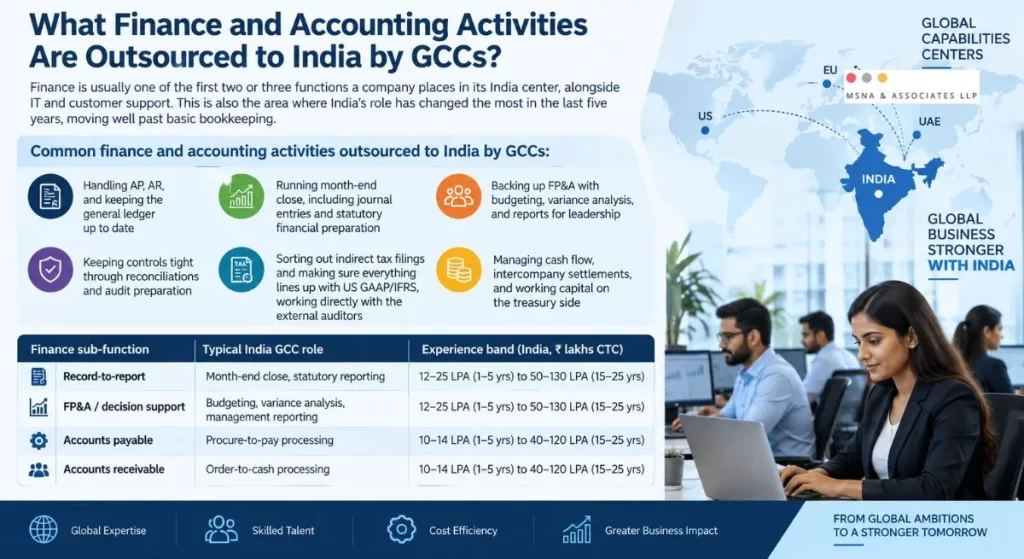
Finance is usually one of the first two or three functions a company places in its India center, alongside IT and customer support. This is also the area where India’s role has changed the most in the last five years, moving well past basic bookkeeping.
Common finance and accounting activities outsourced to India by GCCs:
- Handling AP, AR, and keeping the general ledger up to date
- Running month-end close, including journal entries and statutory financial preparation
- Backing up FP&A with budgeting, variance analysis, and reports for leadership
- Keeping controls tight through reconciliations and audit preparation
- Sorting out indirect tax filings and making sure everything lines up with US GAAP/IFRS, working directly with the external auditors
- Managing cash flow, intercompany settlements, and working capital on the treasury side
Finance sub-function | Typical India GCC role | Experience band (India, ₹ lakhs CTC) |
Record-to-report | Month-end close, statutory reporting | 12–25 LPA (1–5 yrs) to 50–130 LPA (15–25 yrs) |
FP&A / decision support | Budgeting, variance analysis, management reporting | 12–25 LPA (1–5 yrs) to 50–130 LPA (15–25 yrs) |
Accounts payable | Procure-to-pay processing | 10–14 LPA (1–5 yrs) to 40–120 LPA (15–25 yrs) |
Accounts receivable | Order-to-cash processing | 10–14 LPA (1–5 yrs) to 40–120 LPA (15–25 yrs) |
Source: GCC ERA, “GCC Salary Report 2026” (gccera.com), national experience-banded averages, data as of 18 July 2026.
A point worth flagging for US and UAE parent companies: an India GCC or an India-based accounting outsourcing partner can manage the full finance operations cycle, but the parent entity remains responsible for its own local filings and audit sign-off in the US or UAE. The India side supports the numbers. It does not replace the home-country compliance function.
What HR and Payroll Activities Are Outsourced to India by GCCs?
HR is the second function that almost every GCC centralizes early, because payroll and employee support scale predictably with headcount and do not require deep local market context to execute well.
Activities outsourced to India by GCCs:
- Payroll processing across the parent company’s regions, where compliant
- HR operations (hire-to-retire): onboarding, records management, benefits administration, and exits
- Recruitment support: sourcing, screening, and coordination for roles being filled globally
- HR analytics and reporting: attrition tracking, workforce planning data, and compensation benchmarking
- Employee helpdesk: first-line HR query resolution for a global workforce
HR sub-function | Experience band (India, ₹ lakhs CTC) |
Hire-to-retire / HR operations | 12–18 LPA (1–5 yrs) to 35–60 LPA (25+ yrs) |
Talent acquisition/recruitment operations | 20–30 LPA (1–5 yrs) to 55–100 LPA (25+ yrs) |
Source: GCC ERA, “GCC Salary Report 2026” (gccera.com).
For companies with a global, multi-country workforce, an India HR team offers one clear practical advantage: it can run a single, standardized process across regions rather than each local office managing HR administration independently. The trade-off is that country-specific labor law compliance, such as US state-level employment rules or UAE Emiratisation requirements, still has to sit with local counsel or a local HR partner. The India center is a process hub, not a substitute for local legal compliance.
What Marketing Activities Do Companies Run From an India GCC?
Marketing is a newer addition to the GCC function list, but it has grown quickly. The SSON 2026 State of the Shared Services & Outsourcing Industry report found marketing delivery rising to 16% of surveyed shared-services organizations, with sales support close behind at 12%.
Marketing activities commonly centralized in India:
- Digital marketing execution: SEO, paid media management, and content production
- Marketing analytics: campaign performance reporting and attribution modeling
- Marketing operations: CRM and marketing automation platform management
- Creative and design support: brand asset production at scale
- Social media management: content calendars and community management for global brands
Some of the largest India GCC footprints today belong specifically to marketing and advertising holding companies, where India-based teams run global-scale data, media, and creative operations for brands across more than 100 countries. This shows the function has matured well beyond a support role into genuine center-of-excellence territory for some organizations.
What Procurement, IT, Customer Support, and Data Analytics Functions Suit an India GCC?
The remaining functions round out the activities outsourced to India by GCCs once a center matures past the first year or two.
Function | What gets centralized | Why it fits India |
Procurement | Vendor management, purchase order processing, spend analytics, contract administration | Procurement entered the top 10 shared-services functions for the first time in 2025 and continues growing, per SSON 2026 data |
IT | Application development, infrastructure support, helpdesk, cybersecurity operations | India remains the largest single talent pool for IT and engineering roles globally |
Customer support | Voice and non-voice support, technical troubleshooting, CX operations | GCC-run support often shows stronger first-contact resolution than vendor-run BPO, per industry performance benchmarks |
Data analytics | Business intelligence, reporting automation, and increasingly predictive and prescriptive analytics | Data analytics is the most commonly embedded technology capability across shared-services centers (45% of organizations), per SSON 2026 data |
Source: SSON 2026 State of the Shared Services & Outsourcing Industry report, as summarized by Auxis (2026).
A useful real-world example is the retail and CPG sector, where more than 70 companies now run India GCCs employing over 85,000 professionals across merchandising, marketing, customer service, and store operations support, with another 25 or more centers expected in the next two to three years, according to EY India’s 2026 sector analysis. This shows a pattern that repeats across industries: functions that begin as pure execution work tend to expand into planning and decision-support roles once the India team proves itself.
Which Of Your Functions Are Actually Ready For an India GCC? The Three-Test Framework
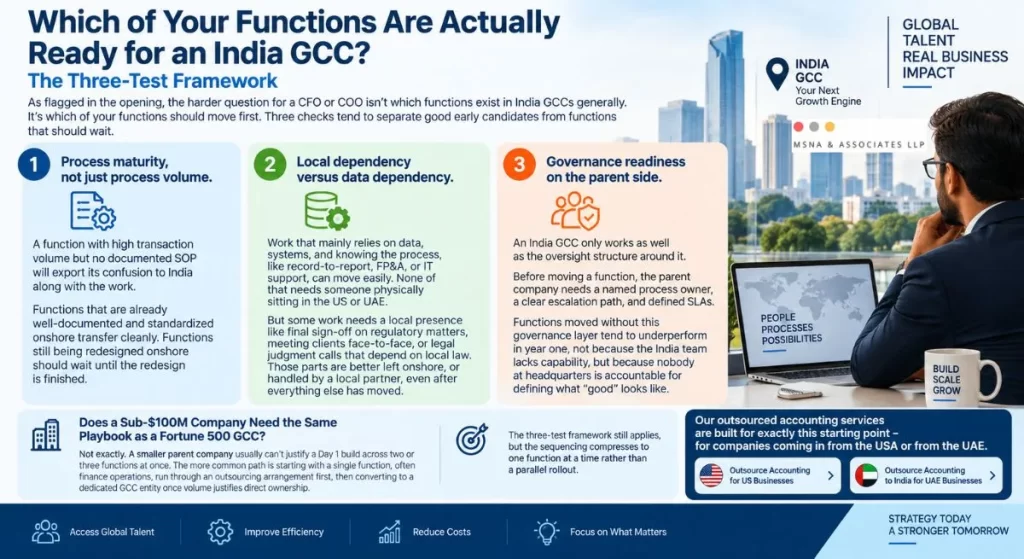
As flagged in the opening, the harder question for a CFO or COO isn’t which functions exist in India GCCs generally. It’s which of your functions should move first. Three checks tend to separate good early candidates from functions that should wait.
1. Process maturity, not just process volume.
A function with high transaction volume but no documented standard operating procedure will export its confusion to India along with the work. Functions that are already well-documented and standardized onshore transfer cleanly. Functions still being redesigned onshore should wait until the redesign is finished.
2. Local dependency versus data dependency.
Work that mainly relies on data, systems, and knowing the process, like record-to-report, FP&A, or IT support, can move easily. None of that needs someone physically sitting in the US or UAE.
But some work needs a local presence like final sign-off on regulatory matters, meeting clients face-to-face, or legal judgment calls that depend on local law. Those parts are better left onshore, or handled by a local partner, even after everything else has moved.
3. Governance readiness on the parent side.
An India GCC only works as well as the oversight structure around it. Before moving a function, the parent company needs a named process owner, a clear escalation path, and defined SLAs. Functions moved without this governance layer tend to underperform in year one, not because the India team lacks capability, but because nobody at headquarters is accountable for defining what “good” looks like.
Does a Sub-$100M Company Need the Same Playbook as a Fortune 500 GCC?
Not exactly. A smaller parent company usually can’t justify a Day 1 build across two or three functions at once. The more common path is starting with a single function, often finance operations, run through an outsourcing arrangement first, then converting to a dedicated GCC entity once volume justifies direct ownership. The three-test framework still applies, but the sequencing compresses to one function at a time rather than a parallel rollout.
Our outsourced accounting services are built for exactly this starting point – for companies coming in from the USA or from the UAE.
What Does This Mean For a US or UAE Company Evaluating an India GCC?
If you are still deciding between a full GCC and a lighter-weight outsourcing or accounting-partner model, the three-test framework above is the starting point, and the function-by-function view fills in what each option looks like in practice. Finance and accounting, HR operations, and IT support are generally the safest functions to centralize first, given how standardized and data-dependent they already are in most companies. Marketing, procurement, and advanced analytics tend to follow once the center has proven it can run the basics reliably.
If you’re a CFO or COO weighing which of your functions are ready for an India GCC, a conversation with an India-side advisory partner can help map the sequencing, and clarify the compliance and tax implications, including the transfer pricing safe harbour rules that took effect in 2026
Assess Your India GCC Function Readiness
Frequently Asked Questions About Activities Outsourced To India By GCCs
Is a GCC the same as outsourcing to an India-based BPO?
No. A GCC is owned and staffed by the parent company itself. A BPO or outsourcing vendor is a third party executing a defined scope of work under contract. Companies sometimes move from the outsourcing model to a GCC as volume and strategic importance grow.
Which function do most companies centralize first in an India GCC?
Finance operations and IT support are the two most common starting points, largely because both are process-driven, well-documented in most companies, and do not depend heavily on physical presence in the parent country.
Does an India GCC replace the need for local accountants or HR staff in the US or UAE?
No. India handles processing, reporting, and analysis. Statutory filings, audit sign-off, and local legal or labor compliance still need someone on the ground, either your own people or a local partner.
How much can a company save by centralizing functions in an India GCC?
Wisemonk’s 2026 numbers show 50 to 65% savings at senior levels, and up to 70 to 85% for specialized junior and technical roles, depending on the function, seniority mix, and how long the center’s been running. Year one is lower because of setup costs, then it climbs from year two.
Related
Discover more from MSNA & Associates LLP
Subscribe to get the latest posts sent to your email.