


What’s the one decision that determines whether your India entry is smooth or expensive?
It isn’t the paperwork. It’s the entity structure you pick before you file a single form.
Most founders assume the hard part of setting up a company in India from US is the process itself, but under the Companies Act, 2013, and India’s foreign investment framework, most sectors already allow up to 100% foreign ownership with no prior government approval, and incorporation runs mostly online.
The real problem shows up later: a Branch Office chosen out of familiarity that ends up taxed at 35% instead of 22-25%, or a B2C e-commerce plan built on US assumptions that India’s FDI rules simply don’t allow. These aren’t small missteps. They mean restructuring, re-filing, and rebuilding trust with banks and investors months after the founder thought the job was done.
This guide walks through the decision the way it actually needs to be made: entity types, FDI routes, real costs, the India-US tax treaty, and how the right structure depends on whether you’re entering as B2B, B2C, or franchise.
Why US Businesses Are Setting Up A Company in India In 2026?
India drew about USD 81 billion in gross FDI in FY 2024-25. Manufacturing alone brought in USD 19 billion, up 18% year on year. That reflects a decade-long policy push, including Make in India 2.0 (27 sectors) and Production Linked Incentive schemes (14 sectors).
For a US founder, the practical reasons to look at India come down to a few things:
1. Scale of the market.
Over 1.4 billion people, a fast-growing middle class, and rising digital spending across SaaS, e-commerce, fintech, and services.
2. Cost-efficient, skilled talent.
Engineering, design, accounting, and support talent costs a fraction of US salaries, without a real drop in English proficiency or technical depth.
3. Time zone overlap.
India’s business hours overlap enough with US mornings and evenings to make daily coordination workable.
4. Policy support.
The National Single Window System (NSWS) now links approvals across 32 central ministries/departments and 34 state governments (as of 2026), cutting down the old run-around between departments.
Our view at MSNA:
The market opportunity gets most of the attention, but the compliance environment has genuinely improved too. The bigger risk today is not red tape. It is choosing the wrong entity structure at the outset and paying for that mistake in later restructuring costs.
Which Entity Type Should You Choose When Setting Up A Company In India From The US?
A US company setting up in India generally chooses from six structures. Each has a different legal identity, liability position, and compliance load.
Entity Type | Structure | Foreign Ownership | Best For |
Private Limited Company (Wholly Owned Subsidiary) | Separate Indian legal entity, up to 100% held by the US parent | Up to 100% (sector-dependent) | SaaS, IT services, product companies, businesses planning to raise capital |
Limited Liability Partnership (LLP) | Hybrid of partnership and company, partner liability limited to investment | Up to 100% under automatic route in eligible sectors | Consulting, professional services, smaller service operations |
Branch Office | Extension of the US company, not a separate legal entity | Not applicable (same legal entity as parent) | Established US companies with a 5-year profit track record wanting consulting, research, or export-import activity |
Liaison Office | Representative office, cannot generate revenue in India | Not applicable | Market research and relationship-building before a full entry |
Project Office | Temporary office tied to a specific contract | Not applicable | Foreign companies executing a construction, engineering, or turnkey project |
Franchise Entity | Local Indian entity (usually Pvt Ltd or LLP) operating under a franchise agreement | Depends on the underlying entity type chosen | Consumer brands, F&B, retail concepts entering via a local partner |
In our advisory work, most US founders end up choosing a Private Limited Company as a wholly owned subsidiary. It’s treated as a domestic Indian company for tax purposes, gives full operational control, and is the structure Indian investors and banks are most comfortable working with.
FDI Routes For Setting Up A Company in India From The US: Automatic vs Government Route
Every rupee of foreign investment into an Indian company has to enter through one of two routes.
1. Automatic Route:
No government or RBI approval needed before you invest. This covers most sectors a US founder would actually be entering through: IT, SaaS, e-commerce marketplaces, professional services, often with full 100% ownership.
2. Government Route:
Requires approval from the relevant ministry before the investment is made. Applies to sensitive sectors such as defence, media, and multi-brand retail, or where sector-specific caps apply.
Once the investment lands, the Indian company must file Form FC-GPR with the RBI within 30 days of allotting shares. Missing this filing is one of the most common compliance slips among first-time US investors, and it carries a penalty under FEMA.
A rough way to think about the real cost of entering through FDI:
Total FDI Entry Cost = Incorporation Fees + Legal/Structuring Advisory + RBI Filing (FC-GPR) + Annual FEMA and MCA Compliance
Skipping the “ongoing compliance” line is the biggest budgeting mistake US businesses make. Incorporation is one-time. FEMA and MCA compliance are recurring, and they do not shrink just because the entity is small.
How Much Does It Cost To Set Up A Company In India From US?
Capital requirements differ sharply by entity type.
Entity | Minimum Capital / Net Worth Requirement | Typical Setup Cost (Professional Fees) |
Private Limited Company | No statutory minimum paid-up capital, but working capital of USD 10,000 to 25,000 is a realistic starting point for most service businesses | USD 800 to 2,000 |
LLP | No statutory minimum capital | USD 500 to 1,200 |
Branch Office | Parent company net worth of at least USD 100,000, with a 5-year profit track record | USD 1,500 to 3,500 (includes RBI approval process) |
Liaison Office | Parent company net worth of at least USD 50,000, with a 3-year profit track record | USD 1,500 to 3,000 |
These are professional and filing costs only. Registered office rent, GST registration, payroll setup, and bank onboarding add another USD 500 to 1,500 in year one, depending on city and headcount.
How To Set Up A Company In India From The US: Step-By-Step
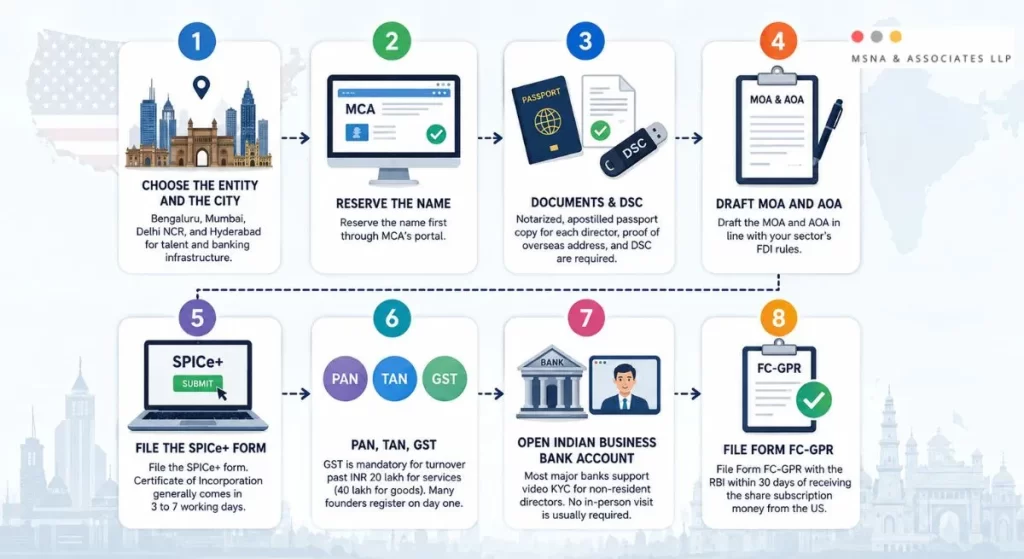
Here is how the process actually runs for a US founder, most of it completed without ever setting foot in India.
- Choose the entity and the city. Bengaluru, Mumbai, Delhi NCR, and Hyderabad remain the default choices for talent access and banking infrastructure.
- Reserve the name first through MCA’s portal.
- You’ll need a notarized, apostilled passport copy for each director, proof of overseas address, and a DSC. This part usually eats the most calendar time because of apostille processing, not because it’s complicated.
- Draft the MOA and AOA in line with your sector’s FDI rules.
- File the SPICe+ form. Certificate of Incorporation generally comes in 3 to 7 working days.
- PAN, TAN, GST. GST is mandatory for turnover past INR 20 lakh for services (40 lakh for goods), but a lot of founders register on day one anyway if they’re billing GST-registered clients.
- Open your Indian business bank account. Most major banks now support video KYC for non-resident directors, so you likely won’t need to visit in person the way founders once did.
- File Form FC-GPR with the RBI within 30 days of receiving the share subscription money from the US.
One India-specific rule that catches US founders off guard is that every company needs at least one director who was resident in India for 182 days in the previous financial year (the Companies (Amendment) Act, 2017. This is not about citizenship, and it’s the single most common gap we flag when reviewing a founder’s incorporation documents. Most first-time founders end up appointing a local resident director through their CA firm to meet it.
A nuance most people skip: the 182-day clock isn’t full-year for a brand-new company
Founders often read “182 days in the previous financial year” and assume it’s a full-year hurdle from day one. It isn’t. Under the MCA’s clarification on Section 149(3), a newly incorporated company applies the requirement proportionately to the remaining days in its first financial year. A company incorporated on day 166 of the financial year, for example, only needs its resident director present for roughly 99 of the 200 remaining days, not the full 182. Worth confirming with your CA before assuming the requirement is unworkable in year one.
B2B vs B2C vs Franchise: Entry Models for Setting Up A Company In India From The US
The entity structure is only half the decision. The other half is how you plan to sell, and India’s FDI policy treats B2B, B2C, and franchise models very differently.
Model | FDI Treatment | Typical Structure | Notes |
B2B / Marketplace e-commerce | 100% automatic route | Private Limited Company | The platform earns commission and does not own inventory. This is how most global marketplaces operate in India. |
B2C / Inventory-based e-commerce | FDI is generally not permitted for domestic sales | Not viable as a foreign-funded entity for the Indian market | A 2026 policy update opened a narrow exception allowing FDI-backed inventory ownership specifically for export-oriented e-commerce, not domestic retail. |
Single Brand Retail | 100% automatic route, with a requirement to open physical stores within 2 years if starting online-first | Private Limited Company or Branch structure | Sourcing norms apply and are averaged over a 5-year window, giving early flexibility. |
Franchise | No separate FDI cap. Franchise fees and royalties are remittable, subject to RBI reporting norms | Local Pvt Ltd or LLP as franchisee, US brand as franchisor | Common for F&B, fitness, and retail brands. The Indian entity holds the operational and compliance responsibility. |
Our take:
B2B is the most straightforward entry today, with a clear automatic route and no ambiguity around inventory control. B2C is where founders most often misjudge the landscape, assuming a US online-selling model transfers directly to India. It does not, and the marketplace-versus-inventory distinction is worth clarifying before a single rupee moves.
Taxation When Setting Up A Company In India From The US: Corporate Tax Rates and The DTAA
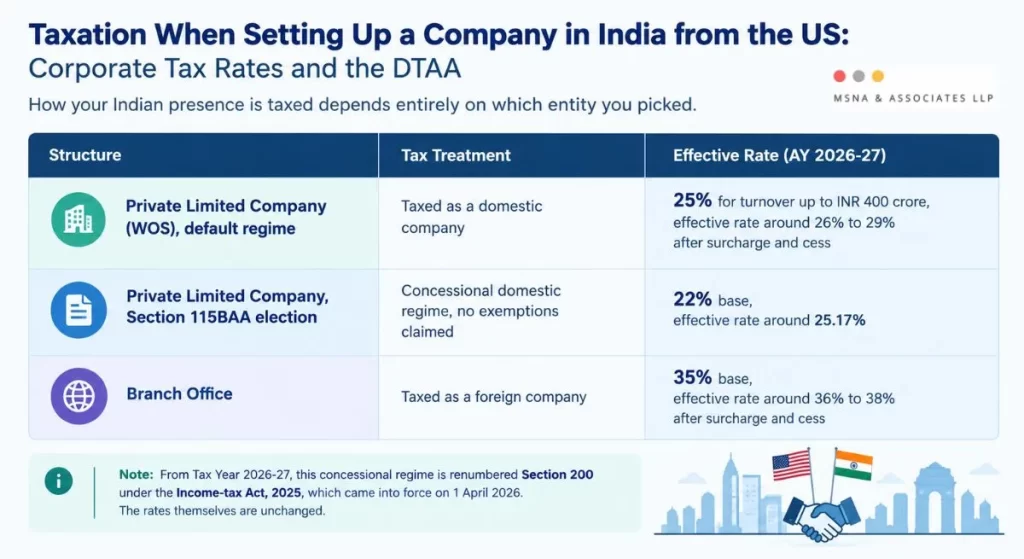
How your Indian presence is taxed depends entirely on which entity you picked.
Structure | Tax Treatment | Effective Rate (AY 2026-27) |
Private Limited Company (WOS), default regime | Taxed as a domestic company | 25% for turnover up to INR 400 crore, effective rate around 26% to 29% after surcharge and cess |
Private Limited Company, Section 115BAA election | Concessional domestic regime, no exemptions claimed | 22% base, effective rate around 25.17% |
Branch Office | Taxed as a foreign company | 35% base, effective rate around 36% to 38% after surcharge and cess |
Note: from Tax Year 2026-27, this concessional regime is renumbered Section 200 under the Income-tax Act, 2025, which came into force on 1 April 2026. The rates themselves are unchanged
This gap between the subsidiary rate and the branch rate, roughly 10 to 12 percentage points, is one of the clearest reasons most US businesses eventually convert a branch into a wholly owned subsidiary once operations mature.
The India-US Double Taxation Avoidance Agreement (DTAA) exists so that income is not taxed twice, once in India and again in the US. Broadly:
- Dividends, royalties, and fees for technical services paid from the Indian entity to the US parent are subject to concessional withholding rates under the treaty, generally lower than the domestic withholding rate.
- Foreign tax credit in the US allows the parent company to offset Indian taxes paid against US tax liability, subject to US tax rules on foreign income, including the Net CFC Tested Income (NCTI) provisions that replaced GILTI under the OBBBA changes.
- Transfer pricing documentation is mandatory for any transaction between the Indian subsidiary and its US parent, including intercompany services, royalties, and cost allocations. The old Form 3CEB filing is transitioning to Form 48, and this remains one of the most scrutinized areas in cross-border tax audits.
A qualified CA firm should run the transfer pricing and treaty analysis before the first invoice is raised between the two entities, not after.
Investment Platforms And Government Support For US Investors
India has built out real institutional support for foreign investors, and most US founders underuse it.
- Invest India, the national investment promotion agency, offers pre-investment advisory and aftercare support at no cost.
- National Single Window System (NSWS) consolidates approvals across ministries and states into one portal, cutting the old sequential back-and-forth.
- State single-window portals in Karnataka, Maharashtra, and Telangana often layer state-level incentives on top of central ones for manufacturing and tech investments.
- GIFT City / IFSC, India’s international financial services centre, is increasingly relevant for US fintech and fund management businesses wanting a tax-efficient, dollar-denominated base in India.
- PLI Schemes, spanning 14 sectors, offer direct incentives tied to incremental production, mainly relevant for US manufacturers rather than pure services businesses.
Common Mistakes US Businesses Make When Entering India
A few patterns recur in the India-entry engagements we handle, and they are avoidable with the right upfront planning. For US businesses considering a professional who helps in Setup New Company in India from the USA, understanding these common mistakes early can help avoid unnecessary costs, delays, and compliance issues.
1. Defaulting to a Branch Office out of familiarity.
The 35% foreign-company tax rate and RBI restrictions on activity make it a costlier long-term choice than a subsidiary for most operating businesses.
2. Treating the resident director requirement as a formality.
The 182-day rule under Section 149(3) needs a genuine plan, not a name added at the last minute.
3. Underestimating transfer pricing exposure.
Any intercompany transaction, even a management fee or software license, needs proper documentation from day one.
4. Assuming US e-commerce logic applies directly.
The marketplace-versus-inventory distinction under India’s FDI policy has tripped up far more sophisticated companies than first-time founders.
5. Ignoring working capital timelines.
Bank account opening and fund remittance can take two to four weeks even with video KYC.
What's Next For US Businesses Setting Up A Company In India: Trends Beyond 2026 ?
A few shifts worth watching for a multi-year India strategy rather than a one-time entry:
1. E-commerce rules are loosening, slowly.
As of 2026, export-focused e-commerce companies can now own FDI-backed inventory in India. It’s not a full opening, domestic B2C retail is still protected, but it’s a sign the door is opening sector by sector.
2. GIFT City is now the go-to base for financial services.
For US fintech and fund managers, it offers a regulatory and tax setup that feels a lot more familiar than mainland India.
3. Manufacturing incentives are spreading beyond electronics and pharma.
That’s a big deal if you’re eyeing India as a production hub, not just a place to sell into.
4. Data privacy rules have teeth now.
India’s Digital Personal Data Protection Act is live. If your business touches Indian customer or employee data, compliance needs to be built into your entry plan from day one, not added later as a fix.
Businesses that treat India entry as a one-time legal exercise will fall behind those that build compliance and tax planning into the operating model from year one.
Plan Your India Entry With the Right Structure
Frequently Asked Questions On Setting Up A Company In India From The US
Can a US citizen own 100% of an Indian company?
Yes, in most sectors, a US citizen or US company can hold 100% ownership of an Indian Private Limited Company through the automatic FDI route, without prior government approval.
Do I need to travel to India to set up a company?
No, Incorporation, DSC issuance, and bank account KYC can all be completed remotely for most entity types, though a Branch Office application involves a longer RBI approval process.
How long does it take to register a company in India from the US?
A Private Limited Company gets its Certificate of Incorporation in 3 to 7 working days after filing, though document preparation, apostille, and bank onboarding usually extend the full timeline to 4 to 6 weeks.
What is the India-US tax treaty and why does it matter?
The DTAA prevents the same income from being taxed twice, in India and the US, and sets concessional withholding rates on dividends, royalties, and technical service fees paid between the two entities.
Related
Discover more from MSNA & Associates LLP
Subscribe to get the latest posts sent to your email.