
AI in Internal Audit: From Manual Testing to Continuous Assurance
At the end of every audit cycle, the story is often the same. The report looks clean, the checks are done, and yet a risk shows up weeks later that no one saw coming. The problem is not effort. It is timing. Traditional audits look backwards, while businesses move forward every day.
This gap is exactly where AI in Internal Audit fits in. Instead of checking data after the damage, AI helps auditors monitor activity as it happens, turning audits into an ongoing process rather than a once-a-year exercise.
In this blog, we are going to discuss how AI is transforming internal audits, its applications, benefits, and what it means for audit teams today.
How Internal Audits Traditionally Worked ?
In a traditional audit, teams usually test a small sample of transactions. They review documents, match numbers, and look for exceptions. Most of this work is done after the fact. By the time issues are found, the damage may already be done.
This model has clear limits. Manual testing takes time. It depends heavily on human judgment, which also means that auditors can only review a fraction of the data. Important risks can still stay hidden simply because they were not part of the selected sample.
As businesses became more digital, this gap became evident, underscoring the growing need for AI in internal audit to review more data more efficiently and accurately.
How AI in Internal Audit Is Changing the Game?
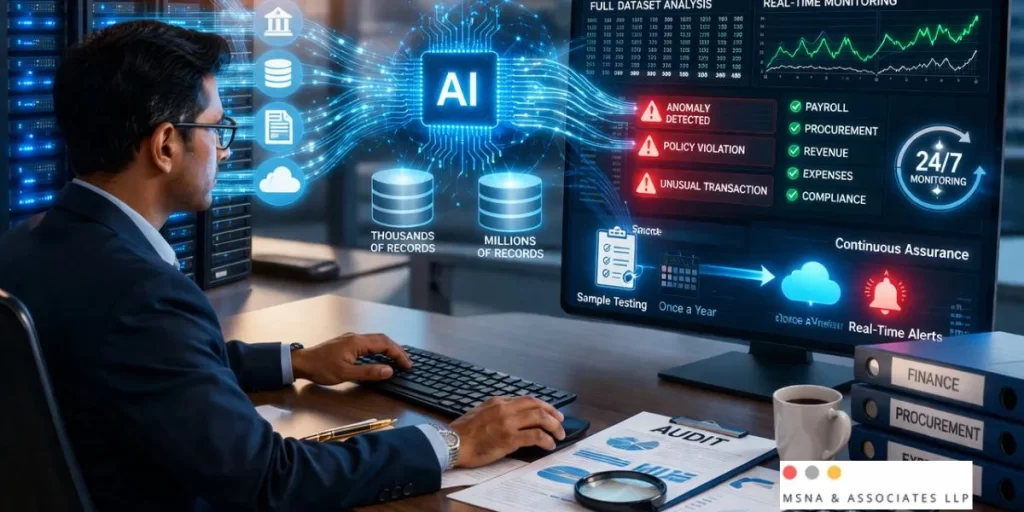
Using AI in internal audit allows auditors to analyse full datasets instead of small samples. AI tools can scan thousands or even millions of records in minutes. They can find odd patterns, rule breaks,as well as other things that people might miss.
More importantly, AI enables continuous assurance. Instead of checking controls once or twice a year, AI systems monitor transactions and processes all in near real time. According to the Institute of Internal Auditors, many audit functions are moving toward continuous monitoring models as AI tools are maturing.
This shift turns internal audit into a proactive function. Auditors receive alerts when something looks off, rather than discovering issues months later during a scheduled audit.
How AI in Internal Audit Is Applied Today ?
- Automated data handling: Most of the time, audit teams work with data from a lot of different systems. AI tools get this data, clean it up, and get it ready for review. This cuts down on the work that needs to be done by hand and lowers the number of mistakes that happen when data is messy or incomplete.
- Internal audit automation: Routine work like reconciliations, control testing, and compliance checks can run automatically and these tasks are handled nonstop by both the machine learning models and the rule-based systems.
- Continuous monitoring: Instead of checking old data, AI watches transactions in real time. When something looks unusual, it flags it early. This is useful in areas like payroll, procurement, revenue, and expenses.
- Smarter risk assessment: AI studies past data to spot trends and predict risk areas. Auditors can then focus where it truly matters. Gartner says that about 41% of internal audit teams are already using or planning to use generative AI to help them with their reporting and analysis.
Benefits of AI in Internal Audit
The benefits of AI in internal audit go beyond speed. They:
Complete data coverage: One of the best things about AI is that it can look at all of your data. AI looks at all of the datasets instead of just a few samples, which makes its results more trustworthy. Experts say that AI makes audits more thorough by finding problems that other methods might miss.
Higher accuracy and consistency: Automated testing reduces manual errors and applies the same rules consistently. This leads to clearer results and fewer false alarms.
Better use of audit skills: When routine testing is automated, auditors can focus on analysis, judgment, and the advisory work that adds real value.
Faster, timely reporting: Reports based on current data help management act before problems worsen. AI-driven monitoring is also helping organisations identify the Most Common Frauds Found During Internal Audits (2026) and How to Prevent Them before they escalate into significant financial or compliance issues.”
Smarter audits make a big difference for small and medium-sized businesses and businesses that are growing.
What AI in Internal Audit Means for Auditors Today?
AI does not replace auditors. It changes how they work. Auditors still look at the results, use their judgment, and understand the business context. The difference is what each one is about. Now, less time is spent on routine checks, and more time is spent figuring out what risks are and how they affect things.
At a leading internal audit firm in India, Auditors can now go from checking boxes to giving advice. They need to know how to use basic data, be able to question the AI outputs, and be able to make good moral decisions when it counts.
Challenges of AI in Internal Audit: Data Quality, Skills Gap & Governance Risks
Despite its benefits, adopting AI in internal audit is not without challenges.
- Problems with data quality: AI needs data that is clean and complete. Bad inputs can cause wrong conclusions and miss risks.
- Lack of skills and training: Audit teams require time and training to understand AI outputs. Without this, there is a risk of trusting results that have not been properly reviewed.
- Governance and ethics: AI models must be tested on a regular basis to minimise biases. Strong oversight is necessary, particularly with the regulated businesses.
The Future of AI in Internal Audit
The profession is continuously moving towards a model of continuous assurance, and AI in internal audit is driving this change. Rather than being a periodic event, an audit will become an ongoing process. With real time risk insight, decisions can be made quicker and better.
As tools become more advanced, internal audit teams will be better positioned to adopt a more strategic role. They will help predict risks, improve controls, and adjust to changes. It will be easier to do audits, and checking by hand will become less common.
AI in Internal Audit Is the New Standard
AI in internal audit is changing how audit teams work. It moves audits from slow, manual checks to continuous, data-driven insight. When internal auditors use AI, they get faster risk spotting, deeper analysis, and more meaningful findings that help leaders make better decisions without extra delay.
For organizations who are looking to modernise, understanding this change matters a lot. Professional Firms like MSNA and Associates are helping teams adopt smart audit methods and bridge the gap between old practices and new expectations. In today’s world, AI isn’t just a tool; it’s actually becoming a way internal audit gets real assurance.
Upgrade Your Internal Audit with AI
Related
Discover more from MSNA & Associates LLP
Subscribe to get the latest posts sent to your email.