
If your US company owns an Indian subsidiary, you already know the numbers don’t always match. Your controller asks for a GAAP reporting package. Your Indian finance team hands back statements built on a different framework. Same transactions but different results.
That gap has a name: US GAAP vs Ind AS. And it shows up every quarter, right when you’re trying to close the books.
This guide breaks down how the two frameworks differ, where the differences hit hardest during consolidation, and what US CFOs, controllers, and financial reporting teams should build into their process. It’s written for teams managing an Indian entity from the US side, whether you’re setting up a new subsidiary or already running one.
What Is Ind AS, and Why Does It Differ from US GAAP?
Ind AS (Indian Accounting Standards) is India’s accounting framework, issued by the Ministry of Corporate Affairs in consultation with ICAI. It’s converged with IFRS (International Financial Reporting Standards), not identical to it, but close enough that the philosophy carries over.
US GAAP is the standard every US public company must follow. It’s issued by the Financial Accounting Standards Board (FASB) and organized under the Accounting Standards Codification (ASC).
The core difference is philosophical, not just technical:
Ind AS | US GAAP | |
Approach | Principles-based | Rules-based |
Guidance style | Broad standards, judgment-heavy | Detailed, transaction-specific rules |
Closest relative | IFRS | Industry-specific US codification |
Regulator | MCA / ICAI | FASB / SEC |
Applies to | Companies incorporated in India, based on thresholds | US public and private companies reporting under GAAP |
Ind AS asks: does this reflect the economic substance? US GAAP asks: does this meet the specific criteria laid out in the standard?
Same transaction, two different starting questions. That’s why a single number rarely converts cleanly.
Does US GAAP vs Ind AS Even Apply to Your Subsidiary?
Not every Indian subsidiary is required to follow Ind AS.
Ind AS applicability in India is threshold-based, not universal. Under the Companies (Indian Accounting Standards) Rules, 2015, a company must adopt Ind AS only if it crosses specific net worth or listing thresholds, or if it’s part of a group where the parent, subsidiary, or associate already applies Ind AS.
A smaller, newly incorporated Indian subsidiary may still be preparing statutory financials under the older Accounting Standards (AS) framework, not Ind AS at all. Your conversion process has to start from the framework that actually applies, not the one you assumed:
- Your Ind AS-to-US GAAP conversion assumptions won’t hold if the subsidiary is actually on AS.
- Group-level applicability rules can pull a small subsidiary into Ind AS even if it wouldn’t qualify on its own, simply because the parent group applies it.
- Statutory auditors sign off on whichever framework applies locally. That sign-off doesn’t confirm GAAP-readiness.
Practical step:
Confirm which framework your Indian entity is legally required to follow before you build a conversion process around it. This is a five-minute question for your India-side accountant, and it prevents months of misaligned assumptions.
Where US GAAP vs Ind AS Differences Actually Show Up in Consolidation ?
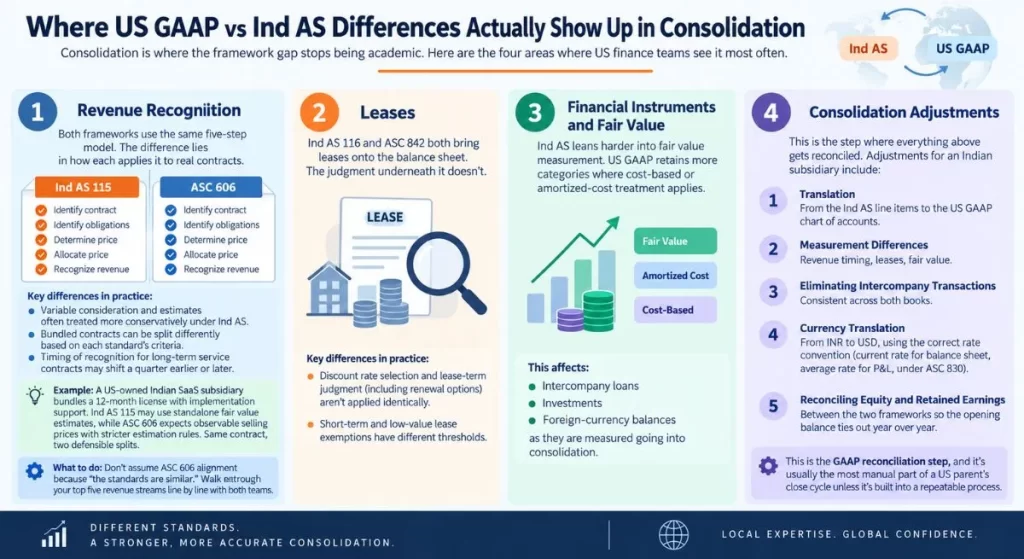
Consolidation is where the framework gap stops being academic. Here are the four areas where US finance teams see it most often.
1. Revenue Recognition
Both frameworks technically use the same five-step model for recognizing revenue. Ind AS 115 and ASC 606 look nearly identical on paper. The problem shows up in how each side applies that model to a real contract.
Think of it this way: two accountants can read the same contract, follow the same five steps, and land on different numbers, because the standards leave room for different judgment calls. A few places this plays out:
- Variable consideration and estimates often get treated more conservatively under Ind AS, reflecting the framework’s fair-value orientation.
- Bundled contracts common in Indian SaaS and services subsidiaries can be split differently depending on which standard’s criteria the local team applies.
- Timing of recognition for long-term service contracts sometimes shifts a quarter earlier or later between the two.
For eg: Take a US-owned Indian SaaS subsidiary bundling a 12-month license with implementation support. Under Ind AS 115, the local team may allocate price using standalone fair value estimates, since few Indian SaaS peers publish comparable pricing. Under ASC 606, the US side expects allocation based on observable selling prices, with stricter estimation rules when those aren’t available. Same contract, two defensible splits; both compliant, both wrong from the other side’s view.
What to do: don’t assume ASC 606 alignment because “the standards are similar.” Walk through your top five revenue streams line by line with both teams.
2. Leases
Ind AS 116 and ASC 842 both moved leases onto the balance sheet, so the headline treatment looks the same on paper. The judgment underneath it doesn’t:
- Discount rate selection and lease-term judgment (including renewal options) aren’t applied identically.
- Short-term and low-value lease exemptions have different thresholds.
3. Financial Instruments and Fair Value
Ind AS leans harder into fair value measurement for financial instruments. US GAAP retains more categories where cost-based or amortized-cost treatment applies. This affects how intercompany loans, investments, and even foreign-currency balances are measured going into consolidation.
4. Consolidation Adjustments
This is the step where everything above gets reconciled. Consolidation adjustments in the case of an Indian subsidiary include:
- Translation from the Ind AS line items to the US GAAP chart of accounts.
- Measurement Differences (Revenue Timing, Leases, Fair Value).
- Eliminating intercompany transactions, consistent across both books.
- Currency translation from INR to USD, using the correct rate convention (current rate for balance sheet, average rate for P&L, under ASC 830).
- Reconciling equity and retained earnings between the two frameworks so the opening balance ties out year over year.
This is the GAAP reconciliation step, and it’s usually the most manual part of a US parent’s close cycle unless it’s built into a repeatable process.
US GAAP vs Ind AS Revenue Recognition: A Quick Reference
Contract-level judgment is where the two frameworks quietly diverge, even when the headline standards look aligned:
Scenario | Ind AS Tendency | US GAAP Tendency |
Long-term service contracts | May recognize over time with conservative estimates | Recognized per ASC 606 performance obligations |
Variable consideration | Often constrained more heavily | Constrained based on specific estimation guidance |
Bundled software + services | Split based on standalone fair value, judgment-driven | Split per detailed allocation guidance |
Use this as a starting checklist, not a final answer. Every contract structure is different, and this is exactly the kind of area where a joint review between your India accountant and US GAAP reviewer pays for itself.
What US CFOs and Controllers Should Build Into Their Process ?
Framework knowledge only helps if it’s built into a process your team repeats every quarter, not something reconstructed from memory each close:
- Confirm the local framework first. As covered above, don’t assume Ind AS. Get written confirmation of which standard the subsidiary statutorily follows.
- Build a standing GAAP reconciliation template. A repeatable template, mapped line by line from the Ind AS or AS trial balance to your US GAAP chart of accounts, turns a quarterly scramble into a predictable process.
- Align close calendars early. India’s statutory audit and tax filing calendar doesn’t run on the same clock as a US quarterly close. Indian statutory audits are finalized well after the fiscal year-end (31 March), while US parents often need numbers within days of quarter-end. Build your reporting calendar around this mismatch, not around the assumption that both sides move together.
- Assign clear ownership for GAAP adjustments. Someone needs to own the conversion, not just the local Ind AS books. Whether that’s an in-house controller, an outsourced accounting partner, or a Virtual CFO function, ambiguity here is where errors creep in.
- Document judgment calls. Because Ind AS is principles-based, local teams make judgment calls your US auditors will want visibility into. Document the reasoning, not just the number.
- Review intercompany transactions every quarter, not just at year-end. Mismatched intercompany balances are one of the most common consolidation issues between India and the US. Catching them quarterly is far cheaper than catching them at audit time.
What Are The Common US GAAP vs Ind AS Mistakes US Parent Companies Make?
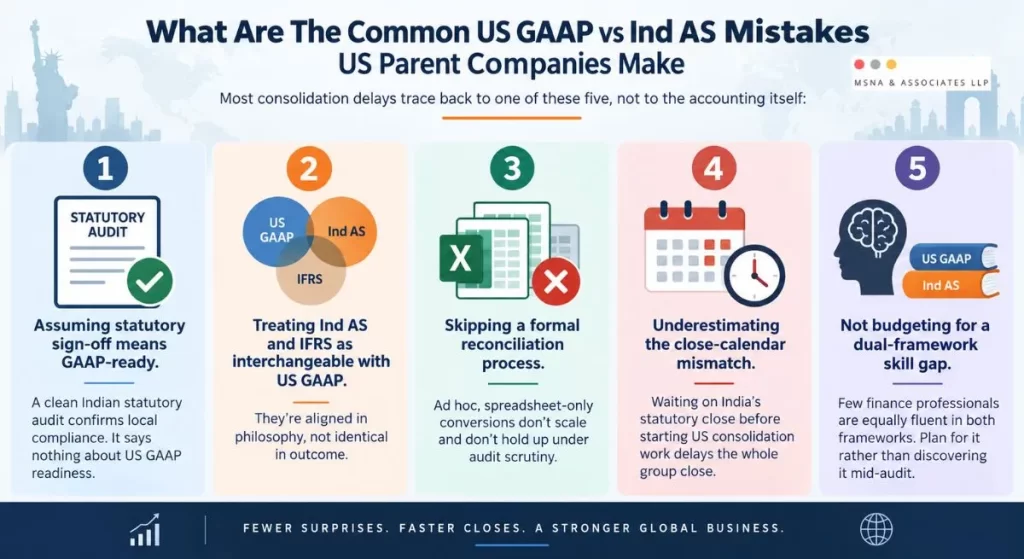
Most consolidation delays trace back to one of these five, not to the accounting itself:
- Assuming statutory sign-off means GAAP-ready. A clean Indian statutory audit confirms local compliance. It says nothing about US GAAP readiness.
- Treating Ind AS and IFRS as interchangeable with US GAAP. They’re aligned in philosophy, not identical in outcome.
- Skipping a formal reconciliation process. Ad hoc, spreadsheet-only conversions don’t scale and don’t hold up under audit scrutiny.
- Underestimating the close-calendar mismatch. Waiting on India’s statutory close before starting US consolidation work delays the whole group close.
- Not budgeting for a dual-framework skill gap. Few finance professionals are equally fluent in both frameworks. Plan for it rather than discovering it mid-audit.
When This Does Not Apply?
If your Indian entity is a wholly-owned subsidiary that reports informally to the US parent with no external audit requirement, and no plans for fundraising, exit, or IPO, a full dual-framework reconciliation may be more than you need today. A lighter management-reporting bridge, updated annually, may be sufficient until the entity scales. It should be equivalent to the size of the entity and the part that the entity plays within your organizational structure.
Next Steps for US GAAP vs Ind AS Reconciliation in Indian Subsidiaries
Getting US GAAP and Ind AS to align isn’t a one-time project. It’s a process that needs to be rebuilt into every close cycle, every new contract type, and every change in the Indian entity’s size or structure.
If you’re setting up an Indian subsidiary for the first time, start with the entity structure itself. Our guide on how to set up a company in India from the USA walks through registration, compliance calendars, and the decisions that shape your reporting obligations from day one.
For subsidiaries already operating, consulting a professional familiar with both frameworks can help you assess where your specific reporting gaps are and how to close them before they show up in an audit.
Need Help Bridging US GAAP and Ind AS?
Frequently Asked Questions About US GAAP vs Ind AS
Is Ind AS the same as IFRS?
No. Ind AS draws from IFRS as its basis, but it transforms IFRS to align with Indian laws and regulations; hence, both can’t be used interchangeably.
Do all Indian subsidiaries have to follow Ind AS?
No. It depends on the subsidiary’s net worth, listing status, and whether the broader group already applies Ind AS, under the Companies (Indian Accounting Standards) Rules, 2015. Plenty of smaller subsidiaries still file under the older Accounting Standards (AS) framework instead.
How often should GAAP reconciliation happen?
Ideally every quarter, aligned with your US close calendar, rather than as a single year-end exercise. Quarterly reconciliation catches intercompany and measurement mismatches while they’re still small.
Who should handle the US GAAP conversion for an Indian subsidiary?
This typically sits with either an in-house controller with dual-framework experience, an outsourced accounting partner, or a Virtual CFO function managing the India side.
Related
Discover more from MSNA & Associates LLP
Subscribe to get the latest posts sent to your email.