


Two companies each spend $4,000 a month on outside financial help. One walks into its Series A due diligence with clean, audit-ready statements. The other is still emailing its CPA the same reconciliation explanations it sent last March. Same budget, same intent but different finance model.
If you run a $2M–$50M US business trying to decide between these two models, outsourced accounting fixes books that aren’t getting done; a fractional controller fixes books nobody trusts.
If you’re weighing outsourced accounting vs fractional controller support, outsourced accounting replaces your bookkeeping and transactional accounting function, while a fractional controller sits a level above that, owning the accuracy, structure, and oversight of your financial reporting. Most growing US businesses need both eventually.
This guide breaks down the actual differences in scope, cost, and oversight between the two models, walks through a stage-based decision framework, and shares where we land after helping outsource accounting to India for USA businesses across every stage from pre-revenue to $50M+.
What Is Outsourced Accounting?
Outsourced accounting means handing your recurring bookkeeping and accounting operations to an external team instead of building an in-house department.
Typically included:
- Accounts payable and accounts receivable management
- Bank and credit card reconciliations
- Month-end close and financial statement preparation
- Payroll processing and journal entries
- Tax-ready, GAAP-consistent books
Who delivers it: A team of bookkeepers and staff accountants, usually with a reviewing senior accountant or CPA checking output before it reaches you. Firms working with US CPA firms on outsourced bookkeeping structure this as a dedicated pod rather than a rotating pool.
Best fit: Businesses that need reliable, accurate books produced on time but don’t yet need someone setting financial strategy or owning technical accounting judgment calls.
What Is a Fractional Controller?
A fractional controller is a senior, part-time accounting professional who owns the accuracy and structure of your financial reporting, not just the data entry behind it.
Typically included:
- Ownership of the month-end close calendar and process
- General ledger oversight and review of bookkeeper/staff work
- Technical accounting decisions (revenue recognition, accruals, multi-entity consolidation)
- Internal controls design and enforcement
- Board-, lender-, or investor-ready reporting packages
Who delivers it: One experienced controller, engaged for roughly 5–20 hours a month depending on complexity. For SaaS and IT companies specifically, this often overlaps with Virtual CFO support for IT and SaaS businesses, since revenue recognition complexity tends to show up earliest in that sector.
Best fit: Businesses whose books are technically “done” but not trusted: late closes, unreliable numbers, a CPA repeatedly requesting cleanup, or growing complexity (multi-entity, inventory, SaaS revenue recognition) that a bookkeeper isn’t equipped to judge.
Outsourced Accounting vs Fractional Controller: Scope of Work Comparison
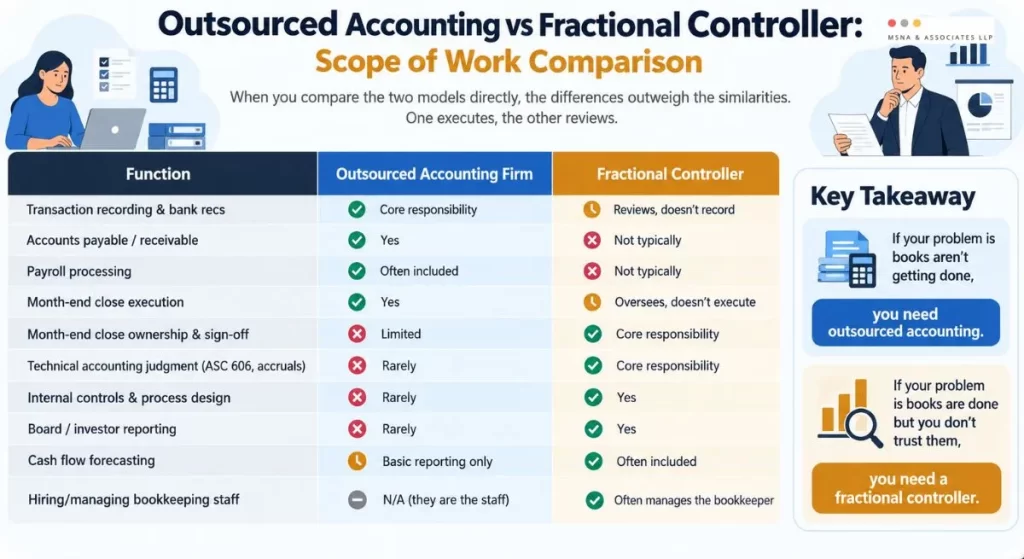
When you compare the two models directly, the differences outweigh the similarities. One executes, the other reviews.
Function | Outsourced Accounting Firm | Fractional Controller |
Transaction recording & bank recs | Core responsibility | Reviews, doesn’t record |
Accounts payable / receivable | Yes | Not typically |
Payroll processing | Often included | Not typically |
Month-end close execution | Yes | Oversees, doesn’t execute |
Month-end close ownership & sign-off | Limited | Core responsibility |
Technical accounting judgment (ASC 606, accruals) | Rarely | Core responsibility |
Internal controls & process design | Rarely | Yes |
Board / investor reporting | Rarely | Yes |
Cash flow forecasting | Basic reporting only | Often included |
Hiring/managing bookkeeping staff | N/A (they are the staff) | Often manages the bookkeeper |
This scope of work comparison is the fastest way to self-diagnose:
- If your problem is books aren’t getting done, you need outsourced accounting.
- If your problem is books are done but you don’t trust them, you need a fractional controller.
Cost Comparison: What Each Model Costs in 2026
Pricing varies by transaction volume, entity complexity, and provider, but published 2026 market data gives a reliable range.
Model | Typical Monthly Cost (2026) | Typical Annual Cost | Source |
Basic outsourced bookkeeping | $500 – $1,500 | $6,000 – $18,000 | La Jolla, 2026 |
Full-service outsourced accounting | $800 – $2,000 | $9,600 – $24,000 | |
Fractional controller (light oversight) | $2,500 – $4,000 | $30,000 – $48,000 | |
Fractional controller (standard/complex) | $4,000 – $8,000 | $48,000 – $96,000 | |
Full-time in-house controller (fully loaded) | $12,000 – $23,000 | $143,000 – $280,000 | Osprey CFO; Pegacorn Group |
Our read on this data: a fractional/outsourced controller costs 25–35% of a full-time hire, and the breakeven point (where full-time actually becomes cheaper per hour) sits around 25–30 hours of controller-level work per week. Below that threshold, fractional wins decisively. Most businesses under $10M in revenue never cross it.
Hourly billing also exists for both models. Outsourced accounting runs $50–$175/hour, while controller-level hourly work runs $100–$250/hour, mostly for cleanup projects or short-term coverage rather than ongoing engagements.
Who Reviews Your Numbers Under Each Model?
This is the distinction most people skip, and it’s the one that matters most.
- With outsourced accounting alone: your books are produced by the same team (or a peer-level reviewer) that produced them. There’s limited independent, senior-level sign-off before numbers reach you or your CPA.
- With a fractional controller: a senior professional stands between the bookkeeping work and the finished statement, checking it against technical accounting standards before you see it.
- With both combined: you get execution and independent oversight. This is the model most CFO advisory firms now recommend once a business outgrows simple bookkeeping.
If your CPA keeps sending back cleanup requests at tax time, that’s usually an oversight-level problem, not a bookkeeping-volume problem.
Finance Model Comparison for US Business: A Decision Framework by Stage
There’s no universal right answer. The right finance model comparison for US business owners has to be run against your actual stage and complexity, not a generic recommendation.
Stage 1: Pre-Revenue to $2M Revenue
- What you need: clean, current books; nothing more
- Recommended model: outsourced bookkeeping or full-service outsourced accounting
- Why: at this stage, transaction volume is low, and reporting needs are simple. A controller is usually overkill and underutilized. This is also the stage where many US founders first look into setting up a subsidiary in India, and getting the accounting foundation right early makes that transition smoother later.
Stage 2: $2M – $10M Revenue (Growth Stage)
- What you need: reliable execution plus someone who owns accuracy. This is where most businesses first feel the gap
- Recommended model: outsourced accounting for execution + a fractional controller for oversight
- Signs you’ve hit this stage: the close consistently slips past day 15, your CPA asks the same cleanup questions every year, you’re preparing for a raise or your first audit, or revenue recognition has stopped being simple (subscriptions, multi-element contracts, inventory).
Stage 3: $10M – $50M+ Revenue (Scaling)
- What you need: board-ready reporting, multi-entity consolidation, and someone thinking about systems and controls, not just closing the books
- Recommended model: a stronger fractional controller engagement (often 15–20+ hrs/month), frequently paired with fractional CFO support for strategy
- Transition point: many businesses at this stage eventually convert the fractional controller relationship into a full-time hire, using the outsourced team as backup and surge support during close and audit.
See our M&A advisory services if a sale, merger, or acquisition is part of the roadmap.
Business Stage | Primary Pain Point | Best-Fit Model |
Pre-revenue – $2M | Books aren’t current | Outsourced accounting |
$2M – $10M | Books are late or untrusted | Outsourced accounting + fractional controller |
$10M – $50M+ | Reporting isn’t audit/investor-ready | Stronger fractional controller (+ fractional CFO) |
$50M+ or 30+ hrs/week of work | Complexity exceeds fractional capacity | Full-time in-house controller |
Outsourced Accounting Firm vs. Fractional Controller: Can You Use Both?
Yes, and for most businesses past the $2M mark, this combination, not either service alone, is the actual best-fit outsourced accounting vs fractional controller answer.
A common, effective structure:
- Outsourced accounting team handles AP/AR, reconciliations, and day-to-day bookkeeping.
- Fractional controller reviews that work, owns the close calendar, makes technical accounting calls, and signs off before anything reaches leadership or your CPA.
- You get a single point of accountability (the controller) instead of managing multiple vendors and chasing status updates yourself.
Some providers deliver this as one integrated engagement rather than two separate vendor relationships. This is worth asking about directly when comparing a fractional controller vs outsourced accounting firm, since stitching two disconnected providers together often recreates the same coordination overhead you were trying to outsource in the first place.
What Does 2026 Data Say About the Finance-Outsourcing Market?
The shift toward fractional and outsourced finance isn’t anecdotal. It shows up clearly in 2026 industry data.
Metric | 2026 Figure | Source |
Top 100 US firms reporting client advisory services (CAS) growth – 3rd straight year | 85% of 88 responding firms | |
Global accounting services market size | $675 billion (US: $160 billion, 130,000+ firms) | |
Firms using cloud-based accounting software | 78% | |
Accountants and auditors who left the profession (2020–2022) | 300,000+ | |
Decline in CPA exam candidates since 2016 | 33% |
Our take: read together, this is one story – a shrinking, aging in-house talent pool colliding with rising demand for senior-level oversight. Firms can’t staff their way out of that gap with more bookkeepers; that’s exactly the space a fractional controller layer is built to fill, and why 53% of firms now point to advisory-style services, not compliance work, as their fastest-growing line.
What Mistakes Do Businesses Make When Choosing Between Outsourced Accounting vs. Fractional Controller?
Most of these come down to the same root cause. Picking a model based on price before diagnosing whether the real problem is execution or oversight.
- Hiring a bookkeeper to solve a trust problem. More hands-on data entry doesn’t fix numbers nobody reviews at a senior level.
- Hiring a controller before the books are current. A controller can’t add oversight to books that don’t exist yet. Cleanup usually has to come first.
- Treating the two models as competitors instead of a stack. They solve different problems and are frequently used together.
- Ignoring time zone and handoff structure. Whichever model you pick, ask how work gets reviewed and handed off, not just who does the work.
- Choosing based on price per hour instead of total oversight. A cheaper bookkeeping rate that produces books your CPA has to redo isn’t actually cheaper.
Our Recommendation on Outsourced Accounting vs Fractional Controller for US
If we had to compress this entire outsourced accounting vs fractional controller decision into one rule of thumb: start with outsourced accounting to get current, add a fractional controller the moment you stop trusting the numbers.
Revenue thresholds are a useful proxy, but the real trigger is behavioral. A late close, a CPA who keeps sending the same cleanup requests, or a fundraising or audit deadline that suddenly makes “good enough” books a liability. Businesses that wait for a specific revenue number to make this call typically wait too long and absorb avoidable risk in the meantime.
Outsourced Accounting vs Fractional Controller: Choosing the Right Finance Model for Your Business
The right finance model isn’t about picking the “better” service. It’s about matching the model to what’s actually broken in your finance function today.
If you’re unsure which side of this comparison you’re on, our team can review your current books and close process and tell you plainly which model fits, rather than defaulting to whichever service we sell more of.
Choose the Right Finance Model for Your Business
Frequently Asked Questions About Outsourced Accounting vs Fractional Controller for US
Is a fractional controller more expensive than outsourced accounting?
Generally yes. Per month, fractional controller engagements run $2,500–$8,000/month versus $500–$3,500/month for outsourced accounting, reflecting the more senior, judgment-based nature of the work. Combined, the two together still cost a fraction of a full-time in-house controller.
Can a small business with under $2M in revenue use a fractional controller?
It’s possible, but for most businesses at this size the immediate need is current, accurate books rather than senior-level oversight. Outsourced accounting alone is usually the better starting point.
Does outsourcing accounting to India change this comparison?
Not structurally. The scope-of-work distinction between outsourced accounting and a fractional controller holds regardless of delivery location. What changes is cost efficiency: outsourcing execution-level work to India typically reduces the outsourced accounting layer’s cost significantly, which is why many US businesses use that savings to fund a US-based or India-based fractional controller layer on top. Our guide on benefits of outsourcing accounting to India for USA businesses covers this in more depth.
How do I know if I need both at the same time?
If your books are both late and untrusted, you likely need both simultaneously rather than sequentially – outsourced accounting to catch up the backlog, and a controller to make sure it doesn’t happen again.
Related
Discover more from MSNA & Associates LLP
Subscribe to get the latest posts sent to your email.