


If your IT or SaaS company is scaling revenue but your finance function still runs on spreadsheets and a part-time bookkeeper, you already have your answer.
The need for a Virtual CFO for an IT company usually shows up long before founders notice it. A Virtual CFO brings finance leadership for tech companies, a clear, real-time view of recurring revenue, R&D cost accounting, and funding readiness, without the cost o f a f u l l – t im e hire.
MSNA & Associates LLP provides Virtual CFO services in India-based IT and SaaS companies, and for Indian subsidiaries of US- and UAE-headquartered tech companies.
This guide covers why IT startups need a CFO, walks through SaaS metrics like ARR tracking and burn rate management, breaks down ESOP management and R&D cost accounting under Indian rules, and lays out how the role should scale as your company grows.
What Makes Finance Different For IT And SaaS Companies?
Traditional CFOs are often trained on manufacturing or trading businesses. IT companies run on a different financial logic.
- Revenue is recurring, not transactional, and measured through MRR and ARR rather than one-time sales
- Cost structure is dominated by engineering, product, and infrastructure spend, not raw materials
- Equity moves constantly through ESOP grants, vesting, exercise, and dilution
- Indian accounting standards (Ind AS 38) require R&D spend to be classified with specific judgment calls
- Growth and cash burn need to be read together, not separately, to make sense to an investor
This is where a Virtual CFO with experience in IT and SaaS businesses can add value bringing together recurring-revenue metrics, unit economics, cash-flow planning, equity management, and financial reporting to give founders a clearer view of both growth and financial health.
What Are The Core Finance Challenges IT Companies Face?
Four areas trip up IT companies more than any other part of the finance function. Each one needs a different approach than what a generalist accountant brings.
1. Recurring Revenue and ARR Tracking
Investors don’t just want your billing total. They want to know how much revenue is predictable, expanding, or at risk of churn.
Three numbers decide how a fundraising conversation goes:
- Net Revenue Retention (NRR): revenue growth from existing customers
- Rule of 40: revenue growth rate plus profit or free cash flow margin
- Burn multiple: how much cash is spent to generate ₹1 of new ARR
Without clean ARR tracking, producing these numbers on demand becomes difficult right when a term sheet conversation needs them most.
2. R&D Cost Management Under Ind AS 38
Engineering and product costs often make up the largest share of an IT company’s spend. Ind AS 38 splits this into two phases:
- Research phase: early exploration, prototyping. Must be expensed as incurred.
- Development phase: can be capitalised as an intangible asset, but only if conditions like technical feasibility and intention to complete are met
Getting this split wrong distorts both the P&L and the balance sheet, and gross margin becomes hard to interpret.
3. ESOP Management
ESOPs are how tech companies compete for talent without matching cash salaries. The tax treatment has two separate stages:
- Perquisite tax at exercise: calculated on FMV(Fair Market Value) minus exercise price, taxed as salary, due even if no shares are sold
- Capital gains tax at sale: calculated separately when shares are eventually sold
DPIIT-recognised startups that also hold a Section 80-IAC certificate from the Inter-Ministerial Board can defer their perquisite tax. This helps with cash flow when employees exercise stock options in a private company that has no easy way to sell shares.
DPIIT recognition alone does not qualify a startup for this benefit. The 80-IAC certificate is a separate step, and it’s the detail most people miss.
4. Funding Readiness and Burn Rate
Investors want to see clean numbers, controlled spending, and a burn rate that fits your stage.
- Early-stage startups get more flexibility here while they’re still finding product-market fit
- From Series B onward, the bar gets much higher. Growing efficiently matters more than just growing fast
- Knowing your monthly burn is not enough. You also need a runway target and a burn rate that fits your stage. Without those, you are not ready to raise funds
When Does the Need for A Virtual CFO for an IT Company Arise?
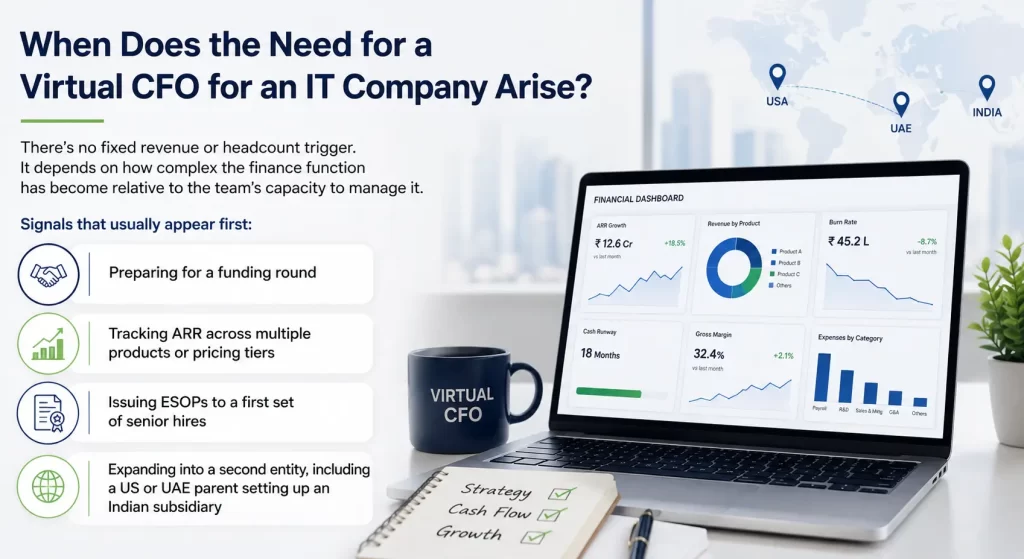
There’s no fixed revenue or headcount trigger. It depends on how complex the finance function has become relative to the team’s capacity to manage it.
Signals that usually appear first:
- Preparing for a funding round
- Tracking ARR across multiple products or pricing tiers
- Issuing ESOPs to a first set of senior hires
- Expanding into a second entity, including a US or UAE parent setting up an Indian subsidiary
What Does a Virtual CFO Do Differently For an IT Company?
Beyond monthly bookkeeping and P&L review, the role covers a specific set of tasks built around how tech companies actually operate.
- Sets up SaaS-metric dashboards (MRR – Monthly Recurring Revenue, ARR – Annual Recurring Revenue, NRR – Net Revenue Retention, CAC – Customer Acquisition Cost, burn multiple, Rule of 40)
- Structures R&D cost accounting under Ind AS 38
- Designs and administers the ESOP pool, including perquisite tax planning
- Builds burn rate models and runway projections benchmarked to your funding stage
- Prepares financial statements and data rooms for fundraising or due diligence
- Advises on entity structure for an Indian company or an Indian subsidiary of a US or UAE parent
- Chooses and oversees the right AI tools for reporting and forecasting, without handing over judgment calls
This is delivered on a fractional basis, so you get senior-level oversight without full-time CFO cost.
Self-Evaluation Checklist: Do You Need a Virtual CFO?
Answer honestly. More than three “no” or “not sure” answers is a signal worth acting on.
1. Revenue and metrics
- Can you produce accurate MRR and ARR within a day, without manual reconciliation?
- Do you track NRR and churn separately by customer segment?
- Could you state your current burn multiple and Rule of 40 score today?
2. Cost structure
- Is your R&D spend split between research and development phases under Ind AS 38?
- Do you know your gross margin after correctly allocating engineering costs?
3. Equity and compliance
- Is your ESOP pool tracked against a clear vesting schedule and cap table?
- Do you know the perquisite and capital gains tax due at each ESOP event?
4. Cash and fundraising
- Do you know your runway in months and how your burn multiple compares to your stage?
- Could you produce an investor-ready data room within a week?
Strategic oversight
- Does anyone review financial strategy beyond monthly bookkeeping?
- Have you made a pricing or funding decision without solid data behind it?
What Happens If You Delay Hiring a Virtual CFO?
Delaying this decision rarely causes an immediate crisis, but the cost shows up gradually.
- Pricing and hiring decisions get made on incomplete data
- Fundraising timelines stretch because documentation isn’t ready when investors ask
- ESOP disputes surface later, when fixing them costs more than getting them right at grant
- None of these are fatal alone, but together they slow growth and affect investor and employee confidence
Will AI Replace the Need for a CFO at IT Companies?
Delaying this decision rarely causes an immediate crisis, but the cost shows up gradually.
- Pricing and hiring decisions get made on incomplete data
- Fundraising timelines stretch because documentation isn’t ready when investors ask
- ESOP disputes surface later, when fixing them costs more than getting them right at grant
- None of these are fatal alone, but together they slow growth and affect investor and employee confidence
Will AI Replace the Need for a CFO at IT Companies?
This is a question we hear more often now, and it deserves a direct, opinionated answer rather than a hedge.
What AI Already Does Well in Finance
- Automated bookkeeping, transaction categorisation, and reconciliation
- Faster cash flow forecasting and scenario modeling
- Anomaly detection in spend and reporting
- Drafting first-pass reports, variance analysis, and investor memos
What AI Still Cannot Do
- Apply judgment to whether a specific R&D cost qualifies for capitalisation under Ind AS 38
- Decide how to structure an ESOP pool for a specific hiring and dilution strategy
- Read the room in a board meeting and advise on a fundraising negotiation
- Take accountability for a compliance filing or a tax position
Our View
AI is changing what a finance function spends its time on, not whether it needs judgment at the top. Industry data through 2026 consistently shows finance teams adopting AI heavily for the mechanical layer, bookkeeping, reconciliation, and first-draft reporting, while decision-making and structuring work still sit with a human.
For an IT company, this actually strengthens the case for a Virtual CFO rather than weakening it. AI can shrink the time spent on data entry. It does not replace the judgment needed to decide how that data should shape pricing, ESOP strategy, or the next funding round. A Virtual CFO who uses AI tools well should be faster and sharper than one who doesn’t, not obsolete.
What Are The Common Finance Mistakes IT Founders Make?
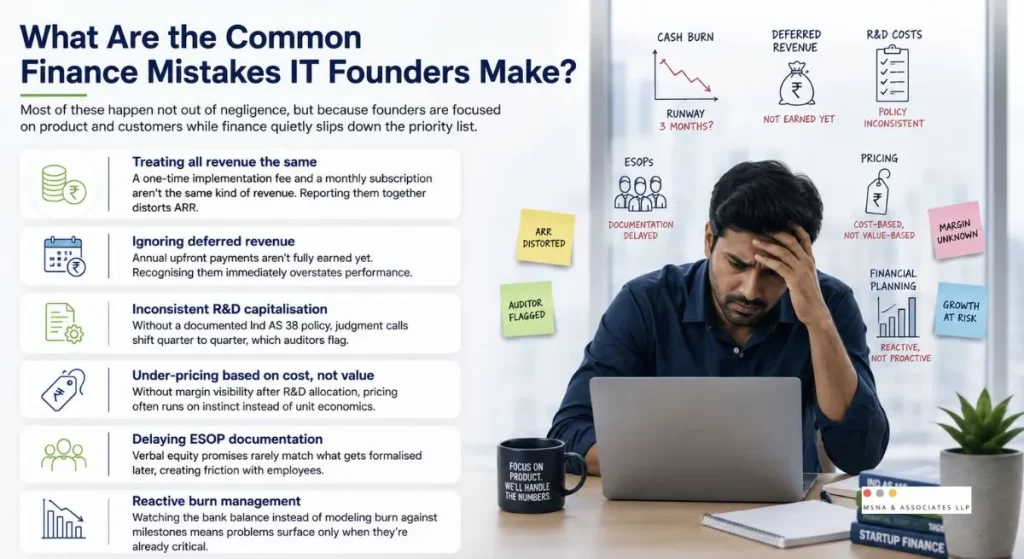
Most of these happen not out of negligence, but because founders are focused on product and customers while finance quietly slips down the priority list.
1. Treating all revenue the same
A one-time implementation fee and a monthly subscription aren’t the same kind of revenue. Reporting them together distorts ARR.
2. Ignoring deferred revenue
Annual upfront payments aren’t fully earned yet. Recognising them immediately overstates performance.
3. Inconsistent R&D capitalisation
Without a documented Ind AS 38 policy, judgment calls shift quarter to quarter, which auditors flag.
4. Under-pricing based on cost, not value
Without margin visibility after R&D allocation, pricing often runs on instinct instead of unit economics.
5. Delaying ESOP documentation
Verbal equity promises rarely match what gets formalised later, creating friction with employees.
6. Reactive burn management
Watching the bank balance instead of modeling burn against milestones means problems surface only when they’re already critical.
What Should an IT Company Look for While Choosing a Virtual CFO?
Not every Virtual CFO service is built with tech companies in mind, so a few checks matter before signing on.
- Direct experience with SaaS or product companies, not just trading or manufacturing clients
- A clear approach to ESOP structuring and Ind AS 38 R&D classification
- Comfort using AI tools for reporting and forecasting, without outsourcing judgment to them
- An engagement that can scale from basic hygiene to board reporting and fundraising support
How Does a Virtual CFO Fit Into an IT Company's Growth Stage?
The role shouldn’t look the same on day one as it does three years in. What a Virtual CFO actually does needs to shift as the company grows.
Early Stage
- Getting the basic financial hygiene right
- Making sure the company is fundraising-ready
- Setting up ARR and burn tracking from the start, not bolting it on later
Growth Stage
- Structuring across multiple entities
- Managing ESOP scaling as hiring picks up
- Building out board-level reporting and forecasting
Where to Start with a Virtual CFO for IT Companies in India?
Financial clarity isn’t something you fix once and move on from. It’s ongoing.
If this checklist turned up more gaps than you expected, it may be worth talking to a virtual CFO for IT companies who understands how IT and SaaS businesses actually run under Indian accounting and tax rules.
Evaluate Your Finance Function
Frequently Asked Questions About the Need for a virtual CFO For an IT company
Do IT startups need a CFO from day one?
Not really, In the early days, solid bookkeeping usually covers it. A Virtual CFO tends to become necessary once ARR tracking, ESOP grants, or a funding round come into play.
Is a Virtual CFO only useful if you're planning to raise funds?
Not at all. ARR tracking, R&D cost management, and ESOP administration matter even for bootstrapped companies focused purely on profitability.
How is a Virtual CFO different from an accountant or bookkeeper?
A bookkeeper records what happened. Virtual CFO takes those same numbers and actually does something with them, using them to shape decisions around pricing, hiring, and how you approach funding.
Will AI tools replace the Virtual CFO role?
Not likely anytime soon. AI is taking over the mechanical, repetitive work, but the judgment, structuring, and accountability still need a human at the table.
Can a Virtual CFO work alongside an in-house finance team?
Yes, that’s actually pretty common. A lot of companies keep a Virtual CFO on for the strategy side, while their in-house or outsourced team just handles the everyday bookkeeping.
Related
Discover more from MSNA & Associates LLP
Subscribe to get the latest posts sent to your email.