


A staff accountant earning $65,000 actually costs a CPA firm $94,000–$115,000 a year once benefits, office space, and overhead are included. Yet, for many firms, that role is genuinely needed for only about four months of the year.
That mismatch, a full-time salary for a seasonal workload, is the core problem outsourced bookkeeping for US CPAs is built to solve. Most firms already sense this every January, when the same hiring scramble repeats itself with no better outcome than the year before.
This guide covers in-house staffing costs, the CPA-India collaboration model behind white-label bookkeeping and staff augmentation, the IRS consent step, and a real cost breakdown from a firm that scaled this way. None of it requires changing your software or how clients experience working with you.
Key Takeaways
- Industry estimates put a fully loaded staff accountant at $94,000-$115,000 a year for a CPA firm; offshore staffing commonly runs $8-$35 an hour, fully loaded, for comparable work.
- White-label bookkeeping means the work is delivered under your firm’s name; your clients never interact with the offshore team directly.
- If your firm’s outsourced scope ever touches tax return preparation, not just bookkeeping, IRS Section 7216 requires signed client consent before any data crosses to an offshore preparer.
- Seasonal staffing for tax season lets a firm scale capacity up for January through April, then back down, without carrying a full-time salary the other eight months.
- The firms that get the most value treat outsourcing as staff augmentation working inside their systems, not as a task handed off to a black box.
Why Tax Season Staffing Is Broken for CPA Firms Right Now?
Tax season means 60-80-hour weeks for three to four months straight, and that pace is a major reason experienced staff leave public accounting faster than firms can replace them. Hiring a full-time employee to cover a workload that’s genuinely intense for four months and lighter the rest of the year is expensive by design, since the firm ends up carrying salary and overhead year-round for a need that isn’t year-round.
Domestic temp staffing agencies exist to fill this gap, but they charge $35- $ 75 per hour, and quality varies significantly from one placement to the next. This is why Outsourced Accounting for US Small Businesses has moved from a cost-saving experiment into a standard staffing tool for firms tired of that cycle.So the real choice most firms are weighing isn’t “in-house vs. outsourced” in the abstract. It’s predictable offshore capacity vs. an expensive, inconsistent domestic temp market.
What Does In-House Tax Season Staffing Cost a CPA Firm?
Here’s how the numbers actually break down once salary, overhead, and billing rate are all placed side by side.
Role | Base Salary | Fully Loaded Cost | Typical Billing Rate |
Staff accountant | $65,000 | $94,000-$115,000/year | $75-$175/hour |
Senior auditor | $85,000 | $120,000-$140,000/year | $150-$300/hour |
Tax manager (CPA) | $110,000 | $155,000-$180,000/year | $200-$450/hour |
Bookkeeping/data entry staff | Varies | — | $40-$90/hour |
The fully loaded cost, not the base salary, is the number that actually matters when comparing to outsourcing. A staff accountant’s salary looks reasonable on its own; it’s the additional 45-75% in benefits, office space, equipment, and management overhead that changes the comparison.
White-Label Bookkeeping and Staff Augmentation: The Two Models of Outsourced Bookkeeping for US CPAs
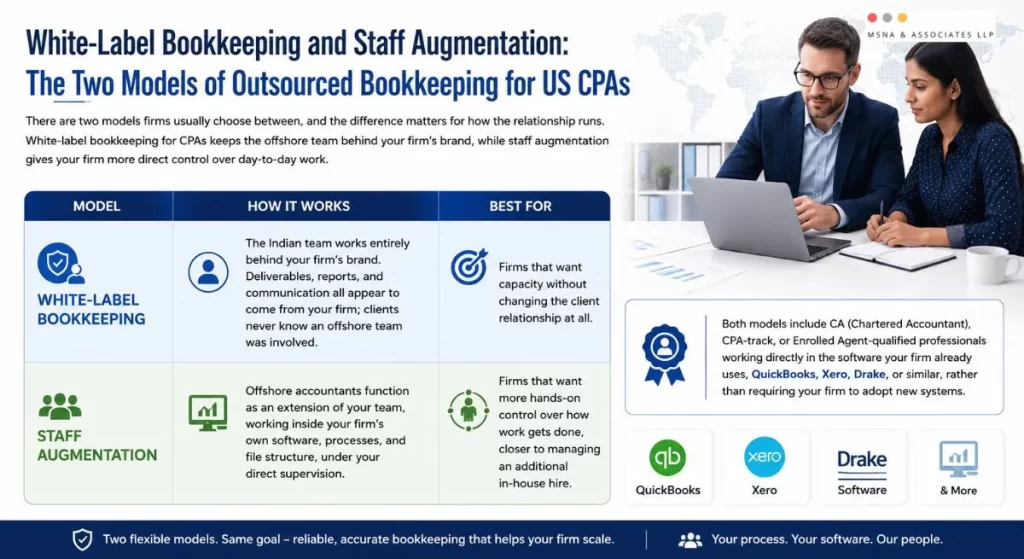
There are two models firms usually choose between, and the difference matters for how the relationship runs. White-label bookkeeping for CPAs keeps the offshore team behind your firm’s brand, while staff augmentation gives your firm more direct control over day-to-day work.
Model | How It Works | Best For |
White-label bookkeeping | The Indian team works entirely behind your firm’s brand. Deliverables, reports, and communication all appear to come from your firm; clients never know an offshore team was involved. | Firms that want capacity without changing the client relationship at all |
Staff augmentation | Offshore accountants function as an extension of your team, working inside your firm’s own software, processes, and file structure, under your direct supervision. | Firms that want more hands-on control over how work gets done, closer to managing an additional in-house hire |
Both models include CA (Chartered Accountant), CPA-track, or Enrolled Agent-qualified professionals working directly in the software your firm already uses, QuickBooks, Xero, Drake, or similar, rather than requiring your firm to adopt new systems.
What Changes in Delivery Efficiency When Work Moves Offshore?
Delivery efficiency is the part most outsourcing guides skip. It comes down to how fast work moves back to your desk, not just the hourly rate.
- Time zone overlap works in your favor. Files sent at day’s end get worked on overnight. They’re ready for your morning review. That’s extra working hours added without extra staff.
- A dedicated point of contact keeps cycles short. A rotating pool means re-explaining your file structure every week, while a consistent accountant learns the firm’s workpapers, review preferences, recurring adjustments, and client-specific requirements over time.
- A shared task tracker beats ad hoc email. Weekly status calls and one tracking system, not scattered threads, are what separate firms with real turnaround gains from firms that just moved the bottleneck offshore.
Does Outsourced Bookkeeping for US CPAs Require IRS Section 7216 Consent?
Section 7216 of the Internal Revenue Code governs how a tax preparer may use or disclose a client’s tax return information. It applies specifically to tax return preparation, not to bookkeeping done on its own.
If your outsourced scope is limited to bookkeeping, write-up work, and reconciliations, and none of it touches a tax return, Section 7216 doesn’t require consent for that portion of the work.
But few firms keep the two fully separate.
Bookkeeping data often feeds into tax prep later, through the same offshore team or the same file. IRS guidance is clear here: even limited involvement, like data entry with no decision-making authority, counts as participation in tax return preparation. Consent is required no matter how narrow that role is.
Treat consent as standing, not conditional.
One rule matters most: it has to be a standalone document. It can’t be a clause in your engagement letter, and it can’t be a condition of service. Set up right at the start, it’s a one-time step. Set up wrong, it exposes the firm to criminal penalties under Section 7216, up to one year imprisonment or $1,000 per violation, and civil penalties under Section 6713 of up to $250 per disclosure, capped at $10,000 a year.
How Seasonal Outsourcing Works During Tax Season ?
Most engagements follow a predictable rhythm across three phases, rather than starting cold in January.
Phase | What Happens |
November-December | Scope, volume, and software access confirmed for the upcoming season; offshore team ramps into your systems |
January-April | Offshore capacity runs at full seasonal volume, handling bookkeeping, data entry, and reconciliation work alongside your in-house team |
May onward | Capacity scales back down to a baseline retainer, or pauses entirely until the next season, without any severance or layoff process |
This is the structural advantage over a full-time hire: the cost curve matches tax season capacity instead of staying flat all year while the workload itself spikes and drops.
Outsourced Bookkeeping for US CPAs: A Tax Season Scaling Case Study
The example below is an illustrative scenario built from typical market rates, not a specific named client.
Before: relying on domestic temp staff
- A five-partner CPA firm brought on two domestic temp placements every tax season
- Rate: roughly $50/hour per placement
- Volume: about 500 hours total across the season
- Cost: approximately $25,000 in temp staffing
- Hidden cost: partners spent time re-training new temp staff each year, most of whom didn’t return the following season
After: moving to staff augmentation
- The firm brought on a dedicated offshore team of two accountants
- The offshore team worked inside the firm’s existing Drake and QuickBooks setup
- Blended rate: about $18/hour
- Cost for the same 500-hour workload: roughly $9,000 – meaningfully lower than the temp-staffing model in this scenario. Actual savings vary by firm size, workload mix, and provider rate. This is a modeled comparison, not a guaranteed outcome.
- Bigger structural win: the same two accountants returned for a second tax season already trained on the firm’s workpapers and client files, something a temp placement model can’t offer
Common Concerns CPA Firm Owners Have About Outsourcing
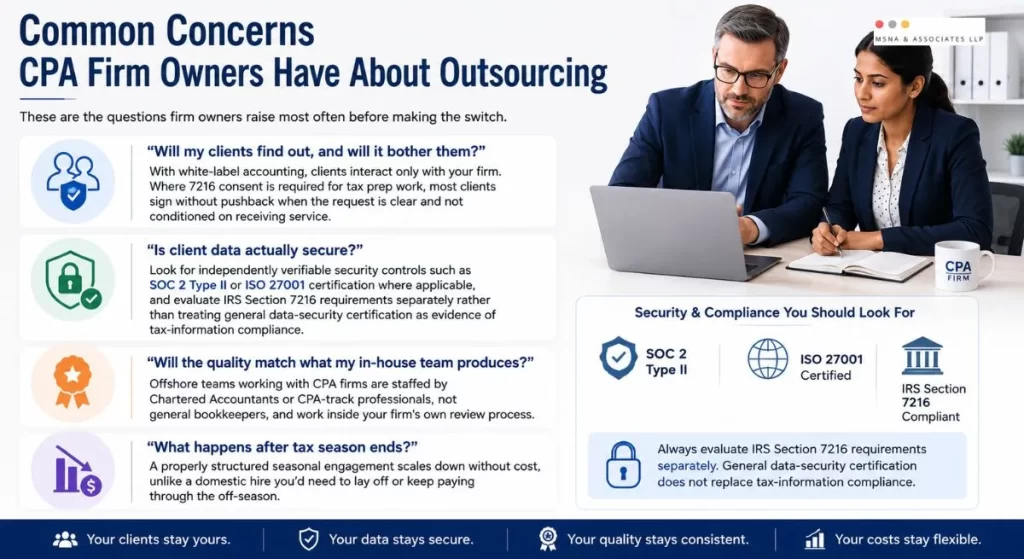
These are the questions firm owners raise most often before making the switch.
Will my clients find out, and will it bother them?
With white-label accounting, clients interact only with your firm. Where 7216 consent is required for tax prep work, most clients sign without pushback when the request is clear and not conditioned on receiving service.
Is client data actually secure?
Look for independently verifiable security controls such as SOC 2 Type II or ISO 27001 certification where applicable, and evaluate IRS Section 7216 requirements separately rather than treating general data-security certification as evidence of tax-information compliance.
Will the quality match what my in-house team produces?
Offshore teams working with CPA firms are staffed by Chartered Accountants or CPA-track professionals, not general bookkeepers, and work inside your firm’s own review process.
What happens after tax season ends?
A properly structured seasonal engagement scales down without cost, unlike a domestic hire you’d need to lay off or keep paying through the off-season.
What Are The Common Mistakes CPA Firms Make When Outsourcing?
A few missteps show up again and again in firms outsourcing for the first time.
- Treating 7216 consent as optional because,it’s just bookkeeping ,If there’s any chance the data flows into tax prep later, get consent structured from day one.
- Choosing a provider on hourly rate alone, without checking whether they’ve actually worked inside your specific software stack before.
- Not assigning a dedicated point of contact on the offshore side, which turns every request into a fresh explanation instead of a continued working relationship.
- Scaling up too late in the season, when onboarding, system access, workpaper familiarisation, and process training need a few weeks of lead time to be useful by January.
Getting Ready for the Next Tax Season With Outsourced Bookkeeping for US CPAs
The math on seasonal staffing rarely favors a full-time hire once the fully loaded cost is compared honestly against offshore staff augmentation or white-label bookkeeping. The bigger risk isn’t cost; it’s starting the search in December for a season that begins in January. Consulting an outsourced accounting/bookkeeping service in India for US businesses can help you scope the right model and get the 7216 consent structure right before the next season starts.
Scale Your CPA Firm’s Bookkeeping Capacity
Frequently Asked Questions About Outsourced Bookkeeping For US CPAs
Is white-label bookkeeping the same as staff augmentation?
No. White-label means the offshore team works entirely behind your firm’s brand, with no client-facing visibility. Staff augmentation gives you more direct, hands-on control over how the offshore accountant works, closer to managing an additional in-house hire.
Do I need IRS Section 7216 consent for pure bookkeeping work with no tax prep involved?
Not strictly, if the scope genuinely never touches tax return preparation. Most firms build consent into the engagement letter anyway, since bookkeeping and tax prep data tend to converge in practice.
How much can a CPA firm actually save by outsourcing seasonal staffing?
Offshore staffing typically runs $8-35 an hour fully loaded, compared to $35-75 an hour for inconsistent domestic temp staffing, or $94,000-$115,000 a year for a fully loaded in-house staff accountant
Can an offshore team work inside the same software my firm already uses?
Yes, Offshore accounting teams working with CPA firms typically operate directly inside QuickBooks, Xero, Drake, or whichever platform the firm already runs, rather than requiring a new system.
Related
Discover more from MSNA & Associates LLP
Subscribe to get the latest posts sent to your email.