

If your US company has just set up an Indian subsidiary, you’re probably not ready to hire a full-time CFO in India. But you still need someone who can own the numbers.
A fractional CFO is a senior finance leader who works with your subsidiary part-time, on a retainer, instead of as a full-time employee. In India, US-owned subsidiaries use this model to get board-ready reporting, cash and transfer pricing oversight, and fundraising or repatriation support, at 20 to 40% of the cost of a full-time hire.
Below, we break down what is a fractional CFO, what the role covers, how it differs from a virtual CFO, outsourced, or shared CFO, what it costs in India, and when a US subsidiary should actually bring one on.
What Is a Fractional CFO?
In short, a fractional CFO is a senior finance leader you retain part-time on a retainer, rather than hire as a full-time employee.
A fractional CFO is an experienced finance executive who takes on a portion, or “fraction,” of a full CFO’s working week for your business, usually 8 to 20 hours a month, on an ongoing retainer rather than a full-time payroll role. The word “fractional” refers specifically to time: you get a slice of a senior professional’s week, not a junior resource working full-time.
For a US subsidiary in India, this means one finance leader who understands both US parent-company reporting expectations and Indian statutory requirements under the Companies Act, 2013, and FEMA, working across your books, board packs, and cross-border cash movement.
Fractional CFO Meaning: How The Role Fits Into A US Subsidiary's Finance Function
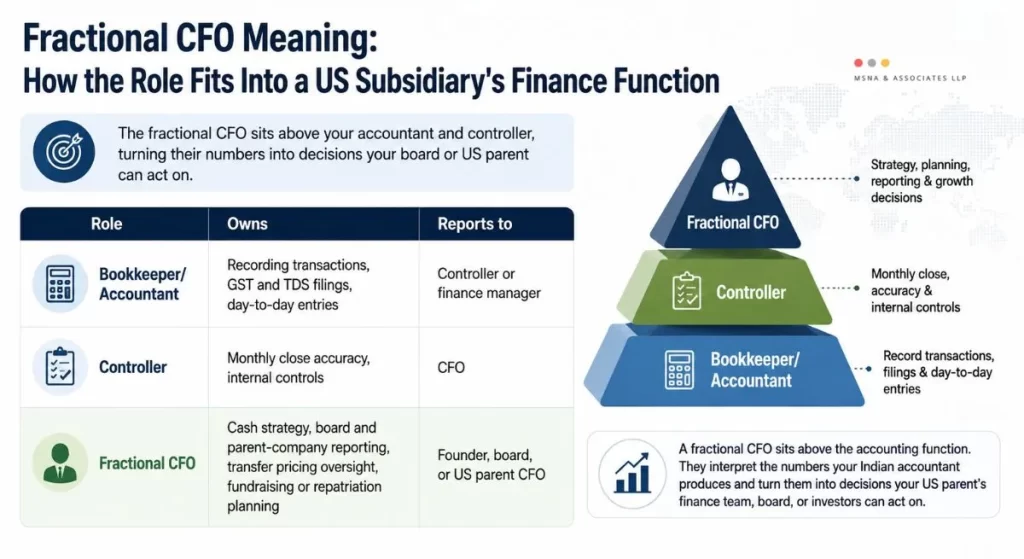
The fractional CFO sits above your accountant and controller, turning their numbers into decisions your board or US parent can act on.
The fractional CFO meaning is often confused with a bookkeeper or an accountant. It shouldn’t be. Here’s the distinction that matters for a US-parent finance team evaluating India:
Role | Owns | Reports to |
Bookkeeper/accountant | Recording transactions, GST and TDS filings, day-to-day entries | Controller or finance manager |
Controller | Monthly close accuracy, internal controls | CFO |
Fractional CFO | Cash strategy, board and parent-company reporting, transfer pricing oversight, fundraising or repatriation planning | Founder, board, or US parent CFO |
A fractional CFO sits above the accounting function. They interpret the numbers your Indian accountant produces and turn them into decisions your US parent’s finance team, board, or investors can act on.
Fractional CFO vs Virtual CFO vs Outsourced CFO vs Shared CFO: What's the Real Difference?
Each term answers a different question: fractional is about time, virtual is about delivery, outsourced is about sourcing, and shared is about how many clients the CFO serves.
This is the question most US founders and finance directors actually search for, and most articles blur the four terms together. Each label answers a different question:
Term | Answers the question | What it means in practice |
Fractional CFO | How much time do you get? | Part-time, ongoing engagement, senior individual |
Virtual CFO | Where does the work happen? | Delivered remotely, via cloud accounting and video calls |
Outsourced CFO | Where does the CFO come from? | Provided by an external firm, not on your payroll |
Shared CFO | Who else is the CFO working with? | The same CFO or firm serves multiple companies concurrently |
In practice, one person or firm can be all four at once: a fractional, virtual, outsourced CFO who is “shared” across several client companies. The terms aren’t competing models, they’re four dimensions of the same engagement. What actually varies between providers is scope, hours committed, and whether the engagement is billed hourly, monthly, or per project.
What Does A Fractional CFO Do for A US Subsidiary In India?
For a US subsidiary, the role covers cross-border reporting, cash and transfer pricing oversight, and coordination with your statutory auditor and company secretary.
For a US-parent entity operating through an Indian subsidiary or branch, the scope typically includes:
- Cross-border reporting: reconciling the Indian books to US GAAP or whatever format the parent company needs for consolidation
- Cash and fund flow management: planning remittances that stay FEMA-compliant, and timing downstream investment and repatriation so funds move when they should, not when they happen to
- Transfer pricing oversight: working with the statutory auditor on intercompany pricing documentation and keeping Form 3CEB compliance on track
- Board and parent reporting: monthly or quarterly MIS packs the US parent’s leadership can actually use, not just file away
- Fundraising or M&A support: getting the data room in shape, feeding in valuation inputs, and staying involved as due diligence moves forward
- Statutory and tax liaison: staying aligned with your CA and company secretary on audit matters as well as ROC and RBI filings, without stepping into their role
A fractional CFO does not replace your statutory auditor, company secretary, or in-house accountant. The role sits above these functions and coordinates them.
Fractional CFO Cost In India: What US-Owned Entities Actually Pay
Expect to pay anywhere from ₹50,000 to ₹4,50,000 a month, depending on hours committed, entity complexity, and whether a fundraise or transaction is active.
Cost depends on time commitment, entity complexity, and how active your fundraising or transaction pipeline is. Based on current India market data for 2026:
Engagement type | Typical range | Best fit |
Monthly retainer (8–15 hrs/month) | ₹50,000 – ₹2,00,000/month | Early-stage subsidiary, steady-state compliance |
Monthly retainer (15–30 hrs/month) | ₹2,00,000 – ₹4,50,000/month | Growth-stage subsidiary, active fundraising or M&A |
Hourly / advisory basis | ₹4,000 – ₹12,000/hour | Specific projects: transfer pricing study, valuation, due diligence |
Full-time in-house CFO (for comparison) | ₹35–50+ lakh/year fully loaded | Complex multi-entity structure, board-mandated appointment |
These are indicative 2026 market estimates compiled from prevailing professional-services pricing and should be validated against current quotations for the specific scope. They are not statutory fee ranges or an official government benchmark.
What moves the number for a US subsidiary specifically: whether transfer pricing documentation is in scope, how frequently the US parent needs consolidated reporting, and whether an active fundraise or repatriation event is underway. A single-entity Indian Private Limited company with routine compliance sits at the lower end. A structure with multiple Indian entities, active FEMA filings, and quarterly board reporting sits higher.
Does Indian Law Require Your Subsidiary To Appoint A Full-Time CFO?
For most US subsidiaries, the answer is no: Section 203 of the Companies Act, 2013 mandates a whole-time CFO only for listed and larger public companies.
This is a question most US finance teams don’t think to ask, and most CFO-services content doesn’t answer directly.
Under Section 203 of the Companies Act, 2013, read with Rule 8 of the Companies (Appointment and Remuneration of Managerial Personnel) Rules, 2014, a whole-time CFO is mandatory only for listed companies and public companies with paid-up share capital of ₹10 crore or more. A private limited company is not covered by this requirement, regardless of its paid-up capital or turnover, unless it voluntarily chooses to appoint one.
Most US subsidiaries in India are incorporated as wholly owned private limited companies. That means, in the large majority of cases, Indian law does not force your entity into a full-time CFO appointment. A fractional or virtual CFO is not a compliance workaround. It’s a legally sound, deliberate choice for this entity structure. This shifts the CFO decision from a legal obligation to a business judgment call, which is the framing US finance directors actually need before they budget for it.
Note: if your Indian entity is structured or converted into a public company, or paid-up capital approaches ₹10 crore, revisit this with your company secretary, since the whole-time KMP requirement would then apply.
When To Hire A Fractional CFO: Signals For US Subsidiary Founders And Finance Directors?
The right time is usually when your accountant’s reporting can no longer keep pace with what the US parent, board, or investors need to see.
A fractional CFO tends to earn its cost once one or more of these is true for the Indian entity:
- Monthly revenue or transaction volume has outgrown what your accountant can turn into decision-ready reporting
- The US parent needs consolidated numbers in a format their finance team can use without translation
- You’re preparing for a funding round, M&A, or a transfer pricing audit
- Cash repatriation or downstream investment decisions are becoming frequent enough to need a dedicated owner
- The founder or India country head is currently the de facto finance decision-maker and it’s becoming a bottleneck
If two or more of these signals sound familiar, it’s usually worth scoping the engagement rather than waiting for a board deadline to force the decision. Our Virtual CFO Services page walks through how that scoping conversation typically goes.
Which CFO Engagement Model Fits Your Growth Stage?
The right model tracks your subsidiary’s stage, from outsourced accounting at incorporation to a full-time CFO once Section 203 thresholds are crossed.
Subsidiary stage | Recommended model | Why |
Just incorporated, pre-revenue | Outsourced accounting + light virtual CFO check-ins | Books need to be built before strategy makes sense |
Early revenue, steady compliance | Virtual CFO, 10–15 hrs/month | Remote oversight, lower cost, no in-person need |
Growth stage, active fundraising or transfer pricing scrutiny | Fractional CFO, 15–30 hrs/month | Needs deeper embedding, board and parent reporting cadence |
Multi-entity, board-mandated KMP | Full-time in-house CFO | Section 203 threshold crossed, or complexity demands daily ownership |
Common Mistakes US Parents Make When Structuring CFO Support In India
The most common misstep is assuming the statutory auditor already plays the CFO role, when in practice the two functions rarely overlap.
- Assuming the statutory auditor also plays the CFO role. Auditors sign off on compliance. They don’t own cash strategy or parent-company reporting.
- Delaying transfer pricing planning until year-end. By the time Form 3CEB is due, pricing decisions have already been made and can’t be restructured.
- Treating the Indian entity’s reporting as a local matter. A fractional CFO who doesn’t understand what the US parent’s finance team needs will produce reports that get redone anyway.
- Confusing “virtual” with “junior.” A virtual CFO is defined by delivery method, not seniority. The experience level should be negotiated separately from the delivery format.
Why Your Fractional CFO's Location Matters: Permanent Establishment Risk Under The India-US DTAA
Where your fractional CFO is based, and how much authority they exercise from India, can quietly affect your US parent’s tax exposure here.
Under Article 5 of the India-US DTAA, a US enterprise can be treated as having a Permanent Establishment (PE) in India if someone here habitually exercises authority to conclude contracts on the parent’s behalf, or if services are rendered beyond the treaty’s Service PE threshold.
Indian courts weigh substance over form: in Progress Rail Locomotive Inc. v. DCIT (Delhi High Court, 2024), the tax department alleged all three PE categories – fixed place, service, and dependent agent. The court rejected each on the facts, with actual control over premises and genuine exercise of authority proving decisive rather than how the arrangement was papered.
Two things to watch:
A US-based CFO who visits India and directs the subsidiary’s finances can rack up days against the Service PE threshold, and an India-based CFO whose authority reads as exercised for the parent, rather than the subsidiary, invites scrutiny. Once PE is triggered, India taxes the attributable profits at the full corporate rate, not the treaty rate.
This isn’t a reason to avoid the fractional model. It’s a reason to document clearly whose payroll the CFO sits on, which board they report to, and where authority to bind the company sits, ideally reviewed with a cross-border tax advisor before the engagement letter is signed.
Conclusion: What Is A Fractional CFO and Is It Right For Your Indian Subsidiary?
Choosing between a fractional, virtual, or full-time CFO for an Indian subsidiary depends on your entity’s stage, reporting complexity, and how the US parent’s finance team needs the numbers structured.
Consulting a professional Virtual CFO Services in India who works with both Indian compliance and US parent-company reporting can help you assess which model fits your specific structure.
Explore the Right CFO Support for Your Business
FAQs About What Is A Fractional CFO
Is a fractional CFO the same as a virtual CFO?
Not exactly. Fractional describes time commitment (part-time), virtual describes delivery (remote). Most fractional CFOs today work virtually, so the terms overlap in practice, but they answer different questions.
Can a private limited subsidiary legally operate without a full-time CFO?
Yes, Under Section 203 of the Companies Act, 2013, the whole-time CFO requirement applies only to listed companies and public companies with paid-up capital of ₹10 crore or more. Private limited companies, including most US-owned subsidiaries, are not covered.
How many hours does a fractional CFO typically work per month for a subsidiary?
Most engagements for early to growth-stage subsidiaries run 8 to 30 hours a month, scaled up during fundraising, audits, or transfer pricing filings.
Does a fractional CFO replace the need for a statutory auditor or CA firm?
No, A fractional CFO works alongside your statutory auditor and company secretary, coordinating strategy and reporting, not replacing the compliance and audit functions they perform.
Related
Discover more from MSNA & Associates LLP
Subscribe to get the latest posts sent to your email.