

How VCFO Supports Corporate Advisory in Structuring a Growing Business ?
Why does cash feel tight when revenue keeps climbing?
This is one of the most common problems for businesses scaling in India today. Sales are up, the team is growing, and clients keep calling. But cash still feels tight, decisions take longer, and even experienced advisors give suggestions that no one is fully confident about because the numbers behind them aren’t clear.
The gap usually isn’t revenue. It’s financial structure.
This is where VCFO support for corporate advisory comes into play. A Virtual CFO brings financial clarity to business advice. They connect strategy with real numbers, help structure growth, and make sure decisions are based on facts, not assumptions.
According to the India Venture Capital Report 2026 by Bain & Company and IVCA, investors are now prioritizing capital efficiency and sustainable, “profitable growth” over “growth at any cost.” For Indian businesses seeking VC funding, financial structuring has moved from a nice-to-have to a requirement for staying investable.
Why Growing Businesses Struggle With Financial Structure ?
In the early days, most businesses focus only on KPIs. Sales, delivery, and customer acquisition come first. Finance is often handled reactively. As long as the money is coming in, everything feels fine.
But as you scale, the complications also increase:
- Uneven Cash Flow: Higher revenue often comes with longer credit periods and mounting operational expenses.
- Compliance Weight: Navigating GST, Tax Audits, and MCA filings becomes a danger zone.
- Investor Readiness: “Rough estimates” won’t work anymore if you want the VC funding or a bank loan.
Without a clear financial structure, growth can cause confusion rather than stability. This is exactly where VCFO support for corporate advisory is important to guide businesses with strong financial insight.
What a Virtual CFO Really Does (Beyond Accounting)?
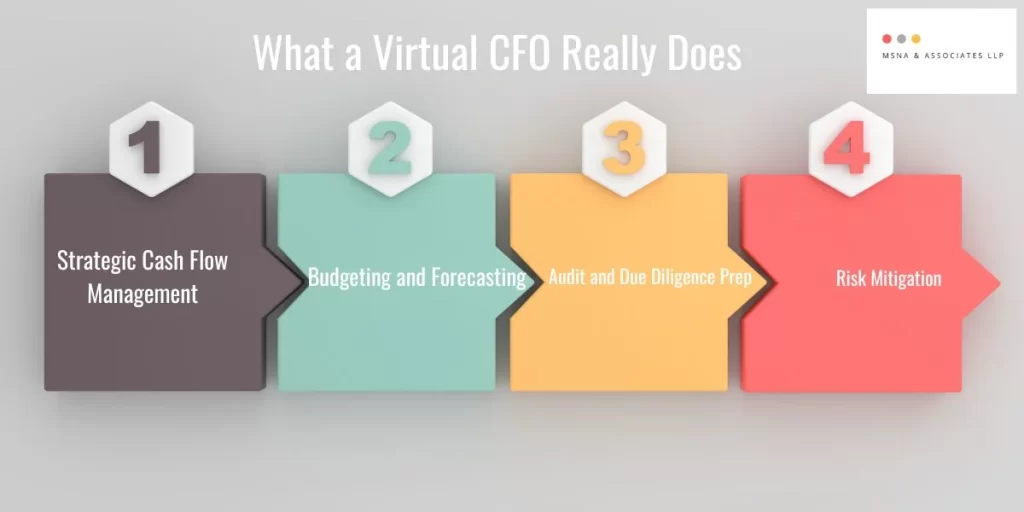
A Virtual CFO isn’t just a “senior accountant.” They’re strategic partners who turn complicated numbers into business logic that can be used.
- Strategic Cash Flow Management: Going beyond just looking at profit and loss to make sure you have enough cash on hand to pay your bills and employees on time.
- Budgeting and Forecasting: Making a 12-month plan that fits with your goals for growth, not just looking at how much you spent last month.
- Audit and Due Diligence Prep: Getting your books in order so that you are ready when an investor or auditor comes in, not panicked.
- Risk Mitigation: Finding clients with high and low margins and stopping financial leaks before they turn into big problems.
A VCFO also ensures your business stays on the right side of the law. This includes navigating the increasingly automated GST portal and staying ahead of MCA (Ministry of Corporate Affairs) filing deadlines to avoid heavy penalties that can drain a growing company’s cash.
In India, this approach is growing very fast, making VCFO services in India a smart alternative to hiring a full-time CFO.If you’re new to the concept, understandingwhat is a Virtual CFO can help clarify how outsourced financial leadership works for scaling businesses.
How VCFO Support Strengthens Corporate Advisory ?
Corporate advisory helps businesses make important decisions around structure, compliance, growth, and funding. But advice only works when it is backed by clear financial insight. This is where VCFO support in corporate advisory adds real value.
A Virtual CFO brings numbers into every discussion, so decisions are not based on guesswork. Their role includes:
- Turning financial data into clear, usable insights
- Preparing projections, cost analysis, and cash flow impact
- Supporting advisors with realistic financial scenarios
When a business plans expansion or restructuring, the VCFO helps advisors see what is practical and sustainable. In simple words, they ensure that every advisory decision makes financial sense.
Structuring a Growing Business With VCFO’s Support in Corporate Advisory
Business structure is more than a legal setup or ownership on paper. It also covers how money moves, how costs are tracked, and how risks are handled. This is where VCFO guidance becomes valuable.
A Virtual CFO helps practically build this structure:
- Creating budgets that match business goals.
- Setting up clear reporting to track the spending and performance.
- Defining financial checkpoints to inform growth decisions.
This structure works as a form of security for growing businesses. It supports faster growth without loss of control. This matters even more for founders without a finance background.
The VCFO Growth Structuring Model
Most people describe what a Virtual CFO does. Fewer explain how that work actually gets sequenced inside a growing business.
At MSNA, engagements tend to follow a repeatable pattern, which can be described as the VCFO Growth Structuring Model. It has four stages that connect day-to-day numbers to corporate advisory decisions.
- Diagnose: Review the current financial structure, including cash flow cycles, compliance status, reporting gaps, and where decisions are currently being made without data.
- Design: Build the reporting rhythm, budgets, and financial checkpoints the business actually needs at its current stage, not a template built for a different-sized company.
- Decide: Bring the VCFO into advisory conversations directly, so expansion, funding, or restructuring decisions are pressure-tested against cash flow and compliance impact before they are finalised.
- Defend: Keep monitoring the structure as the business scales, using scenario planning and board reporting to catch pressure points early rather than after they show up as a cash crunch.
This sequence is less about a fixed checklist and more about a way of thinking. Businesses that move through Diagnose and Design before Decide tend to walk into advisory conversations with fewer surprises.
Advanced Financial Tools a Virtual CFO Brings to Corporate Advisory
As a business moves past its early growth stage, corporate advisory conversations start needing more than budgets and cash flow tracking. This is where a Virtual CFO’s more advanced toolkit comes in:
- Financial Modelling: Building multi-year models that show how revenue, costs, and cash behave under different growth paths, so advisory decisions aren’t based on a single static projection.
- EBITDA Analysis: Calculating a normalised EBITDA, with one-time or non-operating items added back, so investors and advisors are looking at the business’s real operating performance rather than a number distorted by one unusual quarter.
- Board Reporting: Translating raw financial data into a decision-ready board pack, monthly or quarterly, so directors and advisors spend their time on decisions instead of reconciling numbers.
- Working Capital Optimization: Tracking the cash conversion cycle, meaning how long money is tied up in receivables, payables, and inventory, and adjusting payment terms so growth doesn’t quietly drain the bank balance.
- Scenario Planning: Running base-case, upside, and downside versions of a decision (a new hire, a market entry, a funding round) so the advisory conversation covers what happens if things go differently than expected.
These tools do not replace the fundamentals of budgeting and reporting. They sit on top of them, and they are usually what separates a VCFO who reports numbers from one who actively shapes corporate advisory decisions.
What Recurring VCFO Engagements Reveal?
Across VCFO engagements with growing businesses, a few patterns tend to repeat, regardless of industry:
- Founders often equate revenue growth with cash health. In practice, working capital drag, meaning money tied up in receivables or inventory, is one of the more common reasons cash feels tight even when the top line looks strong.
- Businesses preparing for a funding round frequently discover unreconciled inter-company or vendor balances only once a VCFO starts due diligence prep, not before.
- Companies expanding into a new market often carry a financial structure built for their original, single-market setup, which creates reporting gaps once a second entity or currency enters the picture.
These are recurring observations from advisory work, not outcomes specific to any one client, and they illustrate why financial structuring tends to matter earlier than most founders expect.
VCFO Support For US and UAE Subsidiaries Structuring in India
Corporate advisory needs shift slightly when the business isn’t purely India-based. For US and UAE companies with an Indian subsidiary, or ones planning to set one up, advisory decisions have an added layer: aligning Indian financial structure with parent-company reporting (US GAAP or IFRS), managing transfer pricing between the head office and the Indian entity, and keeping Indian statutory timelines in sync with the parent company’s reporting calendar.
A Virtual CFO who works across India, US, and UAE engagements can act as the connecting layer here, translating Indian compliance and financial data into a format the overseas parent’s finance team and advisors can use directly, rather than leaving that reconciliation to happen after the fact.
Cost and Flexibility Benefits of VCFO Support In Corporate Advisory
In the early or mid-growth stage, hiring a full-time CFO often doesn’t make sense. It’s expensive, and the businesses may not need that kind of support every day. In India, a full-time CFO can cost ₹30–60 lakhs a year, even before bonuses and extra expenses.
A Virtual CFO is a smarter option. You can bring them in monthly, usually for ₹50,000 to ₹2 lakhs, or hire them only for specific needs like fundraising or restructuring. This keeps costs under control while still giving access to senior financial guidance that fits where the business is right now.
Common Problems Businesses Face Without VCFO Support
When a business grows without strong financial leadership, the same issues keep showing up. Sales may rise, but control weakens. Common problems include:
- Cash flow gaps despite good revenue
- Missed tax and compliance deadlines
- Weak financial data during investor talks
- Expansion decisions driven by emotion, not numbers
How VCFOs Spot The Hidden Money Leaks While Advisors Focus on Strategy?
Money doesn’t just disappear overnight when a business grows. It goes away without a sound. VCFOs look at where money is leaking in small, everyday areas, while corporate advisors focus on the big picture.
Some of the common hidden leaks are:
- The Subscription Trap: Teams that are growing often waste 5-10% of their operating costs on software and tools that they don’t usually use. A VCFO looks over subscriptions and helps get back money that was wasted.
- Working Capital Drag: Money coming in is not the same as the cash on hand. VCFOs change the terms of payment with vendors so that the business has better cash flow without having to take out expensive loans.
- The Compliance Multiplier: Banks get worried when you don’t file MCA returns, GST returns, income tax, and TDS filings on time. VCFOs make sure that the company follows the rules to keep its credit score high.
Choosing The Right VCFO For Corporate Advisory Needs
Not every Virtual CFO will be the right fit. The right VCFO understands both finance and business decisions. They should:
- Explain numbers in clear, simple terms
- Work easily with founders, lawyers, and advisors
- Focus on long-term value, not just reports
For businesses looking for strong corporate advisory services, the VCFO should act like a partner in growth, not an external consultant.
Expert Insight: A common mistake founders make is treating finance as a ‘post-facto’ reporting task. In reality, a VCFO should be in the room before the contract is signed, not after. They help Corporate Advisors see the tax and cash flow implications of a deal before it’s too late.
VCFO-Led Corporate Advisory For Real Growth
Understanding your numbers can change everything. When VCFO supports the corporate advisory as part of your business, decisions become clearer, risks are easier to manage, and plans stay grounded in real data. This combination of advisory insight and financial expertise is important for founders and leaders looking for reliable financial guidance without making assumptions.
If you’re thinking about stronger financial clarity and sharper strategy, professional firms like MSNA and Associates focus on bringing practical finance support into your growth plans. This kind of support helps you move forward with confidence.
Need Expert VCFO Support for Corporate Advisory?
Frequently Asked Questions About VCFO Support and Corporate Advisory
How much does a Virtual CFO cost in India?
Virtual CFO engagements in India typically range from ₹50,000 to ₹2 lakh per month, well below a full-time CFO’s annual cost of roughly ₹30–60 lakh
When should a growing business hire a Virtual CFO?
Most businesses benefit from a Virtual CFO once revenue growth starts outpacing financial clarity. Signs like tight cash despite strong sales or missed GST/MCA deadlines are the usual trigger.
What's the difference between a Virtual CFO and an accountant?
An accountant records what already happened, while a Virtual CFO uses that data to guide forward-looking decisions like cash flow forecasting and growth planning
Is a Virtual CFO a good fit for a startup, or only larger companies?
Virtual CFOs work for both, since engagements scale with the business’s stage and needs rather than following a fixed template.
Related
Discover more from MSNA & Associates LLP
Subscribe to get the latest posts sent to your email.