
A Bangalore-based apparel exporter shipped a container to a buyer in Hamburg two months ago, invoiced in euros on a 60-day term. By the time payment landed nine days late, the euro had slipped against the rupee and quietly erased a chunk of the margin. Nobody made a mistake. Nobody was tracking the currency, either.
A Virtual CFO for export business is an outsourced finance leader who manages forex risk, letters of credit, FEMA compliance, and export incentive claims as a single connected function, instead of leaving them to a generalist accountant. The goal is to protect margin that would otherwise be lost to currency movement, documentation errors, or missed refunds.
Domestic invoicing and GST filing already keep most finance teams busy. Add multiple currencies, letters of credit, RBI realisation deadlines, and export incentive claims, and the finance function stops being something a part-time accountant can hold together. Which is why export business owners, manufacturers, and merchant exporters increasingly bring one in as a full-time discipline.
Why International Finance Management Looks Different From Running Domestic Books ?
A domestic business deals with one currency and one tax regime, and its buyers mostly pay on predictable local terms. An export business deals with none of that certainty.
1. Foreign Exchange Exposure on Every Invoice
Every export invoice raised in a foreign currency is an open position until the payment is received and converted. Between the invoice date and the realisation date, the rupee can move either way. A business shipping to buyers across several currencies, say dollars, euros, dirhams, and pounds, is carrying multiple unmanaged exposures at once. Most don’t have a formal policy on when and how to hedge them.
2. Letters of Credit and Trade Documentation
Letters of credit protect payment, but only when the documentation matches the LC terms exactly. A mismatched shipping date, a discrepant bill of lading, or a missing certificate can hold up payment for weeks while working capital sits idle. LC management is a documentation discipline as much as a finance one. It needs someone reviewing terms before the shipment leaves, not after the bank raises a query.
3. Export Realisation Timelines Under FEMA
Export proceeds have to be realised and repatriated to India within a period fixed under the Foreign Exchange Management (Export of Goods and Services) Regulations. This window has moved more than once recently.
This is ahead of the new FEMA Export and Import Regulations, 2026 taking effect from 1 October 2026.
For an exporter, that is a reminder that the realisation clock is a regulatory setting that can change with notice, not a fixed constant. Treating it as static in a cash flow plan is a risk in itself.
4. Export Incentive and Refund Tracking
RoDTEP and GST export refunds aren’t there just to cut paperwork. They’re there to protect your margins. As per DGFT Notification No. 74/2025-26, RoDTEP has been extended through 30 September 2026 at the rates and value caps notified as of 31 March 2026. Reimbursement ranges roughly between 0.01% and 4.3% of FOB value by HS code.
That is real money available to exporters who file accurately and on time, and real money left behind by those who do not track claims against what they are actually eligible for.
Many exporters believe currency gains and losses are merely accounting adjustments. In reality, unmanaged forex exposure can erode operating margins even when export volumes are growing.
What Does a Virtual CFO for Export Business Actually Do in India, US or UAE?
A Virtual CFO acts as a strategic finance partner for the export business, without the cost of a full-time, in-house executive. The role sits above bookkeeping and statutory compliance. Instead, it focuses on strategic financial decisions that protect margins. Businesses evaluating broader finance leadership can also explore Virtual CFO Services in India to understand how outsourced CFO support helps manage strategic finance, compliance, cash flow, and business growth across industries.
These include determining how much currency exposure to hedge and whether the business can absorb a 60-day payment delay from its largest customer. Buyer and market concentration get the same level of attention.
Virtual CFO vs Accountant vs Bookkeeper for Export Finance
Function | Bookkeeper | CA / Accountant | Virtual CFO |
Transaction recording | Yes | Oversight | Strategic review |
GST/RoDTEP filing | Limited | Yes | Oversight and claim optimisation |
FEMA/export compliance | No | Limited | Ongoing monitoring |
Forex risk management | No | No | Yes |
LC and trade finance structuring | No | Limited | Yes |
Working capital and cash flow planning | No | Limited | Yes |
Cross-border tax planning | No | Limited | Yes |
MSNA perspective:
When we take on a new export client, the first thing we ask for is not the last balance sheet. It is a currency-wise, buyer-wise breakup of receivables. Most exporters can tell us their total outstanding in rupees within seconds, but few can tell us how much of that is sitting exposed in euros versus dollars, or how many days it has been outstanding against each buyer’s actual payment terms. That gap is usually where the margin leakage is happening.
Why Export Businesses in India, the US, and the UAE Lose Money?
Some of these mistakes are avoidable with a basic review; others need a structural fix.
- Invoicing in a foreign currency and only converting funds when the bank prompts them, instead of on a planned schedule.
- Treating letters of credit as a formality and reviewing the documentation only after a discrepancy notice arrives from the bank.
- Filing incentive or credit-support claims late (RoDTEP/GST in India, EXIM in the US, ECI in the UAE) without checking eligibility against what was actually claimed.
- Growing revenue around one large overseas buyer without asking what happens if that buyer pays late, or just moves on.
If any of this sounds familiar, a professional review can help identify exactly where the exposure sits before it turns into a larger loss.
How a Virtual CFO Handles Forex Risk Management and Global Cash Flow ?
1. Structuring Forex Hedging
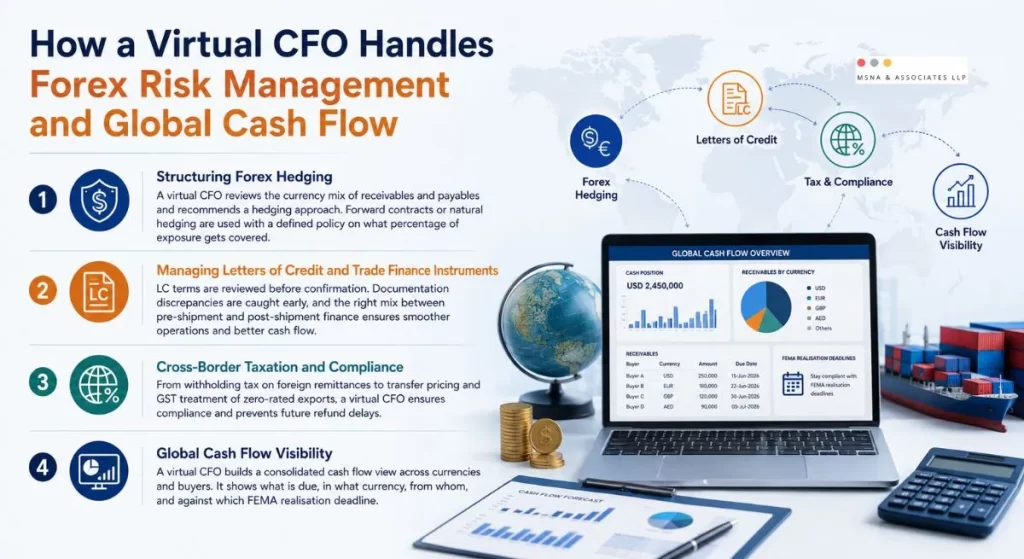
A virtual CFO for export business reviews the currency mix of receivables and payables and recommends a hedging approach. That could mean forward contracts booked with an Authorised Dealer bank, or natural hedging by matching foreign currency inflows against outflows. Either way, it comes with a defined policy on what percentage of exposure gets covered. The point is not to eliminate currency risk. It is to make it a deliberate, monitored decision rather than an accident of timing.
2. Managing Letters of Credit and Trade Finance Instruments
LC terms get reviewed before confirmation, not after. Documentation discrepancies get caught before they reach the bank. And the mix between pre-shipment finance (packing credit) and post-shipment finance gets set deliberately, so production isn’t funded out of pocket.
3. Cross-Border Taxation and Compliance
Export businesses dealing with overseas buyers, agents, or group entities need attention to cross-border taxation questions. That includes withholding tax on foreign remittances and transfer pricing where related parties are involved, along with how GST treats zero-rated exports under a Letter of Undertaking. Getting this wrong slows down every future refund cycle, because the filings no longer reconcile cleanly.
As the business adds buyers and jurisdictions, this exposure doesn’t stay flat. It compounds. What was manageable with two markets can quietly become a real tax liability by the fifth or sixth.
4. Global Cash Flow Visibility
A virtual CFO for export business builds a consolidated cash flow view across currencies and buyers. It shows what is due, in what currency, from whom, and against which FEMA realisation deadline .Businesses looking to improve overall financial planning can also explore how a virtual CFO Helps in Cashflow Management in Business, particularly when managing receivables, working capital, and cross-border cash flows.
One pattern we keep seeing is exporters running two separate pictures of their cash position. One comes from the accounting system in rupees, the other from memory of which buyers still owe what in foreign currency. Those two pictures rarely agree. Bringing them into a single dashboard, updated weekly rather than at month-end, is usually the single change that helps most. It gives an export business owner the most immediate relief.
The Export Finance Control Index (EFCI): A Six-Pillar Review for India, US, and UAE Exporters
A six-pillar review that helps assess how well an export business’s international finances are actually being managed, beyond what the statutory books show.
Pillar | What It Measures | Caution Threshold |
FX Exposure Coverage | Share of foreign-currency receivables hedged or naturally offset | Below 40% covered |
Realisation Compliance | Days outstanding against the applicable regulatory realisation window (FEMA in India; contractual payment terms in the US and UAE) | Past 70% of the permitted window with no extension filed |
Incentive Capture Rate | Export incentive and credit-support claims filed and received against total eligible claims (RoDTEP/GST refunds in India; EXIM or ECI-linked support elsewhere) | Below 90% capture |
Working Capital Cycle | Days from production spend to export proceeds realisation | Exceeding the business’s own trailing 12-month average |
Buyer/Geography Concentration | Largest single buyer or destination country as a share of export revenue | Above 40% concentration |
LC Documentation Discipline | Rate of discrepancies flagged at document presentation | Above 10% discrepancy rate |
How Does Export-Import Compliance and Trade Finance Differ in India, US and UAE?
Market | What governs currency and compliance | Export credit and trade finance body | Export incentive mechanism |
India | FEMA realisation and repatriation deadlines, set by the RBI and subject to change with notice | ECGC (Export Credit Guarantee Corporation) | RoDTEP and GST refunds under LUT |
US | No mandated repatriation timeline; compliance centres on export controls under the EAR, administered by the Commerce Department’s Bureau of Industry and Security, plus OFAC sanctions screening | EXIM Bank, offering export credit insurance and working capital guarantees | No broad remission scheme comparable to RoDTEP; support runs through EXIM financing rather than a refund mechanism |
UAE | No FEMA-style realisation deadline; the dirham’s peg to the US dollar reduces, but doesn’t eliminate, exposure on USD-invoiced trade | Etihad Credit Insurance (ECI), the UAE’s federal export credit company | Preferential access under UAE trade agreements (CEPAs), which cut tariff costs into partner markets rather than issuing a refund |
How a Virtual CFO Helps Export Businesses Access Trade Finance in India, the US, and UAE ?
Growth in an export business usually needs external funding through trade finance solutions at some point. This is where trade finance solutions come in, and a Virtual CFO helps identify which one fits the situation:
- Packing credit to fund a large order before shipment.
- Post-shipment finance to bridge the gap until export proceeds are realised.
- A working capital line to support entry into a new market.
- Export credit insurance protects against buyer default risk: ECGC in India, EXIM Bank in the US, and Etihad Credit Insurance (ECI) in the UAE.
Banks want to see a clear financial model before extending any of these. That means realistic revenue projections by market and an accurate working capital cycle for exporters, backed by a track record of clean FEMA and GST compliance. A Virtual CFO prepares this documentation and takes it into the lender conversation.
If bank negotiations keep stalling or terms keep getting worse, that’s rarely about the relationship. It usually means the numbers being presented aren’t forecasted well enough to earn the lender’s confidence.
How to Choose the Right Virtual CFO for Export Business ?
Not every Virtual CFO has worked with export businesses, and the difference matters. Look for demonstrated experience with FEMA compliance and EDPMS reporting, LC and trade documentation review, and forex hedging structures.
Export incentive schemes like RoDTEP and GST refunds under LUT should be on that list too. A generalist finance advisor can manage domestic books well and still miss a realisation deadline or a hedging gap that only becomes visible with export-focused experience.
The Cost of Treating International Finance as an Afterthought
The realisation window already moved once this year under FEMA, and RoDTEP rates keep shifting by HS code. A forward contract booked a week too late can undo a quarter’s margin on a single shipment. A Virtual CFO for export business operations treats forex risk management, export-import compliance, cross-border taxation, and working capital for exporters as one connected system. These aren’t separate problems that surface only after something has gone wrong. A structured review against the EFCI pillars above is a reasonable place to start. Consulting a professional can help you assess how this applies to your specific export operation.
Strengthen Your Export Finance with Virtual CFO Support
Related
Discover more from MSNA & Associates LLP
Subscribe to get the latest posts sent to your email.