


Why does your business report a profit while cash runs short before the next instalment is due?
Often, the cause is debt repaid on the lender’s calendar instead of your cash calendar. A virtual CFO for debt management can help close that gap by building a repayment plan around actual cash flow. With the RBI raising the repo rate to 5.50% on 7 October 2026, floating-rate borrowers now face rising interest costs too.
This guide shows MSME owners, founders, directors and finance managers how a virtual CFO tracks repayments, reviews borrowing costs and supports financial planning for SMEs.
Key Takeaways
- A virtual CFO turns scattered loans into one debt register, one repayment calendar and one set of lender-ready ratios.
- Many lenders benchmark against roughly 1.25x–1.5x, depending on sector and policy, so track your debt servicing ratio monthly.
- Not every due is equal. Delays in tax, PF and small-supplier payments can bring penalties or a lost deduction, so they belong near the top of your repayment list.
- Talking to lenders at SMA-1 leaves more options than talking at SMA-2.
- Review debt every quarter, not only when a loan renews.
What Does a Virtual CFO for Debt Management Actually Do?
A virtual CFO is a senior finance professional engaged part-time or on contract. The ICAI’s Western India Regional Council published a guide to Virtual CFO services for Chartered Accountants in 2020. In debt work, MSNA’s Virtual CFO services usually cover five tasks.
Task | What the virtual CFO does | What you receive |
Debt mapping | Lists every loan, limit, rate, reset date and covenant | One debt register |
Repayment tracking | Matches due dates to expected collections | Monthly repayment calendar |
Cost review | Compares your spread with current market quotes | Shortlist of savings options |
Lender readiness | Prepares projections and reliable MIS reports | Lender-ready data pack |
Risk monitoring | Flags covenant breaches and overdue stages early | Quarterly financial risk management note |
The virtual CFO advises and prepares. Borrowing decisions and lender negotiations stay with management.
Why Is Debt Management for Businesses Getting Tougher for Indian MSMEs in 2026?
Two things changed this year: interest rates started rising, and stress is building in small unsecured loans.
Indicator | 2026 figure | Why it matters |
RBI repo rate | 5.50% from 7 Oct 2026 (earlier 5.25%) | First hike since February 2023; stance is now calibrated tightening |
Outstanding commercial credit | ₹65.8 lakh crore (Mar 2026), up 14% | Easy credit access can make over-borrowing easier |
Overall delinquency | 1.8% | The wider portfolio looks stable |
Unsecured business loans to entities | 7.2%, up 274 bps in three years | Stress sits in small unsecured loans |
₹2–10 lakh entity loans | 5.6% delinquency | The smallest tickets feel the most pressure |
Formal credit access | About 41% of MSMEs (3.6 of 8.7 crore) | With formal credit reaching a minority of MSMEs, many borrowers have limited credit history |
Sources: TransUnion CIBIL–SIDBI MSME Pulse, July 2026; RBI MPC resolution, October 2026.
What Does a Rate Hike Do to a Floating-Rate Loan?
Our calculation shows each 0.25% rise adds ₹1.25 lakh a year to a ₹5 crore loan, assuming full pass-through at reset. The next MPC meeting is scheduled for 2–4 December 2026.
Rate rise | Extra annual interest on ₹5 crore | Extra per month |
+25 bps | ₹1.25 lakh | About ₹10,400 |
+50 bps | ₹2.50 lakh | About ₹20,800 |
+100 bps | ₹5.00 lakh | About ₹41,700 |
Which Debts Do MSMEs Often Overlook?
- Founder loans used in the business. Individuals hold 28% of outstanding commercial balances, so include personal borrowings when you calculate your debt-to-equity ratio.
- Overdue micro and small supplier dues. Under Section 37(2)(g) of the Income-tax Act, 2025 (earlier Section 43B(h)), sums unpaid beyond 15 days, or 45 days with a written agreement, can defer the tax deduction, as the Finance Ministry clarified in Parliament.
- Carried-forward statutory dues. GST, TDS and PF arrears behave like unsecured debt.
How Does a Virtual CFO for Debt Management Structure Debt Repayment Planning?
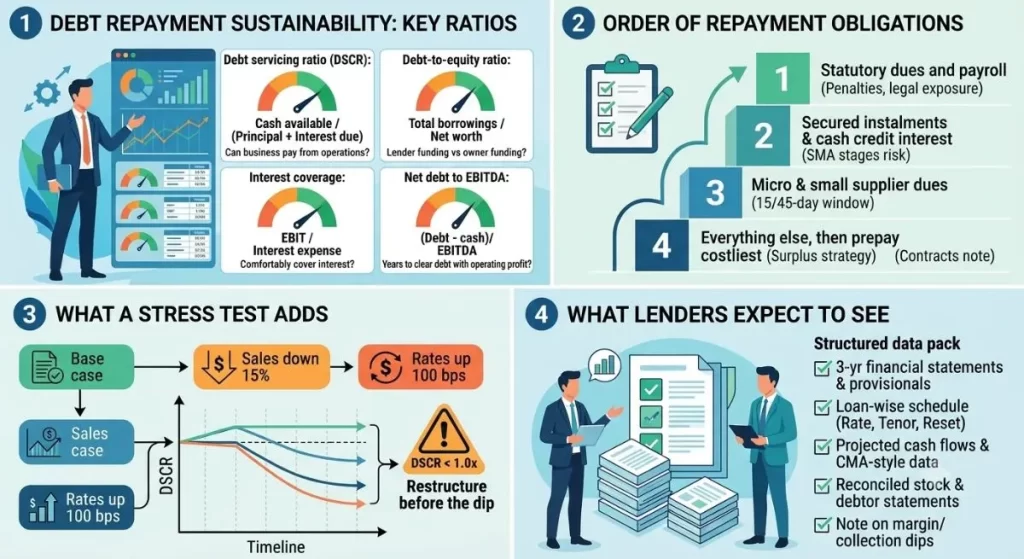
Which Ratios Show Whether Your Debt Is Sustainable?
Ratio | How to work it out | The question it answers |
Debt servicing ratio (DSCR) | Cash available for debt service ÷ (principal + interest due) | Can the business pay its instalments from its own operations? |
Debt-to-equity ratio | Total borrowings ÷ net worth | How much of the business is funded by lenders rather than owners? |
Interest coverage | EBIT ÷ interest expense | How comfortably do profits cover the interest bill? |
Net debt to EBITDA | (Debt − cash) ÷ EBITDA | How many years of operating profit would it take to clear the debt? |
In What Order Should Obligations Be Paid?
- Statutory dues and payroll, because delays carry penalties and legal exposure.
- Secured instalments and cash credit interest, because missed dues push the account into SMA stages.
- Micro and small supplier dues within the 15 or 45-day window.
- Everything else, then prepayment of the costliest loan from surplus.
Contracts can change this sequence, so the virtual CFO documents the logic for lenders.
What Does a Stress Test Add?
Run three cases: base, sales down 15%, and rates up 100 bps. If the DSCR drops below 1.0x in the downside case, restructure before the dip arrives. This is financial risk management in practice.
A virtual CFO can help you assess how these ratios apply to your loan book. You may wish to discuss your situation with the MSNA team.
What Do Lenders Expect to See?
Banks and NBFCs usually ask for a consistent evidence set. A virtual CFO keeps it current so a request never becomes a scramble:
- Three years of financial statements and the latest provisional numbers
- A loan-wise schedule showing outstanding, rate, tenor and next reset
- Projected cash flows and CMA-style data where the bank requires it
- Stock and debtor statements that reconcile with the books
- A short note explaining any dip in margins or collections
How Does a Virtual CFO for Debt Management Use Cash Flow Management to Keep Debt Manageable?
Profit does not repay loans; cash does. A rolling 13-week cash flow forecasting model shows the exact weeks when collections and instalments collide. Disciplined cash flow management then moves those dates apart. A short weekly review works best: compare forecast with actuals, note the variance, and adjust the next four weeks. Over a quarter, the variance trend shows whether the plan or the assumptions need correcting.
Where Does Working Capital Management Release Cash?
Receivables
Track debtor days and ageing weekly. MSNA’s note on how a virtual CFO improves accounts receivable shows how faster collections reduce reliance on overdraft.
Inventory
Slow-moving stock is borrowed money sitting in a warehouse. Sound working capital management uses reorder points and ageing reports to free it.
Payables
Align supplier payments with statutory windows rather than stretching them. Match long-life assets with term debt, a point covered in capex planning with a virtual CFO.
Expert insight: “Lenders rarely lose confidence because of one tight quarter. They lose confidence when management cannot explain it. A debt register, a rolling forecast and an early conversation help more than a late plea.” — Naveen S N, Partner – Risk Advisory, MSNA & Associates LLP
How Does a Virtual CFO for Debt Management Support Interest Cost Optimisation?
Debt management for businesses is a cost exercise as much as a repayment exercise.
Lever | How it helps | Check first |
Spread renegotiation | Lower mark-up over the benchmark as your profile improves | Current spread against fresh quotes |
Refinancing | Moves high-cost debt to a cheaper lender | Processing fees and new security |
Prepayment from surplus | Cuts interest on the costliest loan | Prepayment terms in the agreement |
Limit right-sizing | Removes charges on unused limits | Actual utilisation over 12 months |
On floating-rate loans to micro and small enterprises sanctioned or renewed on or after 1 January 2026, RBI’s directions bar prepayment charges. Exemptions and tiers exist, so read the key facts statement first.
When Should a Virtual CFO for Debt Management Recommend Business Debt Restructuring?
Banks classify early stress as Special Mention Accounts under the RBI’s stressed-asset directions. For term loans, the stages follow days overdue.
Stage | Days overdue | Signal |
SMA-0 | Up to 30 | Early stress is recorded |
SMA-1 | 31–60 | Lender engagement usually begins |
SMA-2 | 61–90 | Last stage before NPA |
NPA | Beyond 90 | Recovery routes open |
For MSMEs with aggregate lender exposure up to ₹25 crore, the MSME revival and rehabilitation framework favours early restructuring over enforcement.
Which Loan Restructuring Options Exist?
Option | What changes | When it makes sense |
Longer tenor | The loan is spread over more years, so each instalment is smaller | The business earns enough, but the cash arrives later than the instalments fall due |
Moratorium | You pause principal repayments for a set period | A one-off disruption, such as a delayed order or a bad season, that you expect to pass |
Lower spread | The lender reduces the mark-up over the benchmark rate | Your numbers have improved since the loan was sanctioned |
Consolidation | Several loans are merged into one with a single instalment | You are juggling many small loans, and some of them are expensive |
One-time settlement | You close the loan by paying an agreed amount. If it is paid over more than three months, RBI treats it as restructuring. Banks also apply a cooling period of at least 12 months before lending to you again | The business is unlikely to recover, so this is a last resort |
The lender makes the final call, and it will look at whether your business can realistically repay. A good proposal uses the same forecast and ratios you built earlier, so the numbers tell one consistent story.
When this does not apply: The MSME revival and rehabilitation framework covers aggregate lender exposure up to ₹25 crore. Restructuring terms vary by lender, and the lender makes the final decision.
What Might This Look Like? (Hypothetical Example)
A manufacturer has ₹3 crore of term debt. It can put ₹80 lakh a year towards repayment, and its instalments plus interest also come to ₹80 lakh, so the DSCR is 1.0x. Refinancing over ten years at a lower rate would bring that outgo down to ₹60 lakh and the DSCR up to 1.33x. The cost is more interest overall, since the loan runs for longer.
How Does a Virtual CFO for Debt Management Adapt to Different Sectors?
The same ratio can mean different things in different businesses, so the virtual CFO tunes the plan to your model.
Sector | Typical debt pressure | Where the virtual CFO focuses |
Manufacturing | Term loans plus heavy stock funding | Matching instalments to production cycles |
Trading and distribution | Long debtor and creditor cycles | Collections discipline and limit utilisation |
Services and IT | Few assets, unsecured loans, payroll-heavy costs | Runway and unsecured-loan servicing; see when an IT company needs a virtual CFO |
Startups | Venture debt or convertibles alongside equity | Covenant tracking; see Series A readiness |
What Three Questions Should Precede Every Borrowing Decision?
Debt problems often begin when a loan that was never tested against the business’s own calendar. Before signing, ask:
- What does it cost after fees, not just on paper? Processing charges, commitment fees and insurance change the real rate.
- Does the cash arrive before the instalment falls due? A profitable order that pays in 90 days cannot service a 30-day obligation.
- What is the exit? Know the prepayment terms, security released on closure and the guarantee obligations that remain.
Debt is a tool, not a verdict. Unmonitored debt is the real risk, and a slipping collection cycle usually warns of it before interest costs do.
Which Mistakes Make Debt Harder to Manage?
- Treating refinancing as relief without comparing total interest over the new tenor.
- Repaying the largest loan first instead of the costliest.
- Signing personal guarantees without modelling the downside.
- Skipping documentation, since lenders weigh evidence over assurances.
What Does a 90-Day Virtual CFO for Debt Management Roadmap Look Like?
A structured debt repayment planning cycle fits into one quarter.
Days | Focus | Output |
1–30 | Reconcile lender statements, start the 13-week forecast | Baseline ratios |
31–60 | Rank loans by cost, collect refinance quotes, align supplier and statutory calendars | Repayment plan |
61–90 | Open lender discussions if DSCR is below your lender’s benchmark (often around 1.25x), set a quarterly review | Board-ready debt policy |
How Do You Know It Is Time to Hire a Virtual CFO for Debt Management?
- Instalments are regularly paid from overdraft or fresh borrowing.
- Cash credit utilisation sits near the limit most months.
- Lenders ask for projections you cannot produce quickly.
- Banks, NBFCs and personal loans are not viewed together.
- Nobody tracks rate reset dates.
Accountant | Virtual CFO | Full-time CFO | |
Focus | Records and compliance | Planning, debt, cash, lender readiness | Same, embedded daily |
Engagement | Monthly | Part-time or retainer | Salaried |
Typical fit | Early stage | Growing MSMEs and startups | Larger, complex groups |
To compare engagement models, see MSNA’s comparison of interim and permanent CFO firms and its financial decision-making service.
How Does a Virtual CFO for Debt Management Plan For Interest Rate Cycles?
Debt is easier to manage when it is visible, forecast and reviewed. A virtual CFO for debt management brings that routine to financial planning for SMEs without a full-time salary. To see how it applies to your loan book, you can reach the MSNA team or read about the partners behind this guidance.
This article is for general information and does not constitute professional advice. Please consult a qualified professional for your situation.
Strengthen Your Audit Practice with Ethical Excellence
Frequently Asked Questions About Virtual CFO for Debt Management
Can a virtual CFO negotiate with my bank?
The virtual CFO prepares projections, ratio analysis and the proposal, and can join discussions when management authorises it. The sanction decision remains with the lender.
Does business debt restructuring hurt my credit profile?
Restructured accounts are typically flagged in credit records, which may affect future terms. The assessment weighs that against the consequences of continued default.
Can my virtual CFO also be my statutory auditor?
A virtual CFO advises management; a statutory auditor gives an independent opinion. Section 144 of the Companies Act, 2013 bars a statutory auditor from providing certain services to the company it audits, so the roles are normally separated. MSNA offers internal audit as a distinct service.
Related
Discover more from MSNA & Associates LLP
Subscribe to get the latest posts sent to your email.