
Why does your P&L show a healthy profit while your bank balance tells a completely different story? If you’ve ever approved a big order, delivered it on time, and then spent the next four months chasing the payment for it, you already know the answer sits in one place: accounts receivable.
A virtual CFO for accounts receivable improves collection performance by rebuilding the credit policy, aging analysis, and follow-up cadence around real customer risk data, then tracking Days Sales Outstanding (DSO) and cash conversion through a monthly dashboard instead of a year-end guess.
For an Indian business, that also means building the collections process around the Micro, Small and Medium Enterprises Development (MSMED) Act’s 45-day payment rule and RBI-linked penal interest, not just internal credit terms.
This article explains what “AR performance” actually means, why Indian businesses are losing more to slow receivables in 2026 than in previous years, what a virtual CFO for accounts receivable changes operationally, and how to know when it’s time to bring one in.
Key Takeaways on Virtual CFO for Accounts Receivable
- A virtual CFO for accounts receivable treats AR as a managed asset, not an admin task. It is tracked through DSO, aging buckets, and a receivables turnover ratio, reviewed monthly like any other financial metric.
- Indian MSMEs are sitting on a large, worsening receivables problem: an industry study puts the average overdue AR at over ₹3.8 crore per firm, with real payment cycles running to roughly 73 days against a 45-day statutory norm.
- Delayed receivables carry a real, calculable financing cost, not just a “cash flow inconvenience”. A DSO slip from 45 to 120 days can tie up crores in working capital and quietly erase a meaningful share of EBITDA.
- A virtual CFO’s core toolkit for accounts receivable management is a credit policy, an AR aging schedule, a structured collections cadence, and a monthly AR dashboard.
- India’s MSMED Act gives suppliers real legal leverage (Section 15 payment timelines, Section 16 compounding penal interest), and a virtual CFO builds that leverage into the credit and collections process rather than treating it as a legal afterthought.
What Does "Accounts Receivable Performance" Mean?
Accounts receivable performance is how efficiently a business converts a completed sale into cash in the bank, not how large the sale looked on the invoice.
Three numbers do most of the work here:
- Days Sales Outstanding (DSO): a running average of how many days pass between a sale going out and the payment actually landing in the bank.
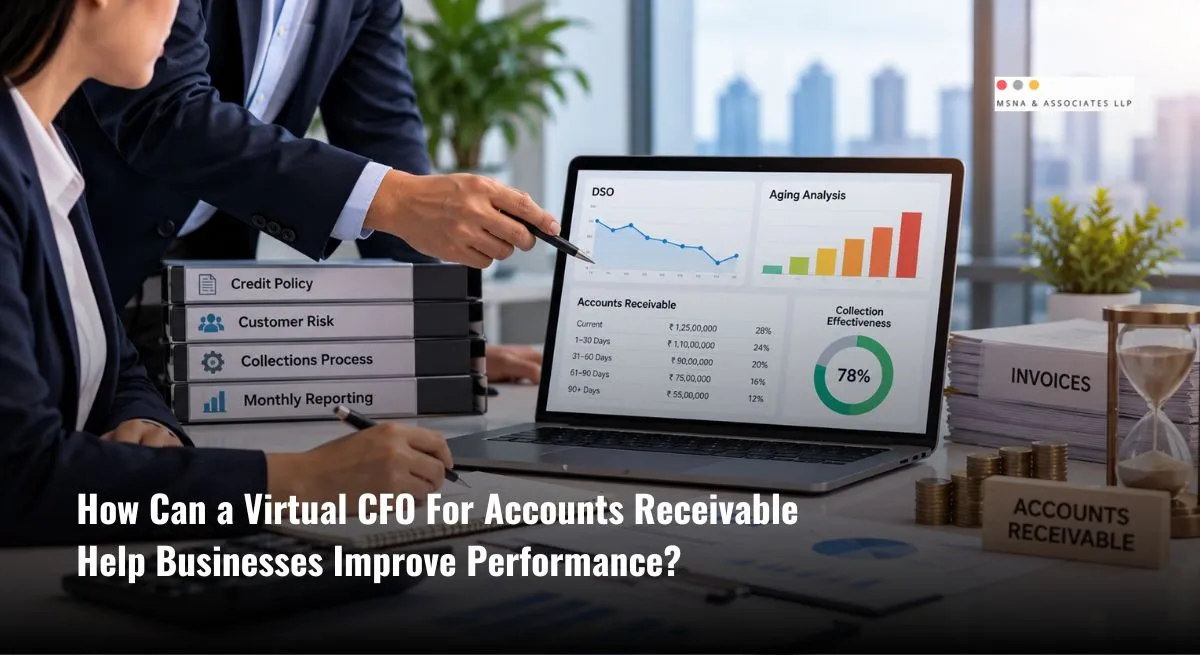
- Accounts receivable aging: invoices grouped into buckets – current, 30, 60, 90, and 90-plus days overdue – showing where cash is actually stuck.
- Receivables turnover ratio: how many times a year a business collects its average AR balance. A rising ratio means collections are getting faster relative to sales.
Most founder-run businesses can quote their revenue for the month without hesitation. Very few can say, without checking, what their current DSO is or how much of their AR balance has crossed 90 days. That gap between “revenue visibility” and “collection visibility” is exactly what a virtual CFO for accounts receivable is brought in to close.
Why Is Accounts Receivable a Growing Problem for Indian Businesses in 2026?
Receivables have become a structural drag on Indian SME cash flow, not just a seasonal one.
Data Point (2026) | Figure | What It Means for AR Performance |
Average overdue receivables per MSME | ₹3.83 crore pending beyond 360 days | A large share of “sales” never converts to usable cash |
National average invoice settlement time | 73 days | Nearly 1.6x the statutory 45-day MSME payment norm |
Total delayed MSME payments (Union Economic Survey) | ₹8.1 lakh crore locked up | Cash that businesses could be putting toward expansion or paying down loans instead |
Global average DSO (Allianz Trade, 2025) | 56.5 days, up 0.3 days YoY | Global payment cycles are lengthening, not shortening |
Historical micro-enterprise DSO (Prowess-based study) | 176 days | Smaller firms absorb the longest delays, since they have the least leverage |
Sources: Recordent’s Indian SME Receivables Report 2026; India’s Union Economic Survey (January 2026); Allianz Trade Global DSO & Working Capital Report 2026; and academic research on MSME payment delays.
Two forces are pushing this further in 2026: rising input, freight, and compliance costs are squeezing already-thin SME margins, and large buyers are under fresh tax-linked pressure on how they treat MSME dues, which is changing (but not eliminating) payment behaviour.
Neither trend fixes AR performance on its own. That still comes down to how disciplined a business is about its own credit and collections process.
The Hidden Cost of Slow Receivables: What Delayed AR Costs Your Business
This is the part most businesses underestimate. A slower DSO isn’t just an inconvenience; it’s a financing cost with a real rupee value.
Academic research on India’s “invisible working-capital tax” gives a useful illustration. For a business with ₹10 crore in annual credit sales and a 10% EBITDA margin, extending actual DSO from 45 to 120 days, at a 12% marginal cost of financing, ties up approximately ₹2.05 crore of additional working capital and creates an annual financing drag of about ₹24.66 lakh, equal to roughly a quarter of that business’s entire EBITDA.
Metric | At 45-Day DSO | At 120-Day DSO |
Additional working capital tied up | Baseline | ~₹2.05 crore |
Annual financing drag (at 12% cost of capital) | Minimal | ~₹24.66 lakh |
Drag as a share of EBITDA (illustrative firm) | — | ~24.7% |
That drag doesn’t show up as a separate line item on the P&L. It shows up as a business that “looks profitable” on paper while quietly running a credit line to cover payroll. A virtual CFO for accounts receivable makes this cost visible before it forces a working-capital crisis, by pricing the AR balance the same way a lender would.
How Does a Virtual CFO Improve Accounts Receivable Performance?
A virtual CFO treats accounts receivable management as a structured, repeatable process, not a once-a-quarter cleanup.
1. Fix the Credit Policy
Right now, everyone gets the same 30-day terms regardless of how they actually pay. That doesn’t make sense. New accounts and riskier customers should get shorter terms, billing in advance, or part-payment upfront. Save the generous terms for people who’ve actually earned them.
2. Get a Real Aging Schedule Going
Instead of vaguely knowing “some invoices are overdue,” break it down properly: 0-30, 31-60, 61-90, 90+ days, and look at it every month, not once a year. That’s the difference between a vague worry and knowing exactly which 14 invoices worth ₹38 lakh have gone past 90 days and need someone to escalate them today.
3. Put an Actual Collections Process in Place
Stop chasing payments whenever someone remembers to. Set a fixed rhythm instead: a reminder just before the due date, a phone call at 7 days overdue, a formal notice at 30 days. And where the supplier is an MSME and the buyer qualifies as an MSME debtor under the MSMED Act, don’t forget the Section 16 interest demand. That’s leverage a lot of companies leave on the table.
4. Customer Credit Risk Scoring
Rank customers by payment history and exposure, not just order size. A large customer who consistently pays at 90 days can be a bigger cash-flow risk than three smaller ones who pay on time.
5. Monthly AR Dashboard and MIS
Feed DSO, aging, and collection-effectiveness data into the same monthly MIS reporting cycle used for margin and budget tracking, so receivables get the same management attention as revenue does.
What Does a Virtual CFO's AR Dashboard Actually Track?
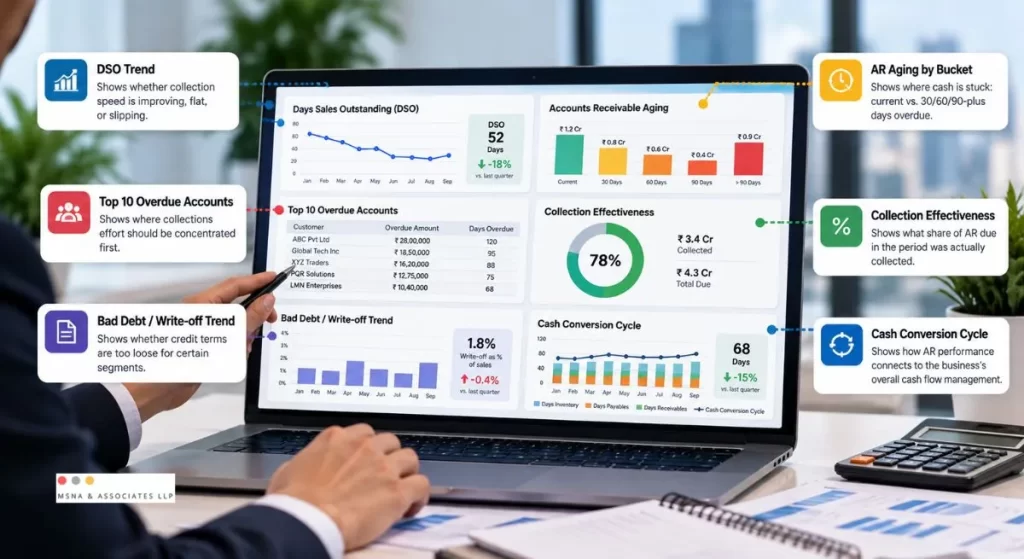
A monthly AR dashboard turns receivables into a habit management actually reviews, instead of a year-end surprise.
Dashboard Component | What It Shows |
DSO trend (month-on-month) | Whether collection speed is improving, flat, or slipping |
AR aging by bucket | Where cash is stuck: current vs. 30/60/90-plus days overdue |
Top 10 overdue accounts by value | Where collections effort should be concentrated first |
Collection effectiveness index | What share of AR due in the period was actually collected |
Bad debt/write-off trend | Whether credit terms are too loose for certain segments |
Cash conversion cycle | How AR performance connects to the business’s overall cash flow management |
For a business without a finance manager, this is often the first structured view it has ever had of where its own cash is sitting.
How Do India's MSME Payment Rules Factor Into AR Strategy?
Most collections processes never touch India’s biggest source of leverage: the MSMED Act, 2006.
- Section 15 lays out the deadline: 45 days from acceptance of goods or services if it’s in writing, or just 15 days if there’s no written agreement at all. This is the “45-day rule” you’ll see referenced everywhere in 2026 coverage of delayed MSME payments.
- Section 16 makes penal interest automatic and non-waivable once a buyer misses that deadline: compound interest at three times the prevailing RBI bank rate, with monthly rests. Since this rate moves with RBI policy, it’s worth recalculating at the time of the claim, but illustrative computations using recent RBI bank rate levels put it in the high-teens percentage range per annum.
- Section 23 disallows the buyer from claiming that interest as a deductible business expense under the Income Tax Act, which is a meaningful disincentive for large buyers who sit on MSME dues.
- The Limitation Act, 1963 generally allows three years from accrual to pursue a claim, and a written acknowledgement of debt (including entries in a buyer’s own audited financials or their half-yearly MSME Form 1 filing) can extend that window.
A virtual CFO’s job here isn’t to turn every overdue invoice into a legal dispute. It’s to make sure the business is registered on Udyam, its invoices reference the applicable payment terms clearly, and Section 16 interest is calculated and demanded as standard collections practice. So the statutory protection isn’t left unused simply because nobody in the business tracks it.
For businesses that need cash before the 45-day window closes rather than after, invoice discounting through the RBI-backed TReDS platforms is worth evaluating alongside stronger collections; it converts approved receivables into near-immediate cash flow management support instead of waiting out the full credit cycle.
A Virtual CFO's Perspective on Accounts Receivable Performance
Most AR problems aren’t collections problems. They’re upstream decisions (vague credit terms, no aging review, and no one person accountable for the receivables number) that only show up as a cash crunch three months later. The single highest-leverage fix is usually the simplest one: reviewing the same aging report on the same day every month, so a slipping account gets caught at 35 days overdue instead of 135.
Businesses that combine a tighter internal collections cadence with their MSMED Act leverage see the fastest DSO improvement, because they’re applying pressure from two directions at once, i.e., operational follow-up and statutory interest exposure rather than relying on either alone.
What Does Good vs. Poor AR Performance Look Like?
Poor AR Performance | Strong AR Performance | |
Credit terms | Same terms for every customer, regardless of risk | Segmented by customer risk profile |
Aging review | Checked only when cash feels tight | Reviewed monthly as standing MIS |
Collections process | Ad hoc calls and emails | Defined cadence with escalation triggers |
MSMED Act leverage | Rarely used | Built into standard follow-up at 45+ days overdue |
Visibility | One blended AR number on the balance sheet | DSO, aging, and collection-effectiveness tracked monthly |
Financing impact | Discovered only when a credit line is needed | Quantified and monitored as a cost of capital |
When Should a Business Bring In a Virtual CFO for Accounts Receivable?
This becomes worth doing once a business has outgrown ad hoc, founder-led follow-up but doesn’t yet need a full-time finance executive.
- DSO has been rising for two or more consecutive quarters without a clear reason why
- A growing share of AR is crossing 90 days, and nobody owns escalation
- Revenue is growing, but the bank balance isn’t moving in line with it
- The business is relying on a credit line or overdraft to cover routine payroll or vendor payments
- Customer concentration means one or two large, slow-paying accounts can disrupt the entire cash position
For a broader view of how this fits into overall financial oversight, see how a virtual CFO improves gross margin and profit visibility, and how DSO and collections metrics fit into the wider set of financial KPIs virtual CFOs track for Indian businesses.
What Should a Business Do With This AR Visibility?
Accounts receivable performance works best as a recurring discipline: a clear credit policy, a monthly aging review, a defined collections cadence, and MSMED Act leverage used as standard practice rather than a last resort.
MSNA & Associates works with Indian businesses, and with Indian subsidiaries of US and UAE parent companies, to build exactly this kind of receivables discipline through structured AR aging analysis, monthly MIS reporting, and collections processes suited to each business’s actual customer mix. This sits alongside our broader financial decision-making support, since AR strategy rarely stands apart from budgeting and pricing decisions. Consulting MSNA’s Virtual CFO services team can help assess where your current AR process is leaking cash and what a practical next step looks like, particularly if working capital management is already a strain across your receivables and payables cycle.
Strengthen Your Accounts Receivable Process
Frequently Asked Questions About Virtual CFO for Accounts Receivable
What is a good DSO for an Indian SME?
It depends on the sector and credit terms offered, but most well-run Indian SMEs on Net 30–45 terms aim to keep actual DSO within 15–20 days of their stated credit period. A DSO consistently running 30-plus days beyond stated terms usually signals a collections process problem, not just slow-paying customers.
Can a virtual CFO actually collect overdue invoices?
A virtual CFO typically designs and oversees the credit policy, aging review, and escalation process, including MSMED Act interest calculations; actual day-to-day collections calls are usually handled by the business’s own accounts team or a dedicated collections resource, with the virtual CFO tracking effectiveness through the monthly dashboard.
Does the MSME 45-day payment rule apply to every business?
It applies where the supplier is registered under the MSMED Act (via Udyam) and is supplying goods or services to a buyer. It does not automatically apply to every commercial contract, which is why Udyam registration and clear invoice terms both matter for using this protection.
How is a virtual CFO's AR work different from a bookkeeper chasing payments?
A bookkeeper typically records invoices and follows up individually. A virtual CFO for accounts receivable builds the credit policy, risk segmentation, aging analysis, and monthly reporting structure around those invoices, so collections becomes a managed process rather than a series of one-off follow-ups.
How often should AR aging be reviewed?
Monthly, at minimum, for any business with more than a handful of active customer accounts. Weekly review is common once DSO or overdue concentration becomes a live concern.
Related
Discover more from MSNA & Associates LLP
Subscribe to get the latest posts sent to your email.