
Your revenue grew 35% this year. So why did your operating margin barely move?
That’s the question most founders don’t ask until a board member or an investor asks it for them. Growth hides cost problems. It doesn’t fix them. Fixed costs like rent, salaries, subscriptions, and long-term vendor contracts pile up quietly while the top line keeps climbing, until one flat quarter exposes exactly how thin the margin really is.
This is where a Virtual CFO for cost restructuring earns its place on the leadership team. Not to freeze budgets or cut headcount across the board, but to work out which fixed costs are actually funding growth and which ones are just sitting there.
The hard part isn’t cutting costs; it’s cutting the right ones, without slowing the business down in the process. For SME owners, startup founders, and CEOs scaling across India, US, or UAE markets, this is the difference between a cost restructuring strategy for growing companies that protects momentum and one that quietly stalls it.
In this blog, we’ll break down what cost restructuring actually means, the framework a Virtual CFO uses to reshape fixed costs, and where most in-house cost-cutting drives go wrong.
Key Takeaways
- Virtual CFO for cost restructuring is deliberate and outcome-based; cost cutting is reactive and often erodes growth-linked spend by mistake.
- Sort fixed costs into Growth Engine, Operating Floor, and Legacy Drift before touching anything (only the last two are fair game)
- Check the Growth-Cost Ratio (revenue growth vs. fixed cost growth) every quarter to catch margin erosion before it turns structural.
- Every proposed cut should pass a cost-benefit analysis against the next 12–18 months of the growth plan, not just this quarter’s numbers.
- Zero-based budgeting, rebuilding budgets from zero instead of adjusting last year’s numbers, catches drift that incremental budgeting misses.
- Watch what happens to cash flow, not just the P&L. A margin that looks better on paper doesn’t always mean more money in the bank that month.
- Real estate and SaaS have the clearest sourced benchmarks for recoverable fixed cost: CBRE puts office utilization at 53% against a 65% target, and Zylo puts unused SaaS licenses at 36%.
What Is Cost Restructuring, and Why Fixed Costs Are the Real Target?
Cost restructuring is not the same as cost cutting.
Cost cutting is reactive. Something feels expensive, so it gets cut, often without checking what that cost was actually funding.
Cost restructuring is deliberate. It examines every fixed cost against what it produces, then reshapes the cost base so spending scales with revenue instead of sitting fixed regardless of how the business performs.
Why Fixed Costs Are the Real Target
Fixed costs don’t move with revenue. Rent, core team salaries, software licenses, and long-term vendor retainers get paid whether the month was strong or slow.
- When a growing company’s fixed cost base grows faster than its revenue, margin erosion stops being a one-off blip and becomes structural
- Under Section 134(5) of the Companies Act, 2013, the boards of listed companies (and certain larger unlisted public companies) must confirm adequate internal financial controls in the directors’ responsibility statement, which is one reason cost discipline is increasingly a board-level conversation, not just a finance-team task.
- Gartner’s 2026 CFO priorities research shows fixed cost optimization sitting near the top of nearly every finance leader’s agenda this year
While this framework applies globally, specific board-reporting obligations (such as Section 134(5) in India) vary by jurisdiction. Clients outside India should confirm equivalent local requirements.
Why Most Cost-Cutting Efforts Slow Down Growth Instead of Protecting It?
This is where most internal cost-cutting drives go wrong: they treat every cost the same way.
A founder under pressure to protect margin usually reaches for the easiest lever: headcount, marketing spend, or tools. But some of that spend is what’s actually generating growth.
Cut a customer success role, and churn goes up. Cut ad spend mid-funnel, and next quarter’s pipeline shrinks. The company hits a short-term cost target and creates a longer-term growth problem in the same move.
A Virtual CFO’s job in a cost restructuring engagement isn’t to find the biggest number to cut. It’s to separate costs honestly before touching anything, which is exactly what the framework below is built to do.
The MSNA Cost Restructuring Lens: Three Cost Types, One Ratio
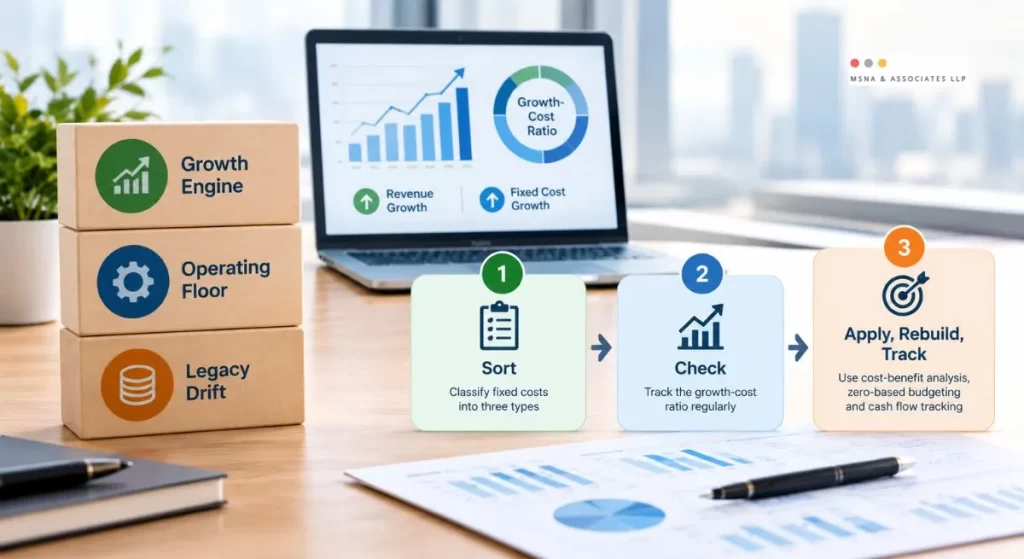
Most cost-cutting guides stop at “classify your costs into buckets.” That’s a good start, but it doesn’t tell you when to act or how much room you actually have. This lens combines both.
Step 1: Sort Every Fixed Cost Into One of Three Types
Growth Engine costs are the ones you’d protect even in a downturn. They’re what actually bring in revenue or keep customers around: sales capacity, customer success, core product infrastructure.
Operating Floor costs keep the business running but don’t expand it, such as compliance, finance operations, and basic infrastructure.
Legacy Drift costs are the ones nobody re-approved this year, like unused software seats, auto-renewed vendor contracts, and office space sized for a headcount that no longer exists. Only Operating Floor and Legacy Drift costs are fair game for reduction.
Step 2: Check the Growth-Cost Ratio Before Acting on Any of It
Take your revenue growth rate over the last four quarters and compare it to your fixed cost growth rate over the same period. If fixed costs are growing faster than revenue, growth is being quietly subsidised by margin, and every quarter that continues makes the eventual correction more painful.
If fixed costs are growing slower than revenue, there’s likely real headroom to invest rather than cut. The P&L shows revenue. The cost-centre breakdown shows fixed cost growth. Most founders look at each on its own and never put them next to each other, so this number just doesn’t get calculated.
Step 3: Apply, Rebuild, and Track
Every cost flagged in Step 1 gets tested with a cost-benefit analysis against the next 12-18 months of the growth plan, not just this quarter’s numbers: if this cost is cut by 20%, does anything in the revenue engine slow down? If no, it’s a genuine reduction opportunity.
From there, the budget gets rebuilt using zero-based budgeting, where every department justifies its costs from zero instead of adjusting last year’s number by a percentage. It’s more work upfront, but it catches the drift that incremental budgeting misses year after year.
Finally, every change is tracked against cash flow impact, not just the P&L, because a restructured cost base that improves accounting margin but doesn’t improve the monthly cash position hasn’t actually solved the problem.
This is a big reason our guide on Virtual CFO for working capital management pairs so closely with cost restructuring work, and it’s the same discipline behind how a Virtual CFO improves EBITDA margins over time.
Common Fixed Cost Levers a Virtual CFO Reviews First, and What the Data Actually Shows
Real estate is usually the first place to look. CBRE’s 2026 Global Workplace & Occupancy Insights report puts global office utilization at 53%, still well short of the 65% target most organizations set, meaning a large share of leased space is paid for but empty most days.
Software and SaaS subscriptions are close behind. Zylo’s 2026 SaaS Management Index found that 36% of purchased licenses sit unused against recommended utilization levels; one of the fastest, lowest-risk places to recover fixed cost.
Vendor and AMC contracts, org structure and role layering, and fixed marketing retainers round out the list. These don’t have one clean industry-wide benchmark the way real estate and SaaS do, so treat any specific percentage you see quoted for them as a commonly cited range from restructuring engagements, not a guaranteed outcome for your business specifically.
A Practical Example: Virtual CFO For Cost Restructuring Without Losing Growth Momentum
Consider a mid-sized IT services company growing revenue at 30% year-on-year, with operating margin stuck at the same level for three straight quarters. (Illustrative composite scenario, not an actual client engagement.)
Running the Growth-Cost Ratio showed fixed costs climbing faster than revenue for two consecutive quarters – the early warning sign. Sorting the cost base surfaced three Legacy Drift items: a real estate footprint sized for a return-to-office plan that never fully materialised, three overlapping project management tools running in parallel across teams, and a vendor AMC contract that hadn’t been renegotiated in four years despite falling market rates.
None of it touched a single Growth Engine cost or customer-facing role. Restructuring these three areas alone freed up enough headroom to fund two additional delivery hires without increasing the overall cost base; the kind of growth-aligned cost cutting that protects the P&L and the pipeline at the same time. It’s a pattern that shows up consistently in manufacturing companies working to cut costs while scaling too: the biggest wins rarely come from touching growth-linked spend.
Cost Restructuring Data: What 2026 Surveys and Research Show
The numbers below aren’t abstract; they’re what’s actually shaping how CFOs are budgeting and cutting right now.
Metric | Data Point | Source |
CFOs ranking cost optimization in top 5 priorities for 2026 | 56% | |
CFOs ranking forecast accuracy improvement in top 5 | 51% | Gartner CFO Priorities Survey |
CFOs ranking capital allocation to growth in top 5 | 47% | Gartner CFO Priorities Survey |
Companies using zero-based budgeting, all industries | 15–20% | Commonly cited in ZBB literature |
Large enterprises now using ZBB | 25–35% | Commonly cited in ZBB literature |
Typical SG&A savings from a well-run ZBB exercise | 10–25% | |
ZBB implementations that under-deliver or get abandoned | 40–60% | Commonly cited in ZBB literature |
Global office utilization vs. 65% target | 53% | CBRE 2026 Global Workplace & Occupancy Insights |
SaaS licenses sitting unused | 36% | Zylo 2026 SaaS Management Index |
These numbers point to one consistent theme: cost restructuring works when it’s structured and governed, and fails quietly when it’s treated as a one-time budget trim.
When Should a Growing Company Bring In a Virtual CFO for Cost Restructuring?
There’s rarely one dramatic trigger. It’s usually a combination of quiet signals like these.
- Margin has stayed flat or dropped for two or more consecutive quarters despite revenue growth
- Fixed costs such as software, real estate, and vendor contracts haven’t been reviewed in over 12 months
- Cost decisions are being made on instinct rather than a cost-benefit analysis
- A fundraise, board review, or acquisition is approaching, and investors will scrutinise operating leverage
- Cash flow feels tighter than the P&L suggests it should
If two or more of these sound familiar, it’s worth looking at how Virtual CFO services in India combine cost restructuring with ongoing financial decision-making support, rather than a one-time cleanup that drifts back within a year. It’s also worth understanding how this differs from bringing in a fractional CFO for a single project versus embedding this as a standing quarterly discipline.
Ready to Reduce Fixed Costs Without Slowing Growth?
MSNA & Associates LLP is an ICAI-registered LLP with 15+ years in practice across India, US, and UAE engagements. Get a structured, data-backed review of your fixed cost base with tailored Virtual CFO services built around the same framework covered in this guide.
Review Your Fixed Cost Structure
Frequently Asked Questions About Virtual CFO For Cost Restructuring
Does reducing fixed costs always slow down growth?
Not if the reduction is targeted. Legacy Drift costs- unreviewed, unused, or outdated- can usually be reduced without touching the growth engine. The risk appears when cuts are applied across the board without separating growth-linked spend first.
How is a Virtual CFO for cost restructuring different from a one-time cost-cutting consultant?
A Virtual CFO stays embedded in ongoing financial planning rather than delivering a single project. The restructured cost base is tracked and governed quarter after quarter, using the same Growth-Cost Ratio check, instead of being reviewed once and left to drift again.
What is zero-based budgeting, and does every business need it?
Zero-based budgeting requires every department to justify its costs from zero each cycle, instead of adjusting the previous year’s budget. It suits companies with fast-changing cost structures or ones that haven’t reviewed fixed costs in a while.
How long does it take to set up a GCC entity in India?
A few weeks, roughly, for the incorporation itself. The MCA’s digital filing process moves faster than people expect. What takes longer is everything after: opening bank accounts, getting registrations done, actually hiring people.
How soon does a cost restructuring exercise show up in cash flow?
Software and vendor tweaks tend to hit within a billing cycle or two. Things like real estate or org changes take longer, usually a couple of quarters before you see the full effect.
Related
Discover more from MSNA & Associates LLP
Subscribe to get the latest posts sent to your email.