


UAE businesses are rethinking where their finance talent comes from.
Hiring a full in-house finance team is expensive. Local talent for specialised roles like CFO-level oversight can be hard to find and costly to retain. This is why more UAE companies are turning to India for Virtual CFO and accounting support.
India’s finance talent market has matured fast. It combines a large skilled workforce, strong technology adoption, and a well-regulated accounting profession. For UAE business leaders, this makes India a practical partner, not just a low-cost option.
This article looks at why India’s finance and accounting ecosystem works for UAE companies. We look at the Indian finance talent market, the Indian accounting skill market behind it, and what a virtual CFO India-UAE partnership looks like in practice.
India's finance talent pool: scale with structure
India’s finance talent pool is large, but its real value for a UAE business lies in how consistently that talent is trained.
India produces one of the largest pools of finance and accounting professionals in the world every year. This includes Chartered Accountants, cost accountants, company secretaries, and finance graduates trained under a structured, exam-based system.
What matters for a UAE business is not just the number of professionals. It is how they are trained. India’s CA curriculum covers financial reporting, audit, taxation, and compliance in depth, with mandatory practical training under a working CA before qualification. This means the person managing your books usually has experience across multiple client environments before joining a dedicated engagement.
For UAE CFOs building a lean finance function, this depth reduces the learning curve. You are directing someone who already understands core finance and accounting practice, not training them from scratch.
There is also a scale advantage that is easy to underestimate. India’s finance education system produces this talent every year, across cities well beyond the traditional metros. A UAE business is not competing for a narrow pool of specialists, but drawing from an ecosystem built to keep producing trained professionals at volume.
This scale also supports continuity. A talent market this deep makes it easier to maintain a stable, experienced team on your account over time, rather than facing constant turnover and re-training. This is really the foundation of the Indian accounting skill market: depth that holds up over a long engagement, not just at the hiring stage.
Why do Indian finance teams integrate so easily with UAE systems?
Technology adoption is what turns a skilled talent pool into a finance team that can actually plug into your business from day one.
A skill market is only as useful as its ability to work inside your existing systems. This is where India’s finance ecosystem has moved quickly.
Indian accounting and outsourcing firms have adopted cloud accounting platforms, automation tools, and reporting dashboards as standard practice, not as an add-on. Professionals here are used to platforms like QuickBooks, Xero, Zoho Books, and NetSuite, along with reconciliation and reporting automation tools.
This matters for a UAE business in a direct way. When your India-based Fractional CFO or accounting team already works inside cloud systems, integration is faster. You are working with professionals for whom cloud-first accounting is the norm, not an adjustment.
Technology adoption also supports something UAE businesses often ask about: visibility.
Real-time dashboards and shared cloud ledgers mean a UAE-based founder or finance head can review numbers from Dubai or Abu Dhabi as easily as if the team sat down the hall. Invoice approvals, reconciliations, and expense reviews move through cloud workflows with clear audit trails, rather than email chains and spreadsheets. It is what keeps a remote finance function from feeling remote.
What makes India's accounting profession reliable enough for UAE oversight?
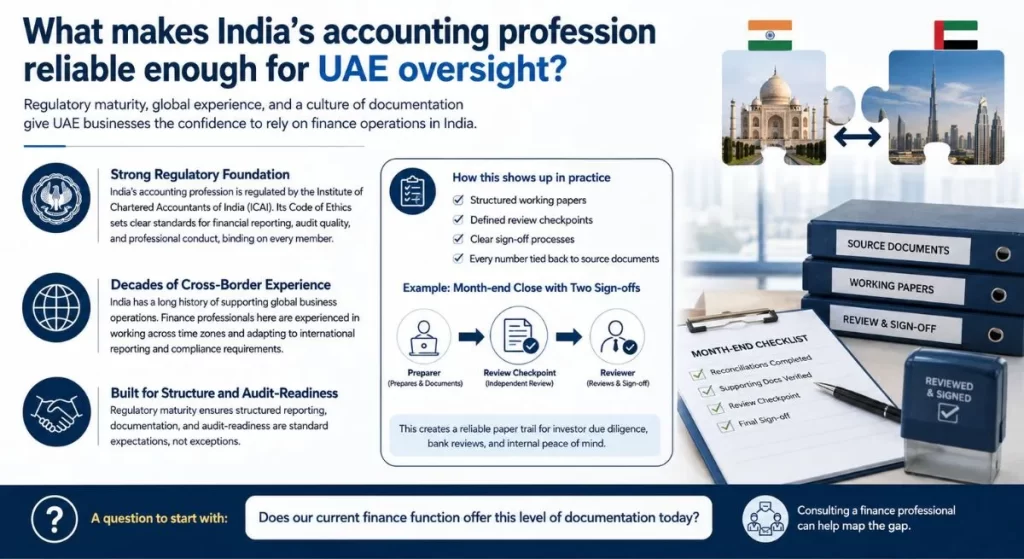
Regulatory maturity is what gives a UAE business the confidence that reporting from India will hold up to scrutiny.
India’s accounting profession operates under a well-established regulatory structure, overseen primarily by the Institute of Chartered Accountants of India (ICAI). Its Code of Ethics sets defined standards for financial reporting, audit quality, and professional conduct, binding on every practising member.
This regulatory maturity matters to a UAE business for a specific reason. An outsourced CFO or accounting partner working under this framework treats structured reporting, documentation, and audit-readiness as a baseline expectation, not an exception.
India also has decades of experience supporting cross-border finance and reporting work, given its long history as a base for global business process operations. Indian finance professionals are generally comfortable working across time zones and reporting formats that differ from India’s own domestic requirements.
For a UAE company, this means less time spent explaining basic reporting expectations, and more time on decisions that actually need a CFO’s judgement. It also shows up in how engagements are documented.
Structured working papers, defined review checkpoints, and clear sign-off processes are standard practice under ICAI’s framework. This gives a UAE business a paper trail it can rely on for investor due diligence, a bank review, or internal peace of mind. In practice, this looks like a month-end close with two sign-offs: one from the preparer, one from a separate reviewer, before numbers move forward. Every reported figure ties back to a source document, not a spreadsheet nobody can trace.
A UAE business weighing this shift can start with one question: does our current finance function offer this level of documentation today? Consulting a finance professional can help map the gap.
The Rise of Global Capability Centres: A Signal Worth Reading
The growth of Global Capability Centres in India shows how far up the finance value chain this market has moved.
One of the clearest signs of India’s finance talent maturity is the growth of Global Capability Centres (GCCs), dedicated finance, technology, and operations hubs that multinational companies set up in India. Many now handle functions as senior as regional or global financial reporting. India hosts 2,117 GCCs today, employing roughly 2.36 million professionals. The ecosystem’s revenue is nearing USD 98.4 billion, up 32% since FY2021, per the Nasscom-Zinnov GCC Landscape Report 2026.
This trend is relevant to a UAE business leader for one reason. Large multinationals do not place high-responsibility finance work in India because it is cheap. They place it there because the talent and infrastructure can support it. The same market that supports GCC-level finance work is the market a UAE SME or growth-stage company can access through a Virtual CFO or accounting outsourcing partner.
A GCC is a significant, long-term investment that only large enterprises can justify. A Virtual CFO engagement gives a much smaller UAE business a way to tap into the same underlying talent and infrastructure, without that upfront cost. It is one more reason India functions as an accounting outsourcing hub for businesses well beyond multinational scale, and reflects how mature the wider India Inc finance ecosystem has become.
The workflow behind accounting outsourcing to India generally follows a defined path, from onboarding through to a steady monthly reporting cycle, rather than an ad hoc arrangement
What this means for a Virtual CFO structure?
These three factors, talent, technology, and regulation, come together most clearly inside a Virtual CFO engagement.
A fractional CFO model works by pairing strategic finance oversight with a supporting accounting team, delivered remotely. India’s talent market makes this model practical in three connected ways.
1. Depth of bench
A Virtual CFO engagement is rarely one person. It usually draws on a layered team, from accounting support to senior review, and India’s finance talent pool makes it realistic to staff that structure without compromising on experience at each level.
2. Process discipline
Indian finance professionals are trained within a compliance-first culture, which shows up in how consistently month-end closes, reconciliations, and reporting packs are delivered, often what a UAE business actually needs from an outsourced finance function.
3. Cost structure without a quality trade-off
UAE businesses often assume that lower-cost finance support in India means diluted expertise. India’s regulatory and educational structure for finance professionals makes this assumption incorrect in most cases. The cost advantage comes from India’s overall cost of operations, not from lower training or oversight standards.
Questions UAE business leaders often ask
These are the questions that come up most often when a UAE business first considers this model.
Is India-based Virtual CFO support suitable for a UAE-regulated business? Yes, when the engagement is structured correctly. An outsourced CFO based in India typically focuses on financial strategy, reporting, budgeting, and management information. UAE-specific filings, including corporate tax returns under Federal Decree-Law No. 47 of 2022 and VAT returns under Federal Decree-Law No. 8 of 2017, are handled separately by your local UAE advisors, in coordination with the India-based team.
How does a UAE company maintain oversight of an India-based finance team? Cloud accounting platforms, shared dashboards, and scheduled reporting cycles are the standard tools for this, giving a UAE-based leadership team visibility without needing to manage day-to-day tasks. MSNA’s outsourced bookkeeping and QuickBooks support is built around this kind of visibility.
What size of UAE business benefits most from this model? Growth-stage companies and SMEs that need CFO-level thinking, but are not yet at a size that justifies a full-time in-house CFO, tend to see the clearest benefit.
How long does onboarding a Virtual CFO from India typically take, and what if it overlaps a filing deadline?
A typical onboarding runs 4 to 6 weeks. The first 1 to 2 weeks cover cloud platform and system access. The next stretch reviews two to three months of past financials to set a baseline. The first full monthly reporting cycle lands around week six. If a UAE audit or VAT deadline falls inside that window, flag it upfront. Build the reporting cadence around it from day one; this mismatch is the most common cause of first-quarter friction.
Does the India-UAE tax treaty affect how a Virtual CFO engagement is structured?
The India-UAE Double Taxation Avoidance Agreement has been in force since 1993. It prevents the same income from being taxed twice. Most Virtual CFO engagements are structured as a straightforward services contract, not a permanent establishment, to stay within that framework; worth confirming with your advisor at setup. On the operational side, India runs about 1.5 hours ahead of the UAE. That leaves a comfortable same-day overlap for reviews and sign-offs, rather than next-day replies.
The Strategic Read For UAE Business Leaders
Taken together, India’s finance ecosystem gives UAE business leaders a partner built for durability, not just a lower invoice.
India’s finance talent market is not a trend. It reflects a structural combination of scale, technology adoption, and regulatory discipline built up over decades. For UAE business leaders evaluating Virtual CFO or accounting outsourcing options, this combination is the real reason India works as a partner, not simply a matter of cost.
Reviewing your current finance function against three factors (talent depth, technology fit, and reporting discipline) is a useful starting point.
One practical step:
Request a sample monthly reporting pack from a prospective Virtual CFO partner. Compare it with what you get today in terms of depth, structure, and audit-readiness. India, as an accounting outsourcing hub and finance talent market, is built on those factors, not on cost alone. Consulting a finance professional can help you assess how this applies to your specific situation.
Evaluate Your India-Based Finance Support Options
Related
Discover more from MSNA & Associates LLP
Subscribe to get the latest posts sent to your email.