

Picture a small marketing agency in the US.
Twelve people, steady clients, and one bookkeeper who’s quietly kept QuickBooks Online running for years. Then that bookkeeper resigns, right before quarter-end close. The owner is left with a stack of unreconciled transactions, a deadline that isn’t moving, and no fast way to replace someone who knew the books that well.
This kind of gap is common. Small businesses often run their entire finance function through one person, and when that person leaves, everything they knew about the books leaves with them.
QuickBooks bookkeeping outsourcing to India means a specialist team takes over your day-to-day books inside your existing QuickBooks Online account, with role-based access, a week-long setup, and a fixed weekly reporting cadence. This is the exact moment most business owners give it a serious look. Most have heard of it vaguely, as something bigger companies do. Few actually know how it works: who gets access to your books, how the handoff happens, and whether an accountant thousands of miles away can really keep things running.
This guide answers all of that in plain terms, and explains why so many US businesses end up choosing India specifically.
What Is QuickBooks Bookkeeping Outsourcing Exactly?
QuickBooks Online outsourcing means handing the day-to-day work inside your QuickBooks Online account to a team based elsewhere, most often in India, instead of an in-house employee or a local firm.
That work includes transaction categorization, bank reconciliation, accounts payable and receivable, and monthly reporting. It’s the same work a local bookkeeper does. Only the location changes.
It isn’t a software change, either. A business doesn’t need to switch platforms or migrate its data. The books stay in QuickBooks Online exactly where they are.
Why So Many US Businesses Choose QuickBooks Bookkeeping Outsourcing in India ?
This isn’t random. Three things line up at once, and none of them work as well on their own.
Factor | What It Actually Means |
A genuinely large talent pool | India’s Institute of Chartered Accountants (ICAI) is one of the largest professional accounting bodies in the world, with over 400,000 qualified members and more than 1 million students in training (per ICAI’s 2025 Student & Member Report). |
QuickBooks created the specialization | QuickBooks holds roughly 80% of the US small business accounting software market across its product line, making it worth Indian firms’ time to build deep expertise around one platform |
A mature offshore relationship | US firms have been sending accounting and tax work to India for over two decades, so the infrastructure and quality processes aren’t a recent experiment |
The depth of QuickBooks expertise coming out of India isn’t an accident. It’s a direct result of scale, on both sides. A huge, credentialed talent pool met a huge, standardized software market, and certification programs and specialist firms built up around that overlap.
A QuickBooks-certified ProAdvisor in India usually isn’t a generalist bookkeeper who happens to know one more tool. It’s a genuine specialization, built on a talent base most other outsourcing destinations don’t have at the same scale.
Most Indian QuickBooks certification professionals hold Intuit’s own certification, the same credential a US-based ProAdvisor holds. Many are also Chartered Accountants with additional training in US GAAP layered on top.
How Much Do QuickBooks Bookkeeping Services in India Cost?
Here’s how the typical pricing breaks down across the different ways a business can engage a provider.
Engagement Type | Typical Cost |
Certified QuickBooks ProAdvisor, hourly | $7.50-$25/hour |
Dedicated bookkeeper, monthly retainer | $650-$2,000/month |
Senior QuickBooks accountant with US GAAP experience | $15-$30/hour |
Replacing a departed bookkeeper locally in the US often means a $50,000 to $65,000 salary search, plus weeks of recruiting time most businesses don’t have during a close. A dedicated outsourced QuickBooks bookkeeper typically runs around $1,400 a month for the same scope of work.
QuickBooks Online Access Setup: Giving Access the Right Way
This is the part that makes business owners nervous before they understand how it actually works. Handing someone access to a company’s entire financial history can feel like a bigger leap than it needs to be.
It doesn’t have to be. A properly structured engagement never uses a shared master login. QuickBooks Online has its own built-in permission system, and a competent provider sets access up specifically for the role being filled.
- Accountant user access. This is QuickBooks’ own role, built exactly for this purpose. It gives a bookkeeper the functional access needed, without full admin control.
- Two-factor authentication. This should be enabled on every account with access. It’s not optional.
- Scoped permissions. Permissions must be granted based on the needs of the role itself. Someone handling accounts payable doesn’t need payroll visibility, for instance.
- Activity logs, reviewed periodically. QuickBooks logs every user action. That gives the business owner a clear, reviewable audit trail at any time.
Set up correctly, this process takes under a day. The owner’s own admin access stays untouched throughout.
How QuickBooks Bookkeeping Outsourcing Workflow Gets Set Up ?
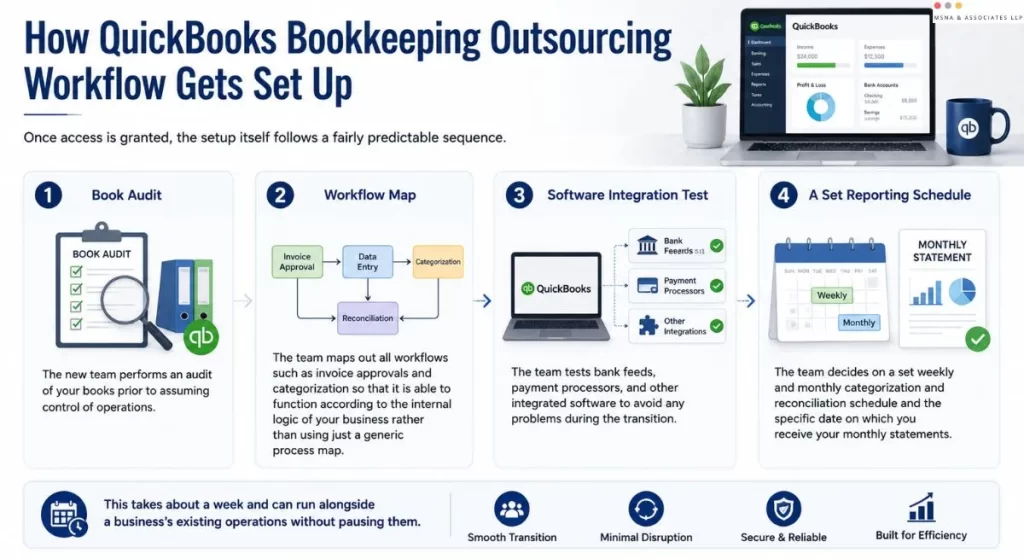
Once access is granted, the setup itself follows a fairly predictable sequence.
1. Book Audit.
The new team performs an audit of your books prior to assuming control of operations.
2. Workflow Map.
The team maps out all workflows such as invoice approvals and categorization so that it is able to function according to the internal logic of your business rather than using just a generic process map.
3. Software Integration Test.
The team tests bank feeds, payment processors, and other integrated software to avoid any problems during the transition.
4. A Set Reporting Schedule.
The team decides on a set weekly and monthly categorization and reconciliation schedule and the specific date on which you receive your monthly statements.
This takes about a week and can run alongside a business’s existing operations without pausing them.
How AI-Driven Bookkeeping Is Changing QuickBooks Bookkeeping Outsourcing ?
AI and workflow automation have changed the value of outsourcing more than cost ever did. Traditional outsourced bookkeeping/accounting services to India for US businesses meant waiting for a monthly report. That model is fading. Firms using AI-assisted bookkeeping now offer something closer to continuous accounting, where the books stay current every day instead of getting reconstructed once a month.
- OCR (optical character recognition) reads receipts, invoices, and bank statements, pulling the data into the right fields without anyone typing it in manually.
- Machine learning classification models look at a transaction and suggest which account it belongs to, based on patterns learned from thousands of prior transactions, getting more accurate over time as a human confirms or corrects them.
- Anomaly detection flags anything that breaks the pattern: a duplicate payment, an unusually large vendor charge, a transaction that doesn’t match historical spending. It runs continuously, not just once a month.
- Predictive cash flow models use historical spending and payment cycles to flag a likely cash shortfall before it happens, not after.
A few numbers show how far this shift has actually gone.
- As of 2026, 73% of accounting firms have implemented some form of AI automation, up sharply from 2022 levels.
- Purpose-built AI tools can cut transaction processing time by 80% or more, and reduce manual data entry by a similar margin, compared to fully manual bookkeeping.
- 68% of US small businesses now use AI tools regularly in their operations, according to Intuit’s own 2025 data, up from 48% the year before.
In practice, this means a business owner can open a real-time dashboard at any time and see cash position, categorised expenses, and outstanding invoices as of that morning. Not a PDF that lands in an inbox three weeks after the month closes.
AI handles the repetitive categorisation and flagging work. The accountant still makes the judgment calls a dashboard can’t.
For a business owner new to this, the distinction matters: AI sorts and flags. A person still decides what those flags actually mean, and still signs off on the numbers.
Is Outsourced Bookkeeping Secure for US CPA Firms? Understanding Data Security
This is usually the first worry that comes up, and it’s a fair one. Financial data is sensitive, and handing it to a team outside the country can feel risky if you don’t know what to look for.
A reputable provider should be able to show, not just claim, real security standards:
- SOC 2 Type II certification. This implies that there has been verification by an independent auditor of the provider’s security controls on a continuous basis and not just one-off.
- ISO 27001 certification. This is the international information security management standard and deals with storage, access, and protection of data.
- Encrypted data transfer and storage, both when data moves and when it sits on a server.
- No local downloads of client data. Work should happen inside QuickBooks itself, not in spreadsheets or files copied onto someone’s personal laptop.
- Compliance with India’s data protection law. Under the Digital Personal Data Protection Act, 2023, any Indian provider processing personal financial data is required to follow defined consent, storage, and breach-notification obligations. A provider should be able to speak to how this applies to a US client’s data, not just point to SOC 2 or ISO 27001.
Ask for these certifications directly before signing anything. A provider that can’t produce them shouldn’t be handling anyone’s books, US-based or not.
How Time Zone Differences Affect Outsourced Bookkeeping for US CPAs?
In practice, this worry is smaller than it sounds. India is roughly 9.5 to 13.5 hours ahead of the continental US, depending on the time zone.
In practice, that gap works in a business’s favor more often than against it. Work submitted at the end of a US business day is often completed by the time that business opens the next morning. Most established providers also build in a few hours of overlap with US working hours specifically for calls, questions, and real-time collaboration, so it’s rarely a case of waiting a full day for a simple answer.
What Changes After Switching to Outsourced Bookkeeping for US CPAs?
Three months into a properly set-up engagement – the kind covered under Virtual CFO and advisory services for businesses that want more than bookkeeping – the pattern is usually consistent. Books get reconciled weekly instead of scrambled together once a month. The dashboard shows real-time cash position instead of a lagging report that used to arrive weeks late. The monthly cost typically comes in below what a local hire’s salary alone would have cost.
What surprises business owners most isn’t the savings. It’s how little actually changes on their end. Same QuickBooks account. Same login for their own use. Same reports they’re used to seeing, just current instead of stale, with someone actually reviewing the books every week instead of once a month.
Common Mistakes Businesses Make When Outsourcing QuickBooks
Most outsourcing problems trace back to one of a handful of avoidable setup mistakes. Watch for these before they cost a close cycle:
- Sharing a single login instead of setting up proper user roles, losing the audit trail QuickBooks’ own permission system is built to provide.
- Skipping the workflow mapping step, then finding the new team’s process doesn’t match how the business actually operates.
- Choosing a provider without confirming QuickBooks ProAdvisor certification specifically, rather than general bookkeeping experience.
- Not agreeing on a reporting cadence upfront, leaving both sides guessing about when updates should arrive.
Final Thoughts on QuickBooks Bookkeeping Outsourcing
The gap between a business struggling to keep QuickBooks current and one with real-time financial visibility isn’t a software problem. It’s a staffing and workflow problem, and it’s solvable without changing a single tool the team already knows.
Consulting a professional for Outsource Accounting / Bookkeeping Services to India for a USA Business can help map out what a properly structured QuickBooks bookkeeping outsourcing setup would actually look like for a specific business.
Streamline Your QuickBooks Bookkeeping
Frequently Asked Questions About Quickbooks Bookkeeping Outsourcing
Is it safe to give an outsourced team access to my QuickBooks account?
Yes, when access is granted through QuickBooks’ own accountant-user permissions with two-factor authentication, not a shared login. This gives you a full activity log of everything done in your books.
Do I need to change accounting software to outsource my bookkeeping to India?
No, Outsourced QuickBooks bookkeeping works inside your existing QuickBooks Online account. Nothing about your software setup needs to change.
How is AI actually used in outsourced QuickBooks bookkeeping?
AI tools handle repetitive work: transaction categorization, receipt matching, and anomaly flagging. That lets the human accountant focus on reconciliation judgment calls and financial analysis, rather than manual data entry.
Related
Discover more from MSNA & Associates LLP
Subscribe to get the latest posts sent to your email.