


Your India entity’s board meeting is in two hours.
Someone on the parent’s finance team asks why last month’s margin dropped four points, and no one in the room has an answer yet. The India accountant is asleep in a different time zone. The numbers came in a format nobody upstream recognises. The real explanation will land in an email sometime tomorrow.
If you’re a US or UAE finance leader who can’t get a straight, timely answer from your India subsidiary, CFO services for foreign companies in India are built to close exactly that gap.
A Virtual CFO sits between the subsidiary’s books and the parent’s boardroom, and reports in a format the parent can actually act on. They build monthly consolidation, track FEMA and transfer pricing compliance, and give the India team and the parent finance function one shared reporting rhythm, without the cost of moving a full-time CFO to India.
What Does Financial Control Mean for a Foreign-Owned India Subsidiary?
Control isn’t just about getting the numbers right.
Financial control means the parent can trust the subsidiary’s numbers at any time, use them for consolidation, and defend them to auditors and regulators without a scramble.
For most US and UAE parents, this control breaks down in three specific ways:
Control Gap | What It Looks Like | Why It Happens |
Reporting lag | MIS reaches the parent 15 to 20 days after month-end | No one owns the monthly close calendar |
Format mismatch | Indian books use Ind AS; the parent expects US GAAP or IFRS | No one maps the accounts to the group’s format |
Compliance blind spots | The parent hears about a FEMA or transfer pricing deadline only after it’s missed | The local accountant handles bookkeeping, not group-level governance |
A Virtual CFO for foreign subsidiary India engagements is built to close all three gaps together, instead of leaving them to the auditor, the accountant, and the company secretary to sort out separately.
What Do CFO Services for Foreign Companies in India Include?
“Virtual CFO” means different things to different providers. For a foreign subsidiary, good virtual CFO work for foreign companies covers four areas, and they need to work together, not sit as separate add-ons:
- Financial reporting and MIS: monthly P&L, balance sheet, and budget-vs-actual reports, in the parent’s own format
- Consolidation support: mapping Ind AS accounts to US GAAP or IFRS so quarterly consolidation isn’t a manual scramble
- Compliance oversight: tracking FEMA, transfer pricing, and ROC filings on one calendar the parent can see
- Strategic finance support: cash flow planning, budgeting, board packs, and help moving profits back to the parent
This combination is what separates a Virtual CFO from a bookkeeping vendor. Once cross-border reporting is involved, accounting and compliance can’t be handled as two separate jobs.
How Do CFO Services for Foreign Companies in India Handle Consolidation?
Consolidation is usually where the most friction shows up between an India subsidiary and its parent. Indian companies report under Ind AS. US parents consolidate under US GAAP. UAE parents use IFRS. These three frameworks don’t always agree. They differ on when to recognise revenue, how to account for leases, and how to set aside provisions.
A Virtual CFO handles this with a repeatable process:
- Dual chart of accounts: mapped from day one to both the Indian format and the parent’s own template
- A fixed close calendar: the same close date every month, so the parent isn’t left waiting on India
- A GAAP-to-GAAP adjustment log: a running record of where the two frameworks differ, and the entry made to fix it
- A board-ready reporting pack: variance notes written for a parent-company audience, not an Indian one
Without this structure, consolidation turns into a scramble every quarter. With it, the India subsidiary becomes something the parent can plan around.
Which Compliance Requirements Put Financial Control for an India Subsidiary at Risk?
This is where most parent companies quietly lose control, because Indian regulators expect the subsidiary itself, not the parent, to track its own deadlines.
Requirement | Governing Law | Typical Deadline | Consequence of Missing It |
FLA Return (Foreign Liabilities and Assets) | FEMA, 1999, via RBI’s FLAIR portal | 15 July each year (extended to 31 July for FY 2025-26) | Late Submission Fee (LSF) of a flat ₹7,500 per return for the FLA filing itself (per RBI circular RBI/2022-23/122). Event-based FEMA filings like FC-GPR or FCTRS carry a different formula – ₹7,500 plus 0.025% of the transaction amount per year of delay. |
31 October of the assessment year (one month before the 30 November tax return deadline for transfer pricing cases) | Penalty of ₹1,00,000 under Section 271BA, plus separate penalties for weak documentation | ||
FC-GPR (share allotment reporting) | Within 30 days of allotting shares to a foreign investor | RBI compounding proceedings, and delays in the next round of capital coming in | |
ROC annual filings (AOC-4, MGT-7) | Within 30 days (AOC-4) and 60 days (MGT-7) of the AGM | Daily late fees, and director disqualification risk if this drags on |
Two things are worth calling out here:
FLA filing depends on the balance sheet position as of 31 March, not on whether the company made a fresh investment that year. So even a dormant subsidiary must file FLA if the parent’s original equity is still sitting on its books. This is confirmed in RBI’s own FAQ on the FLA return.
Section 92E documentation isn’t limited to product sales. It covers any transaction between the parent and the subsidiary, including management fees, royalties, and cost-sharing arrangements.
Can an India Subsidiary Accidentally Create a Tax Presence for the Parent Company?
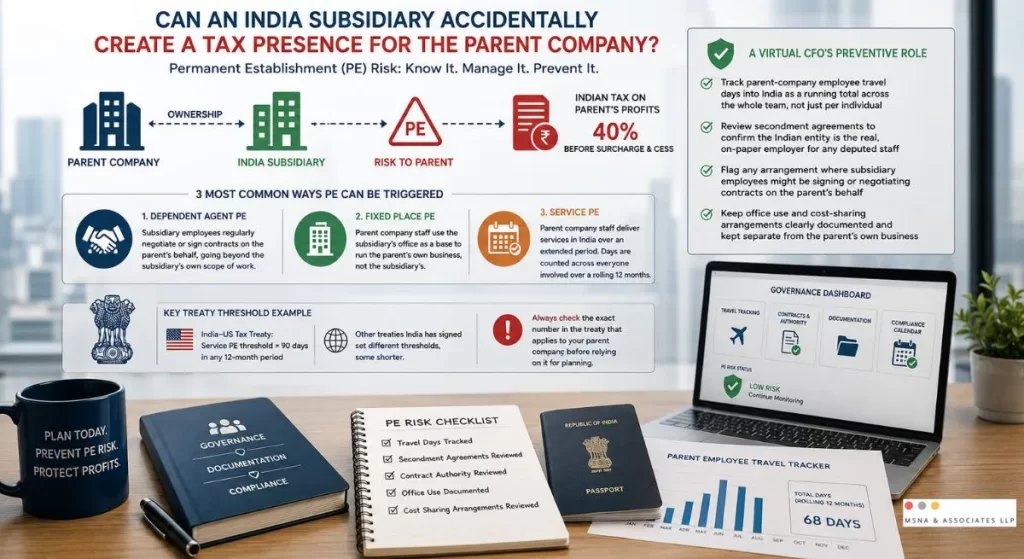
This risk rarely shows up in generic Virtual CFO checklists, but it can expose the parent to Indian tax on income that was never meant to be taxed in India.
Tax treaties treat a subsidiary as its own legal entity, separate from the parent. But under certain conditions, India can still tax the parent directly, as if the parent itself had an office here. This is called a Permanent Establishment, or PE, and it can exist even if the subsidiary itself is fully tax-compliant.
The three most common ways this happens:
- Dependent agent PE: subsidiary employees regularly negotiate or sign contracts on the parent’s behalf, going beyond the subsidiary’s own scope of work
- Fixed place PE: parent company staff use the subsidiary’s office as a base to run the parent’s own business, not the subsidiary’s
- Service PE: parent company staff deliver services in India over an extended period. Regulators add up the days across everyone involved, not just one person, over a rolling 12 months
Getting this wrong is expensive. If a PE is triggered, India taxes that profit at the foreign company rate, 40 percent before surcharge and cess, well above what the subsidiary pays on its own income.
Exactly how many days count as “too many” depends on which country’s tax treaty applies: the India-US treaty sets the service PE threshold at 90 days in any 12-month period, and other treaties India has signed set different thresholds, some shorter. Always check the exact number in the treaty that applies to your parent company before relying on it for planning.
A Virtual CFO’s role here is preventive:
- Track parent-company employee travel days into India as a running total across the whole team, not just per individual
- Review secondment agreements to confirm the Indian entity is the real, on-paper employer for any deputed staff
- Flag any arrangement where subsidiary employees might be signing or negotiating contracts on the parent’s behalf
- Keep office use and cost-sharing arrangements clearly documented and kept separate from the parent’s own business
How Does a Virtual CFO Manage Profit Repatriation Back to the US or UAE Parent?
Financial control only pays off when it turns into cash the parent can actually use and that’s the step most Virtual CFO service descriptions skip entirely.
Dividends from an Indian subsidiary are taxed in the shareholder’s hands, not at the company level, since Dividend Distribution Tax was abolished from FY 2020-21.
The steps below decide how much profit actually reaches the parent, and how fast:
Step | What It Involves | Governing Provision |
Confirm distributable profits | Dividends can only come from current profits or free reserves, after setting aside depreciation | |
Declare the dividend | A board resolution for an interim dividend, or shareholder approval at the AGM for a final one | Companies Act, 2013 |
Withhold tax at source | 20 percent domestic rate plus surcharge and cess, typically reduced to 10-15 percent under most DTAAs | Section 195 read with Section 115A, Income Tax Act |
File remittance paperwork | Form 15CA and 15CB, certified by a chartered accountant, before the bank sends the money out | Income Tax Act compliance |
Remit through an Authorised Dealer bank | Dividends count as a current account transaction under FEMA and don’t need prior RBI approval | FEMA, 1999 |
The lower treaty rate isn’t automatic. The parent needs a Tax Residency Certificate from its home country, and usually a Form 10F declaration too, before the subsidiary can apply the treaty rate instead of the standard 20 percent.
A Virtual CFO’s job in this process is to time the dividend against the subsidiary’s actual reserves, get the TRC (tax residency certificate) and Form 15CA/15CB paperwork ready well before the remittance date, not at the last minute, and flag when a management fee, royalty, or interest payment might suit the parent’s cash needs better than a dividend that year. Getting this wrong doesn’t just delay the transfer. It can mean paying 20 percent instead of a treaty-reduced 10 to 15 percent on every rupee moved.
How Does a Governance Framework Keep Parent and Subsidiary Finance Teams Aligned?

Compliance calendars only solve half the problem. The other half is communication. A working governance framework rests on three habits:
- A fixed reporting cadence: monthly MIS by a set date, quarterly review calls, and a budget cycle aligned to the parent’s own fiscal year
- One named point of accountability: the Virtual CFO, someone the parent’s finance director can call directly with a variance question
- A shared documentation trail: board resolutions, transfer pricing policies, and intercompany reconciliation records kept where the parent’s auditors can reach them during group audit season
When Should a Foreign Parent Consider CFO Services for Its India Subsidiary?
Not every India entity needs a Virtual CFO from day one. The real signal is how complex the reporting relationship has become, not the size of the entity. Consider it if any of these apply:
- The India subsidiary has completed one full financial year and now has FLA, transfer pricing, and ROC obligations all running at once
- The parent’s audit committee has asked questions about the India numbers that the local team couldn’t answer directly
- Intercompany transactions have grown past a simple cost-reimbursement arrangement, and intercompany reconciliation is starting to take real effort each month
- The subsidiary is preparing for a funding round, a profit repatriation, or a group-wide audit on a fixed timeline
Where the entity is genuinely dormant, with very little compliance load, a lighter compliance-only retainer may be enough. Matching the service to how complex the entity actually is means you’re not paying for oversight you don’t need yet.
What Mistakes Do Foreign Parents Commonly Make With Their India Subsidiary's Finance Function?
A few patterns show up again and again across parent companies managing an India entity:
- Treating the local accountant as the CFO: bookkeeping and group-level control are different skills
- Consolidating once a year instead of monthly: annual consolidation catches Ind AS-to-parent-GAAP gaps too late to fix cleanly
- Skipping a documented transfer pricing policy: informal cost allocations are a common trigger for transfer pricing scrutiny
- Treating FEMA compliance as a one-time task: FLA and FC-GPR are recurring filings, tied to the balance sheet position, not to the date of incorporation
- Overlooking PE and repatriation planning: assuming the subsidiary’s tax position is automatically separate from the parent’s, and leaving dividend timing to the last minute
How Should a Foreign Parent Start Building Financial Control Over Its India Entity?
Financial control over an India subsidiary isn’t really about any single filing. It’s about having a predictable, documented view of the entity at all times, one where the parent already knows the answer before the board meeting starts.
A professional with real cross-border reporting experience can help you work out how much oversight your entity needs right now, whether that means setting up a new India entity correctly from the start, or bringing an existing one under tighter control. At MSNA & Associates, this is the kind of gap we help US and UAE parent companies close, through our Virtual CFO services for India subsidiaries.
If you’re still weighing whether your entity needs full Virtual CFO oversight or a lighter compliance retainer, that’s a conversation worth having with an advisor before your next board cycle, not after a missed deadline forces the issue.
Strengthen Financial Control for Your India Subsidiary
Frequently Asked Questions About CFO Services For Foreign Companies In India
Does a US or UAE parent need to be involved in filing the FLA return?
No, The India subsidiary files it directly with the RBI through the FLAIR portal.
Can a Virtual CFO handle transfer pricing documentation for parent-subsidiary transactions?
A Virtual CFO can coordinate the study and maintain Rule 10D documentation, working with a CA to file Form 3CEB. A qualified transfer pricing professional typically certifies the arm’s length analysis itself.
Does having an India subsidiary automatically create a Permanent Establishment for the parent?
No, PE exposure comes only from specific patterns, such as a dependent agent signing contracts for the parent, or parent staff using the subsidiary’s office to run the parent’s own business.
Do dividends from an India subsidiary always get taxed at 20 percent?
Only at the default domestic rate. A valid Tax Residency Certificate can bring the withholding rate down to typically 10 to 15 percent under most DTAAs.
Related
Discover more from MSNA & Associates LLP
Subscribe to get the latest posts sent to your email.