

In FY2025-26, gross FDI reached USD 94.5 bn, yet net FDI was only USD 7.7 bn, because repatriation, disinvestment and outward investment absorbed most of the inflow. Planning for that gap from day one is what keeps an entry reversible.
A sound India entry strategy settles those three decisions in sequence: whether demand is real and permitted under India’s FDI policy, which entry route fits your risk appetite, and which state should host the operation. Taking them in that order, before any incorporation under the Companies Act, 2013 or FEMA reporting, keeps early commitments reversible.
This guide, written for founders, CEOs and strategy heads of global companies, walks through that sequence step by step, starting with the 2026 data that explains the gap.
Key Takeaways
- Assess first, incorporate last. Demand, permission, price, and proof decide the route.
- Weights decide the winner. Entry routes score close together; your priorities break the tie.
- Test before you commit. Use a distributor, EOR or liaison office with go/no-go gates agreed in advance.
- Pick the state by customers, not by the size of the incentive.
- Plan for 12–18 months from first assessment to a stable, compliant operation.
Why Should Your India Entry Strategy Start With 2026 Data?
Any entry plan now has to price in strong inflows and fast outflows at the same time.
Indicator | 2026 reading | Planning implication |
Gross FDI, FY2025-26 | USD 94.5 bn, up 17% from USD 80.6 bn | Policy support and investor appetite are real |
Net FDI, FY2025-26 | USD 7.7 bn, after USD 53.6 bn of repatriation and disinvestment and USD 33.3 bn of outward FDI (RBI data via Outlook Business) | Model dividends, buy-backs and exits before entry |
Greenfield rank | Second globally after the US | Expect competition for talent and land |
Trade pacts in force | UK CETA (15 Jul 2026), Oman CEPA (1 Jun 2026), New Zealand FTA (20 Oct 2026); EU FTA concluded but not in force (Invest India) | Export-linked entry gets cheaper by country of origin |
Founder’s view: “Most boards ask which entity to form. The sharper question is what evidence would make them regret not forming one. Write that down before anything else.” —Naveen, Founder, MSNA
Stage 1: Which Four Filters Should Shape a Market Entry Strategy for India?
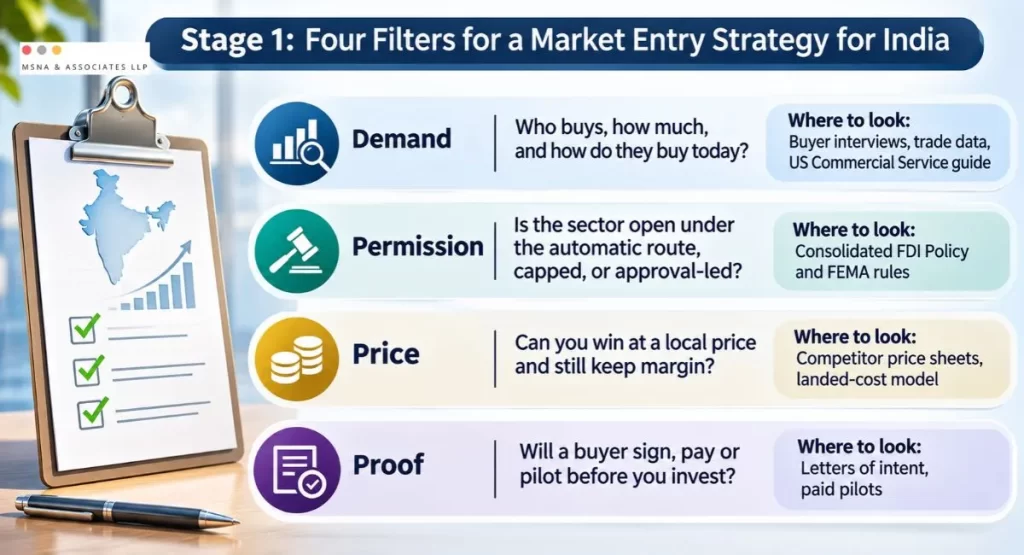
Run every idea through these filters before hiring anyone. A failed filter changes the route, not just the budget.
| Filter | Question | Where to look |
|---|---|---|
| Demand | Who buys, how much, and how do they buy today? | 15–20 buyer interviews, trade data, the US Commercial Service guide |
| Permission | Is the sector open under the automatic route, capped, or approval-led? | Consolidated FDI Policy and FEMA rules |
| Price | Can you win at a local price and still keep margin? | Competitor price sheets, landed-cost model |
| Proof | Will a buyer sign, pay or pay or pilot before you invest? | Letters of intent, paid pilots |
Permission deserves care. Retail, defence, media and telecom carry sector caps or conditions, and even a 100% automatic-route sector may need separate licences.
Investors from countries that share a land border with India need government approval under Press Note 3 (2020). Under the 2026 amendment (Press Note 2 of 2026), non-controlling beneficial ownership of up to 10% from such countries can come through the automatic route, but direct investment from those countries still needs approval.
Pricing localisation decides whether the numbers work
- Indian buyers benchmark against local suppliers, not your home price list.
- Redesign pack sizes, service tiers and credit terms, not only the headline price.
- Model GST and duty together, because both change the landed price.
Product readiness: licences, certification, labelling, IP and import papers
The US Commercial Service guide flags these route-to-market items, and they are where launches stall.
- Licences and approvals: confirm mandatory sector approvals before you promise a launch date.
- Certification and labelling: find out which product standards and labels apply to your category before anything ships.
- Intellectual property: file your trademarks and patents in India first, so no partner sees your designs unprotected.
- Import documentation: align customs classification and valuation with your invoices.
Services and software firms can skip the certification and labelling checks, but IP registration and contract terms still apply.
Worked example: an illustrative market assessment
A European sensor maker (USD 1,800 per unit at home) tests India. All inputs are assumptions for illustration, not a forecast.
| Step | Assumption | Result |
|---|---|---|
| Addressable | 14,000 mid-size plants in three target states | 14,000 plants |
| Reachable | 15% fit certification and distributor reach | 2,100 plants |
| Year-3 share | 4% of reachable | 84 customers |
| Localised price | Local rivals near USD 1,200; stripped variant at USD 1,150 | US$1,150 per unit |
| Year-3 revenue | 84 plants × 40 units × US$1,150 | ≈ US$3.86 m |
| Contribution at 38% | Revenue × 38% | ≈ US$1.47 m |
Verdict: attractive but unproven. Year-3 contribution of about USD 1.47 m covers USD 0.9 m of annual fixed cost only if the 84-customer target is reached. If years 1 and 2 deliver a fraction of that, cumulative break-even moves beyond year 3. A subsidiary commits fixed cost before the evidence exists, so this company should test through a distributor first.
Stage 2: Which India Market Entry Modes Score Highest?
Score each of the India market entry modes from 1 to 5, where 5 is better for you. Default weights are shown in brackets.
Mode | Speed (20%) | Control (25%) | Low capital (15%) | Can sell and contract (20%) | Light compliance (10%) | Reversible (10%) | Score |
Distributor | 5 | 1 | 5 | 4 | 5 | 3 | 3.60 |
Wholly owned subsidiary | 3 | 5 | 2 | 5 | 2 | 2 | 3.55 |
EOR | 5 | 2 | 4 | 2 | 4 | 5 | 3.40 |
Branch office | 2 | 4 | 3 | 4 | 2 | 3 | 3.15 |
Joint venture | 2 | 3 | 3 | 5 | 3 | 1 | 3.00 |
Liaison office | 3 | 2 | 4 | 1 | 3 | 4 | 2.60 |
The top three sit within 0.2 points, which is the real finding. A leadership team that values control over speed will see the subsidiary lead. One that values reversibility will lean towards a distributor or EOR.
What the scores hide?
- Distributor: fast, but price, customer data and warranty sit with the partner. Fix exit terms before launch.
- EOR: lets you hire without an entity, yet it does not remove permanent-establishment exposure if staff routinely conclude contracts in India.
- Liaison office: approved through an authorised dealer bank under FEMA, funded from abroad, and barred from earning revenue. See our note on liaison office registration.
- Branch office: open only to qualifying parents (commentary cites five profitable years and US$100,000 net worth) and taxed as a foreign company. Compare with branch office registration requirements.
- Joint venture: useful where sector caps or government relationships matter. Governance, IP and exit rights need attention, a point the Canadian Trade Commissioner also stresses. Our joint venture advisory covers this.
- Wholly owned subsidiary: most sectors allow 100% under the automatic route. A private limited company needs two directors, one of them resident in India. See wholly owned subsidiary setup.
- Tax rate: the Income-tax Act, 2025 applies from 1 April 2026. Foreign companies and branches pay a 35% base rate plus surcharge and cess , against a concessional 22% (about 25.17% effective) for domestic companies that opt in. A subsidiary’s dividends carry withholding tax, which narrows the gap, so model both routes before you choose.
Other entry routes not scored above
- Acquisition: buying an Indian business gives you licences, plants and customers at once, but it needs deeper due diligence and FEMA-compliant pricing. It suits manufacturing and regulated sectors.
- Franchising and licensing: a low-capital way to test a consumer brand through a local operator. Put brand standards and quality controls in the agreement.
- Project office: fits a foreign company delivering a specific contract in India, not general market entry.
- LLP: usable in eligible sectors, yet most global companies prefer a private limited company.
A second view on your weights and gates can help confirm they fit your sector. MSNA’s India entry team can review your scorecard.
Stage 3: How to Enter the Indian Market With a “Test First, Commit Later” Route?
If you are weighing how to enter the Indian market without betting the balance sheet, stage the commitment. This India market entry strategy turns one large yes/no decision into four small ones.
- Months 0–2, assess: run the four filters and the buyer calls, including at least one in-person visit, since Indian partnerships are usually formalised face to face.
- Months 2–9, test: one distributor, an EOR-hosted team of two or three, or a liaison office for sourcing and brand presence.
- Month 9, gate review: compare evidence against the thresholds below.
- Months 9–15, commit: incorporate, migrate customers and convert the distributor into a channel partner.
| Gate | Evidence required | Illustrative threshold |
|---|---|---|
| Demand | Paid orders, not expressions of interest | 5 paying customers or 2 repeat orders |
| Price | Gross margin after localization | 30% or higher |
| Channel | Partner delivery against plan | 70% of agreed pipeline |
| Compliance | Clean GST, tax and import records | No open notices |
Write the kill criteria in advance. If two of four gates fail, pause instead of extending the test.
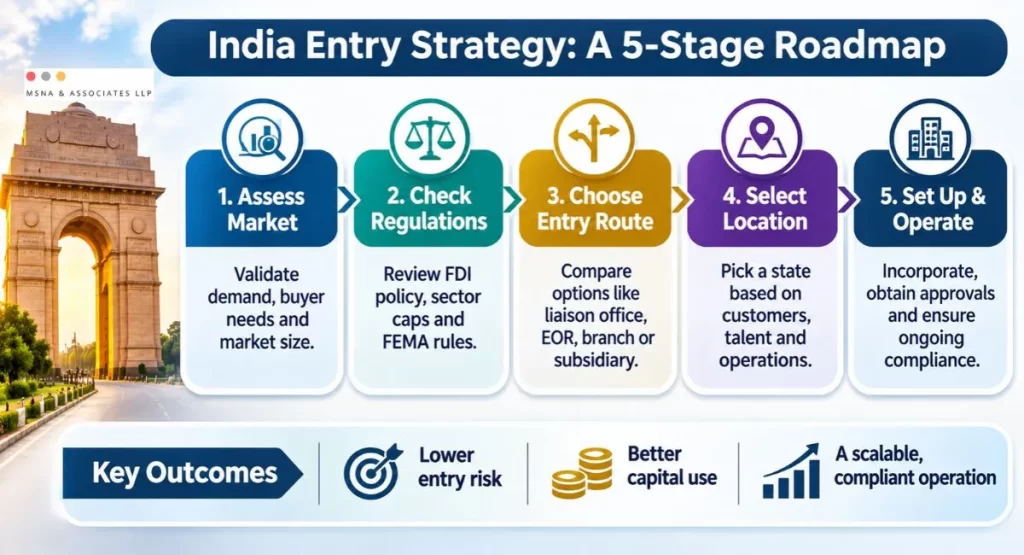
Stage 4: How Do You Choose a State and Set Up Your Business in India?
State selection guide
Choose the state where your first 20 customers or critical suppliers sit. Incentives come third, because language, consumer behaviour and standards often differ from state to state
| State | Strong for | Watch-out | FDI equity, Apr–Sep 2025 |
|---|---|---|---|
| Maharashtra | Finance, pharma, auto, consumer goods | High real-estate cost | US$10.57 bn |
| Karnataka | GCCs, deep tech, electronics design | Wage inflation and attrition | US$9.4 bn |
| Tamil Nadu | Auto, electronics, EV manufacturing | Cluster-level labour and land checks | US$3.57 bn |
| Haryana (Delhi NCR) | Auto parts, services, logistics | Congestion and cost in Gurugram | US$3.22 bn |
| Gujarat | Chemicals, ports, semiconductors, GIFT City | Narrower sector clusters | US$2.24 bn |
Source: DPIIT quarterly fact sheet. Use it for direction, not as a suitability ranking.
The setup sequence
- Reserve the name and obtain director identification numbers and digital signatures.
- Incorporate through the MCA’s SPICe+ form ( see our foreign company registration page)
- Obtain PAN, TAN and GST registration, then open the bank account.
- Bring the capital in through your bank and report it to the RBI under FEMA (FC-GPR, due within 30 days of share allotment). Our FEMA compliance desk can track these filings.
- Have the board appoint your first statutory auditor within 30 days of incorporation.
- Register payroll (PF, ESI) and state shops-and-establishment licences through payroll services.
- Sign intercompany agreements and a transfer pricing policy before the first invoice.
What Should an India Market Entry Strategy for Foreign Companies Check in a Partner?
Every entry plan leans on someone local. Check them before they check you.
Legal and financial
- Verify incorporation, directors, charges and litigation on MCA21 records.
- Review three years of audited financials and GST filing regularity.
Commercial
- Speak to two current customers and one former principal.
- Confirm no competing line or territory overlap.
- Set a pilot target and judge execution, not the presentation.
Contract
- Tie exclusivity to minimum performance, with termination triggers.
- Keep IP, brand, data and pricing authority with you.
- Specify governing law, arbitration seat and FEMA-compliant payment terms.
- Include buy-back, inventory and customer-handover clauses.
Red flags: large advance fees, no references, vague answers on statutory compliance.
What Mistakes Hold Back an India Entry Strategy at Each Stage?
Each stage of a market entry strategy for India has its own typical error, paired below with a better move.
| Stage | Common mistake | Better move |
|---|---|---|
| Assess | Treating GDP size as demand; skipping pricing localization | Bottom-up buyer interviews |
| Choose mode | Copying a competitor; reading “100% FDI” as “no approvals” | Score modes; check sector licences |
| Test | Exclusivity without targets; EOR staff negotiating contracts or paid from abroad | Milestone-linked exclusivity; contracts signed by an Indian entity, staff hired through an EOR |
| Set up | Choosing the state by incentive alone; informal funding or nominee shareholders | Customer-led state choice; banking-channel remittance and disclosed beneficial ownership |
| Scale | Untested management fees and royalties; no repatriation plan | Documented intercompany flows; dividend plan |
What Budget and Timeline Does an India Expansion Strategy Need?
Indicative 2026 planning ranges in USD, excluding inventory, rent and local salaries unless stated. Replace them with sector-specific quotes.
| Route | First-year cash envelope | Time to be operational | Notes |
|---|---|---|---|
| Desk and field assessment | 10k–30k | 4–8 weeks | Interviews and legal screen |
| Distributor test | 25k–75k | 3–6 months | Samples, certification, contracts |
| EOR pilot (2–3 hires) | 60k–200k | 4–8 weeks to hire | Salaries plus EOR fee |
| Liaison office | 20k–50k | 6–10 weeks for approval | No revenue allowed |
| Wholly owned subsidiary | 150k–500k | 4–8 weeks to incorporate, then 2–3 months to operate | Core team, audit, tax |
| Joint venture | 250k and above | 3–6 months to negotiate | Diligence and legal |
How Do You Plan Exit and Repatriation Before Your India Entry Strategy?
Boards commit faster when they know how cash and ownership can leave cleanly. Design the way out before the way in; the net-FDI gap shown earlier is what happens when nobody does
| Exit or cash-out route | Fits when | Prepare in advance |
|---|---|---|
| Dividend repatriation | The subsidiary is profitable | Distributable reserves, withholding tax and treaty relief, FEMA-compliant remittance |
| Share sale to a partner or buyer | Joint venture or subsidiary exit | FEMA pricing and reporting rules, valuation report, capital gains tax |
| Buy-back or capital reduction | Surplus cash sits in the subsidiary | Company-law approvals and buy-back gains taxed as capital gains from 1 April 2026, with additional tax for promoters |
| Closing a liaison or branch office | The test fails | Authorised dealer bank closure approval, tax clearance, auditor certificates |
| Ending a distributor contract | The channel under-performs | Notice period, inventory buy-back, customer handover |
Rule of thumb: if the exit cannot be described in one paragraph, the joint venture may need further work.
Your Next Step On India Entry Strategy
Treat entry as the first move in a longer India expansion strategy, not the finish line. If a second view helps, MSNA’s India entry services for UAE and US teams can pressure-test your scorecard and state shortlist against current FDI policy and FEMA rules. A conversation with a qualified professional can help you assess how this applies to your situation.
You can read our guide on India entry checklist for US and UAE Companies for more info.
When This Guide Does Not Apply: This guide does not cover banking, insurance, defence or other sectors with specific regulator approvals or tighter caps. Check the sector’s own rules before using the scorecard.
Plan Your India Entry Strategy
FAQs About India Entry Strategy
How to enter the Indian market with limited capital?
Start with a distributor or EOR pilot, set gates, and incorporate only after evidence arrives.
Can a foreign company sell in India without an entity?
Yes, through exports to distributors. Direct invoicing, local hiring and after-sales service usually need an entity.
Is 100% FDI allowed?
In most sectors under the automatic route. Confirm sector caps and licences in the current FDI policy.
How long does it take to set up a subsidiary in India?
Incorporation usually takes 4–8 weeks, followed by 2–3 months to become operational.
Can a foreign company hold 100% of an Indian private limited company?
In most sectors, yes, under the automatic route. Sector caps and Press Note 3 conditions apply.
Related
Discover more from MSNA & Associates LLP
Subscribe to get the latest posts sent to your email.