
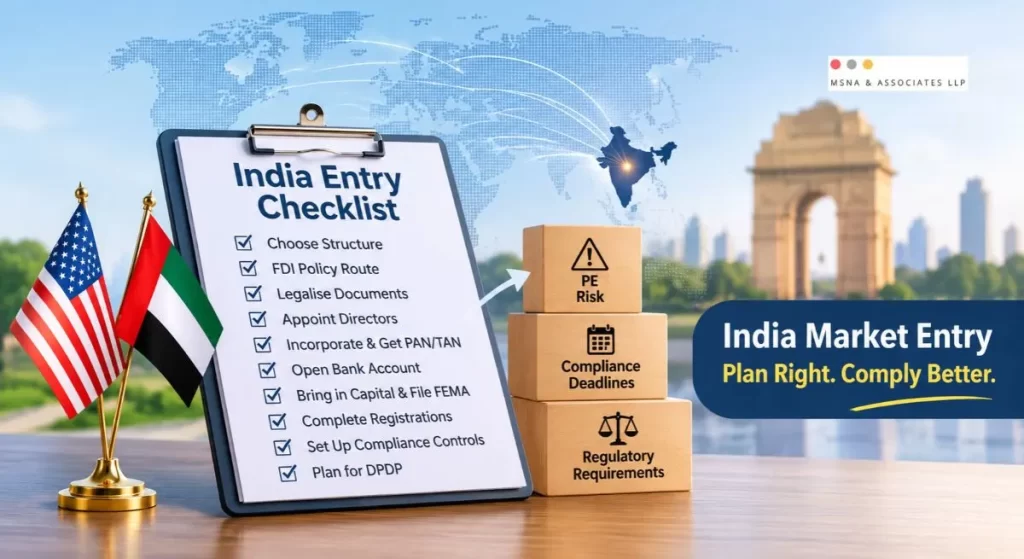

Could India tax your company before it has set up a single entity there?
For a US parent, that can happen after 90 days of services, and for a UAE parent after nine months. An India entry checklist exists to prevent that surprise. It is the ordered list of legal, tax and regulatory steps a foreign company completes to set up and operate in India, and for US and UAE companies it has ten steps under the Companies Act, 2013, FEMA, the FDI policy and the Income-tax Act, 2025.
The ten steps are shared, but seven items differ by home country. The two that most often delay entry are document legalisation (an apostille for US parents, a three-step attestation for UAE parents) and permanent establishment thresholds. This guide works as an India market entry checklist for both, with a US vs UAE comparison, 2026 rule changes, costs and a first-year calendar.
Key Takeaways
- A wholly owned subsidiary (a private limited company) on the automatic route suits most mid-market entrants.
- Sequence beats speed: legalised parent documents, then incorporation, then bank account, then capital inflow, then RBI reporting.
- US and UAE parents differ on seven items, led by the attestation route and permanent establishment thresholds.
- A permanent establishment can create an Indian tax bill before any registration exists.
- DPDP core duties start 13 May 2027, so design for them now.
What Are the Steps in an India Entry Checklist?
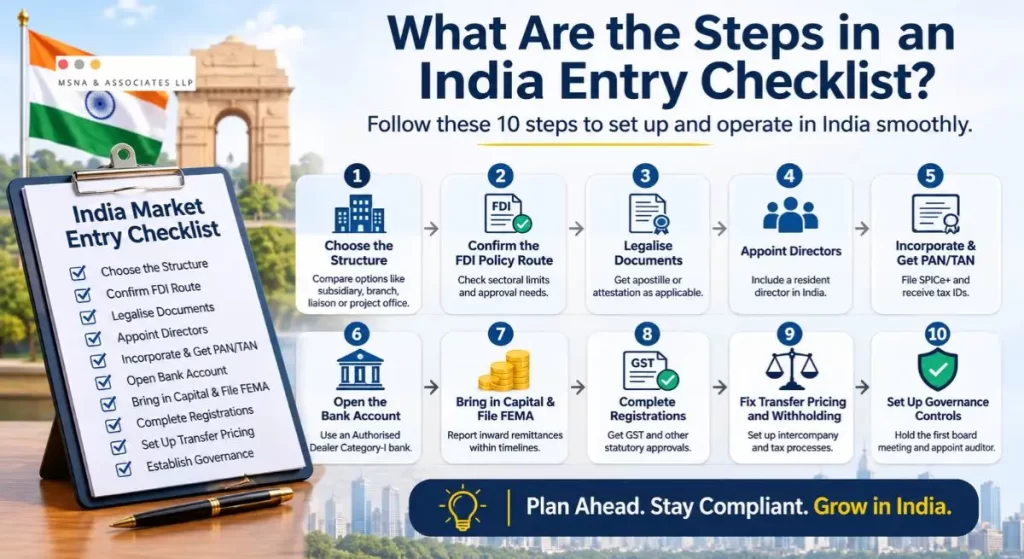
Complete the ten steps below in order, because each one produces the document or account the next one needs. Step 10 runs in parallel from incorporation.
Step 1: Choose the Structure
Structure decides your tax rate, approval route and liability, so compare all four options before filing anything.
Option | Fits | Tax on Indian profits | Catch |
Wholly owned subsidiary (private limited company) | Sales, services, GCCs, manufacturing | 22% concessional option, about 25.17% with surcharge and cess | Two directors and two shareholders minimum |
Established parent with listed activities | 35% plus surcharge and cess | Five profitable years and USD 100,000 net worth | |
Liaison office | Market study only | No income permitted | Three profitable years and USD 50,000 net worth |
Project office | One Indian contract | 35% plus surcharge and cess | Ends with the project |
Our view: a liaison office feels cheap, but anything beyond liaison work turns it into a tax and FEMA problem. Choose a wholly owned subsidiary unless the activity is genuinely narrow.
Step 2: Confirm the FDI Policy Route
- Most sectors allow 100% under the automatic route; some need government approval or carry caps. Read the sector entry in the FDI policy.
- Test beneficial ownership against land-border rules, including control, not only shareholding (Chambers analysis).
When this does not apply: sectors with caps or an approval route (for example defence, multi-brand retail and some financial services) need government approval or follow sector limits. Check the sector entry before relying on the automatic route.
Step 3: Start Document Legalisation on Day One
It is the longest lead item and the main US-versus-UAE difference; the routes are compared below.
Practitioner note: the delay is rarely the registry. It is usually a board resolution whose signatory name differs across the passport, trade licence, and resolution. Match the names before anything is notarised.
Step 4: Appoint Directors, Including a Resident Director
- One of your directors has to be a resident, meaning someone who spent 182 days or more in India during the previous calendar year (Section 149(3)).
- Obtain Class 3 DSCs and DINs before filing.
- Treat the resident director as a real decision-maker: banks, auditors and tax officers read board substance.
Step 5: Incorporate and Obtain PAN and TAN
- File SPICe+ with name reservation, MoA, AoA and registered office proof; PAN and TAN arrive with the certificate.
- Confirm that business has started through Form INC-20A, which closes 180 days after incorporation.
Step 6: Open the Bank Account
- Use an Authorised Dealer Category-I bank; expect beneficial-owner KYC on the parent chain.
- Capital must arrive through banking channels into this account, so open it before remitting.
Practitioner note: banks ask for the ownership chain down to the natural person, so keep a one-page ownership chart ready before the KYC call.
Step 7: Bring in Capital and Complete FEMA and RBI Reporting
- Price shares at or above fair value certified by a CA or merchant banker.
- Report receipt of funds through your AD bank / FIRMS within 30 days, allot shares within 60 days of receipt, then file Form FC-GPR within 30 days of each allotment. Each tranche restarts the clock.
- Our FEMA and RBI reporting work usually starts here because a missed window cannot be reversed.
Step 8: Complete Operating Registrations
- GST registration before the first taxable supply (threshold INR 20 lakh; INR 10 lakh in special category states).
- Shops and Establishments, Professional Tax, EPF and ESI, and IEC if you import or export.
- Sector licences (FSSAI, RBI, IRDAI, SEBI) before regulated activity starts.
Step 9: Fix Transfer Pricing and Withholding Foundations
- Sign intercompany agreements before the first invoice; transfer pricing applies from the first rupee.
- Collect the parent’s Tax Residency Certificate and Form 10F before the first payment, or TDS runs at domestic rates.
Step 10: Set Up Governance Controls (runs in parallel from incorporation)
- Call the first board meeting and appoint the first auditor in the opening 30 days after incorporation.
- Run a virtual CFO and internal audit reporting rhythm from month one, so the first FEMA, GST and TDS filings are not built from scratch.
How Does the India Entry Checklist Differ for US and UAE Companies?
US and UAE parents share ten steps but differ in seven areas:
Item | US parent | UAE parent |
Document route | Notarise, then apostille | Notarise, UAE MOFA, then Indian Embassy attestation |
Treaty | India-US DTAA (1989) | India-UAE DTAA (1993), plus CEPA for trade |
Withholding caps | Dividends 15%/25%; interest 10%/15%; royalties and included services 10%/15% | Dividends 10%; interest 5% to 12.5%; royalties 10%; no fees-for-technical-services article |
Service PE threshold | 90 days in 12 months, or services performed in India for a related enterprise | Nine months, same or connected project |
Building or installation PE | Over 120 days | Over nine months |
Residency certificate | IRS Form 6166 | UAE Federal Tax Authority TRC |
Home-country reporting | Form 5471, NCTI | UAE 9% corporate tax, free-zone conditions |
A structured review with a Chartered Accountant can help you map these differences to your parent structure.
India Market Entry Checklist for US Companies: Home-Country Items
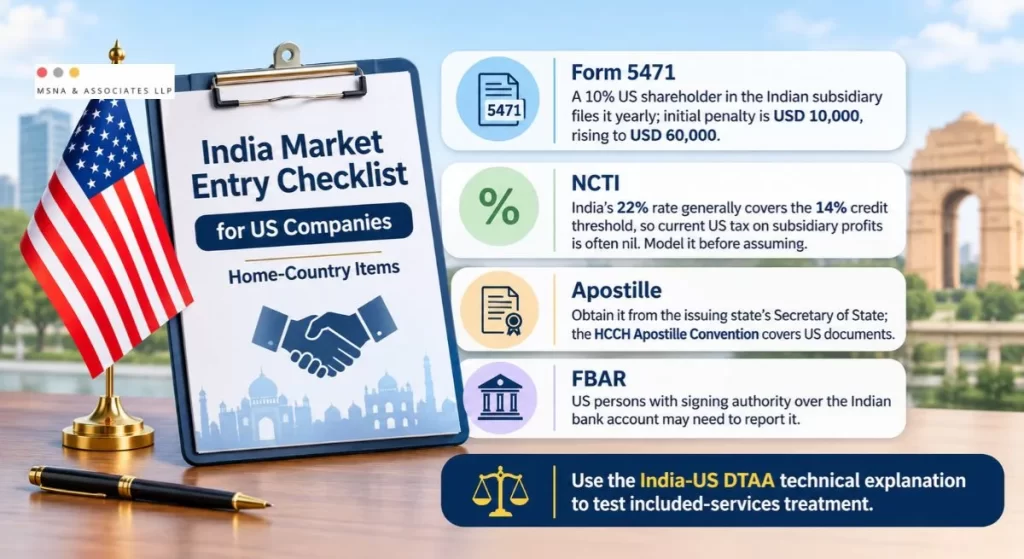
These obligations sit with the US parent, not the Indian subsidiary, and no Indian filing replaces them.
- Form 5471: a 10% US shareholder in the Indian subsidiary files it yearly; the initial penalty is USD 10,000 per form, rising to USD 60,000.
- NCTI: India’s 22% rate generally covers the 14% credit threshold, so current US tax on subsidiary profits is often nil. Model it before assuming.
- Apostille: obtain it from the issuing state’s Secretary of State; the HCCH Apostille Convention covers US documents.
- FBAR: US persons with signing authority over the Indian bank account may need to report it.
- Use the India-US DTAA technical explanation to test included-services treatment.
Checklist for UAE Companies: Home-Country Items
These items sit with the UAE parent and decide whether approvals and treaty benefits work in practice.
- Attestation, not apostille: the UAE is not on the HCCH contracting-party list, so every document needs the three-step chain; check the HCCH Apostille Convention status table.
- Free zone licence: confirm the licence permits activity outside the zone; some authorities require a no-objection certificate.
- TRC: apply annually to the Federal Tax Authority and file Form 10F; treaty rates also face substance checks.
- CEPA is not tax relief: the India-UAE CEPA (in force since 2022) eases goods trade; it does not change FEMA, FDI policy or PE rules.
- Credit for Indian tax: collect Form 16A certificates so your UAE 9% corporate tax computation can claim credit.
When Does a Permanent Establishment Arise Before Registration?
A permanent establishment needs no Indian company. Employees, a client-site team or a founder working from home can create one. A TRC or UAE licence does not prevent it.
Trigger | Risk signal |
Consultants on an Indian client site | Days counted for the enterprise, not per person |
Sales lead negotiating prices in India | Dependent-agent PE, even if Dubai or Delaware signs |
Founder or director based in India | Fixed place or place-of-management exposure |
Splitting one project into short contracts | Connected projects are aggregated |
CA Naveen Nagaraj: “Boards often review PE only after a withholding notice arrives. The cheaper sequence is a day-count tracker and a contract-approval trail from the first visit.”
Seconding Staff to Your Own Indian Subsidiary: The Related-Enterprise Service PE Limb
Many US parents second engineers or managers to their own Indian subsidiary and assume the 90-day count is the only test. The India-US treaty also has a second limb: services performed in India for a related enterprise can create a service PE. A US parent serving its own Indian subsidiary is exactly that case. Before secondment starts, document who directs the work, who bears the risk, and who pays. Then test the arrangement against the treaty text and the current Indian case law.
DPDP: Data Privacy for a New India Entity
The DPDP Act also reaches a company outside India when it processes personal data in connection with offering goods or services to people in India (AZB timeline).
- 13 November 2026: consent manager registration opened.
- 13 May 2027: notice, consent, safeguards, breach reporting and cross-border transfer duties apply.
- Penalties reach INR 250 crore for security failures and INR 200 crore for unreported breaches.
- GDPR compliance does not substitute; add India-specific consent language to parent data agreements.
How Long Does Each Step Take in the First Year?
Use these planning bands to size the first-year budget and find the critical path before you commit.
Item | Time |
Parent document legalisation | US: 1 to 2 weeks; UAE: 2 to 4 weeks |
DSC, DIN, name reservation | 3 to 5 working days |
Incorporation and registrations | 7 to 15 working days |
Bank account | 2 to 6 weeks, KYC-driven |
Statutory and tax audit | After year-end |
Transfer pricing study and report | Before 31 October |
Accounting, GST, TDS, payroll | Monthly |
FEMA, FLA and ROC filings | Per cycle |
DPDP gap assessment | 4 to 8 weeks |
Timings are indicative and depend on documents and bank KYC. Decision to operational typically takes 8 to 12 weeks for US parents and about two weeks longer for UAE parents. Professional fees depend on scope and are agreed after a consultation.
7 Common India Entry Compliance Mistakes and Penalties for Foreign Companies
Each mistake maps to a specific statutory exposure, so the cheapest control is catching it before the first filing.
Mistake | Consequence |
Wrong FDI route or ignored land-border ownership | Compounding; FEMA Section 13 allows up to three times the amount involved |
Late or missing FC-GPR | Late submission fee, escalating until compounding |
No TRC or Form 10F before first payment | TDS at 20% to 40% instead of treaty rates |
No transfer pricing documentation | 2% of each international transaction value |
No transfer pricing report | INR 1 lakh minimum penalty under the earlier law |
Late AOC-4 or MGT-7 | INR 100 per day per form |
Missing Form 5471 (US) | USD 10,000 per form per year |
Shortcuts That Backfire
- Nominee resident director: the person signs, the foreign team decides. Bank KYC and tax officers see through it.
- Third-country holding shell: used to dodge land-border or sector limits. Ownership tests look through to the beneficial owner and control.
- Employer-of-record “pilot”: fine for a short test, but it can create PE and labour-law exposure if it becomes permanent.
- Selling through a liaison office: breaches its permitted scope.
- Splitting contracts below PE thresholds: connected projects are aggregated.
What works: parallel-track legalisation and DSCs, a documented pilot with PE review, and a pre-filing FDI route memo.
First-Year Compliance Calendar
Dates assume a 31 March financial year, so map them against your own incorporation date.
When | Obligation |
Monthly: 7th, 11th, 15th, 20th | TDS deposit; GSTR-1; PF and ESI; GSTR-3B |
15 June, 15 September, 15 December, 15 March | Advance tax |
31 July, 31 October, 31 January, 31 May | TDS returns (24Q, 26Q, 27Q) |
15 July | FLA return to RBI |
30 September | AGM (first AGM: within nine months of first year-end); annual activity certificate for branch and liaison offices |
Within 30 and 60 days of AGM | AOC-4 and MGT-7 |
31 October | Transfer pricing report and local file |
30 November | ITR-6 where transfer pricing applies; otherwise 31 October |
Four meetings, gaps under 120 days | Board meetings |
13 November 2026 and 13 May 2027 | DPDP milestones |
Next Step On India Entry Checklist
A structured review with a Chartered Accountant can help assess how this India entry checklist applies to your sector, parent structure and timeline. MSNA & Associates LLP’s India Entry Services team works with US and UAE parents on this sequence, and this India market entry guide will be updated as the 2026 rules settle.
Planning Your Company's Entry into India?
FAQs On India Entry Checklist
Do we need an entity to sell into India?
Not always, but regular sales through Indian staff may create PE and GST obligations. Test the model first.
Does one India entry checklist work for both parents?
The steps match; the legalisation route, treaty rates and home filings do not.
Can the subsidiary invoice before GST and the bank account are ready?
Not safely; complete registrations first.
Is there a minimum capital requirement for a private limited company?
No statutory minimum paid-up capital applies, but shares must be priced at or above fair value, and regulated sectors can set their own capital floors.
Does a branch or liaison office need a resident director?
The 182-day rule applies to companies. A branch or liaison office is not a company, but it must name a person in India authorised to accept legal notices.
Related
Discover more from MSNA & Associates LLP
Subscribe to get the latest posts sent to your email.