
An Indian subsidiary owned by a UAE parent produces two different sets of numbers every reporting cycle, and understanding Ind AS vs IFRS is the first step to closing that gap.
One is the statutory filing under Ind AS, prepared for India’s Registrar of Companies. The other is the version folded into the group’s IFRS consolidation back in Dubai or Abu Dhabi. They rarely match line for line, and closing that gap correctly is the actual job.
Ind AS, developed by ICAI and notified by India’s Ministry of Corporate Affairs under the Companies Act, 2013, tracks IFRS closely but keeps a specific set of India-only carve-outs. Knowing exactly where those carve-outs sit is what decides whether consolidation runs smoothly each quarter or turns into a scramble at year-end.
Key Takeaways
- Ind AS vs IFRS applicability depends on the Indian subsidiary’s own standalone net worth, not the UAE parent’s size or the group’s consolidated figures.
- Consolidation requires mapping every material Ind AS–IFRS gap each reporting cycle, not a one-time reconciliation.
- The Ind AS 101 foreign currency exemption applies only to loans already on the books at first-time adoption, not to new borrowings.
- Deferred tax does not travel across unchanged. Once a carrying amount is restated to IFRS, the temporary difference on it has to be recomputed.
- The GAAP difference schedule needs quarterly auditor review and updates, or it goes stale and creates audit friction by year three.
- Getting the reconciliation wrong carries personal liability under Section 129(7) of the Companies Act, 2013, alongside group audit qualification risk.
What Is the Difference Between Ind AS and IFRS?
Before comparing line items, it helps to understand where each framework comes from and why India did not simply adopt IFRS outright.
- IFRS is issued by the International Accounting Standards Board (IASB), which operates under the IFRS Foundation, and is applied in the UAE and 140-plus jurisdictions as the primary financial reporting language. For a UAE group, this means IFRS is the default language of the consolidation, and any Indian input has to be translated into it rather than the other way round.
- Ind AS is the Indian converged form of IFRS, formulated by the Institute of Chartered Accountants of India (ICAI) and notified by the MCA. It follows the IFRS structure closely but carries specific carve-outs suited to Indian legal, tax, and regulatory conditions.
- Convergence, not adoption, is the operative word. India chose to align with IFRS rather than adopt it word for word, so certain treatments (foreign currency translation, financial instruments, and business combinations among them) differ in ways that affect consolidated numbers.
For a UAE parent, this means the Indian subsidiary’s standalone financial statements cannot be dropped into group consolidation without adjustment. Someone on the finance team needs to map every material difference.
Why Do These Differences Matter for UAE Parent Companies?
A UAE holding company consolidating an Indian subsidiary is combining two sets of books prepared under different rules. Both frameworks describe themselves as IFRS-aligned. In practice, they do not produce identical numbers.
1. Group reporting accuracy.
Differences in recognition, measurement, and presentation can change reported profit, equity, or asset values at the group level. Left unadjusted, these differences distort the consolidated result.
2. Audit and regulatory scrutiny.
Auditors on both sides expect a documented reconciliation between the Indian entity’s Ind AS figures and the group’s IFRS consolidation.
3. Investor and lender expectations.
Group financial statements shared with UAE banks, DIFC or ADGM regulators, or investors are typically prepared entirely under IFRS. Ind AS figures need a clean conversion trail before they reach that stage.
The practical consequence follows directly. Consolidation is not a copy-paste exercise. It is a standards-mapping exercise that has to happen every reporting cycle.
Which Indian Companies Must Follow Ind AS?
Not every Indian company is required to apply Ind AS, so it’s worth confirming where your subsidiary sits before assuming the comparison even applies.
Company Type | Ind AS Applicability |
Listed companies (equity or debt), other than SME-exchange-listed | Mandatory |
Unlisted companies with net worth ≥ ₹250 crore | Mandatory |
Holding, subsidiary, associate, or joint venture of a company covered above | Mandatory |
Banks, NBFCs, and insurance companies | NBFCs: phased in FY2018-19/19-20. Banks: deferred indefinitely (RBI, Mar 2019). Insurers: deferred by IRDAI. No voluntary adoption for any of the three. |
Smaller unlisted companies below the net worth threshold | May continue under Indian GAAP (AS), unless voluntarily adopting Ind AS |
For a UAE group, the banking and insurance row is the one that surprises people. If the Indian entity is an NBFC, it reports under Ind AS and the gap analysis below applies in full. If it is a bank, it does not, and the group will be consolidating Indian GAAP numbers with a wider set of differences than this guide covers.
A UAE parent’s size does not bring the Indian subsidiary under Ind AS. What matters is the subsidiary’s own standalone net worth (Section 2(57), Companies Act), its listing status, or whether it’s a subsidiary, associate, or joint venture of an Indian company that is already covered. Check this yearly; a growing subsidiary can cross the threshold between reporting cycles, and the year it crosses is the year the reconciliation work starts.
What Are the Key Differences Between Ind AS vs IFRS for Consolidation?
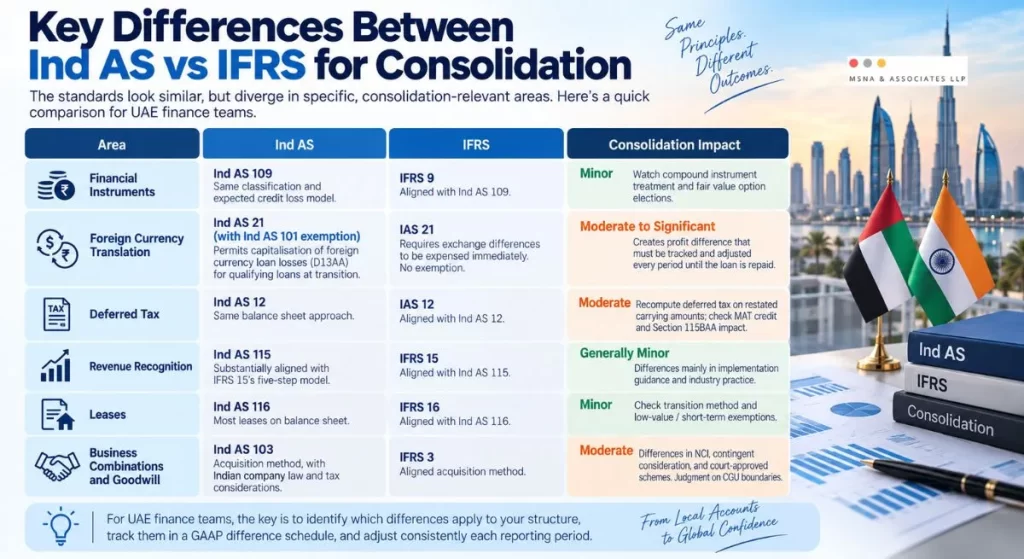
This is where UAE finance teams usually need the most help, since the standards look similar on the surface but diverge in specific, consolidation-relevant areas.
How do the frameworks treat financial instruments?
Ind AS 109 and IFRS 9 classify financial instruments the same way and use the same expected credit loss model. Differences appear in compound instruments and fair value option elections, where Indian company law on preference shares and convertibles bites.
How is foreign currency translation handled?
Ind AS 21 and IAS 21 both use the same idea: functional currency. But Ind AS adds one exception, under Ind AS 101.
Normally, if a foreign currency loan loses value due to exchange rates, that loss hits the profit and loss account right away. Under this Ind AS exemption, companies could instead add the loss to the cost of the asset. The loss sits on the balance sheet instead of showing up as an expense. (This election under Ind AS 101 paragraph D13AA was available only at first-time adoption, for loans already on the books at transition. It cannot be applied to borrowings taken after the entity moved to Ind AS.)
IFRS does not allow this. It requires the loss to be expensed immediately. So where a company used this exemption, a gap opens between its Ind AS and IFRS numbers. This gap does not close on its own. It must be tracked and adjusted every reporting period, until the loan is repaid.
For a hypothetical example, say a long-term foreign currency loan has moved 8 to 10 percent against the rupee since it was taken. Under Ind AS, the loss is added to asset cost. Under IFRS, it is expensed right away. In a scenario like this, the gap between the two can run into crores of rupees. It stays open until the loan matures or is repaid, and consolidation teams must track and reverse it every period.
How is deferred tax affected?
Ind AS 12 and IAS 12 use the same balance sheet approach, so the gap is not in the standard. It is a consequence gap: deferred tax is computed on carrying amounts, so the capitalised exchange loss above changes the temporary difference and the deferred tax has to be recomputed, not carried across.
Two balances to check before consolidating: MAT credit, presented as a deferred tax asset under Ind AS 12 subject to recoverability, and any remeasurement triggered by a Section 115BAA rate election.
What changes for revenue recognition?
Ind AS 115 is substantially aligned with IFRS 15’s five-step model, so this is usually one of the smaller gaps. The differences that remain tend to sit in implementation guidance and industry-specific practice rather than in the core standard.
How do lease accounting rules compare?
Ind AS 116 and IFRS 16 both moved most leases onto the balance sheet. The core mechanics are closely aligned.
Differences show up in two places. One is the transition approach a company chose when it first adopted the standard. The other is how low-value or short-term lease exemptions were applied at that time.
What about business combinations and goodwill?
Ind AS 103 adopts the acquisition method as per IFRS 3. In certain areas, though, accounting for Indian companies is shaped by Indian company law and taxation. Contingent consideration, non-controlling interest, and accounting for a court-approved scheme of arrangement are the usual examples.
Goodwill impairment testing under Ind AS 36 follows a structure close to IAS 36. Judgment on cash-generating units can still vary in practice, which is why the group auditor usually wants to see how the Indian entity drew its CGU boundaries rather than accept the impairment conclusion on its own.
How does this play out in a real DIFC-parented structure?
Take a Dubai holding company with a $5M loan on its Indian subsidiary’s books. Under Ind AS, a currency loss on that loan can sit capitalised into asset cost (if the D13AA election applied at transition). Under IFRS, the same loss is expensed the moment it happens. One line item, two different profit numbers, every quarter until the loan is repaid. Deferred tax then moves with it, because the asset’s carrying amount differs under each framework. That’s the gap a DIFC or ADGM regulator will expect the group’s auditor to explain.
Area | Ind AS | IFRS | Consolidation Impact |
Financial instruments | Ind AS 109 | IFRS 9 | Minor: watch compound instrument treatment |
Foreign currency translation | Ind AS 21 (with Ind AS 101 exemption) | IAS 21 | Moderate to significant if exemption was used |
Deferred tax | Ind AS 12 | IAS 12 | 12Moderate: recompute on every restated carrying amount; check MAT credit presentation |
Revenue recognition | Ind AS 115 | IFRS 15 | Generally minor |
Leases | Ind AS 116 | IFRS 16 | Minor: check transition method |
Business combinations | Ind AS 103 | IFRS 3 | Moderate: NCI and contingent consideration |
How Should UAE Group Controllers Approach Ind AS to IFRS Conversion?
Convert in this order, whether the work is in-house or with an outsourced accounting services to India from UAE.
- Map the applicable standards. Identify which Ind AS and IFRS standards apply to each material balance. Note where the two diverge.
- Build a GAAP difference schedule. Document every adjustment line by line. Include the supporting Ind AS and IFRS references side by side.
- Prepare a reconciliation statement. Reconcile Ind AS profit and equity to their IFRS equivalents. This is similar in structure to an Ind AS 101 first-time adoption reconciliation.
- Recompute deferred tax on the restated figures. Do this after the other adjustments are settled, not alongside them, so the tax effect follows the final carrying amounts.
- Route adjustments through consolidation workpapers. Feed the reconciled figures into the group consolidation package. Do not adjust the Indian entity’s statutory books.
- Have both auditors review the reconciliation. The Indian statutory auditor and the group’s IFRS auditor should both be satisfied with how the adjustments were derived.
Do this every quarter, not only at year-end. A consistent cadence reduces last-minute audit friction considerably.
A common failure point deserves attention here. The GAAP difference schedule is often built once, at first-time adoption. It then goes stale as new leases, loans, or acquisitions are added. By year three, the reconciliation no longer matches the actual balance sheet. Treat the schedule as a living document, updated as the business changes, not a one-time deliverable.
What Disclosure Requirements Change Under Ind AS?
Beyond recognition and measurement, disclosure formats differ enough that UAE finance teams reviewing Indian subsidiary statements for the first time often find the presentation unfamiliar.
- Related party disclosures under Ind AS 24 require specific formats that align with Indian Companies Act Section 188 requirements, which can be more granular than typical IFRS related-party notes. For a UAE group, this usually means the Indian note discloses intra-group transactions in more detail than the parent’s own accounts do.
- CARO reporting. Indian statutory audits include a Companies (Auditor’s Report) Order report, which has no direct IFRS or UAE equivalent and covers matters like fixed asset verification and statutory dues. Group finance teams should read it, because it often surfaces operational issues that never reach the consolidated numbers.
- Segment reporting under Ind AS 108 follows the same management-approach logic as IFRS 8, so this area usually needs little adjustment.
- Schedule III presentation. Indian financial statements follow the Companies Act’s Schedule III format, which affects balance sheet and P&L presentation even where the underlying numbers match IFRS.
None of this changes the economics of the business. It does mean the Indian subsidiary’s statutory financials will look structurally different from the UAE parent’s IFRS accounts even after all GAAP adjustments are made.
What Happens If an Ind AS vs IFRS Reconciliation Is Wrong?
Section 129(7) of the Companies Act, 2013 makes non-compliance with the notified accounting standards punishable with imprisonment of up to one year, or a fine of ₹50,000 to ₹5,00,000, or both. That exposure is personal, attaching to the CFO or the director charged with finance, not to the company in the abstract.
At the group level, an adjustment that cannot be evidenced invites a qualified opinion visible to UAE banks and DIFC or ADGM regulators. The likelier cost arrives earlier: an untraceable reconciliation means the Indian numbers get reworked during the group close, when the calendar has no slack.
What Should Finance Teams Do Next for Ind AS vs IFRS Conversion?
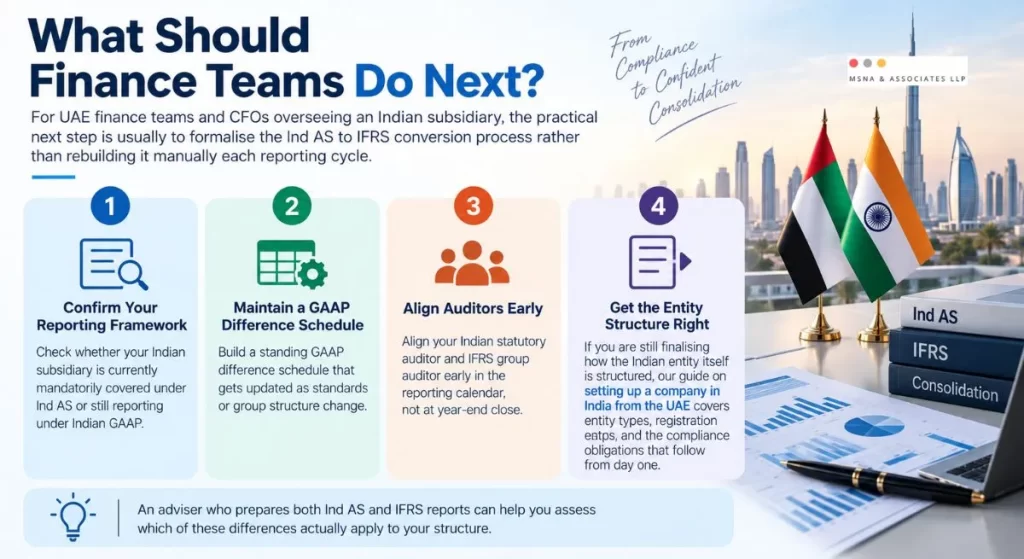
For UAE finance teams and CFOs overseeing an Indian subsidiary, the practical next step is usually to formalise the Ind AS to IFRS conversion process rather than rebuilding it manually each reporting cycle.
- Confirm whether your Indian subsidiary is currently mandatorily covered under Ind AS or still reporting under Indian GAAP.
- Build a standing GAAP difference schedule that gets updated as standards or group structure change.
- Align your Indian statutory auditor and IFRS group auditor early in the reporting calendar, not at year-end close.
- If you are still finalising how the Indian entity itself is structured, our guide on setting up a company in India from the UAE covers entity types, registration steps, and the compliance obligations that follow from day one.
An adviser who prepares both Ind AS and IFRS reports can help you assess which of these differences actually apply to your structure.
Need Help With Ind AS to IFRS Conversion?
What Questions Do UAE Finance Teams Often Ask About Ind AS vs IFRS?
Does the Indian subsidiary need to prepare two full sets of financial statements?
No. The subsidiary prepares one statutory set under Ind AS for Indian regulatory purposes. The IFRS figures used in group consolidation come from a reconciliation schedule built on top of the Ind AS numbers, not from a second full audit.
Will Ind AS and IFRS eventually converge completely?
Full convergence isn’t currently expected, since several carve-outs exist specifically to accommodate Indian company law and tax treatment. The gap has narrowed considerably since Ind AS was first notified, but a full merger of the two frameworks isn’t part of the current roadmap.
Does the UAE 9% corporate tax regime change how the Indian subsidiary's numbers are reported?
Not at the Indian entity level, but the group tax note now carries a UAE component alongside the Indian one, which means the reconciliation feeds a tax computation as well as a consolidation.
Who should own the GAAP reconciliation, India or the UAE head office?
Practice varies by group. Some UAE holding companies keep reconciliation ownership centrally with the group finance team, while others delegate the first draft to the Indian entity’s finance function and review it centrally. Either approach works as long as both auditors sign off on the same reconciliation.
Related
Discover more from MSNA & Associates LLP
Subscribe to get the latest posts sent to your email.