


If you’re looking into how to register a company in India from the UAE, you don’t need to fly to India to do it. Every step, from digital signature and name reservation to incorporation filing and the first bank account, can be completed from Dubai, Abu Dhabi, Sharjah, or anywhere else in the UAE.
What actually slows UAE entrepreneurs down isn’t the incorporation process itself. It’s three specific friction points: getting a resident director lined up, getting UAE-issued documents recognised in India, and opening the company’s bank account without ever walking into an Indian branch.
This guide walks through exact steps on how to register a company in India from the UAE, in the order you’ll actually do it, with the UAE-specific part of each step spelled out.
Key Takeaways
- The full company registration process in India from the UAE can be completed remotely, with no travel required.
- A resident director based in India is mandatory before you file, not something you can add later.
- UAE-issued documents need attestation through the UAE Ministry of Foreign Affairs and International Cooperation (MOFAIC) and the Indian Embassy or Consulate, since the UAE is not a Hague Apostille Convention member; confirm the exact format your bank or filing agent expects before you start.
- Opening the company’s Indian bank account, not the incorporation filing itself, is usually the slowest step for UAE founders.
- FC-GPR filing to the RBI, within 30 days of your shares being allotted, is not optional once UAE-sourced funds enter the company.
Step 1: Appoint Your Resident Director Before You File Anything Else
Indian company law requires at least one director to have lived in India for 182 days in the previous financial year.
Under Section 149(3) of the Companies Act, 2013, this residency requirement applies to every company incorporated in India, with no exception for foreign-promoted entities. If you’re incorporating from the UAE and don’t already have a co-founder, business partner, or relative who meets this, you need to arrange one before the SPICe+ filing.
Two options, in practice:
- A co-founder, business partner, or relative already resident in India
- A professional resident director service, typically ₹1,50,000-3,00,000 a year
Which one makes sense depends on how much you already trust the person and how quickly they respond to documents.
A relative who’s genuinely engaged is often the cheaper, faster route, and at this price point the gap between the two options is real money, not a rounding difference. A relative who’s willing in principle but slow to reply to WhatsApp messages about board resolutions is worse than a professional service. If you don’t have a strong candidate already, it’s usually faster to go professional from day one.
This is the step UAE entrepreneurs underestimate most. Board resolutions, the bank account, and statutory filings all sit downstream of this person’s signature. A disengaged resident director doesn’t just cost the fee. It stalls the whole registration.
If you don’t have a resident director lined up yet, it’s worth getting that conversation started before anything else.
Step 2: How Do I Get a Digital Signature Certificate From the UAE?
You can’t file SPICe+ without a Digital Signature Certificate (DSC). Getting one as a UAE-based applicant works differently than it does for someone in India. Indian applicants complete DSC issuance through Aadhaar-based e-KYC.
As a UAE-based founder, you won’t have that option, so the process runs through document-based verification instead: an attested passport copy, attested UAE address proof (a utility bill or Emirates ID copy), and in some cases a video verification call with the certifying authority.
If you’re unsure about the complete documentation process, our guide on Documents Required For NRI Company Registration in India explains the identification requirements, mandatory documents, and the role of DIN and DSC in company incorporation.
Get this attestation done early. It’s one of the most common reasons DSC applications from abroad get delayed.
Step 3: Attest Your Documents, Since Apostille of Documents Doesn't Apply to the UAE
This is very important to know.
The UAE is not a member of the Hague Apostille Convention, so documents can’t be apostilled the way they could for a US- or UK-based founder. In practice, get your passport copy, UAE address proof, and any other identity documents attested through the UAE Ministry of Foreign Affairs and International Cooperation (MOFAIC), then legalised by the Indian Embassy or Consulate, not just notarised locally.
Notarisation alone isn’t the same thing, and a document that’s only notarised will get bounced back at some stage of the filing, costing you a full re-submission cycle.
One nuance for free zone founders: documents issued by a free zone authority sometimes need a Chamber of Commerce stamp before MOFAIC will accept them; mainland-issued documents usually don’t. Confirm this with your free zone authority before you attest.
Confirm the exact format your resident director’s CA or filing agent expects before you send documents for attestation. What different banks and RoC benches accept without query has been inconsistent. It’s worth a five-minute check before you spend on attestation, not after.
Step 4: Reserve Your Company Name and File SPICe+ Form
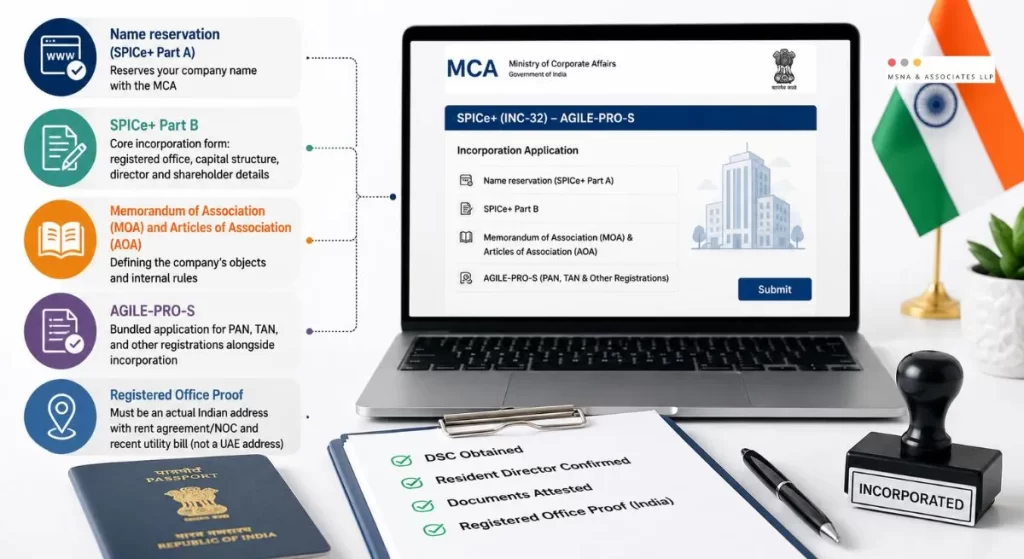
With your resident director confirmed and your DSC in hand, the filing itself follows the same path as any Indian incorporation:
Filing Step | What It Covers |
Name reservation (SPICe+ Part A) | Reserves your company name with the MCA |
SPICe+ Part B | Core incorporation form: registered office, capital structure, director and shareholder details |
Memorandum of Association (MOA) and Articles of Association (AOA) | Memorandum and Articles of Association, defining the company’s objects and internal rules |
AGILE-PRO-S | Bundled application for PAN, TAN, and other registrations alongside incorporation |
This bundled filing structure is set out under the MCA’s SPICe+ (INC-32) framework and the AGILE-PRO-S form; confirm the current version on the MCA portal before filing, since form versions get updated periodically.
Your registered office proof needs to be an actual Indian address, your resident director’s premises, a co-founder’s office, or a registered virtual office service, with a rent agreement or NOC and a recent utility bill.
This can’t be a UAE address; it has to be inside India.
Step 5: Wait for Your Certificate of Incorporation and PAN, and TAN
Once SPICe+ is filed correctly, the RoC issues your Certificate of Incorporation (CIN), your PAN, and your TAN together. This step itself typically moves faster than either the attestation process before it or the bank account process after it.
Step 6: Open the Company's Bank Account, the Step That Actually Takes the Longest
This is usually the slowest part of the entire process for a UAE-based founder, more than the incorporation itself.
To open the company’s current account, you’ll need:
- The Certificate of Incorporation
- PAN
- A board resolution authorising the account
- KYC documents for the authorised signatories, attested since you’re not walking into a branch, by the Indian Embassy or Consulate in the UAE, a notary, or an overseas bank branch the Indian bank recognises
Timelines vary more between banks than founders expect:
- Some Indian banks process this in about a week
- Others can take several weeks for the same document set
- Banks with an established UAE presence tend to move faster and query less. Their relationship managers handle FEMA-linked accounts regularly, so their compliance teams already know what a UAE-issued attestation is supposed to look like.
If your bank account application stalls, a professional who works with FEMA-linked accounts regularly can usually tell you why within a day. A quick review of the attestation route on your side usually surfaces the fix fast.
One of the most common reasons a bank account application from the UAE gets stuck is a document attested the wrong way for that specific bank’s checklist. Two banks can ask for the same underlying proof and accept different attestation routes for it. So confirming the exact requirement before you attest saves a full resubmission cycle.
Step 7: Fund the Company and Complete FEMA Reporting Through FC-GPR
Once the bank account is open, capital comes in through an NRE, NRO, or FCNR account, converted from AED to INR. The moment shares are allotted against that investment, the clock starts on FC-GPR, the mandatory RBI filing reporting the foreign investment. This reporting requirement is set out under the Foreign Exchange Management (Mode of Payment and Reporting of Non-Debt Instruments) Regulations, 2019. It’s due within 30 days of allotment, and missing it carries a penalty that generally costs more than the filing itself would have.
How to Register Company in India from UAE: Week-by-Week Registration Timeline
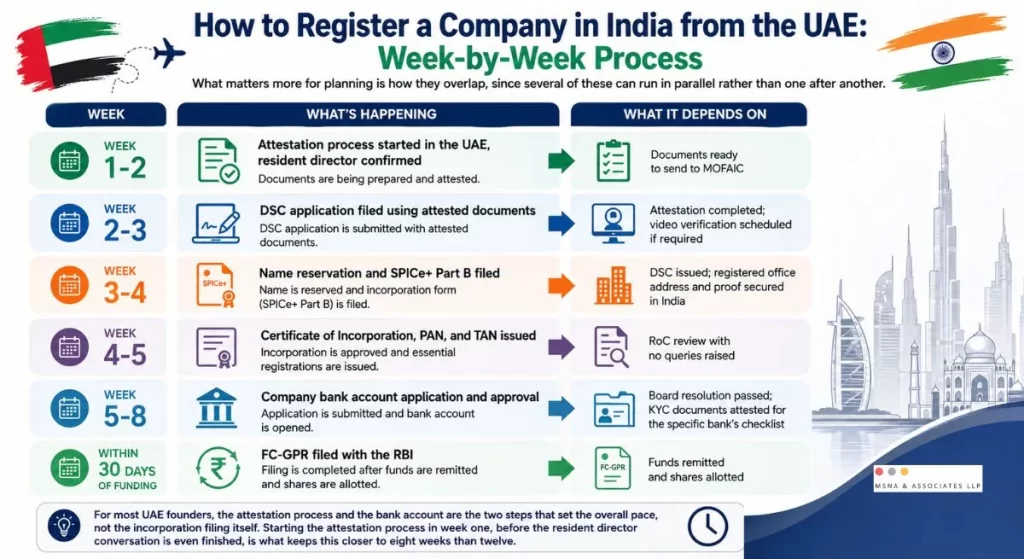
What matters more for planning is how they overlap, since several of these can run in parallel rather than one after another.
Week | What’s Happening | What It Depends On |
Week 1-2 | Attestation process started in the UAE, resident director confirmed | Documents ready to send to MOFAIC |
Week 2-3 | DSC application filed using attested documents | Attestation completed; video verification scheduled if required |
Week 3-4 | Name reservation and SPICe+ Part B filed | DSC issued; registered office address and proof secured in India |
Week 4-5 | Certificate of Incorporation, PAN, and TAN issued | RoC review with no queries raised |
Week 5-8 | Company bank account application and approval | Board resolution passed; KYC documents attested for the specific bank’s checklist |
Within 30 days of funding | FC-GPR filed with the RBI | Funds remitted and shares allotted |
For most UAE founders, the attestation process and the bank account are the two steps that set the overall pace, not the incorporation filing itself. Starting the attestation process in week one, before the resident director conversation is even finished, is what keeps this closer to eight weeks than twelve.
Common Mistakes in the Incorporation Process for UAE Founders
Even when founders understand the steps to register a company in India from the UAE, these are the mistakes that most often delay incorporation and increase costs.
Starting the attestation process after everything else is ready.
It’s usually the longest lead time in the whole sequence, so it should start first, not last.
Treating the resident director as a placeholder.
Filings stall the moment this person is slow to respond or unclear on what they’re signing.
- Choosing a bank without UAE-specific experience, only to discover the account takes 3 times longer than expected because the bank’s compliance team rarely handles FEMA-linked corporate accounts.
- Sending only notarised documents, not fully attested ones, and finding out at the filing stage that it isn’t enough.
- Assuming every bank’s KYC checklist is identical. Attesting documents once and sending the same set to multiple banks, hoping one sticks, wastes more time than confirming requirements with one bank first.
How To Register Company In India From UAE: Key Takeaways
Knowing how to register a company in India from the UAE is genuinely a remote process, but success depends more on following the right sequence than on any individual step. Start by appointing a resident director, initiate document attestation as early as possible, complete the incorporation filing, open the company’s bank account, and finally submit the FC-GPR after the investment is received. Following this order helps avoid unnecessary delays and keeps your expansion plans on schedule.
Every business has different regulatory, tax, and operational requirements, so it’s worth seeking professional guidance before you begin. If you’re planning to Setup New Company In India from the UAE, working with experienced professionals can help you choose the right business structure, manage documentation, and ensure compliance with MCA, FEMA, and RBI requirements from incorporation through post-registration filings.
Planning To Register A Company In India From The UAE?
How to Register Company in India from UAE: Common Questions Answered
Can I register a company in India from the UAE without ever visiting?
Yes. DSC issuance, SPICe+ filing, and even bank account opening can all be completed remotely from the UAE, provided documents are properly attested and your resident director is in place.
How long does the whole process take from the UAE?
Incorporation itself typically moves faster than the two steps around it: attestation and bank account opening. Budget more time for those two than for the SPICe+ filing.
Do I need to open a UAE bank account differently for this, or can I use my existing one?
Your existing UAE account works for funding the Indian company through an NRE, NRO, or FCNR account. What you’ll additionally need is the company’s own current account inside India, opened after incorporation.
What's the single biggest delay UAE founders run into?
Bank account opening, more often than the incorporation filing itself. Choosing a bank with real UAE-facing experience tends to shorten this step considerably.
Can my Indian resident director also be a shareholder, or does that role need to stay separate?
A resident director can also hold shares. The residency requirement is about the director role specifically, not about shareholding, so the same person can be both if that fits your structure
Related
Discover more from MSNA & Associates LLP
Subscribe to get the latest posts sent to your email.