


If a nonprofit misses its Form 990 filing three years in a row, the IRS automatically takes away its tax-exempt status. There’s no warning letter. No review of the circumstances. It just happens, on the due date of the third missed return, and reinstatement takes nine to twelve months.
This doesn’t happen because nonprofits don’t care about compliance. It happens because most nonprofit finance functions are thin by design. A single part-time bookkeeper is often doing the work of an entire finance team: tracking restricted grants, reconciling accounts, and preparing statements, on top of whatever else the role includes. Something eventually slips.
That single rule is why outsourced accounting for US nonprofits isn’t really about saving money on bookkeeping. It’s about not losing the organization’s exempt status over a filing that a stretched, part-time finance function let slip.
This guide covers four things: what makes nonprofit accounting different from regular bookkeeping, what fund accounting outsourcing actually includes, a Single Audit rule change many nonprofits still don’t know applies to them, and how Indian accounting teams work inside a nonprofit’s existing systems.
Key Takeaways
- Nonprofit accounting requires fund accounting: tracking restricted and unrestricted net assets separately, not just recording transactions.
- The Single Audit threshold rose from $750,000 to $1,000,000 in federal awards, but a dual-threshold transition period runs through 2026 for older grants.
- Form 990 late filing costs $20-$105 a day, up to $54,500 for larger organizations, and three missed years trigger automatic loss of tax-exempt status.
- Most nonprofits understaff their finance function to protect their program-spending ratio, and that trade-off is exactly where outsourcing changes the math.
- Outsourced accounting for US nonprofits works inside the same software already in use, QuickBooks, Sage Intacct, Aplos, or Blackbaud, rather than requiring a system change.
Why Outsourced Accounting For US Nonprofits Is Different From Regular Bookkeeping ?
Fund accounting is the real difference, and it’s not optional.
Under ASC 958, a nonprofit has to classify every dollar as either ‘with donor restrictions’ or ‘without donor restrictions,’ making restricted vs unrestricted funds a core part of nonprofit financial reporting. That’s more than just tracking total cash in and out. A restricted grant for a specific program has to stay traceable to that program. This holds true even if the cash sits in the same bank account as everything else. Commingling restricted and unrestricted funds without separate tracking is one of the most common errors nonprofit finance teams make. It can trigger funder clawbacks and audit findings, not just an accounting correction.
Nonprofits also have to produce a Statement of Functional Expenses, allocating every expense across program services, management and general, and fundraising. This is the one Form 990 requirement that trips up the most organizations, because it can’t be reconstructed accurately at year-end if expenses weren’t tagged correctly every month.
What Does In-House Nonprofit Accounting Actually Cost?
Here’s how the roles and their fully loaded costs compare, before nonprofit accounting outsourcing even enters the picture.
Role | Typical Annual Cost | Notes |
Part-time bookkeeper | $25,000-$40,000/year | Common at smaller nonprofits, often without fund accounting expertise |
Full-time nonprofit accountant | $55,000-$75,000/year, fully loaded | Requires ASC 958 and Form 990 familiarity specifically |
Finance director/controller | $80,000-$120,000/year, fully loaded | Only justified above a certain budget size |
Many US nonprofits keep finance staffing thin on purpose, to protect their program-spending ratio. That’s a reasonable instinct; funders do scrutinize it, but it often backfires. A thin finance function is exactly what leads to commingled funds, missed restriction releases, and late Form 990 filings, and those cost far more in penalties and lost trust than proper staffing would have.
If your finance function looks like the numbers above, it’s worth reviewing your current setup against a fund accounting outsourcing engagement before your next audit cycle, rather than after a filing slips.
Fund Accounting Outsourcing For US Nonprofits: What Actually Gets Done
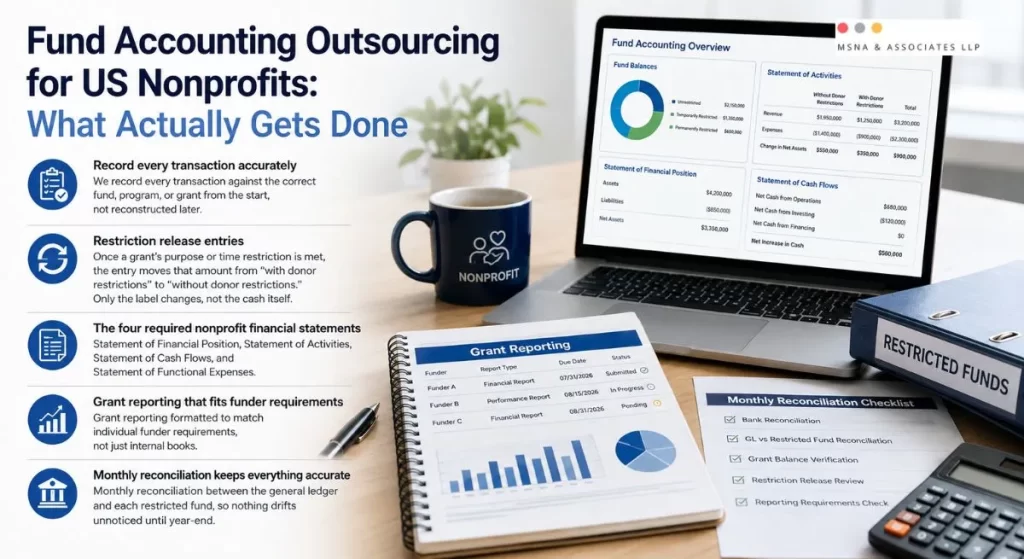
An outsourced fund accounting engagement covers:
- Recording every transaction against the correct fund, program, or grant from the start, not reconstructed later
- Restriction release entries: once a grant’s purpose or time restriction is met, the entry moves that amount from “with donor restrictions” to “without donor restrictions.” Only the label changes, not the cash itself.
- The four required nonprofit financial statements: Statement of Financial Position, Statement of Activities, Statement of Cash Flows, and Statement of Functional Expenses
- Grant reporting formatted to match individual funder requirements, not just internal books
- Monthly reconciliation between the general ledger and each restricted fund, so nothing drifts unnoticed until year-end
The Single Audit Threshold Just Changed, and Not Every Nonprofit Knows Which Rule Applies to Them
What is a Single Audit? It’s an extra, more detailed audit the federal government requires once a nonprofit spends a certain amount of federal grant money in a year. Below that dollar amount, you don’t need one.
What changed: That dollar amount used to be $750,000. As of October 2024, it went up to $1,000,000. On the surface, that’s good news; more nonprofits now fall under the threshold and can skip the Single Audit.
Here’s the confusing part: The new $1,000,000 threshold applies to fiscal years beginning on or after October 1, 2024. A nonprofit whose fiscal year started before that date is still measured against the old $750,000 threshold for that year. So two nonprofits with identical federal spending can land on opposite sides of the audit requirement depending on their fiscal year calendar, not their grant dates.
On top of that, some states run their own, separate audit rules, and those don’t match the federal number either.
State | State Audit Threshold |
California | $2,000,000 |
New York | $1,000,000 (Article 7-A registered organizations) |
Pennsylvania | $750,000 |
Massachusetts / Connecticut | $500,000 |
Rhode Island | $300,000 |
A nonprofit operating across state lines, or registered to solicit donations in more than one state, needs to track the lowest applicable threshold among them, not just the federal number.
How Does Outsourced Accounting for US Nonprofits Support Form 990 Filing?
Form 990 is due the 15th day of the fifth month after fiscal year-end, May 15 for a calendar-year organisation. Missing it costs $20-$105 a day, up to $54,500 for organisations with gross receipts over $1 million. Miss three years in a row, and tax-exempt status is revoked automatically under IRC Section 6033(j), with no warning and no review.
An outsourced accounting team supporting Form 990 doesn’t file the return itself; your CPA or tax preparer still does that part. But they keep the underlying books in a state where the return can actually be prepared accurately and on time:
- functional expense allocation done monthly,
- restricted fund activity properly documented, and
- financial statements ready well before the deadline rather than reconstructed under pressure in April.
How Nonprofit Financial Reporting From India Works?
Indian accounting teams supporting US nonprofits work inside the organization’s existing platform, QuickBooks Online, Sage Intacct, Aplos, or Blackbaud Financial Edge NXT, rather than requiring a switch. The engagement usually runs as staff augmentation: a dedicated accountant or small team working inside the nonprofit’s own fund structure and chart of accounts, under the finance director’s or board treasurer’s oversight, rather than a black-box service handing back numbers with no visibility into how they were produced.
MSNA & Associates LLP is a Bangalore-based Chartered Accountancy firm that has supported outsourced accounting/bookkeeping engagements for US and UAE organizations since 2020.
What Changes After Switching to Outsourced Accounting For US Nonprofits?
The example below is an illustrative scenario built from typical nonprofit finance costs, not a specific named organization.
Here’s a realistic before-and-after picture of what switching to outsourced fund accounting actually looks like for a nonprofit this size.
Before outsourcing:
- $1.8 million annual budget, run by one part-time bookkeeper earning about $32,000 a year
- No dedicated fund accounting expertise on staff
- Restricted grant funds tracked in a separate spreadsheet, outside the actual accounting system
- The Statement of Functional Expenses rebuilt from scratch every year at tax time
- Filing regularly ran past the Form 990 deadline, requiring a costly extension
After moving to outsourced fund accounting:
- Restricted funds tracked directly inside the accounting software, from the moment each transaction happened
- Functional expense allocation done monthly instead of once a year
- Outsourced cost came in close to what the original bookkeeper’s salary had been
- In this scenario, the switch to outsourced fund accounting supported an on-time Form 990 filing and a notably smoother funder audit than in prior years.
What Are The Common Concerns About Outsourced Accounting for US Nonprofits ?
Most of these questions come from board members and funders before they come from the finance team itself, since outsourcing decisions at a nonprofit usually need board-level buy-in.
- Will our board and funders see this as a red flag? Most funders care about accurate, on-time reporting far more than where the bookkeeping physically happens. What matters to them is the output, not the org chart behind it.
- Can an outsourced team really understand fund accounting, not just regular bookkeeping? Look specifically for experience with ASC 958 and nonprofit-specific software, not general small business bookkeeping experience.
- Does this compromise our program-spending ratio? Properly scoped outsourcing usually costs less than a fully loaded in-house hire with the same expertise, which can improve, not worsen, that ratio.
- What happens during an annual audit or Single Audit? An outsourced team that’s kept monthly fund reconciliations current makes the audit faster and less disruptive, since the auditor isn’t waiting on reconstructed records.
Common Mistakes Nonprofits Make With Fund Accounting
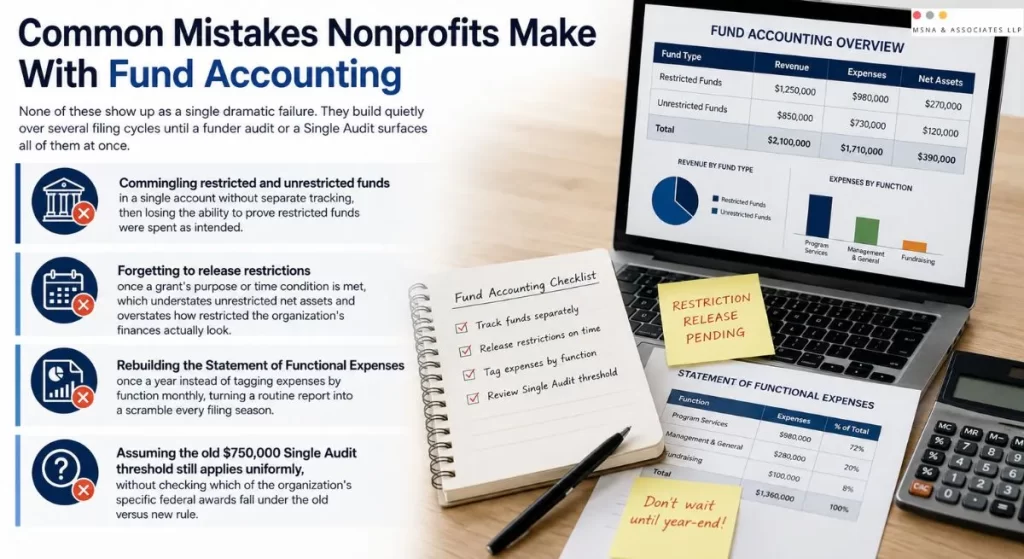
None of these show up as a single dramatic failure. They build quietly over several filing cycles until a funder audit or a Single Audit surfaces all of them at once.
- Commingling restricted and unrestricted funds in a single account without separate tracking, then losing the ability to prove restricted funds were spent as intended.
- Forgetting to release restrictions once a grant’s purpose or time condition is met, which understates unrestricted net assets and overstates how restricted the organization’s finances actually look.
- Rebuilding the Statement of Functional Expenses once a year instead of tagging expenses by function monthly, turning a routine report into a scramble every filing season.
- Assuming the old $750,000 Single Audit threshold still applies uniformly, without checking which of the organization’s specific federal awards fall under the old versus new rule.
Conclusion
Nonprofit accounting carries real regulatory weight, restricted fund obligations, Single Audit thresholds, and a Form 990 deadline with no room for a third miss, that a thin, generalist finance function often can’t carry safely.
If your organization is within 12 months of crossing the $1 million federal-award mark, or your Statement of Functional Expenses still gets rebuilt once a year instead of monthly, that’s the signal to review your fund accounting setup now.
Consulting a professional for outsourced accounting/bookkeeping services to India for US Businesses can help you assess where the gaps are before they show up in a Single Audit or a missed Form 990 deadline.
Strengthen Your Nonprofit Accounting Process
Frequently Asked Questions About Outsourced Accounting For US Nonprofits
Can outsourced accountants in India actually handle US fund accounting correctly?
Yes, when the team has specific ASC 958 and nonprofit compliance experience, not just general bookkeeping. This is worth confirming directly before engaging a provider, since it’s not universal even among firms that offer nonprofit services.
Does outsourcing accounting put a nonprofit's tax-exempt status at risk?
Typically no. In most cases, it lowers that risk, since auto-revocations are usually driven by missed filings from an understaffed finance function, which is the gap outsourcing is meant to close.
What's the real difference between $750,000 and $1,000,000 Single Audit thresholds for our organization?
It depends on when each of your federal awards was issued. Awards from before October 1, 2024 may still fall under the old $750,000 threshold even if your newer awards fall under the new $1 million line.
Will an outsourced team file our Form 990 for us?
Typically no, the filing itself usually stays with your CPA or tax preparer. What outsourcing changes is whether the books feeding that return are accurate and ready well before the deadline.
Related
Discover more from MSNA & Associates LLP
Subscribe to get the latest posts sent to your email.