

The sales call is always the easy part. Every provider can describe the savings and the talent pool. What most companies actually want to know, and what rarely gets a straight answer, is what happens in the weeks between signing the contract and seeing the first clean set of books.
The accounting outsourcing process to India runs through four stages: discovery, onboarding, process transition, and steady-state operations.
Each stage has its own deliverables, its own timeline, and its own set of people responsible for signing off before the engagement moves forward. Skipping or compressing any one of them is usually where the trouble starts later, whether as a reconciliation error, a missed deadline, or a provider unable to explain how a number was arrived at.
Below is a practical walkthrough of each stage, along with the governance structure, realistic timelines, and the questions worth asking a provider before signing.
Accounting Outsourcing Process at a Glance
| Stage | Typical Duration | What Happens | Who’s Involved |
|---|---|---|---|
| Discovery | 1–2 weeks | Scoping workshop, accounting software review, process assessment, and pain-point mapping to define project scope. | Client finance lead, provider transition manager |
| Onboarding | 2–3 weeks | Secure access setup, data migration, NDA execution, document collection, and workflow configuration. | Client accounts team, provider onboarding team |
| Process Transition | 3–5 weeks | Standard Operating Procedure (SOP) creation, parallel accounting run, knowledge transfer, and phased handover of responsibilities. | Both teams working side by side |
| Steady State | Ongoing | Routine bookkeeping, maker-checker workflow, monthly financial close, periodic reconciliations, and quarterly quality assurance reviews. | Assigned accounting team, client approver |
What Is Accounting Outsourcing?
Accounting outsourcing means handing off bookkeeping, reconciliations, payables, receivables, and month-end close to an external accounting team, while the client keeps oversight and final say on decisions.
It’s not about giving up control. A well-run outsourced process keeps the client in the loop through regular reporting and approval checkpoints along the way. The outsourced team simply takes on the transactional work that would otherwise eat up internal finance capacity.If you’re still evaluating whether outsourcing is the right strategic move, explore the Benefits of Outsourcing Accounting to India for US Businesses before planning your transition.
When businesses understand the accounting outsourcing process, they stay in control. They can also hand off daily finance tasks and save time.
Stage 1: What Happens During the Discovery and Scoping Stage?
Every project starts with a discovery workshop, usually just one or two sessions, where the team gets to know how the client currently works.
What discovery typically covers:
- Software in use and existing chart of accounts
- Monthly transaction volume and seasonal spikes
- Current internal controls and approval hierarchy
- Pending audits or compliance deadlines the transition has to work around
- The specific pain point driving the decision to outsource
A detailed discovery phase ensures the accounting outsourcing process is designed around the company’s existing systems, controls, and reporting requirements rather than a generic outsourcing model.
Practitioner note: Rushing discovery to save a week almost always backfires. The team eventually hits an undocumented exception in the books, and fixing it then takes far longer than the time saved upfront. A written scope document, agreed before any transition work starts, is non-negotiable.
Stage 2: Accounting Outsourcing Onboarding and Data Migration
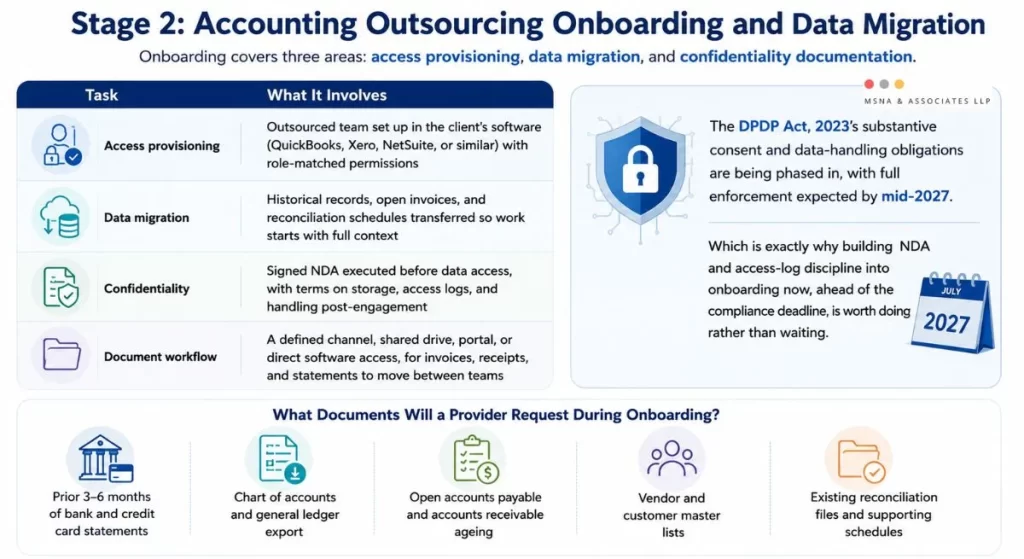
Onboarding covers three areas: access provisioning, data migration, and confidentiality documentation.
| Task | What It Involves |
|---|---|
| Access Provisioning | The outsourced accounting team is onboarded to the client’s accounting software (such as QuickBooks, Xero, NetSuite, or similar) with role-based permissions to ensure secure and appropriate access. |
| Data Migration | Historical financial records, open invoices, customer and vendor balances, and reconciliation schedules are transferred to provide complete financial context from day one. |
| Confidentiality | A Non-Disclosure Agreement (NDA) is signed before any data access, outlining confidentiality obligations, secure data storage, access controls, audit logs, and data handling procedures after the engagement ends. |
| Document Workflow | A structured process is established for sharing invoices, receipts, bank statements, and supporting documents through secure channels such as shared drives, client portals, cloud storage, or direct accounting software access. |
The DPDP Act, 2023’s substantive consent and data-handling obligations are being phased in, with full enforcement expected by mid-2027. Which is exactly why building NDA and access-log discipline into onboarding now, ahead of the compliance deadline, is worth doing rather than waiting.
What Documents Will a Provider Request During Onboarding?
- Prior 3-6 months of bank and credit card statements
- Chart of accounts and general ledger export
- Open accounts payable and accounts receivable ageing
- Vendor and customer master lists
- Existing reconciliation files and supporting schedules
Stage 3: How Does Process Transition and SOP Creation Work?
Once access and data are in place, the outsourced team starts shadowing or taking over specific tasks, typically beginning with lower-risk work like accounts payable before moving into reconciliations and reporting.
SOP creation runs alongside this: standard operating procedures documenting exactly how each task should be performed for that client, covering approval thresholds, coding conventions, and client-specific exceptions. This is what lets the engagement survive a staff change on the provider’s side without the client noticing a dip in quality.
Who owns what during transition:
| Responsibility | Client | Outsourced Team |
|---|---|---|
| Final Approval of Entries and Reports | Owns final review and approval of financial entries, reports, and submissions. | Prepares financial records, reconciliations, and reports for client approval. |
| SOP Sign-Off | Reviews, provides feedback, and approves Standard Operating Procedures (SOPs). | Drafts, documents, and updates SOPs based on agreed workflows. |
| Historical Data Accuracy Check | Confirms the accuracy and completeness of historical financial data. | Reviews migrated records and flags any discrepancies or missing information. |
| Software Access and Permissions | Grants, modifies, and revokes user access and permissions as required. | Uses approved system access strictly within the assigned scope of work. |
| Escalation of Unresolved Issues | Reviews escalated matters, makes decisions, and provides resolutions. | Identifies, documents, and escalates unresolved accounting or operational issues promptly. |
Most providers run a parallel period here, checking the outsourced team’s output against the client’s existing process before full handover. This overlap is what separates a controlled transition from a risky one.
Stage 4: Steady-State Accounting Outsourcing Workflow
Once the accounting outsourcing process finds its steady rhythm, nothing moves forward without passing through a maker-checker check first. This reduces the number of errors and provides an additional layer of assurance prior to the work being delivered to the client.
Month-end closing runs on a fixed reporting calendar agreed during onboarding, with set dates for reconciliations, accruals, financial statement preparation, and management report delivery, removing the guesswork around when numbers will be ready for a board meeting or investor update.
The Time-Zone Question Nobody Answers Clearly
Most outsourcing content is written for domestic outsourcing within the US and skips this entirely. Outsourcing specifically to India adds a working-hours question that deserves a direct answer, not a vague assurance of “24/7 support.”
India Standard Time runs 9.5 to 10.5 hours ahead of US Eastern Time, and 12.5 to 13.5 hours ahead of Pacific Time, depending on whether the US is currently observing daylight saving. India does not adjust its clocks either way.
What this means in practice:
- Real-time overlap with US business hours is narrow unless the provider staggers shift timings deliberately
- Most of the collaboration happens asynchronously: documents queued at the end of the client’s day are worked on overnight and ready by the client’s next morning
- Urgent items need a defined escalation channel rather than reliance on someone happening to be online, which is exactly why an escalation matrix matters more for India-based outsourcing than for a domestic arrangement
- Ask any provider directly what their staffed hours are, not just what time zone they’re headquartered in, before assuming availability matches your calendar
Accounting Outsourcing Process Governance: SLA, Quality Assurance & Escalation
| Element | What It Defines |
|---|---|
| Service Level Agreement (SLA) | Establishes agreed response times, turnaround times for deliverables, accuracy benchmarks, reporting schedules, and service expectations between the client and the outsourced accounting provider. |
| Quality Assurance (QA) | Defines the process for periodic reviews of completed accounting work against approved SOPs, with error rates, compliance, and performance metrics monitored to drive continuous improvement. |
| Escalation Matrix | Specifies the appropriate points of contact, escalation levels, and response timelines for urgent issues such as financial discrepancies, missed deadlines, system failures, or unresolved accounting queries. |
A governance model without a documented escalation matrix tends to break down exactly when it’s needed most, during a tight audit deadline or a year-end crunch. It’s worth confirming this exists in writing before the engagement goes live, not after the first fire drill.
How Do You Know the Transition Is On Track?
Most guidance on outsourcing describes the ideal path. Fewer sources describe what to actually watch for while it’s happening. By week six to eight, this is a reasonable checkpoint:
On track:
- The provider has raised questions about your specific coding conventions, not just generic ones
- Reconciliations are coming back with fewer corrections needed each cycle
- You’ve had at least one conversation about an exception in your books that they caught, not one you had to catch
Worth a direct conversation:
- The SOP still hasn’t been shared for your review past week four
- The same type of error keeps recurring despite being flagged before
- Escalations go to a general inbox rather than a named person with a committed response time
Accounting Outsourcing Process Implementation Roadmap
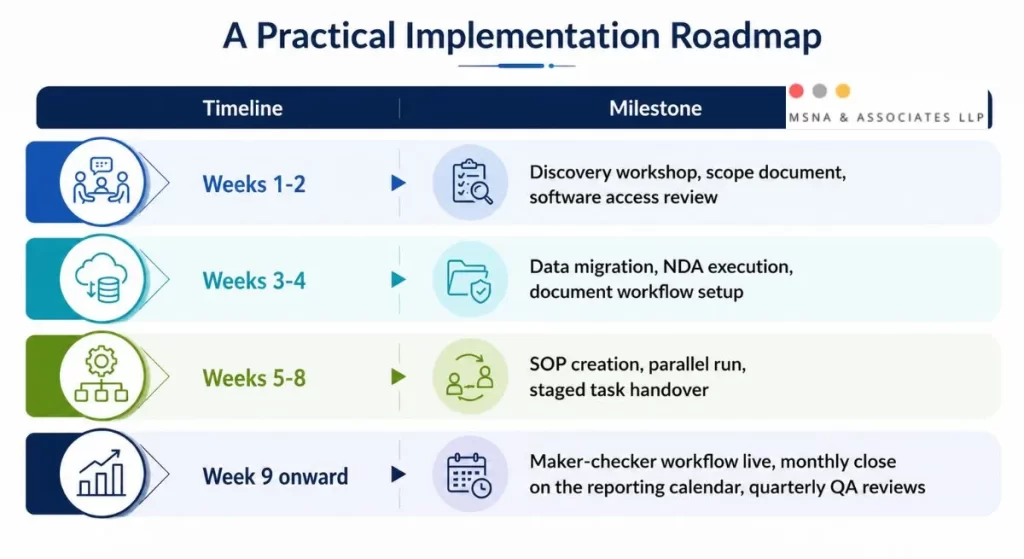
Timeline | Milestone |
Weeks 1-2 | Discovery workshop, scope document, software access review |
Weeks 3-4 | Data migration, NDA execution, document workflow setup |
Weeks 5-8 | SOP creation, parallel run, staged task handover |
Week 9 onward | Maker-checker workflow live, monthly close on the reporting calendar, quarterly QA reviews |
Multiple entities, high transaction volumes, or significant historical cleanup can extend this timeline by several weeks. A provider quoting a fixed timeline before discovery is complete is worth questioning, since the real duration depends on what discovery uncovers.
Companies that treat discovery and SOP creation as formalities often struggle later because the success of an accounting outsourcing process depends on clear governance, documented workflows, and defined accountability from the start. Building the governance model in from day one is what makes outsourced accounting a reliable long-term function rather than a short-term fix.
If you’re evaluating outsourced accounting & Bookkeeping Services to India for UAE businesses, MSNA & Associates helps finance teams build structured onboarding, documented workflows, and clear reporting frameworks from day one. Talking through your specific transition timeline with a provider can help you scope onboarding accurately before you commit to a start date.
Contact us at +91 9036727740 or contact@msna.co.in.
The most common failure point isn’t the provider’s skill. It’s an unclear escalation path. In our experience, engagements run more predictably when the ‘checker’ in the maker-checker workflow is a named person with a committed response time, rather than an assumed role. Given the timezone gap, this matters more here than in a domestic engagement.
Build a Structured Accounting Outsourcing Process
Frequently Asked Questions Related To Accounting Outsourcing Process
How long does the accounting outsourcing onboarding process typically take?
Onboarding through the full process transition generally takes six to eight weeks for a standard engagement, varying with transaction volume and the number of entities involved
Does the client lose control of financial data during outsourcing?
No, Despite the fact that the outsourced team operates within a maker-checker workflow and documented SOPs, the client retains the ultimate approval on reporting and reconciliations.
Is data migration secure during the transition?
Security is designed into each stage, such as a signed NDA, role-based access, and full activity logging. So nothing is left to informal trust.
How much real-time overlap is there with an India-based team?
Given the time difference, live overlap with US hours is naturally limited. Because of that, most collaboration happens asynchronously. But a clear escalation channel is always in place for anything that needs a fast response.
Related
Discover more from MSNA & Associates LLP
Subscribe to get the latest posts sent to your email.