


If your business has outgrown its accountant but a full-time Chief Financial Officer feels premature, the real choice in front of you is usually between a finance manager and a virtual CFO.
A finance manager handles budgeting and day-to-day financial operations, backed by routine MIS. A virtual CFO adds strategic financial leadership, forecasting, and investor-ready reporting, without the cost of a full-time executive.
This guide breaks down the roles, the cost difference, and how to decide which one fits where your business stands today.
At MSNA & Associates, a Bangalore-based Chartered Accountancy firm working with SMEs and startups across India, the UAE, and the US, this is one of the most common questions founders ask once revenue starts moving past the early stage. There is no single right answer. It depends on the complexity of your finances, whether you are raising capital, and how much strategic input your finance function currently gives you.
What Does a Finance Manager Do?
A finance manager sits inside the business and owns the operational side of finance. The role is execution-focused rather than strategy-focused, and it usually reports into a founder or a CEO, or, in larger setups, a CFO.
Common finance manager roles and responsibilities include:
- Preparing and monitoring monthly budgets against actuals
- Managing day-to-day cash flow and working capital
- Overseeing accounts payable, receivable, and reconciliations
- Coordinating with auditors and tax consultants during filings and assessments
- Generating routine MIS reports for internal review
- Supervising the accounts and bookkeeping team
A finance manager is generally strong on financial controls. What the role does not include is board-level strategy, investor communication, capital structuring, or scenario planning for the next 12 to 24 months. That gap is where a virtual CFO usually steps in.
What Is a Virtual CFO?
A virtual CFO, also called an outsourced CFO or fractional CFO, is a senior finance professional who provides CFO-level strategic input on a part-time, retainer, or project basis, instead of as a full-time in-house hire. The scope usually covers financial planning and analysis (FP&A), fundraising support, cash flow forecasting, board and investor reporting, and risk advisory, layered on top of the accounting and compliance work that is already happening.
Where an in-house finance manager keeps the books moving, a virtual CFO interprets what those books mean for the next decision the business needs to make, whether that is pricing, hiring, fundraising, or expansion into a new market.
Outsourced CFO services are structured to scale with the business. Some months may need a few hours of strategic review; a fundraising round or an audit season may need considerably more. That flexibility is one of the main reasons SMEs and growth-stage startups in India increasingly use virtual CFO services rather than hiring a full-time CFO from day one.
Rather than replacing your existing finance team, a Virtual CFO works alongside accountants and finance managers to convert financial data into strategic business decisions. That could mean pinpointing where profitability is actually coming from, tightening up working capital, or working through what an expansion or a fundraising round would mean for the business financially. At the core, it’s about giving founders the numbers-backed context to make that next call with more confidence.
Virtual CFO vs Finance Manager: The Core Differences
| Parameter | Finance Manager | Virtual CFO |
|---|---|---|
| Primary Focus | Manages day-to-day financial operations, accounting, and compliance | Provides strategic financial leadership and long-term financial planning |
| Reporting | Prepares internal MIS, routine financial reports, and operational dashboards | Develops board presentations, investor reports, financial forecasts, and strategic insights |
| Decision Input | Supports operational and day-to-day financial decisions | Advises on capital structure, fundraising, pricing strategy, business expansion, and financial growth |
| Engagement Model | Full-time, in-house employee | Part-time, retainer-based, or project-based engagement |
| Cost Structure | Fixed salary, employee benefits, and overhead costs | Flexible, scalable fee based on the scope of work and engagement hours |
| Typical Business Stage | Suitable for early-stage operations and stable SMEs | Ideal for scaling businesses, pre-fundraising companies, multi-entity organizations, and businesses with complex growth plans |
| Works Well With | An existing CFO or a founder-led finance function | An existing finance manager, accounting team, or finance department |
In the Virtual CFO vs Finance Manager discussion, the two roles are not always direct substitutes. Many growing businesses eventually use both together: a finance manager who runs operations day to day, supported by a virtual CFO who sets the financial direction and represents the business in front of investors, lenders, or the board.
When to Hire a CFO vs When a Finance Manager Is Enough?
Is a finance manager enough for an early-stage business in India, UAE, and the US?
If your business has straightforward revenue, a small team, and compliance needs that your accountant already manages well, a finance manager is usually sufficient. The priority at this stage is accuracy, timeliness, and control over cash, not board-level strategy.
When does a growing business in India, the US, or the UAE need CFO-level input?
If you’re wondering when to hire a CFO, a few signals usually appear together.
- You are preparing for a fundraising round and need an investor-ready financial model
- Cash flow has become harder to predict as revenue or operations scale
- You are entering multiple states, entities, or business lines and need consolidated reporting
- Lenders or investors are asking for financial projections you are not currently able to produce internally
- Margins are under pressure, and you need a structured view of where the leakage is happening
- The business is preparing for a stake sale, merger, or significant restructuring
If two or more of these apply, it is worth having a conversation about whether a virtual CFO should be layered on top of your existing finance team, rather than waiting until the gap becomes a problem during due diligence or a board meeting.
If you want to talk through where your business currently stands on this spectrum, you can reach MSNA & Associates at +91 9036727740 for an initial conversation.
Illustrative Example: How the Two Roles Work Together
Consider a manufacturing SME expanding from one state into another. The in-house finance manager continues handling day-to-day compliance and cash management, while a virtual CFO builds the cash flow forecasts and lender-ready projections the expansion needs. Neither role replaces the other. The finance manager keeps operations running, and the virtual CFO adds the forward-looking view that expansion decisions require.
“One mistake we frequently see is founders delaying strategic financial leadership until investors ask difficult questions. By that stage, financial reporting often needs significant restructuring. Bringing in CFO-level expertise earlier usually makes fundraising and expansion considerably smoother.”- Naveen S N, Partner, MSNA & Associates LLP
Virtual CFO vs Finance Manager Cost Comparison
Cost is usually the deciding factor, and it is worth comparing on a full-cost basis rather than salary alone.
Glassdoor’s 2026 India data puts in-house finance manager pay between ₹9 lakh and ₹22.6 lakh a year. That’s base salary only; once PF, gratuity, insurance, and workspace costs are factored in, the real cost to the business runs higher.
An outsourced CFO services engagement, by comparison, is generally structured as a retainer or an hours-based fee tied to the scope of work agreed with the firm. Because there is no full-time salary, benefits, or long-term employment commitment attached, the cost of a virtual CFO scales up or down with what the business actually needs in a given quarter.
For a business that needs strategic decision support a few days a month rather than a full-time executive, this usually works out more cost-efficient than hiring a full-time CFO, while still costing more than relying on a finance manager alone for services outside their scope. For US and UAE-based founders with an India entity, virtual CFO retainers are billed in INR, usually a meaningful cost advantage over engaging a US or UAE-based fractional CFO directly.
| Factor | Finance Manager | Virtual CFO |
|---|---|---|
| Salary | High fixed salary | No salary commitment |
| Employee Benefits | Included (PF, insurance, leave, bonuses, etc.) | Not applicable |
| Office Cost | Requires office space, equipment, and overhead | No additional office or infrastructure cost |
| Strategic Planning | Limited involvement in long-term strategy | Extensive strategic planning and financial guidance |
| Investor Support | Typically not involved | Supports fundraising, investor reporting, due diligence, and board meetings |
| Scalability | Low – capacity limited to one employee | High – services scale based on business needs and growth |
Virtual CFO vs Finance Manager: Which One Should You Choose?
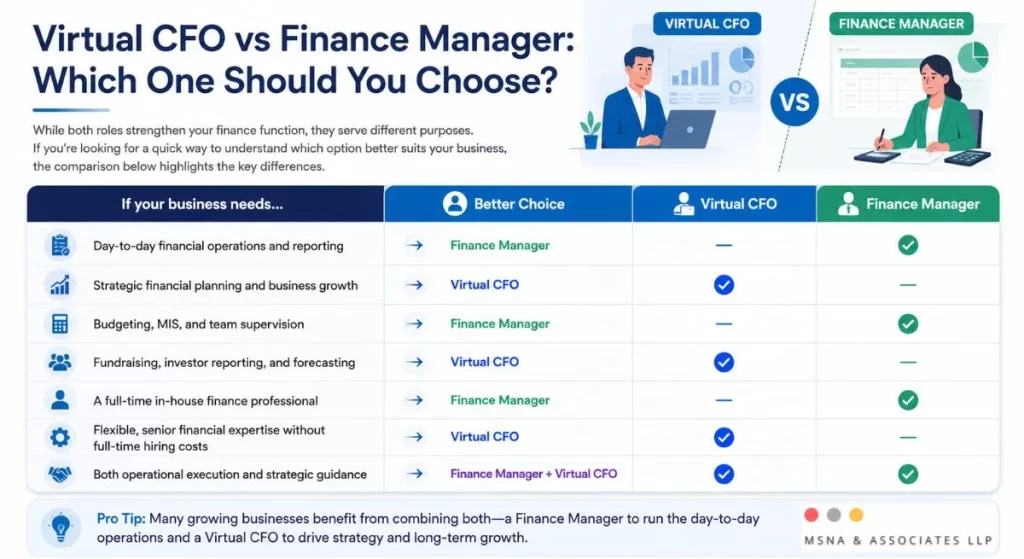
While both roles strengthen your finance function, they serve different purposes. If you’re looking for a quick way to understand which option better suits your business, the comparison below highlights the key differences
| If Your Business Needs… | Better Choice |
|---|---|
| Day-to-day financial operations and reporting | Finance Manager |
| Strategic financial planning and business growth | Virtual CFO |
| Budgeting, MIS reporting, and finance team supervision | Finance Manager |
| Fundraising, investor reporting, financial modeling, and forecasting | Virtual CFO |
| A full-time in-house finance professional | Finance Manager |
| Flexible access to senior financial expertise without full-time hiring costs | Virtual CFO |
| Both operational execution and strategic financial guidance | Finance Manager + Virtual CFO |
What are the fractional CFO Benefits for SMEs and Startups in India, UAE, and the US
Engaging a fractional or virtual CFO offers several practical advantages over the binary choice of hiring a full-time CFO or managing without one. Businesses exploring Virtual CFO Services in India often choose this model because it combines strategic financial expertise with flexibility and cost efficiency.
1. Access to senior expertise without a full-time cost commitment.
The business gets CFO-level judgment applied to its numbers without carrying a full-time executive salary.
2. Faster scalability.
The engagement can expand around a fundraising round, audit, or expansion phase, and scale back down once that phase is complete.
3. Objectivity.
An external CFO reviews the numbers without the internal pressures that can sometimes soften how issues get flagged to founders.
4. Continuity during transitions.
If a finance manager or in-house CFO moves on, a virtual CFO can hold the reporting together while the business finds their replacement.
When Does Appointing a CFO Become a Legal Requirement in India?
Here’s where it stops being optional: once a public company’s paid-up capital crosses ₹10 crore, or if it’s listed, Section 203 of the Companies Act, 2013 requires a whole-time CFO as Key Managerial Personnel. That’s under the Companies (Appointment and Remuneration of Managerial Personnel) Rules, 2014.
Private companies below this threshold are generally not required to appoint KMP under Section 203 unless they choose to do so voluntarily. For most SMEs and early-stage startups, this means the decision to bring in CFO-level support, whether through a finance manager, an outsourced CFO, or eventually a full-time CFO, is a business decision well before it becomes a compliance requirement.
“The mistake we see most often is founders treating this as an either-or decision made once and never revisited. A finance manager and a virtual CFO solve different problems. As the business changes, whether that’s a fundraising round or entry into a new state, it’s worth reassessing whether the finance function still matches what the business needs from it.” – Naveen S N, Partner, MSNA & Associates LLP
Common Mistakes When Choosing Between a Finance Manager and a Virtual CFO
- Waiting too long to bring in strategic input.
Businesses often reach out for virtual CFO support only once a lender or investor has already asked a question they cannot answer, rather than before that conversation happens.
- Assuming a finance manager can absorb CFO-level work.
A capable finance manager can grow into some of this over time, but financial forecasting, capital structuring, and investor reporting are a different skill set from day-to-day operational finance.
- Treating virtual CFO services as a replacement for accounting support.
A virtual CFO works on top of accurate books, not instead of them. If the underlying bookkeeping is inconsistent, CFO-level reporting will inherit those gaps.
Conclusion
Choosing between a Virtual CFO vs Finance Manager isn’t about deciding which role is better. Really, it comes down to what your business needs right now. A finance manager keeps operations tight and under control. A virtual CFO brings the strategic view that helps that growth hold up over time.
Most SMEs land somewhere in between, using both together as they scale. If you’re not sure which shape fits yours, MSNA & Associates can take a look at your finance function and talk through what makes sense.
Need Guidance on Your Finance Function?
FAQ's Related To Virtual CFO and Finance Manager
Can a virtual CFO replace a finance manager?
Not usually. A virtual CFO adds strategic financial leadership on top of the day-to-day operational work a finance manager already handles.
How much does a virtual CFO cost for an SME in India?
Virtual CFO fees scale with scope, not a fixed salary. A few hours of monthly review costs far less than full support during a fundraising round or audit season. Industry data puts virtual CFO retainers in India between ₹30,000 and ₹1.5 lakh a month, depending on business size and scope.
When should a growing business hire a virtual CFO instead of a finance manager?
Once the finance function needs to support fundraising, multi-entity consolidation, or investor and lender reporting, it’s time to layer in a virtual CFO.
Does a startup legally need to appoint a CFO in India?
The only companies that have to hire a full-time CFO are either listed firms or public firms whose paid-up capital is equal to or above ₹10 crores, as per Section 203 of the Companies Act, 2013. Private companies below that threshold can appoint one voluntarily.
Can a US or UAE-based business use an Indian virtual CFO?
Yes. Many US and UAE-based founders with an India entity, subsidiary, or outsourced finance function work with an India-based virtual CFO for cost efficiency and local regulatory expertise, while keeping day-to-day finance operations onshore.
Related
Discover more from MSNA & Associates LLP
Subscribe to get the latest posts sent to your email.