

Every business owner has felt it: the books show a profit, yet the bank balance tells a different story.
A management information system for business (MIS) closes that gap by turning raw accounting entries into timely, decision-ready reports, so owners see cash, margins and risks while there is still time to act. On its own, though, an MIS only shows numbers. A Virtual CFO interprets them, tests assumptions and converts them into decisions.
This guide explains how the two work together for Indian SMEs and startups in 2026, including GST, TDS and MSME payment rules. You will see which metrics to track and how to build a reporting rhythm that improves financial visibility.
Key Takeaways
- A management information system for business answers “where do we stand?”
- A Virtual CFO decides the next move once the numbers show where things stand.
- Timeliness matters as much as accuracy: a report that arrives after the decision date has little value.
- A good financial MIS links profit, cash, working capital and business KPIs in one pack.
- India-specific layers (MSME payables, GST reconciliation, statutory due dates) are often missing from generic templates.
- Virtual CFO services add the interpretation layer: variance reasons, forecasts and recommended actions.
- Start lean. A simple monthly pack reviewed consistently beats a complex dashboard nobody opens.
What Is a Management Information System for Business?
A management information system for business is a structured process that collects data from accounting, banking, sales and operations, then presents it as regular reports for management. In practice, business MIS usually means a monthly pack plus a management dashboard for weekly or daily checks.
How Is MIS Different From Normal Accounts?
The two serve different readers and run on different clocks, as the table shows.
Aspect | Statutory accounts | Business MIS |
Purpose | Compliance, audit, tax | Decisions and performance monitoring |
Timing | Quarterly or annual | Monthly, weekly or live |
Format | Prescribed by law | Tailored to the business |
Audience | Auditors, regulators | Owners, CEOs, finance heads |
Looks at | Past results | Past results plus forecast |
Both matter. Statutory financial reporting proves what happened; MIS helps management decide what happens next.
Why Does Financial Visibility Matter More in 2026?
In 2025, tech startup funding fell about 25% in the first half compared with the same period a year earlier, and investors now expect dependable financial figures before committing money. The data points below come from Treelife’s April 2026 analysis of the Indian startup ecosystem, drawing on public datasets, with the startup count cross-checked. The data points below come from Treelife’s April 2026 analysis of the Indian startup ecosystem, drawing on public datasets.
Indicator | Reported figure | Why it matters for MIS |
DPIIT-recognised startups (Dec 2024) | 1,57,000+ | More competition for the same capital |
Startup closures, Jan–Oct 2025 | 11,223 (10 months), Full year 2024: 8,649 | Cash discipline is a survival issue |
Tech startup funding, H1 2025 | US$4.8 billion (about 25% lower year on year) | Investors weigh cash flow over burn |
Recommended runway for Indian startups | 18–24 months | Needs a monthly runway view |
Virtual CFO retainer range (reported) | ₹15,000–₹1,00,000 per month | Versus ₹30–80 lakh a year for a full-time CFO |
Source: Treelife, MIS Reports for Startups. Startup-specific figures also sit alongside official programme data at Startup India.
Our reading: these numbers describe startups, but the lesson applies to every growing SME. Visibility problems rarely come from missing data. They come from data that arrives late, in the wrong shape, with nobody accountable for acting on it.
In What Ways Does a Well-Built MIS Keep Management Informed on Financial and Operational Performance?
An effective financial MIS works because of three design choices: the right components, the right metrics and a disciplined close calendar.
Which Core Components Should a Business MIS Include?
Component | What it shows | Decision it supports |
Revenue summary | Sales by product, customer or region | Where to push or pause |
Expense breakdown | Fixed vs variable costs against budget | Cost control |
Profitability view | Gross and contribution margin | Pricing and mix |
Cash flow and runway | Inflows, outflows, 13-week forecast | Funding and payment timing |
Working capital | Receivables, payables, inventory days | Credit terms |
Budget vs actual | Variance with reasons | Course correction |
Compliance tracker | GST, TDS, PF, ROC status | Penalty avoidance |
This is the backbone of management reporting. Trim it for a small team; extend it as complexity grows.
Which Business KPIs Belong on a Management Dashboard?
A management dashboard should fit on one screen. Pick five to eight business KPIs by model:
Business model | Suggested KPIs |
Trading or D2C | Gross margin, inventory days, return rate, average order value |
Manufacturing | Cost per unit, yield, receivable days, payable days |
Services | Utilisation, realisation, billing vs target, receivable ageing |
SaaS or subscription | MRR, churn, CAC payback, net revenue retention |
All businesses | Cash balance, runway, EBITDA margin |
How Fast Can a Monthly Close Run?
Timeliness is where many teams lose value. This illustrative close calendar shows how MIS reporting can reach management in the first week.
Working day | Activity | Output |
Day 1–2 | Bank, GST and vendor reconciliations | Clean ledgers |
Day 3 | Accruals, provisions, payroll booking | Closed books |
Day 4 | Variance analysis, KPI refresh | Draft pack |
Day 5 | Virtual CFO review and commentary | Final MIS pack |
Day 6–7 | Management review meeting | Decisions and owners |
Our view: five days is a realistic target for a business with tidy systems, though it depends on transaction volume and how well bank and vendor data arrive.
How Does a Virtual CFO Turn MIS Reporting Into Decisions?
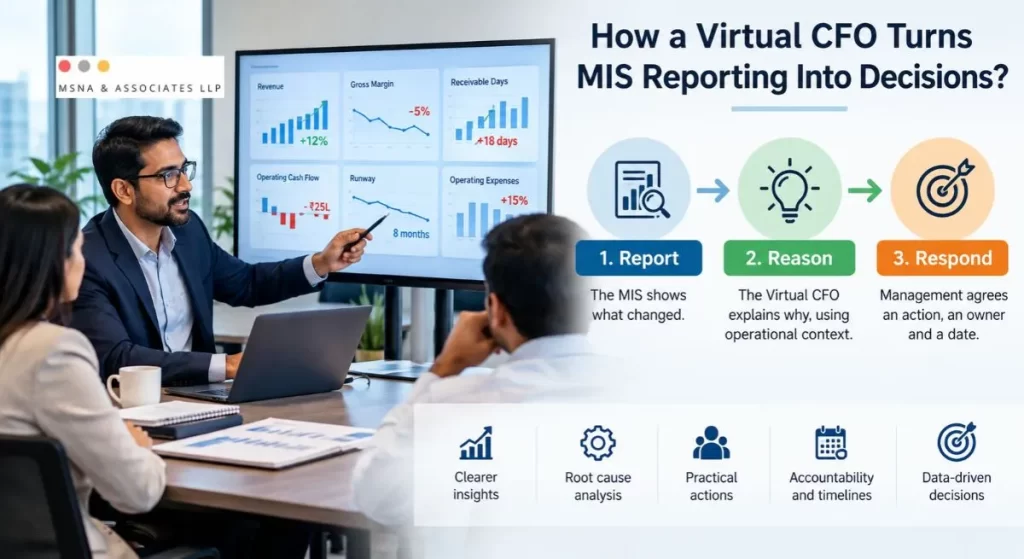
This is where a Virtual CFO adds value. A Virtual CFO is an experienced finance professional engaged part-time, typically a Chartered Accountant, who owns the interpretation layer. You can see how MSNA structures its Virtual CFO services in India for founder-led businesses.
What Is the Report, Reason, Respond Loop?
- Report: the MIS shows what changed.
- Reason: the Virtual CFO explains why, using operational context.
- Respond: management agrees an action, an owner and a date.
This loop is the practical engine of data-driven decisions. Without the second and third steps, an MIS becomes an archive.
What Does the Virtual CFO Do With a Warning Signal?
Each warning signal below leads to a question the Virtual CFO asks before recommending any action.
Signal in the MIS | Likely causes | Question the Virtual CFO asks | Possible action |
Gross margin falls | Price discounts, input cost rise | Is it one product or all? | Reprice or renegotiate |
Receivable days rise | Weak follow-up, large customer delays | Which customers drive it? | Tighten credit terms |
Runway shrinks | Hiring ahead of revenue | Which hires are revenue-linked? | Phase hiring |
Overspend with flat sales | Poor budget control | Was the spend approved? | Reset budget owners |
Profit up, cash down | Stock build, slow collections | Where is cash stuck? | Working capital plan |
A typical pattern: An illustrative scenario: a manufacturing SME shows a healthy profit in its monthly pack, yet operating cash turns negative. The MIS points to receivable days stretching month after month. The Virtual CFO traces the delay to two slow-paying customers, and management resets their credit terms and sets a weekly collection follow-up.
For deeper decision frameworks, see MSNA’s financial decision making service.
Accountant, Virtual CFO or In-House CFO: Who Does What?
The three roles overlap in places, but each owns a different part of the finance function.
Role | Primary focus | Typical engagement |
Accountant | Recording, reconciliation, filings | Daily or monthly |
Virtual CFO | MIS, forecasting, cash, strategy support | Part-time retainer |
In-house CFO | Full finance leadership, board and treasury | Full-time employee |
The Virtual CFO sits on top of the accounting spine; it does not replace it. A Virtual CFO also does not take over directors’ statutory responsibilities under the Companies Act, 2013.
Which India-Specific Layers Do Most MIS Templates Miss?
Generic templates come from global software. Indian businesses need extra lines. This is a differentiator we recommend adding.
Layer | Why it matters | What to track |
MSME payables (Section 43B(h), Income-tax Act, 1961, and Section 37(2)(g), Income-tax Act, 2025) | Under Section 43B(h) of the Income-tax Act, 1961 (up to tax year 2025-26) and Section 37(2)(g) of the Income-tax Act, 2025 (from tax year 2026-27), amounts owed to micro and small enterprises beyond the MSMED Act, 2006 time limit are deductible only when actually paid. The time limit is 15 days, or up to 45 days with a written agreement, counted from the day of acceptance or deemed acceptance. The Finance Ministry confirmed the link between the two sections in a Parliament reply on 21 July 2026. | Payable ageing by MSME status and Udyam registration |
GST input credit | Mismatch between GSTR-2B and books can block credit | Monthly reconciliation gap |
Statutory dues | Late TDS, PF or GST attracts interest and penalty | Due-date calendar with status |
Audit trail in accounting software | Rule 3(1) of the Companies (Accounts) Rules, 2014 requires accounting software with an audit trail that cannot be disabled. Auditors report on it under Rule 11(g). | Confirm the feature is active for all books |
Foreign-linked operations | FX and parent reporting needs | Currency-wise view |
KPMG’s review of audit trail reporting found modified reporting in 55 of the 93 companies it analysed for FY25. Cited causes included the feature not being enabled at software level and the feature being ineffective in operation.
Check current provisions on the Income Tax Department portal, the GST portal and the Ministry of Corporate Affairs site. Rules change, so confirm applicability for your case.
Businesses serving overseas parents can also review MSNA’s guidance on outsourcing accounting for US businesses and UAE businesses.
How Should You Age MSME Payables Under Section 43B(h) and 37(2)(g)?
Ageing payables by supplier status shows which bills put the deduction at risk.
Ageing bucket | Status | Suggested monthly action |
0 to 15 days | Within the default limit | Schedule payment on due date |
16 to 45 days | Allowed only with a written agreement | Confirm the agreement exists; prioritise payment |
45+ days | Deduction at risk | Pay before year end; flag to the Virtual CFO |
Where Does Your Business Stand on MSNA’s MIS Maturity Model?
Use this model to self-assess your current reporting level.
Level | Stage | Typical signs | Next step |
1 | Reactive | Books closed after year end; bank balance guides decisions | Monthly close |
2 | Compliant | Monthly books, no analysis | Add budget vs actual |
3 | Informed | Monthly financial MIS with KPIs | Add forecast and commentary |
4 | Predictive | Rolling forecast, live management dashboard | Scenario planning |
Many growing SMEs sit at Level 2, with monthly books but little analysis. Moving up a level depends more on process and ownership than on new software.
What Common Mistakes Weaken Business MIS?
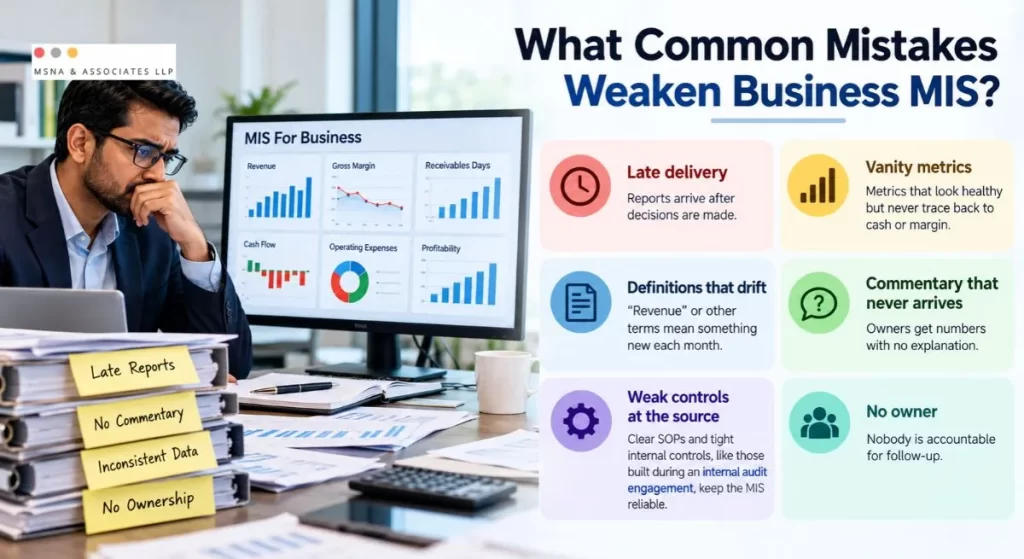
Most reporting failures trace back to a handful of avoidable habits, listed below.
- Late delivery: reports arrive after decisions are made.
- Vanity metrics that look healthy but never trace back to cash or margin.
- Definitions that drift, so “revenue” quietly means something new each month.
- Commentary that never arrives, leaving owners with numbers and no explanation.
- Weak controls at the source. Clear SOPs and tight internal controls, like those built during an internal audit engagement, are what keep the MIS reliable.
- No owner: nobody is accountable for follow-up.
When Does a Business Need a Management Information System and Virtual CFO?
The approach has limits, and these situations call for a lighter or different setup.
- Very early stage: a one-page cash and runway sheet may be enough.
- Stable micro business: quarterly review may be sufficient.
- Poor books: fix bookkeeping first; MIS built on weak data misleads.
- Engagement is optional: unlike a statutory auditor, a Virtual CFO is a commercial choice, not a legal requirement for private companies.
Expert Insights on Management Information Systems for Business and Financial Performance
A practitioner’s view from MSNA’s partner shows how to keep reporting useful rather than merely detailed.
“Owners often ask for a bigger dashboard when what they need is a smaller question: what decision is this report meant to support? When every KPI is tied to a decision and an owner, financial visibility improves quickly, even with simple tools.”
— CA Naveen, Partner, MSNA & Associates LLP
Perspective: technology now automates categorisation and reconciliation, which frees professional time for judgement. Judgement is still the scarce input in good performance monitoring.
How Can You Start in 90 Days?
A phased plan keeps the first quarter practical and avoids over-building.
Phase | Focus | Outcome |
Days 1–30 | Diagnostic of books, chart of accounts, data sources | Clean base |
Days 31–60 | Design MIS reporting pack and KPI definitions | First monthly pack |
Days 61–90 | Add forecast, dashboard and review cadence | Routine decisions |
Conclusion on Management Information System for Business
A well-designed management information system for business gives management one trusted view of profit, cash and risk. A Virtual CFO makes that view actionable by explaining variances and agreeing next steps. Together they move a business from reacting to planning.
For Indian SMEs, the value grows when the pack also carries local layers such as MSME payables under Section 43B(h) and Section 37(2)(g), GST reconciliation and statutory due dates.
You do not need a complex dashboard to begin. A lean monthly pack that reaches the owner in the first week, clear KPI definitions and one person accountable for follow-up will deliver more than any new software.
Consulting a Chartered Accountant can help you work out which maturity level your reporting sits at today and what the first step should be.
Improve Financial Visibility With a Structured MIS
Frequently Asked Questions About Management Information System for Business
What is a management information system for business in simple terms?
A management information system for business is a regular set of reports and a dashboard that turns accounting, banking and sales data into decision-ready information. Owners see profit, cash, margins and risks every month, so they can act while there is still time to change the outcome.
How is MIS different from financial statements?
Financial statements meet legal, tax and audit needs and follow a prescribed format. MIS is built around what management needs to decide, so it carries forecasts, cash views and operational KPIs alongside the financials. Both draw on the same books, which is why clean accounting comes first.
How often should business MIS be prepared?
Most SMEs review a full MIS pack monthly and check cash weekly. Faster-moving or larger businesses may add a daily dashboard for sales and cash. The right rhythm is the one the team will actually use, because a report nobody reviews adds cost without adding visibility.
Can a small business use a Virtual CFO for MIS?
Yes. Engagements are usually scoped to size and stage, so a small business can begin with a one-page cash and margin summary reviewed monthly. As transactions and the team grow, the pack can add forecasts, KPIs and a management dashboard in stages.
Does a Virtual CFO replace my accountant?
No. The accountant maintains records, reconciliations and filings. The Virtual CFO builds on those records for analysis, forecasting and planning. Reliable books are the base the Virtual CFO works from, so the two roles complement each other.
Related
Discover more from MSNA & Associates LLP
Subscribe to get the latest posts sent to your email.