


If you are buying, selling or merging a company in India in 2026, tax due diligence shows what the target may owe, what tax authorities could still raise, and how the deal can be structured to allocate that risk. It is a structured review of a target’s tax records, filings, disputes and positions before signing. Because the Income-tax Act, 2025 replaced the Income-tax Act, 1961 on 1 April 2026, many live deals now sit across two regimes, so price, structure and indemnities should reflect both.
Which tax exposures may not appear on a target’s balance sheet? This guide explains how tax due diligence finds them, how findings can translate into price, structure and contractual protection, and what changes when a deal spans both tax Acts.
Key Takeaways
- Tax due diligence quantifies exposure so a buyer can adjust price, change structure or reconsider the deal.
- Indemnities should name the correct Act: the Income-tax Act, 1961 for years up to FY 2025-26, and the Income-tax Act, 2025 from FY 2026-27.
- For amalgamations and reorganisations effected on or after 1 April 2025, inherited losses can be carried forward for only eight assessment years.
- Common sources of post-closing tax exposure include unprovided past liabilities, GST gaps and unresolved disputes.
What Is Tax Due Diligence in Mergers and Acquisitions?
Tax due diligence is a focused examination of a target’s direct tax, indirect tax and transfer pricing position, run alongside financial, legal and commercial diligence. The review normally spans direct tax (demands, assessments, appeals, withholding), indirect tax (GST registrations, returns, input credit), transfer pricing, and the tax efficiency of the proposed structure.
How does a buy-side tax review differ from a sell-side review?
A buy-side review is commissioned by the acquirer to price risk and shape the share purchase agreement. A sell-side (vendor) review is commissioned by the seller to identify and address issues before buyers see the data room, which can help buyers decide faster.
Why Does Tax Due Diligence Matter More in 2026?
Three things make 2026 different: one deal can now fall under two tax Acts, inherited losses expire sooner after a merger, and there are fewer deals but bigger ones.
How do the 1961 and 2025 Acts split a deal that spans 1 April 2026?
Income up to 31 March 2026 continues under the 1961 Act, while income from 1 April 2026 falls under the 2025 Act.
Section 536(2)(c) of the 2025 Act preserves the old law for proceedings relating to years up to FY 2025-26, so a notice issued in 2027 for an older year can still be handled under the 1961 Act.
Section numbers changed almost everywhere. Confirm every reference against the Income Tax Department portal before it goes into a contract.
Topic | Income-tax Act, 1961 | Income-tax Act, 2025 |
Loss carry-forward in amalgamation or demerger | ||
Slump sale: computation | ||
Slump sale: definition | ||
Reassessment | Sections 147 to 153 | Sections 279 to 286 |
The mapping follows published section-mapping tables for the 2025 Act. Published tables can lag amendments, so treat them as a navigation aid.
What is the eight-year cap on loss carry-forward after amalgamation?
For amalgamations and reorganisations effected on or after 1 April 2025, inherited losses can be carried forward for no more than eight assessment years from when the original predecessor first computed them. The rule sits in Section 72A(6B) of the 1961 Act, and SCC Online reports that the Finance Act, 2026 left it untouched. If the target was in losses for five years before the merger, perhaps only three of the eight permitted years remain, so any deferred tax asset tied to those losses should be valued conservatively.
Are deals getting fewer but larger in 2026?
LSEG reports H1 2026 deal value, covering any Indian involvement including outbound, of US$86.9 billion, up 31%, while volume fell 8%. BCG’s India M&A 2026 analysis shows volume down about 20% from January to July. The two sources use different methods and periods, so read them as directional.
LSEG reports H1 2026 deal value of US86.9billion(anyIndianinvolvement,includingoutbound),up31%,whilevolumefell8%.BCGreportsthatIndiadealvolumefellabout20%inJanuary–July2026whiledealvaluewasbroadlyflat(down2%),withdealsaboveUS1 billion making up half of that value. The two sources use different methods and periods, so read them as directional.
What Key Risks Does a Tax Risk Assessment Uncover?
A disciplined assessment commonly sorts exposure into five buckets.
1. Historical liabilities:
Unpaid taxes, short-deducted TDS and late payments attract interest and penalties. Section 149 of the 1961 Act sets the deadline for a reassessment notice at three years and three months after the end of the relevant assessment year, as the Income Tax Department’s text of the section shows. Where the Assessing Officer holds documents or evidence showing that the income escaping assessment is ₹50 lakh or more, that outer limit moves to five years and three months.
Older years can follow different transitional limits, and earlier years can still be reopened under the 1961 Act after 1 April 2026, so confirm the limit year by year.
2. Assessments and litigation:
Open assessments, disputed demands and pending appeals shape contingent liability. Check whether provisions in the accounts match the realistic outcome of each dispute.
3. GST compliance:
Most GST trouble starts where the books and the returns disagree. Check input credit claims, how goods and services were classified, and reverse charge. If the target is merging, any credit left in its electronic credit ledger can move to the merged entity under Section 18(3) of the CGST Act, using Form GST ITC-02. The latest forms are on the CBIC website.
4. Deferred tax:
Book profit and taxable profit rarely match, usually because of depreciation. The gap lowers the company’s net asset value and points to tax that will have to be paid in cash later.
5. Transfer pricing and valuation:
Deals between related parties need to be priced as if the two sides were strangers. Issuing or transferring shares at a value that strays from the prescribed method is another common cause of disputes.
Risk area | What reviewers test | Likely deal impact |
Historical liabilities | Payment and filing trail | Price adjustment or escrow |
Pending disputes | Demand orders, appeal status | Specific indemnity |
GST | Return-to-books reconciliation | Condition precedent |
Deferred tax | Timing differences, loss usability | Valuation adjustment |
Transfer pricing | Documentation, benchmarking | Warranty plus indemnity |
How Does the Tax Due Diligence Process Work?
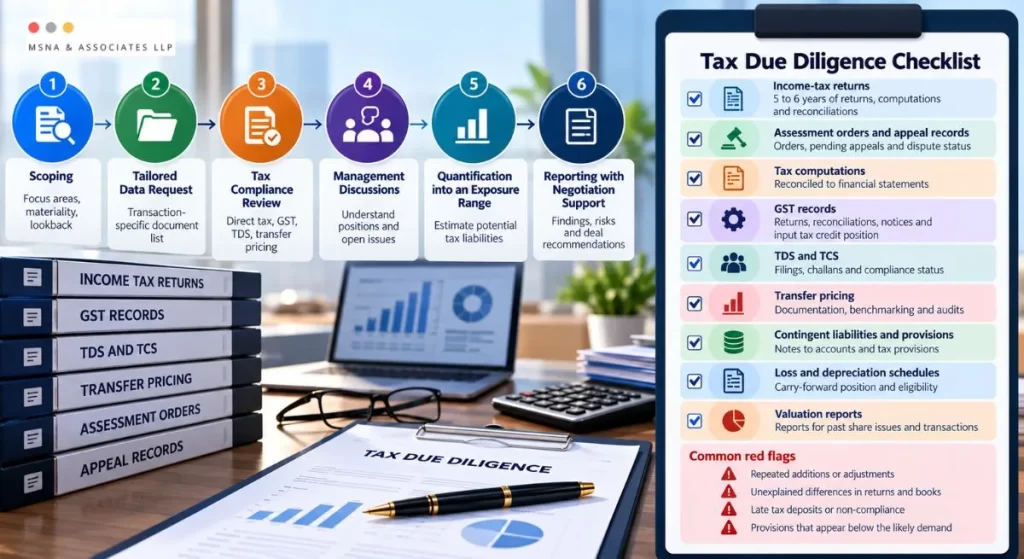
The process runs in six stages:
- Scoping (focus areas, materiality, lookback)
- Tailored data request
- Tax compliance review
- Management discussions
- Quantification into an exposure range
- Reporting with negotiation support
To see how these steps apply to a specific transaction, read our guide to startup due diligence support.
What should a tax due diligence checklist include?
A practical checklist covers returns, assessment orders and appeal records for five to six years; tax computations reconciled to books; GST returns, reconciliations and notices; TDS and TCS filings with challans; transfer pricing documentation; contingent liability notes and tax provisions; loss and depreciation schedules; and valuation reports for past share issues. Red flags include repeated additions, unexplained differences, late deposits and provisions below the likely demand.
How Do You Read a Tax Due Diligence Report?
A good report ranks findings by severity and attaches a rupee number to each.
A red, amber and green rating keeps negotiations factual: red means a probable, quantifiable liability (price adjustment or special indemnity), amber a possible liability with a defensible position (escrow or specific warranty), and green a remote risk (general warranty cover).
What does this look like in practice? (Illustrative example)
The figures below are hypothetical and show only how findings map to deal levers.
Finding (hypothetical) | Rating | Possible lever |
GST input credit of ₹1.2 crore claimed on invoices the supplier never reported; show cause notice pending | Red | Specific indemnity plus escrow |
TDS short-deducted on contractor payments, ₹15 lakh including interest | Amber | Specific warranty and pre-closing rectification |
Transfer pricing documentation complete and benchmarked | Green | General tax warranty |
Carried-forward losses of ₹4 crore, of which ₹1.5 crore falls outside the eight-year window | Red for that portion | Exclude it from the tax asset valuation |
How Does Tax Structuring in M&A Protect Deal Value?
Structuring decides who inherits liabilities, who earns depreciation benefits and when tax falls due.
Route | Tax position | Watch point |
Share purchase | Liabilities stay inside the company | Needs the strongest indemnity |
Asset or slump sale | Buyer takes assets or an undertaking; most liabilities stay with the seller | Seller’s capital gains; GST and stamp duty need separate review |
Amalgamation | Can be tax-neutral when statutory conditions are met | Loss limits and post-merger conditions |
Demerger | Tax-neutral only if the scheme meets the statutory definition. Under the 2025 Act, a fast-track demerger under Section 233 of the Companies Act, 2013 falls outside it | Scheme must fit that definition |
Court approval alone does not make a merger tax-neutral. The scheme must meet the Income-tax Act definition, and the fast-track route under Section 233 of the Companies Act, 2013 does not remove that requirement, as SCC Online’s analysis discusses.
Under Section 2(1B) of the 1961 Act, shareholders holding not less than three-fourths in value of the amalgamating company’s shares must become shareholders of the amalgamated company, excluding shares already held by the amalgamated company, its nominee or its subsidiary. Section 72A loss relief needs its own conditions met, and a later breach can create deemed business income in the year of breach.
Should the seller obtain an income tax NOC?
Section 499 of the Income-tax Act, 2025 (erstwhile section 281 of the 1961 Act) can expose a transfer to being treated as void against the tax department where the seller has pending proceedings or outstanding dues. In asset or slump sales, buyers often make a clean tax position or an NOC a closing condition. Counsel should confirm how it applies to the specific assets.
“Buyers often spend weeks on price and hours on structure. Yet structure often decides who inherits a notice for a year the business has long closed. Tax due diligence should feed the structuring conversation from day one, well before the term sheet hardens.” — Naveen S N, Chartered Accountant, MSNA & Associates LLP
How Do Tax Indemnity Clauses and Warranties Turn Findings Into Protection?
Findings matter only when the share purchase agreement reflects them.
Finding | Price lever | Contract lever | Closing lever |
Probable, quantified liability | Reduce price | Specific tax indemnity | Escrow or retention |
Possible dispute | Hold back part of price | Specific warranty | Disclosure schedule |
Late or unfiled returns | None | Warranty on filings | Condition precedent |
Unverifiable loss claims | Exclude tax asset value | Warranty on loss status | None |
Four drafting points deserve attention: name the applicable Act and sections, tie the survival period to reassessment limits, define who controls disputes after closing, and keep warranties specific to the years reviewed.
How should an indemnity handle both Acts together?
As a drafting concept for counsel to finalise: define a “Pre-Transition Tax Period” as any period up to 31 March 2026, governed by the 1961 Act, and a “Post-Transition Tax Period” from 1 April 2026, governed by the 2025 Act. Provide that a reference to a section of either Act includes its corresponding provision, and set survival periods separately so that reassessment of an older year is still covered.
If you are drafting or reviewing a share purchase agreement, MSNA & Associates LLP can help you assess how these points apply to your transaction
When Does This Approach Need Adjusting?
- Small acquisitions: For a small deal, a full review is often overkill. A lighter check of filings, TDS, and any open notices usually covers what matters.
- Newly formed or asset-light targets: A young or asset-light company has little tax history to dig through. Spend the time on how the promoters are involved, how shares were valued, and whether withholding was done properly.
- Cross-border deals: transfer pricing, withholding and indirect transfer issues usually need specialist input.
What Mistakes Weaken Tax Due Diligence?

Several avoidable mistakes can reduce the value of a tax review:
- Starting after the term sheet is signed
- Reviewing only the latest year
- Treating GST as secondary
- Reusing indemnity templates that cite repealed section numbers
- Accepting book provisions without testing them
- Failing to turn findings into contract protection
What Should You Ask Any Tax Due Diligence Adviser?
Useful questions include whether the team covers income tax, GST and transfer pricing, quantifies findings in rupees, coordinates with financial and legal advisers, and is familiar with both the Income-tax Act, 1961 and the Income-tax Act, 2025. These questions help you compare advisers on scope and method.
Conclusion On Tax Due Diligence
Tax surprises are generally easier to address before signing than after. A thorough review, a clear exposure rating and a carefully drafted agreement can help protect deal value. If you are planning a transaction, speaking with a qualified tax professional, such as MSNA’s M&A tax team, can help you assess how these points apply to your deal.
Make Informed Decisions Before Your Next M&A Transaction
Frequently Asked Questions About Tax Due Diligence
What is tax due diligence in M&A?
Tax due diligence in M&A is a review of a target company’s tax filings, liabilities, disputes and positions before closing. It helps a buyer estimate what the business may owe, price that risk, and decide which protections to include in the share purchase agreement.
How long does it take, and how many years are reviewed?
Mid-market reviews commonly run a few weeks, and complex groups can take longer. Teams usually review five to six years and extend the lookback for open assessments or disputes.
How is it different from financial due diligence?
Financial due diligence tests earnings quality, cash flows and net debt. Tax due diligence tests whether the reported profits were taxed correctly and what tax may still be payable. The two reviews overlap on tax provisions, so they are often coordinated.
Can findings change the deal price?
Yes. When a review quantifies a probable liability, the buyer can negotiate a price adjustment, an escrow or retention, or a specific indemnity. Possible but defensible issues are more often handled through warranties and disclosures.
Does the Income-tax Act, 2025 change how acquired losses are valued?
The eight-year limit applies to amalgamations and reorganisations effected on or after 1 April 2025, so count only the years still remaining when you value inherited losses. The limit was added to the 1961 Act by the Finance Act, 2025, and the rule now sits in Section 116 of the 2025 Act
How does a slump sale differ from a share purchase for tax diligence?
When you buy shares, the company’s tax history comes with it. In a slump sale you buy a business undertaking for a lump sum, so the seller pays capital gains tax under Section 50B of the 1961 Act or Section 77 of the 2025 Act. Your review then focuses on that undertaking, not the whole company.
Related
Discover more from MSNA & Associates LLP
Subscribe to get the latest posts sent to your email.