


On 23 July 2026, the Securities and Exchange Board of India (SEBI) released a consultation paper proposing a comprehensive review of the SEBI (Portfolio Managers) Regulations, 2020. The proposed reforms come at a time when India’s Portfolio Management Services (PMS) industry has witnessed significant growth in assets under management (AUM), the number of registered portfolio managers, and investor participation.
As of 31 May 2026, approximately 515 registered Portfolio Managers managed investments for around 2.19 lakh clients. With the industry expanding rapidly, SEBI believes the existing regulatory framework should evolve to improve operational efficiency, strengthen investor protection, and simplify compliance requirements.
It is important to note that these recommendations are consultation proposals and have not yet become law. SEBI has invited public comments before finalizing the revised regulations.
Why SEBI is Reviewing the Portfolio Management Regulations?
The Portfolio Management Services industry has matured considerably since the introduction of the Portfolio Managers Regulations, 2020. During the last seven years:
- Assets under management have more than doubled.
- The number of registered PMS entities has increased significantly.
- Investor participation has expanded rapidly.
- Compliance obligations have become more complex.
SEBI had earlier consolidated multiple circulars into a single Master Circular to simplify regulatory compliance. The latest consultation paper continues this objective by proposing reforms that reduce operational challenges while maintaining strong governance standards.
The proposals were prepared after discussions with the Association of Portfolio Managers in India (APMI) and other industry stakeholders.
Major Proposals Under the SEBI Consultation Paper on Portfolio Management Regulations 2026
The consultation paper broadly covers three important areas:
- Expansion of investment opportunities
- Introduction of Mutual Fund-only PMS
- Simplification of compliance and operational requirements
1. Wider Investment Opportunities for Portfolio Managers
Investment in To-Be-Listed Securities
SEBI proposes allowing Portfolio Managers to invest in securities that are yet to be listed on recognised stock exchanges. This enables PMS investors to participate earlier in companies approaching public listing.
Why this matters
- Better access to high-growth companies
- Opportunity to capture value before listing
- Increased investment flexibility
Higher Exposure to Unlisted Securities
Currently, Non-Discretionary PMS and PMS Advisory services can invest up to 25% of client assets in unlisted securities.
The proposal extends this flexibility to Discretionary PMS, permitting investments in unlisted securities up to 10% of client assets.
This proposal creates greater parity between discretionary and non-discretionary PMS while maintaining appropriate investment limits to manage risk.
Overseas Investment through RBI’s Liberalised Remittance Scheme
SEBI proposes allowing both Discretionary and Non-Discretionary PMS to invest in overseas securities under the RBI Liberalised Remittance Scheme (LRS).
Key conditions include:
- Maximum investment limit of USD 250,000 per financial year
- Compliance with RBI LRS regulations
- Mandatory positive client consent
- Responsibility placed on the Portfolio Manager to ensure regulatory compliance
This proposal expands global diversification opportunities for Indian investors.
2. Introduction of Mutual Fund-only PMS
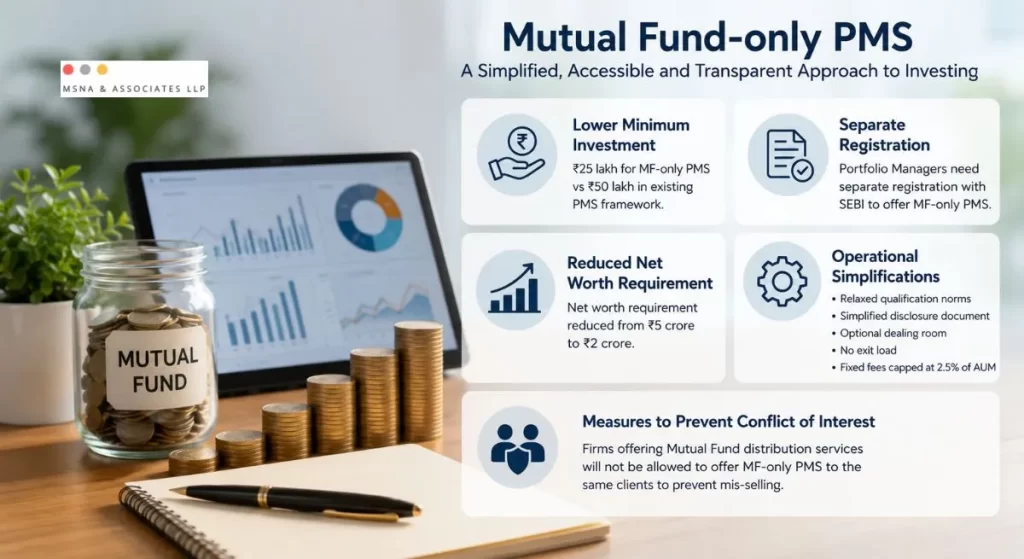
One of the most significant proposals is the creation of a separate category called MF-only PMS.
1. Lower Minimum Investment Requirement
The proposed minimum investment is:
- ₹25 lakh for MF-only PMS
- Compared to ₹50 lakh under the existing PMS framework
A lower entry threshold may make professionally managed investment solutions accessible to a wider investor base.
2. Separate Registration Framework
Portfolio Managers intending to operate MF-only PMS must obtain separate registration under SEBI.H3
3. Reduced Net Worth Requirement
The proposal reduces the minimum net worth requirement from:
- ₹5 crore
- to ₹2 crore
This could encourage more firms to enter the market while maintaining regulatory oversight.
4. Operational Simplifications
Other important proposals include:
- Relaxed qualification norms for Principal Officers
- Simplified disclosure document
- Optional dealing room requirement
- No exit load
- Fixed fees capped at 2.5% of AUM
5. Measures to Prevent Conflict of Interest
To prevent mis-selling, firms offering Mutual Fund distribution services will not be permitted to offer MF-only PMS to the same clients.
This proposal aims to improve investor protection by reducing conflicts between advisory and distribution activities.
3. Ease of Compliance and Operational Reforms
SEBI has proposed several measures to simplify compliance for Portfolio Managers.
a. Relaxation in Principal Officer Qualifications
The eligibility criteria for Principal Officers may be relaxed to include graduates and recognised professional qualifications.
b. Liquid Asset Requirement
Portfolio Managers must maintain at least 10% of their prescribed net worth in liquid assets such as:
- Bank balances
- Bank deposits
- Money market instruments
A transition period of 12 months has been proposed.
c. Extended Compliance Timelines
SEBI proposes:
- Disclosure document timeline increased from 7 to 10 working days
- Corporate Governance reporting timeline increased from 30 days to 60 days
These changes reduce operational pressure while maintaining transparency.
d. Business Commencement Requirement
Registered Portfolio Managers must commence business within three years of registration by achieving either:
- Minimum 10 clients, or
- Assets under Management of ₹5 crore
This proposal aims to discourage inactive registrations.
e. Simplified Regulatory Reporting
The consultation paper also proposes:
- Simplified reporting formats
- Mandatory NISM certification for Compliance Officers
- DEMAT account portability
- Relaxation regarding Power of Attorney requirements
- Relaxation in dedicated dealing room requirements for smaller Portfolio Managers
What Do These Proposed Changes Mean for Investors?
If implemented, the proposals could offer several benefits.
1. Greater Investment Choice
Investors may gain access to:
- Overseas securities
- To-be-listed companies
- Wider investment opportunities
2. Better Accessibility
The proposed MF-only PMS with a lower investment threshold may attract a larger segment of investors.
3. Stronger Investor Protection
Measures relating to conflict of interest, disclosure, and governance continue to prioritise investor protection.
Impact on Portfolio Managers
Portfolio Managers could benefit from:
- Reduced compliance burden
- Simplified operational processes
- Greater flexibility in investment strategies
- Easier regulatory reporting
- Improved business efficiency
At the same time, firms must strengthen governance systems to comply with new certification, liquidity, and client consent requirements.
Expert Analysis
The consultation paper reflects SEBI’s intention to modernise India’s Portfolio Management Services ecosystem while maintaining robust investor safeguards.
Rather than merely easing compliance, the proposals seek to balance innovation with accountability. Expanding investment avenues, introducing MF-only PMS, and simplifying operational requirements could make Portfolio Management Services more competitive alongside Mutual Funds and Alternative Investment Funds (AIFs).
If adopted substantially in their current form, these reforms are likely to improve investor confidence, encourage new market participants, and support the continued growth of India’s wealth management industry.
Consultation Timeline
- Consultation Paper Released: 23 July 2026
- Public Comments Invited Until: 13 August 2026
- Final Regulations: To be notified by SEBI after considering stakeholder feedback
Since these are consultation proposals, stakeholders should monitor SEBI’s final notification before implementing operational changes.
Conclusion
The SEBI Consultation Paper on Portfolio Management Regulations 2026 represents one of the most significant proposed reforms to India’s Portfolio Management Services framework in recent years. By expanding investment opportunities, introducing MF-only PMS, simplifying compliance obligations, and strengthening governance, SEBI seeks to create a more efficient and investor-friendly regulatory environment.
While these proposals are still under consultation, Portfolio Managers, investment professionals, and investors should evaluate their potential impact and remain prepared for the final regulatory changes once SEBI issues the revised regulations.
Frequently Asked Questions On SEBI Consultation Paper On Portfolio Management Regulations 2026
Are these SEBI proposals applicable immediately?
No,These are consultation proposals and will become effective only after SEBI notifies the final regulations.
What is MF-only PMS?
MF-only PMS is a proposed category that would invest exclusively in mutual funds under a simplified regulatory framework.
Can PMS invest in overseas securities?
Yes, subject to the RBI Liberalised Remittance Scheme (LRS), client consent, and the prescribed annual investment limit.
Why is SEBI introducing these reforms?
The proposals aim to modernise the regulatory framework, simplify compliance, expand investment opportunities, and enhance investor protection.
Need Professional Guidance on SEBI Regulatory Compliance?
Related
Discover more from MSNA & Associates LLP
Subscribe to get the latest posts sent to your email.