
Every bank in India runs on trust. Depositors trust the bank with their savings. Regulators trust the bank to follow the rules. The board trusts its own teams to flag problems before they turn into losses. Internal audit in a bank is the function that protects all three types of trust at once.
In simple terms, internal audit in a bank is an independent, ongoing check on how well the bank’s risk management, internal controls, and governance processes actually work. It is not the same as the yearly statutory audit, and it is not the same as concurrent audit either.
This guide breaks down what internal audit in a bank covers, who is responsible for what, the RBI rules that govern it, and where the function is headed as banking gets more digital and AI-driven.
What Does Internal Audit in a Bank Actually Cover?
Internal audit in a bank is a continuous, risk-based review carried out by a dedicated, in-house internal audit function.
For banks specifically, RBI does not allow this function to be outsourced; a bank may bring in outside experts, including former employees, on a contractual basis where the required expertise does not exist in-house, but ownership of audit reports must stay with the bank’s own internal audit staff. Its job is to test whether the bank’s stated controls are actually working on the ground, across credit, operations, treasury, IT, and compliance.
Under the Basel Committee’s “three lines of defense” model, which the RBI has broadly adopted for Indian banks:
- First line: business and operations teams, who own and manage risk day-to-day
- Second line: risk management and compliance functions, who set policy and monitor limits
- Third line: internal audit, which independently reviews both the first and second lines
This third-line placement is what gives internal audit its authority. It reports to the Audit Committee of the Board (ACB), not to the business heads it reviews. That separation is the whole point. A control function that reports to the people it is checking on cannot stay objective for long.
What Do RBI's Guidelines Say About Internal Audit in a Bank?
The starting point for internal audit in a bank, in the Indian context, is RBI’s Guidance Note on Risk-Based Internal Audit, issued under circular DBS.CO.PP.BC.10/11.01.005/2002-03 dated December 27, 2002. This circular required commercial banks to move from a transaction-checking style of audit to a Risk-Based Internal Audit (RBIA) system, one built around a documented audit policy, functional independence, and audit resources with real professional competence.
RBI sharpened this further through a follow-up circular, RBIA Framework – Strengthening Governance Arrangements, dated January 7, 2021. This circular is where several specifics that banks are commonly tested on during RBI inspections actually come from: the Head of Internal Audit should be appointed for a minimum of three years, the internal audit function must not report to or take targets from the business verticals it audits, and remuneration for audit staff must not be linked to the financial performance of the business lines they review.
What this means for a bank’s management: independence is not a policy statement; it has to show up in the reporting line, the tenure structure, and the pay structure at the same time, or RBI will treat it as a gap.
RBI later extended a similar RBIA requirement to large NBFCs and Primary (Urban) Co-operative Banks through a circular dated February 3, 2021, with a deadline for transition by March 2022. The direction across all these circulars is consistent: RBI wants internal audit judged by how well it identifies and tests real risk, not by how many transactions it has ticked off a checklist.
For a bank’s management, this has a practical implication. An internal audit function that only samples transactions and reports minor errors is not meeting RBI’s expectations. The audit plan itself needs to start from a documented, yearly risk assessment, updated whenever the bank changes products, systems, or reporting lines.
Who Is Responsible for Internal Audit in a Bank?
Responsibility for internal audit in a bank sits across three levels, and each level has a distinct job.
Board of Directors / Audit Committee of the Board (ACB)
- Approves the internal audit policy and the annual risk-based audit plan
- Oversees the appointment, removal, and remuneration of the Head of Internal Audit or Chief Audit Executive (CAE)
- Reviews audit findings directly, without filtering by business heads
- Monitors closure of high-risk audit observations
Head of Internal Audit / Chief Audit Executive
- Owns the audit methodology, staffing, and reporting calendar
- Ensures the function has enough qualified people: RBI has flagged banking operations, IT, data analytics, and forensic investigation as key skill areas
- Is typically appointed for a minimum of three years, per RBI’s expectation, so audit knowledge and independence have time to build
- Escalates unresolved or high-risk issues directly to the ACB
Internal Audit Team
- Carries out risk assessment, transaction testing, and control testing across the bank
- Reviews credit appraisal, NPA classification, treasury and forex operations, IT systems, and cash management
- Tracks AML and KYC compliance, including suspicious transaction reporting to FIU-IND
- Documents findings and follows up on corrective action until issues are actually closed
Typical audit coverage in an Indian bank spans several areas at once:
- Credit appraisal, sanctioning, and NPA classification accuracy
- Treasury, forex, and investment portfolio operations
- IT systems, cybersecurity controls, and data integrity
- AML, KYC, and sanctions screening
- Branch operations, cash handling, and vault management
- HR processes and outsourcing/vendor risk
- Regulatory return accuracy and RBI circular compliance
How Is Internal Audit Different From Statutory and Concurrent Audit in a Bank?
These three terms get mixed up often, and content on this topic rarely lays out the difference clearly. Here is a direct comparison.
Parameter | Internal Audit | Concurrent Audit | Statutory Audit |
Conducted by | The bank’s own internal audit function (outside experts may be contracted in, but not the function itself) | Empanelled CA firms or in-house concurrent auditors | Statutory auditors appointed with RBI/board approval |
Timing | Periodic, risk-based cycle across the year | Near real-time, ongoing at high-risk branches | Once a year, at year-end |
Primary focus | Risk management, control effectiveness, governance | Transaction-level accuracy as it happens | True and fair view of financial statements |
Reports to | Audit Committee of the Board | Branch/controlling office, feeding into ACB oversight | Shareholders, with RBI oversight |
Nature | Assurance and advisory | Preventive, transaction-focused | Compliance and certification |
Read together, these three functions are meant to overlap in coverage but not in purpose. A gap in any one of them is usually where risk quietly builds up.
What Are the Best Practices for Internal Audit in a Bank?
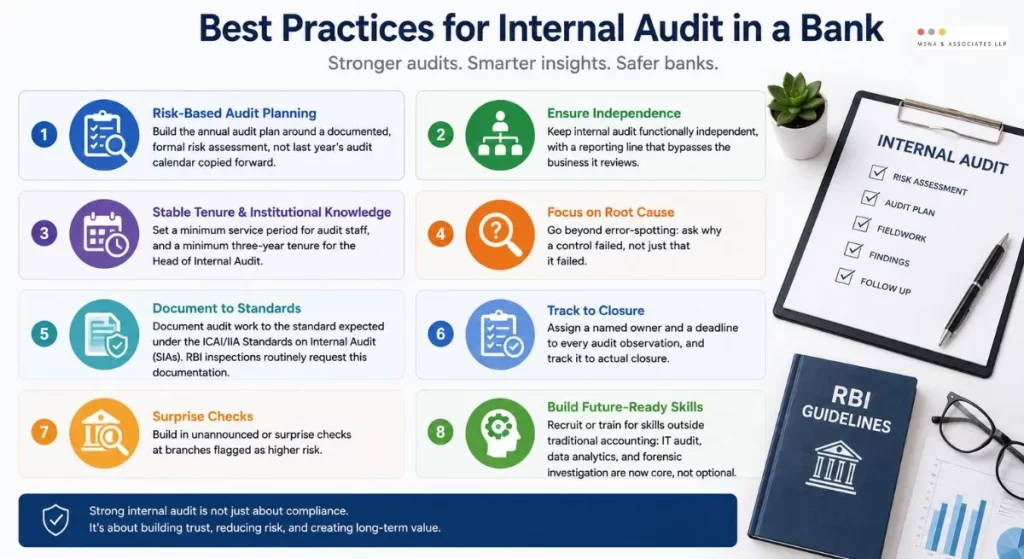
RBI’s framework sets the floor. These practices are what separate an internal audit function that genuinely strengthens a bank from one that exists mainly on paper. Many of these principles carry over directly from statutory and concurrent audit work as well; see our related guide on choosing the right audit firm for how this plays out on the statutory audit side.
- Build the annual audit plan around a documented, formal risk assessment, not last year’s audit calendar copied forward
- Keep internal audit functionally independent, with a reporting line that bypasses the business it reviews
- Set a minimum service period for audit staff, and a minimum three-year tenure for the Head of Internal Audit, so institutional knowledge does not walk out the door every year
- Go beyond error-spotting: ask why a control failed, not just that it failed
- Document audit work to the standard expected under the ICAI/IIA Standards on Internal Audit (SIAs), since RBI inspections routinely request this documentation
- Assign a named owner and a deadline to every audit observation, and track it to actual closure
- Build in unannounced or surprise checks at branches flagged as higher risk
- Recruit or train for skills outside traditional accounting: IT audit, data analytics, and forensic investigation are now core, not optional
What Challenges Do Banks Face With Internal Audit?
In practice, banks and smaller finance companies run into a few recurring problems.
- Specialised skills are hard to find and retain. IT audit and forensic audit expertise is scarce, and smaller banks and UCBs compete with larger institutions and consulting firms for the same limited talent pool.
- Digital products move faster than audit coverage. New lending products, API-based partnerships, and app-based channels can go live well before the audit function has built a testing approach for them.
- Central oversight versus branch reality is a constant balancing act. A risk-based plan set centrally can miss local, branch-specific control gaps unless the audit team stays genuinely connected to ground-level operations.
- Resource constraints bite hardest at smaller institutions. A large private bank can staff a specialised AI or cyber audit team. A mid-sized UCB usually cannot, and has to rely more heavily on outsourced expertise within RBI’s permitted limits.
Where Is Internal Audit In Banks Headed Next?
RBI’s Committee for Responsible and Ethical Enablement of AI (FREE-AI) submitted its report on August 13, 2025, setting out seven guiding principles and 26 recommendations across governance, risk, and consumer protection for AI use in the financial sector. Separately, reporting since then indicates RBI is weighing a broader, more structured AI governance framework for banks and NBFCs, covering model risk, data use, and human override mechanisms. Nothing here is final yet, and the shape of any eventual RBI mandate is still being worked out. But the direction of travel is clear enough to plan around, and internal audit functions that wait for a finished circular before building any AI-review capability risk starting several steps behind once one arrives.
Our view:
Banks that start building AI-related audit capability now, meaning the skills to review model data lineage, bias testing, and override controls, will be in a far better position than banks that wait for a formal circular. Retrofitting audit trails onto an AI system that is already live and embedded in lending or fraud decisions is always harder than designing for auditability from day one.
Globally, industry reports on internal audit priorities for 2026 point in a similar direction: generative and agentic AI oversight, cyber and operational resilience, and a faster-moving regulatory landscape are named as leading themes for financial services internal audit teams. None of this replaces RBI’s existing RBIA framework. It sits on top of it, and it is likely to expand what “risk-based” means for internal audit in a bank over the next few years, particularly around technology and third-party/outsourcing risk as banks lean further into digital lending and API-based services.
Banks that treat this as a planning input today, rather than a compliance deadline to react to later, are simply better placed.
Internal Audit in Banks: Key Takeaways and RBI Compliance Requirements
Internal audit in a bank is not a once-a-year formality. It is a continuous, independent check that the RBI expects to be genuinely risk-based, properly resourced, and reported straight to the board. Getting the roles right, from the ACB down to the audit team on the ground, and building in the practices covered above, gives a bank a real early-warning system rather than a paper trail.
Every bank’s risk profile, size, and regulatory obligations are different. Consulting an internal audit firm in Bangalore can help you assess how a risk-based internal audit framework applies to your institution’s specific situation.
Disclaimer:
This article is informational and reflects RBI guidelines current as of August 2026; it is not a substitute for professional advice specific to your institution.
Strengthen Your Bank’s Internal Audit Framework
Frequently Asked Questions About Internal Audit In Bank
Is internal audit mandatory for banks in India?
Yes, RBI’s 2002 guidance note requires commercial banks to run a risk-based internal audit system as part of their internal controls. The same requirement has since been extended to large NBFCs and UCBs above defined asset thresholds.
Who appoints the internal auditor of a bank?
The Board’s Audit Committee handles this. It approves the internal audit policy and the audit plan for the year, and it oversees who gets appointed as Head of Internal Audit or Chief Audit Executive.
What is the difference between internal audit and concurrent audit in a bank?
Internal audit looks at the bank’s overall risk and control setup on a periodic, risk-based cycle. Concurrent audit works differently: it checks transactions close to real time, usually at branches or business units RBI or the bank has flagged as higher risk.
What qualifications does a bank's internal auditor need?
Most internal audit staff hold a CA, CMA, or CS, backed by real banking experience. RBI also wants IT audit, data analytics, and forensic investigation skills on the team now, not just traditional accounting.
Related
Discover more from MSNA & Associates LLP
Subscribe to get the latest posts sent to your email.