
Can a business with spotless financials still fall short once the deal closes?
Spotless accounts can hide a business that cannot repeat its results, and operational due diligence in India exists to catch that before signing. Instead of re-checking the numbers, it examines the machinery behind them: plants and workflows, suppliers, software, staff, and internal controls. Buyers then use what they learn to test the forecast, adjust the price, ask for contractual protection, and prepare the first 100 days.
Some risks never appear on a balance sheet: a warehouse held together by manual workarounds, one vendor behind most of a critical input, or core processes that live only in the minds of three senior people.
If you invest in, advise on, or fund acquisitions, the sections ahead walk through each stage of the review, the documents to request, and the issues that most often change price and deal terms.
Key Takeaways
- Operational due diligence tests whether the target can deliver its projected earnings, not just whether past numbers are accurate.
- The review covers six areas: efficiency, processes, supply chain, technology, workforce and internal controls.
- Findings feed three decisions: price adjustment, deal protections and the first 100 days after closing.
What Is Operational Due Diligence and Why Does It Matter for Acquisitions in India?
Operational due diligence examines the machinery behind a target’s revenue, which is the part financial statements describe only indirectly.
Where financial review asks what the business earned, this review asks how it earned it and whether it can repeat that result at a larger scale. Often described as a business operational assessment, the review draws on site visits, management interviews, process walk-throughs, system demonstrations and data sampling. It forms one workstream within acquisition due diligence in India, alongside the legal, financial and tax reviews.
The deal environment makes this more relevant.
In Q3 2026, Grant Thornton Bharat’s Dealtracker counted 608 M&A and PE transactions valued at USD 23.1 billion. Between Q2 and Q3, the number of transactions grew by 8 percent, yet their combined value fell by 36 percent, partly reflecting a few very large deals in Q2.
Over a longer window, BCG reports that Indian M&A volumes dropped roughly 20 percent year on year across the first seven months of 2026, yet total deal value stayed broadly steady. The mix keeps shifting between volume-led and value-led quarters, so integration plans built on last year’s deal pattern age quickly.
2026 indicator | Figure | Source |
M&A and PE transactions, Q3 2026 (excluding IPOs and QIPs) | 608 deals, USD 23.1 billion | Grant Thornton Bharat |
India M&A volume change, first seven months of 2026, year on year | Down about 20 percent | BCG |
Deals above USD 500 million, share of total deal value (January to July 2026) | About 59 percent, against 49 percent a year earlier | About 59 percent | BCG |
How Does Operational Due Diligence Differ From Financial, Legal and Tax Due Diligence?
Each workstream answers a different question about the target, and operational due diligence covers the gap the others leave.
Workstream | Core question | Gap it leaves |
Financial | Are the earnings real? | Whether processes can sustain them |
Legal | Does the target hold clear rights? | How contracts perform in practice |
Tax | What liabilities exist? | Operational causes of tax leakage |
Operational | Can the business deliver and scale? | Not a substitute for audited numbers |
The workstreams also feed each other. A finding on slow invoicing in the operational review explains a working capital trend that the financial due diligence team flagged.
What Is the Operational Due Diligence Process for M&A in India?
The operational due diligence process consists of six stages. A review only pays off when its priorities are fixed early. Decide what to examine, which sites to visit and what data to request before anyone starts fieldwork.
Step 1: Set the Investment Thesis and Scope
The deal rationale comes first. A scope note then lists the priority areas, the sites to visit and the data to request.
Step 2: Send the Information Request
The request list asks for organisation charts, process documents, vendor contracts, system inventories, key performance reports and internal audit reports.
Step 3: Hold Interviews and Site Visits
Procedure manuals show how work is supposed to happen. To see how it does happen, reviewers sit down with function heads and then walk the plant floor, the back office or the delivery centre. Putting the same question to people at three levels, from the plant or branch head up to the CFO, reveals where handoffs are weak.
Step 4: Test Data and Controls
The team samples transactions, reviews system access logs and reconciles operational data to financial records. Samples are chosen by transaction volume, value and risk, using the same risk-based approach applied in internal audit scoping.
Step 5: Rate Risks and Quantify Impact
Every finding gets a severity rating (High, Medium or Low) and a likelihood, along with a rupee estimate. This converts observations into inputs for valuation and deal terms.
Step 6: Report and Hand Over
The report concludes with recommended price adjustments, protective clauses and an integration plan.
When every finding is scored on the same three-level scale, the deal team can respond to each one in the same way.
Rating | What it means | Typical response |
High | Threatens the core of the investment case | Price adjustment or closing condition |
Medium | Fixable within 100 days at a known cost | Covenant or integration plan item |
Low | Housekeeping with no value impact | Note in the report |
What Does an Operational Due Diligence Checklist Cover?
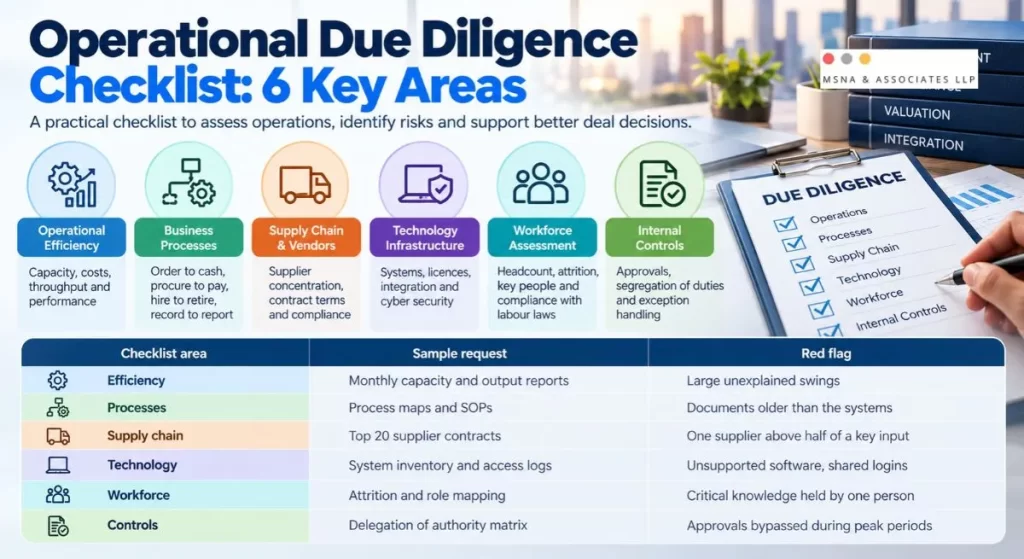
A practical operational due diligence checklist groups requests under six headings, with each heading tied to a specific deal risk.
1. Operational Efficiency Analysis and Performance Review
Reviewers analyse three years of operating data, including capacity utilisation, throughput, defect rates, order cycle times and unit costs. An operational performance review separates structural strengths from one-off improvements made to dress the business for sale.
2. Business Process Evaluation
In a business process evaluation, reviewers trace four core cycles from start to finish: order to cash, procure to pay, hire to retire and record to report. They flag manual handoffs, duplicate approvals and steps that depend on a single person.
3. Supply Chain Risk Assessment and Vendor Risk Management
Start with where the inputs come from. Reviewers look at how concentrated the supplier base is, how long deliveries take, how stock is managed and whether logistics partners turn up on time. Then we read the vendor contracts: credit terms, exclusivity, and whether one supplier quietly holds the business hostage. They also check that key vendors are compliant themselves because their problems become the target’s problems.
4. Technology Infrastructure Review
Next, reviewers list every system, whether that is ERP, CRM or production software. For each one, they ask who holds the licence, how it connects to the others and how well it is protected against cyber threats. If the target holds customer data, they also test how ready it is for the Digital Personal Data Protection Act, 2023 and the DPDP Rules, which are being phased in.
5. Workforce Assessment
Workforce assessment reviews headcount by function, attrition, key person dependency, contractor use and compensation structures. The four Labour Codes took effect on 21 November 2025, replacing 29 central labour laws, so payroll practices, contractor arrangements and employment terms deserve a fresh look against the Codes and the central rules published in May 2026.
6. Internal Control Assessment
An internal control assessment tests approval limits, segregation of duties and exception handling. Targets that already maintain internal financial controls over financial reporting (ICFR) under the Companies Act, 2013 often produce evidence faster.
Checklist area | Sample request | Red flag |
Efficiency | Monthly capacity and output reports | Large unexplained swings |
Processes | Process maps and SOPs | Documents older than the systems |
Supply chain | Top 20 supplier contracts | One supplier above half of a key input |
Technology | System inventory and access logs | Unsupported software, shared logins |
Workforce | Attrition and role mapping | Critical knowledge held by one person |
Controls | Delegation of authority matrix | Approvals bypassed during peak periods |
Deal teams often find a scoped information request list useful before management meetings. A qualified professional can help you assess which areas matter for your transaction
Where Does a Checklist Alone Fall Short in Operational Due Diligence?
A checklist keeps the review complete, but it does not rank what matters. Two targets can tick the same boxes and carry very different risk. A single-plant business with one critical supplier has a narrower margin for error than a three-plant business with dual sourcing, even if both hold documented SOPs.
Findings are best weighed against the investment case first and the checklist second. A gap in a process that drives 5 percent of revenue is a footnote. The same gap in a process that drives 50 percent is a pricing issue.
Why Does the Indian Context Change an Operational Due Diligence Review?
The same checklist produces different findings in India because of how many target businesses are structured and regulated.
Three patterns deserve extra attention:
- Promoter dependence: In many Indian companies, pricing, vendor negotiation and approvals still run through one or two promoters. Treat this as an operating finding, not a governance footnote.
- Multi-state compliance: A single manufacturer may hold separate GST registrations, factory licences and labour registrations across states. Gaps tend to sit at unit level rather than head office.
- Informal vendor terms: Verbal credit terms and long-standing supplier relationships rarely appear in contracts, so reviewers confirm them directly with the vendors.
Should Investors Cut the Operational Review When the Timeline Is Tight?
Deal timelines often squeeze operational work first, because its findings are harder to price than a tax exposure.
Shrink the scope and keep the review. Pick the two or three areas that carry the investment case, such as the largest cost line, the critical supplier and the core system. A narrow review done properly gives more usable findings than a broad one done in a hurry. It also gives the deal team a clear baseline for the first 100 days.
How Does Operational Risk Assessment Identify Acquisition Risks Before Signing?
An operational risk assessment converts fieldwork observations into a ranked list of risks that the deal team can price or contain.
Risks are scored on likelihood and impact, then linked to a response. Some risks justify a price reduction. Others call for a closing condition, an indemnity or a covenant requiring the seller to fix an issue before completion.
Operational risk | Example signal | Possible deal response |
Supplier concentration | One vendor, no backup contract | Closing condition for second source |
Key person dependency | Founder approves all pricing | Retention agreement, handover plan |
System fragility | Core ERP unsupported by vendor | Price adjustment for upgrade cost |
Compliance gaps | Missing licences at one plant | Indemnity, pre-closing remediation |
Business continuity risks | No tested disaster recovery plan | Covenant to implement before closing |
Business continuity risks deserve their own line in the report. Reviewers ask what happens when a plant, a data centre or a key vendor is unavailable for two weeks.
How Does Operational Due Diligence Test Scalability and Cost Optimisation Opportunities?
The review tests whether the target can handle the volumes in the investor’s plan and where the cost base can improve.
An operational scalability assessment, part of the wider business operational assessment, compares current capacity with the investment case. If the plan assumes volumes doubling in three years, reviewers check plant headroom, hiring pipelines, system limits and supplier capacity against that figure.
Illustrative Scenario
Consider a hypothetical mid-sized packaging manufacturer in Karnataka. The investor’s plan assumes output rising 80 percent. Fieldwork shows the main plant runs at high utilisation on two lines, the ERP handles order entry but not production planning, and one resin supplier provides most of the raw material. The review prices a second line, an ERP module and a supplier agreement as prerequisites.
Cost Optimisation Opportunities
Reviewers also note where savings may exist, such as vendor consolidation for volume terms, warehouse and route rationalisation, shared finance and HR services, and duplicate software licences. Treat estimates as ranges until management validates them.
How Do Operational Due Diligence Findings Shape Post-Merger Integration?
Findings become the working plan for post-merger integration, which is why the report should arrive in a form the operating team can use.
A good report ranks actions by value and effort, assigns owners and sets dates for the first 100 days.
Timeline | Focus | Example actions |
Day 1 to 30 | Stabilise | Retain key staff, confirm vendor contracts, secure system access |
Day 31 to 60 | Align | Harmonise reporting, close control gaps, start process fixes |
Day 61 to 100 | Improve | Launch cost programmes, plan system upgrades |
Integration also needs a finance view. A reliable management reporting set helps leadership track progress, and our guide on management information systems explains why many reports fail to support decisions.
How Do Investors Choose Operational Due Diligence Services in India?

Investors choosing operational due diligence services should look for sector understanding, an evidence-based method and clear reporting.
- Experience with the target’s industry and its regulatory setting
- A team that combines finance, process and technology skills
- Willingness to visit sites and test samples directly
- Coordination with legal, tax and financial advisors on the same deal
MSNA & Associates LLP is a Bangalore-based chartered accountancy firm that supports investors and Indian companies with due diligence, internal audit and virtual CFO services. Its team works across the finance and control aspects of operational reviews.
“Investors often ask for the numbers first, but the numbers are the end of a chain. When we trace a revenue line back through the people, systems and vendors that produce it, the deal conversation becomes much more specific.”
Naveen S N, Chartered Accountant, MSNA & Associates LLP
Planning an acquisition? Connect with our team to discuss how a focused operational review could apply
Conclusion On Operational Due Diligence
Operational due diligence connects the deal model to the reality of daily operations, which is why it earns a place in every acquisition due diligence in India workplan. A well-scoped review gives deal teams facts for price, protections and integration planning. The most valuable findings are the ones a buyer can act on within the first 100 days.
Deal teams that scope the review early, rank findings against the investment case and assign owners for the first 100 days are better placed to turn operational due diligence into a clear price, a sound set of protections and a workable integration plan.
Need More Information?
Frequently Asked Questions About Operational Due Diligence
What is operational due diligence in simple terms?
It is a pre-deal check of how a company runs day to day. Reviewers study processes, suppliers, systems, staff and controls to see whether the business can deliver what the buyer expects.
How long does an operational due diligence review take?
Timelines depend on deal size, number of sites and data readiness. Due diligence in India commonly takes several weeks, depending on deal size, number of sites and data readiness.The operational workstream is scheduled alongside the legal, financial and tax work during scoping.
How does it affect the purchase price?
Findings that require spending or carry measurable risk can support price adjustments, escrow arrangements or indemnities.
What drives the cost of an operational due diligence review?
Scope, the number of sites, sector complexity and data readiness set the effort involved. A narrower scope focused on the areas behind the investment case reduces it.
A procurement audit examines your buying process and controls. A vendor audit examines a supplier’s own operations.
Related
Discover more from MSNA & Associates LLP
Subscribe to get the latest posts sent to your email.