


Yes, an NRI can register a company in India. NRIs, OCIs (Overseas Citizenship of India), and foreign nationals can own up to 100% of most sectors under the automatic route, so you skip prior government approval. Your exact eligibility and FEMA rules still depend on your location and sector.
NRI eligibility to register a company in India, the FEMA compliance involved, and the routes available differ depending on where you are based and which sector you are entering.
Incorporation can be completed entirely remotely, without any physical presence in India. One condition applies regardless of where the shareholders live: the resident director requirement, which is the single most common thing that catches NRI founders off guard.
This guide covers who qualifies, the resident director requirement, the automatic route vs approval route decision, and exactly what changes for NRIs based in the US versus the UAE. By the end, the question “can an NRI register a company in India from where I live” has a specific answer whether you’re in Dubai, Abu Dhabi, California, New Jersey, or Texas.
Who Counts as an NRI, and What Changed for OCI and PIO Holders in 2026?
“NRI” is not defined the same way everywhere, and that matters for eligibility.
Law | How It Defines NRI |
FEMA | Based on intent and purpose. If you go abroad for work, business, or any purpose indicating a long-term stay, you are classified as an NRI. The exact number of days spent in India becomes irrelevant in this case. |
Income Tax Act | A strict day-count formula for the financial year, separate from the FEMA definition. |
For NRI company registration and FDI purposes, the FEMA definition governs. An Overseas Citizen of India (OCI) is a foreign passport holder, usually of Indian origin, registered under the Citizenship Act. An OCI is legally a foreign national, not an Indian citizen. But it is treated on par with an NRI for most FDI and shareholding purposes.
One update worth flagging:
PIO (Person of Indian Origin) cards stopped being accepted as valid travel documents after 31 December 2025. The PIO-to-OCI conversion facility has since been discontinued entirely. Anyone still holding only a PIO card needs to apply for a fresh OCI card.
What Is the NRI Eligibility to Register a Company in India?
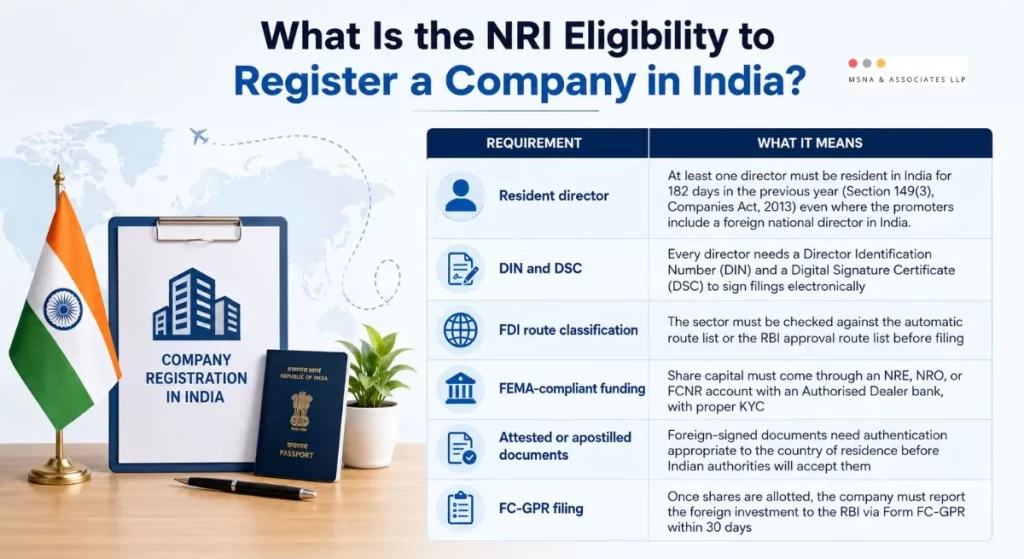
To understand can NRI register company in India, you first need to meet these six eligibility requirements. Missing any one of them causes rejection or delay at the Registrar.
Requirement | What It Means |
Resident director | At least one director must be resident in India for 182 days in the previous year (Section 149(3), Companies Act, 2013) even where the promoters include a foreign national director in India. |
DIN and DSC | Every director needs a Director Identification Number (DIN) and a Digital Signature Certificate (DSC) to sign filings electronically |
FDI route classification | The sector must be checked against the automatic route list or the RBI approval route list before filing |
FEMA-compliant funding | Share capital must come through an NRE, NRO, or FCNR account with an Authorised Dealer bank, with proper KYC |
Attested or apostilled documents | Foreign-signed documents need authentication appropriate to the country of residence before Indian authorities will accept them |
FC-GPR filing | Once shares are allotted, the company must report the foreign investment to the RBI via Form FC-GPR within 30 days |
The resident director requirement is usually where NRI founders get stuck, not the FDI rules. It is common to assume a trusted friend or relative back in India can hold this role loosely. In practice, this person carries real legal responsibility for the company’s compliance. For example, a US-based NRI founder who lists a parent or sibling in India as resident director should still confirm that person can commit to signing statutory filings on time, not just hold the title. Since the correct route depends on your specific sector and the beneficial-ownership chain, it’s worth having this checked before you file.
Automatic Route or Government Approval Route: Which One Applies to Your NRI Startup Registration in India?
This is the biggest fork in the road for NRI startup registration in India. It is decided by sector and, in specific cases, by the investor’s country, not simply by NRI status.
Automatic Route | Approval Route (RBI / Government Route) | |
Prior approval needed | No | Yes, from the relevant government department before funds move |
Typical sectors | Most sectors: IT and software, e-commerce, manufacturing, most services | Sensitive or regulated sectors, and any investment routed from a country sharing a land border with India |
Post-investment step | FC-GPR filing within 30 days | Approval first, then the same FEMA reporting applies |
Speed | Faster, since there is no waiting period for approval | Slower, subject to review timelines |
Prohibited sectors regardless of route include lotteries, gambling, chit funds, real estate trading, agricultural or plantation activity, tobacco manufacturing, and atomic energy.
A rule that surprises many overseas founders:
Under Press Note 3 (2020), any investment where the beneficial owner sits in a country sharing a land border with India, or where the ultimate ownership traces back to such a country, must go through the RBI approval route regardless of sector. This is not an NRI-specific restriction. It is a beneficial-ownership check, which is exactly why it matters here.
A note on LLPs:
Everything above assumes a private limited company. That’s the structure most NRI startup registration in India goes through. If you’re considering an LLP instead, the automatic route is not a given. FDI into an LLP only gets automatic-route treatment in sectors that permit 100% FDI automatically with no FDI-linked performance conditions attached. Outside that, LLPs need RBI approval route clearance even where a private limited company in the same sector would not. If you’re unsure which structure fits, check this before you file.
Does It Matter Whether You Are Registering From the US or the UAE?
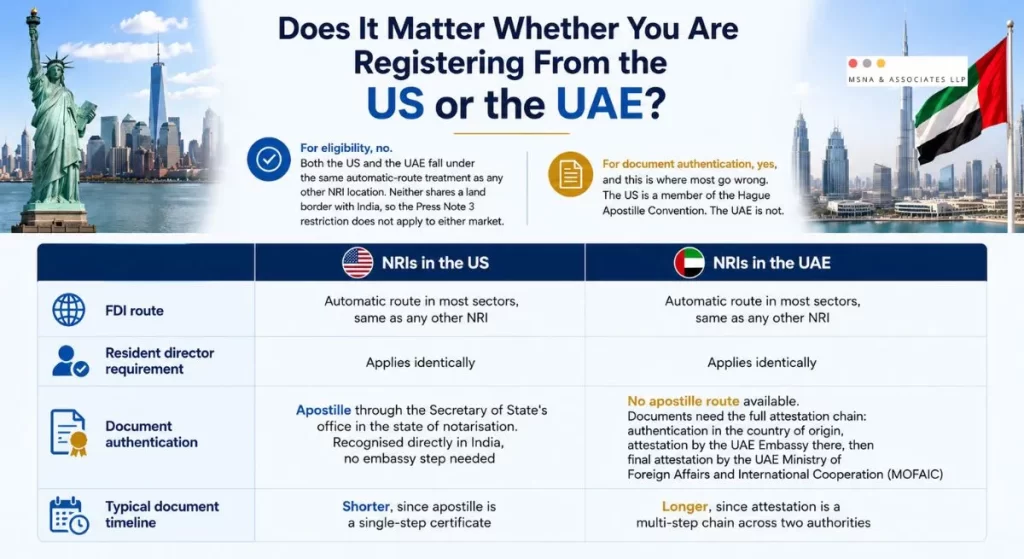
For eligibility, no. Both the US and the UAE fall under the same automatic-route treatment as any other NRI location. Neither shares a land border with India, so the Press Note 3 restriction does not apply to either market.
For document authentication, yes, and this is where most go wrong. The US is a member of the Hague Apostille Convention. The UAE is not.
NRIs in the US | NRIs in the UAE | |
FDI route | Automatic route in most sectors, same as any other NRI | Automatic route in most sectors, same as any other NRI |
Resident director requirement | Applies identically | Applies identically |
Document authentication | Apostille through the Secretary of State’s office in the state of notarisation. Recognised directly in India, no embassy step needed | No apostille route available. Documents need the full attestation chain: authentication in the country of origin, attestation by the UAE Embassy there, then final attestation by the UAE Ministry of Foreign Affairs and International Cooperation (MOFAIC) |
Typical document timeline | Shorter, since apostille is a single-step certificate | Longer, since attestation is a multi-step chain across two authorities |
This is not a minor formality for UAE-based founders. If you want a detailed step-by-step guide covering documentation, timelines, and FEMA requirements, read our guide on Company registration in India from UAE. It is the single biggest cause of incorporation delays we see among them, so it is worth building extra time into the timeline for it specifically.
Can an OCI Register a Company in India the Same Way as an NRI?
Yes, From an incorporation perspective, OCI holders and any foreign national director in India follow substantially the same framework as NRIs. The practical differences relate to FEMA classification, documentation requirements, and investment reporting rather than eligibility itself.
Factor | NRI | OCI |
FEMA route | NRI investment route (Schedule IV, FEMA Non-Debt Instruments Rules) | Standard FDI route (Schedule I), same as any other foreign investor |
Repatriation | Depends on NRE (repatriable) vs NRO (non-repatriable) funding | Fully repatriable by default; no repatriable/non-repatriable split |
Documentation | Passport and NRI status proof | Passport, OCI card, and standard FDI documentation |
OCI investment routes through the same FDI compliance checks as any foreign national, which means more documentation on the FEMA side, not less.
What Changes for NRI Startup Registration in India If You Want DPIIT Recognition?
If the plan is to register as a recognised “Startup,” not just a private limited company, NRI startup registration in India runs through DPIIT (Department for Promotion of Industry and Internal Trade). DPIIT recognition itself does not require Indian promoters to hold majority ownership. Foreign or NRI-owned companies qualify like any other, provided the entity is incorporated in India and meets the usual innovation, age, and turnover criteria.
Under the February 2026 DPIIT notification (G.S.R. 108(E)), the turnover ceiling for regular startup recognition was doubled from ₹100 crore to ₹200 crore, and a new Deep Tech Startup category was introduced with a 20-year recognition window (up from 10) and a turnover ceiling of ₹300 crore. What still carries a majority-Indian-shareholding condition is a separate scheme, the Startup India Seed Fund. Reading these two as the same rule is a common, avoidable mistake.
What Does Repatriation of Profits Actually Mean for an NRI Shareholder?
Repatriation of profits is the process of legally moving your share of profits, or your investment itself, back out of India to your country of residence. It is the differentiation between repatriation basis and non-repatriation basis that makes this happen:
- Repatriation basis: the investment is treated as FDI and follows FEMA’s Schedule I reporting. Profits and the original capital can be moved back out of India, subject to reporting through your NRE or FCNR account.
- Non-repatriation basis: the investment is treated on par with domestic investment through your NRO account and is not subject to FDI-linked FEMA reporting. But the funds generally cannot be freely moved abroad later, beyond the standard USD 1 million annual limit with CA certification.
Choosing the wrong basis at the funding stage is one of the more expensive mistakes an NRI can make. It affects how the money moves both in and out for the life of the company.
Can NRI Register Company in India? Common Mistakes to Avoid
Even after confirming can NRI register company in India, avoid these common mistakes that delay incorporation or create compliance issues.
- Treating the resident director as a formality: This person carries real compliance responsibility; an unresponsive resident director can stall filings for months.
- Confusing repatriation basis with non-repatriation basis :At the funding stage, then discovering later that profits cannot move out the way they expected.
- Missing the FC-GPR deadline: Late FEMA filings carry penalties often steeper than the entire cost of registration.
- Assuming apostille works everywhere: UAE-based founders in particular lose weeks assuming a standard apostille will be accepted, when the UAE requires the full embassy-plus-MOFAIC attestation chain instead.
Can NRI Register Company In India? Final Takeaways For US And UAE Entrepreneurs
Registering a company in India as an NRI is no longer a question of legal possibility. The real challenge lies in selecting the correct investment route, structuring the transaction in line with FEMA requirements, and planning compliance before incorporation rather than after it.
For founders Setup New Company In India from the UAE, understanding FEMA compliance, document attestation, and incorporation requirements from the outset helps minimise delays and supports smoother business expansion.
Whether your question is can OCI register company in India or whether an NRI qualifies, MSNA can assist in assessing whether the rules mentioned above apply to one’s case, regardless of whether one is from India, the US, or the UAE.
Can NRI Register Company in India: Frequently Asked Questions
Can an NRI own 100% of a private limited company in India?
In most sectors, yes. IT services, consulting, and professional services all fall under the automatic route, so there’s no government approval needed upfront. A few regulated industries are the exception, so it’s worth checking your specific sector before you file.
Does an NRI director need to travel to India to get a DSC?
Not at all. You can get a Class 3 DSC done remotely, either through video verification or by submitting notarised passport copies, and it’s usually ready in a day or two.
Is the FLA return required even if there's no new investment during the year?
Yes. As long as there’s outstanding foreign shareholding on the books, even from a single NRI investor, the return is due every 15 July whether or not any money moved that year.
Need Clarity on NRI Company Registration Requirements?
FAQs About Can NRI Register Company In India
Can an NRI incorporate a One Person Company (OPC) in India instead of a private limited company?
Only if the NRI holds Indian citizenship. Since the 2021 amendment to the Companies (Incorporation) Rules, NRIs who are Indian citizens can incorporate an OPC; OCIs and other foreign passport holders cannot use this route.
Can an NRI be the sole director and shareholder of an Indian company?
Not in a private limited company; the Companies Act requires at least two directors and two shareholders, with one director resident in India. Sole ownership is possible only through the OPC route, and only for citizen-NRIs.
How long does company registration actually take for an NRI, start to finish?
SPICe+ incorporation itself typically takes 10 to 15 working days once documents are ready. The bigger variable is document authentication: apostille from the US adds a few days, while UAE attestation can add two to four weeks.
Can an NRI open the company's bank account without visiting India in person?
Often yes, since most banks now offer video-KYC for company accounts, but this varies by bank. Some private banks still prefer an in-person visit for the first account opening, so it is worth confirming beforehand.
Related
Discover more from MSNA & Associates LLP
Subscribe to get the latest posts sent to your email.