
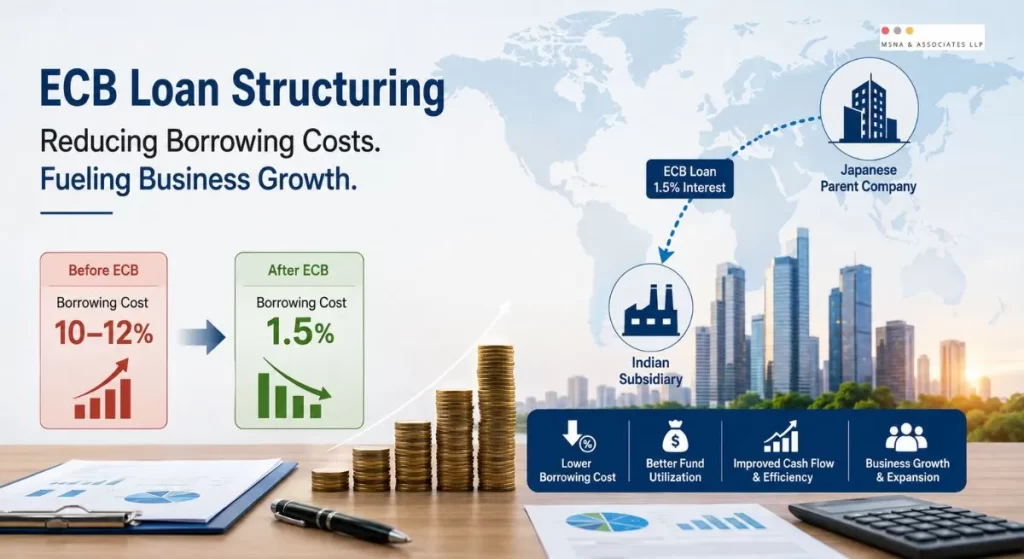

When an Indian subsidiary needs funding for expansion, choosing the right financing structure can significantly impact borrowing costs, cash flow, and long-term growth. In this case, MSNA helped a Japanese parent company restructure the funding arrangement for its Indian subsidiary through an External Commercial Borrowing (ECB) structure.
By replacing higher-cost domestic borrowing with a parent-company ECB loan, the subsidiary reduced its stated borrowing cost from approximately 10–12% to 1.5%, while the Japanese parent company generated a return on funds that had previously remained largely idle.
Client Background
Japanese Parent Company with an Indian Subsidiary
The client was a Japanese company with an operating subsidiary in India. The Indian business required additional capital to support its expansion plans and scale its operations.
The group was looking for a funding structure that could:
- Reduce the Indian subsidiary’s financing cost
- Make better use of the parent company’s surplus funds
- Improve overall cash flow efficiency
- Support the subsidiary’s long-term expansion
Business Challenge: High Cost Of Domestic Borrowing
The Indian subsidiary had traditionally relied on a combination of share capital and domestic bank loans to fund its operations and expansion.
Domestic borrowing costs were approximately 10–12%, creating a significant financing burden for the subsidiary.
At the same time, the Japanese parent company had surplus funds that were earning very little return while sitting in deposits in Japan.
This created an opportunity to rethink the group’s overall funding structure.
The Funding Inefficiency
The existing arrangement presented two challenges:
- High financing costs in India: The subsidiary was paying approximately 10–12% on domestic borrowing.
- Underutilised parent-company funds: The Japanese parent company had surplus funds earning minimal returns.
MSNA evaluated whether the group’s cross-border funding could be structured more efficiently while considering the applicable regulatory and compliance requirements.
MSNA's Solution: External Commercial Borrowing Structure
Replacing Higher-Cost Domestic Finance with ECB Funding
MSNA advised the group on an External Commercial Borrowing (ECB) structure under which the Indian subsidiary borrowed funds from its Japanese parent company.
The ECB was structured at an interest rate of 1.5%, providing the Indian subsidiary with access to lower-cost funding compared with its existing domestic borrowing.
This approach allowed the group to better align the funding requirements of the Indian subsidiary with the availability of surplus funds at the parent-company level.
Cross-Border Financial Structuring
The engagement involved more than simply identifying a lower interest rate. MSNA’s role included evaluating the funding structure from a broader cross-border finance and regulatory compliance perspective.
The objective was to develop a funding approach that addressed:
- Financing costs
- Parent-company fund utilisation
- Cross-border borrowing considerations
- Cash flow requirements
- Long-term business expansion
Results: Lower Financing Costs And Improved Capital Efficiency
The ECB structure delivered measurable financial benefits for the group.
1. Borrowing Cost Reduced to 1.5%
The Indian subsidiary’s stated borrowing cost was reduced from approximately 10–12% under domestic borrowing to 1.5% under the ECB structure.
This represented a substantial reduction in the cost of financing the subsidiary’s expansion.
2. Better Utilisation of Parent-Company Funds
The Japanese parent company was able to deploy surplus funds into the Indian business rather than leaving those funds earning minimal returns in Japan.
This created greater efficiency at the group level by connecting available capital with the subsidiary’s funding requirements.
3. Supported Business Expansion
The improved funding structure supported the Indian subsidiary’s growth over the following years.
According to the client, the business expanded from approximately 100 employees to nearly 400 employees over a three-to-four-year period.
The client also regarded the ECB financing structure as one of the company’s significant competitive advantages.
Key Financial Impact
| Area | Before ECB Structure | After ECB Structure |
|---|---|---|
| Indian subsidiary funding | Domestic bank finance and share capital | Parent-company ECB |
| Approx. borrowing cost | 10–12% | 1.5% |
| Parent-company surplus funds | Minimal return | Deployed into Indian business |
| Cash flow efficiency | Higher financing burden | Improved financing efficiency |
| Business scale | Around 100 employees | Nearly 400 employees |
Figures are based on the client’s stated experience and are presented for illustrative case-study purposes.
Key Services Delivered By MSNA
1. Virtual CFO Services
MSNA provided strategic financial guidance to help the group evaluate and implement a more efficient funding structure.
2. ECB Advisory
The engagement included advisory around the proposed External Commercial Borrowing structure for funding the Indian subsidiary.
3. Cross-Border Financial Structuring
MSNA evaluated the financing arrangement from a cross-border perspective to help align the Indian subsidiary’s funding requirements with the Japanese parent’s available capital.
4. Corporate Finance Strategy
The funding structure was considered as part of the company’s broader expansion and capital management strategy rather than as an isolated borrowing decision.
Why The Right Funding Structure Matters For Indian Subsidiaries?
For multinational groups operating through Indian subsidiaries, the source and structure of funding can materially affect financing costs, cash flows, and the efficiency of capital deployment.
An appropriately structured ECB financing arrangement can potentially provide an alternative to higher-cost domestic borrowing, subject to eligibility, pricing, maturity, end-use, and other applicable regulatory requirements.
The key is to evaluate the structure holistically rather than focusing only on the headline interest rate.
How MSNA Helps Businesses Optimise Cross-Border Funding?
MSNA works with businesses on Virtual CFO, corporate finance, cross-border financial structuring, and ECB advisory to help management evaluate funding options and make informed financial decisions.
For Indian subsidiaries of overseas companies, the focus is on creating financing structures that support business objectives while addressing the relevant financial, regulatory, and compliance considerations.
Looking for a More Efficient Funding Structure?
Related
Discover more from MSNA & Associates LLP
Subscribe to get the latest posts sent to your email.