
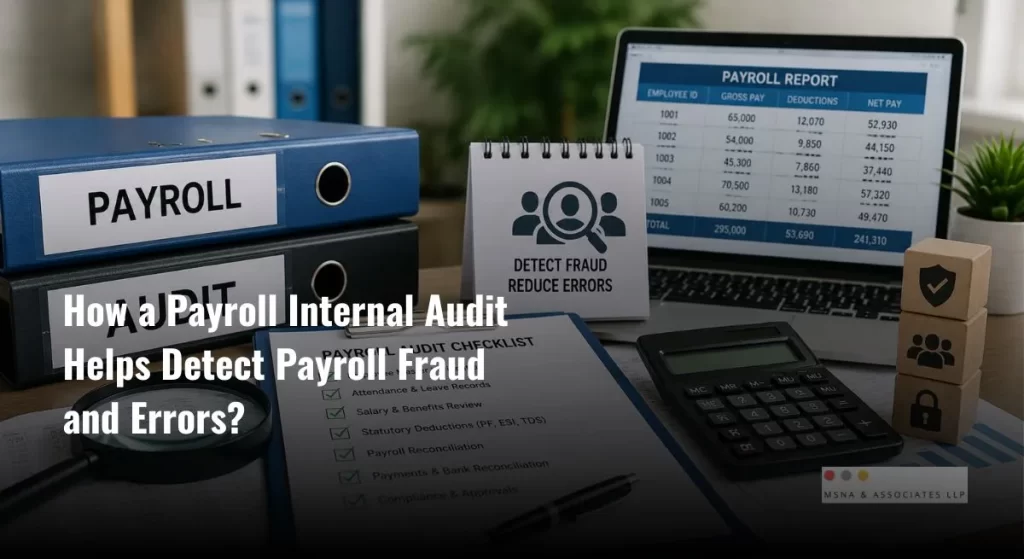

Payroll is usually the largest single expense on a company’s books, and it is also one of the least audited. A payroll internal audit checks whether the people being paid actually exist and did the work, whether statutory deductions are correct, and whether the numbers in the payroll register match what was actually paid out.
Beyond catching errors before they become costly, a well-run audit is also one of the more reliable methods for detecting payroll fraud and confirming that statutory compliance is actually being met.
For HR heads, payroll managers, CFOs, and internal audit heads, this is one of the few reviews that pays for itself: it surfaces ghost employees and calculation mistakes before they compound month after month.
This article walks through what a payroll audit actually covers, where fraud and errors generally hide, and how to build a checklist that holds up.
Key Takeaways
- A payroll internal audit checks accuracy, statutory compliance, and fraud risk together, not just one of the three.
- Ghost employees and unauthorised pay changes are usually caught through data-matching, not through manual review.
- Statutory deductions (PF, ESI, TDS) carry real financial penalties for errors, on top of the reputational cost.
- India’s payroll compliance rules changed materially from 1 April 2026, and many audit checklists still in use are already out of date.
What Is a Payroll Internal Audit?
A payroll internal audit is a structured review of how a company processes, pays, and reports employee compensation. It checks three things together: accuracy, statutory compliance, and fraud risk.
Most companies review payroll only when something looks wrong, such as a cost spike or an employee complaint. By then, the error or the fraud has often been running for months. A scheduled internal audit, done quarterly or half-yearly, catches problems while they are still small.
Scope includes:
- Employee master data and headcount reconciliation
- Salary structure and statutory wage compliance
- Deductions and statutory remittance (PF, ESI, TDS)
- Payroll reconciliation with general ledger and bank statements
- Approval process for joining, exits, and changes in salaries
Unlike the statutory audit, which mainly concerns itself with accounting practices, the payroll internal audit checks if the payroll processes have been carried out as per the set standards. In other words, it deals with all the payroll processes from recruitment of employees, salary approvals, payroll process, deductions, payments, and ultimately reconciliation.
Its aim is not just to check whether the standards are being followed but also whether there is enough control mechanism in place to avoid any future problems.
Why Does Payroll Fraud Go Undetected for So Long?
Payroll fraud is quiet by design. It rarely shows up as a single large transaction. It shows up as a small, recurring payment that looks routine.
According to the Association of Certified Fraud Examiners’ 2024 Report to the Nations, the largest global study of workplace fraud, payroll fraud cases run for about 18 months before anyone catches them, with a median loss of around USD 50,000 per case.
That number is global, not India-specific, but the underlying pattern holds everywhere: payroll fraud survives on repetition and on the assumption that “someone else is checking this.”
Our take: the highest-risk payroll processes are usually the ones nobody explicitly owns. If no single person is accountable for reconciling headcount against active employees every month, that gap is where fraud tends to settle in.
What Is Ghost Employee Fraud, and How Does an Audit Catch It?
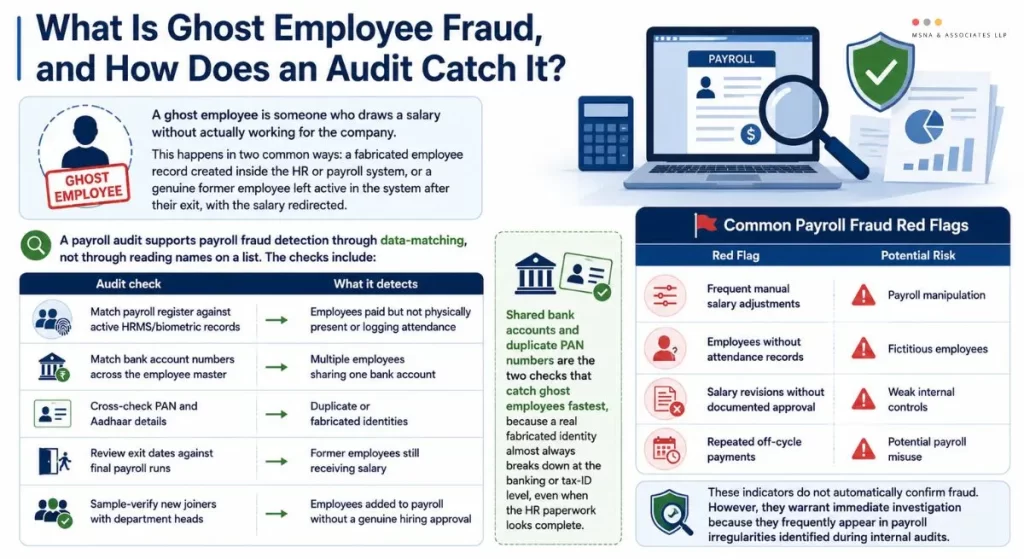
A ghost employee is someone who draws a salary without actually working for the company. This happens in two common ways: a fabricated employee record created inside the HR or payroll system, or a genuine former employee left active in the system after their exit, with the salary redirected.
A payroll audit supports payroll fraud detection through data-matching, not through reading names on a list. The checks include:
Audit check | What it detects |
Match payroll register against active HRMS/biometric records | Employees paid but not physically present or logging attendance |
Match bank account numbers across the employee master | Multiple employees sharing one bank account |
Cross-check PAN and Aadhaar details | Duplicate or fabricated identities |
Review exit dates against final payroll runs | Former employees still receiving salary |
Sample-verify new joiners with department heads | Employees added to payroll without a genuine hiring approval |
Shared bank accounts and duplicate PAN numbers are the two checks that catch ghost employees fastest, because a real fabricated identity almost always breaks down at the banking or tax-ID level, even when the HR paperwork looks complete.
Common Payroll Fraud Red Flags
Red Flag | Potential Risk |
Frequent manual salary adjustments | Payroll manipulation |
Employees without attendance records | Fictitious employees |
Salary revisions without documented approval | Weak internal controls |
Repeated off-cycle payments | Potential payroll misuse |
These indicators do not automatically confirm fraud. However, they warrant immediate investigation because they frequently appear in payroll irregularities identified during internal audits.
How Does Payroll Reconciliation Fit Into the Audit?
Payroll reconciliation means tying the numbers together: what the payroll register says, what the bank statement shows was actually paid, and what the general ledger records as an expense. When these three don’t match, the gap is either an error or something worse.
A reconciliation-focused audit checks:
- Total payroll cost per the register against the total salary expense booked in the ledger
- Net pay per the register against actual bank disbursements
- Statutory deductions withheld against amounts actually deposited with PF, ESI, and the tax department
- Reversals, hold-backs, and off-cycle payments, since these are the entries most often used to disguise irregular payments
Reconciliation differences are common and not automatically fraud. Rounding, timing gaps, and processing errors happen. The audit’s job is to explain every difference, not just note that one exists.
In practice, payroll fraud is rarely discovered because someone notices unusual salary payments. Most cases are uncovered when internal audits compare payroll records with HR master data, attendance systems, and bank transfers together. The real strength of payroll internal audits lies in connecting data across departments rather than reviewing payroll in isolation.
What Statutory Compliance Checks Belong in a Payroll Compliance Audit?
This is the part of a payroll audit that changes most often, and it just changed significantly. From 1 April 2026, the Income Tax Act, 2025 replaced the Income Tax Act, 1961. TDS on salary, previously governed by Section 192, now falls under Section 392 of the new Act.
The quarterly TDS return has moved from Form 24Q to Form 138, and the annual TDS certificate has moved from Form 16 to Form 130. The underlying calculation method (tax at the average rate on estimated annual income) is unchanged; what changed is the section numbers, form numbers, and filing references.
This matters for an audit specifically: if your payroll audit checklist or your finance team’s documentation still cites Section 192, Form 24Q, or Form 16, that reference is now outdated and should be corrected during the audit itself.
A payroll compliance audit typically covers:
Component | What the audit verifies |
Provident Fund (PF) | Employee and employer contributions calculated correctly (12% each of basic plus DA, employer’s share split 3.67% to EPF and 8.33% to EPS), deposited by the 15th of the following month |
Employee State Insurance (ESI) | Applied to employees earning up to Rs 21,000 a month (Rs 25,000 for persons with disabilities), employer 3.25% and employee 0.75%, deposited by the 15th of the following month |
TDS on salary (Section 392, Income Tax Act 2025) | Tax deducted at the correct average rate for each employee’s chosen tax regime, deposited by the 7th of the following month (30 April for March salaries), reported via Form 138 |
Wage structure under the Labour Codes | Basic pay plus dearness allowance is at least 50% of total CTC, which directly affects the PF, ESI, and gratuity calculation base |
Getting this wrong has a real cost. Late PF deposits carry 12% annual interest, plus damages of up to 25% for prolonged delay. Late TDS deposits carry 1.5% monthly interest under the new Act.
Getting the wage-structure rule wrong has a knock-on effect: if basic pay is understated to reduce the PF contribution, both the PF and gratuity bases are understated too, which is exactly the kind of error a statutory audit is built to catch.
What Belongs on a Payroll Internal Audit Checklist?
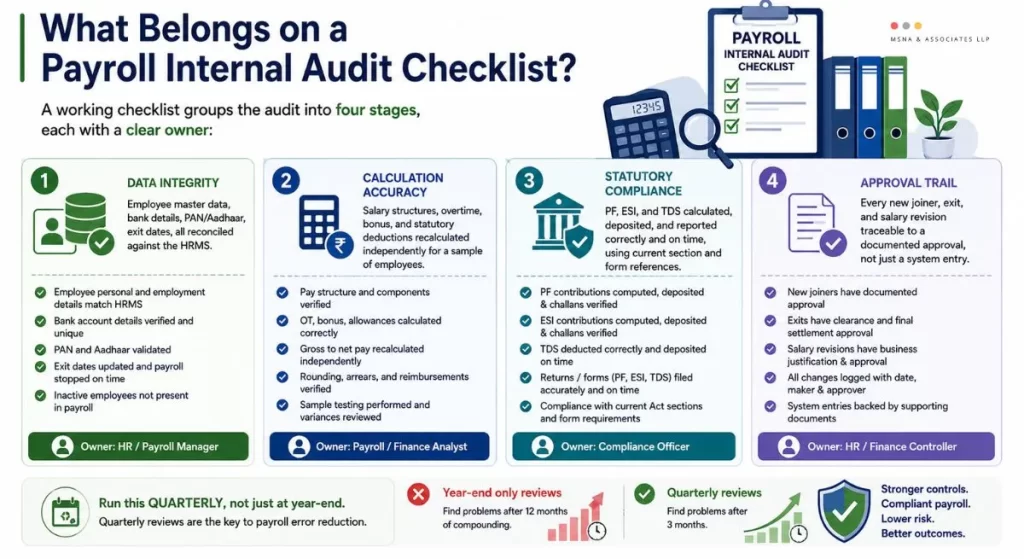
A working checklist groups the audit into four stages, each with a clear owner:
- Data integrity: employee master data, bank details, PAN/Aadhaar, exit dates, all reconciled against the HRMS
- Calculation accuracy: salary structures, overtime, bonus, and statutory deductions recalculated independently for a sample of employees
- Statutory compliance: PF, ESI, and TDS calculated, deposited, and reported correctly and on time, using current section and form references
- Approval trail: every new joiner, exit, and salary revision traceable to a documented approval, not just a system entry
Running this quarterly, rather than only at year-end, is what actually supports payroll error reduction. Year-end-only reviews find problems after twelve months of compounding; quarterly reviews find them after three.If you’re planning a broader internal audit beyond payroll, read how Will an Internal Audit Be Conducted to understand each stage of the audit process and the key areas founders should prepare.
Myth vs Reality related to Payroll Internal Audit
Myth | Reality |
Payroll fraud always involves large amounts | Most fraud begins with small recurring payments that go unnoticed. |
Payroll audits mainly benefit HR | Finance, compliance, internal audit, and leadership all benefit from stronger payroll controls. |
How Does a Payroll Internal Audit Strengthen Payroll Risk Management?
A payroll audit is a point-in-time check. Payroll risk management is what happens between audits. The two work together: audit findings should feed directly into stronger controls, not just a report that gets filed away.
The controls that consistently reduce payroll risk include:
- Segregation of duties between the person who adds or edits employee records and the person who approves payroll for disbursement
- A defined approval workflow for every salary revision, with no exceptions for “urgent” changes
- Monthly reconciliation of headcount, rather than leaving it to the audit cycle
- A documented exception list for anything paid outside the standard payroll run
Our take: the single biggest risk-reduction step is separating who can create or edit an employee record from who can approve that person’s payment. Most ghost-employee cases we see in audit work trace back to one person holding both.
If no one at your company can say for certain who owns payroll reconciliation each month, bringing in an internal audit firm in Bangalore to build this ownership structure is worth considering before it becomes a bigger problem.
Why Payroll Software Alone Cannot Replace Payroll Controls ?
Modern payroll software significantly improves processing accuracy, automates statutory calculations, and reduces manual effort. However, software can only process the information entered into it. If an employee record is incorrect, if a ghost employee has been created, or if an unauthorised salary revision is approved, the payroll system will process those transactions accurately.
This is why payroll internal audits remain essential even in organisations using advanced payroll platforms. Technology improves efficiency, while internal audits validate data integrity, governance, and compliance. In other words, software processes payroll efficiently, but audits verify whether the payroll itself can be trusted.
Final Thoughts on Payroll Audit and Internal Controls
Payroll fraud and payroll errors rarely begin as major problems. They usually start as small process gaps that remain unnoticed because nobody questions routine payroll activities. Organisations that treat payroll internal audits as an ongoing governance practice are better positioned to detect fraud early, reduce payroll errors, and strengthen internal financial control.
A payroll internal audit, run on a fixed schedule rather than only when something looks wrong, is what closes that gap. Consulting a professional can help you assess how frequently your payroll should be audited and what a checklist for your business should specifically cover.
Improve Payroll Accuracy with an Independent Internal Audit
Frequently Asked Questions Related To Payroll Internal Audit
How often should a company run a payroll internal audit?
Quarterly for mid-sized and larger companies. Smaller companies can do it half-yearly, as long as headcount is reconciled monthly in between.
Does a payroll audit replace the statutory audit under the Companies Act?
No. It’s a separate, operational check. It can reduce what the statutory auditor finds later, since payroll issues get caught earlier.
What's the difference between a payroll error and payroll fraud?
An error is unintentional, like a wrong deduction rate. Fraud is deliberate, like a fake employee. An audit flags both the same way at first, then checks intent.
Can a small business skip a payroll audit if it uses payroll software?
No, Software checks the math, not whether the underlying data is real. The two aren’t a substitute for each other.
Related
Discover more from MSNA & Associates LLP
Subscribe to get the latest posts sent to your email.