


If your foreign parent has just incorporated an India entity, first auditor appointment for subsidiary companies in India is the first statutory deadline on your calendar.
Under Section 139(6) of the Companies Act, 2013, the Board must appoint the first auditor within 30 days of incorporation. The ADT-1 question is less settled. The statute is silent on it for a first auditor, yet the revised form now carries a first-auditor option and MCA’s own FAQ recommends filing.
This guide covers the Companies Act requirements, appointment timelines, board and shareholder requirements, and ADT-1 filing considerations, so a foreign subsidiary can act with clarity.
Key Takeaways
- Who appoints: the Board of the Indian subsidiary, not the foreign parent, appoints the first auditor.
- When: within 30 days of incorporation. If the Board misses the window, it must inform the members, who can then appoint at an EGM within 90 days.
- Term: the first auditor holds office only until the conclusion of the first AGM.
- ADT-1: Rule 4(2) does not expressly require it for a Board-appointed first auditor. MCA’s FAQ still recommends filing within 15 days of the appointment meeting.
- Why it matters: ICSI’s April 2026 letter notes that AOC-4 validations can push companies to file ADT-1 later.
- After that: shareholders appoint a five-year statutory auditor at the first AGM under Section 139(1).
MSNA’s position: treat the first auditor appointment as a control decision. Appoint at the first board meeting, file ADT-1 despite the open legal question, and keep the statutory auditor away from bookkeeping and internal audit (Section 144).
What Is First Auditor Appointment for Subsidiary Companies in India?
The first auditor of a subsidiary company is the Chartered Accountant (or CA firm) who carries out the statutory audit from incorporation until the first AGM. It is a short, board-led appointment. A five-year term follows later.
Legal basis at a glance
Provision | What it governs |
Section 139(6), Companies Act 2013 | First auditor of a non-government company, appointed by the Board |
Section 139(1) | Five-year auditor appointed by members at the first AGM |
Eligibility and disqualifications | |
Auditor’s certificate and notice to the Registrar in Form ADT-1 | |
Penalties for contravening Sections 139 to 146 |
Section 139(6): Who Appoints the First Auditor, and By When?
This is the core of first auditor appointment in India for any non-government company.
Step | Who acts | Deadline |
1 | Board of Directors | Within 30 days of incorporation |
2 (fallback) | Members at an EGM | Within 90 days, after the Board fails to appoint and informs the members |
3 | First AGM | Auditor’s office ends; members appoint under Section 139(1) |
The Board of the Indian subsidiary must appoint the first auditor within 30 days of incorporation under Section 139(6) of the Companies Act, 2013. If it misses the window, it must inform the members, who can appoint at an EGM within 90 days. The auditor serves until the first AGM.
The shareholder (EGM) fallback
Once the 30 days lapse, the Board must inform the members, who can then appoint the auditor at an EGM within 90 days. In a typical foreign-owned subsidiary, the members are the parent and any nominee shareholder. Treat this as a rescue route and build your timeline around the Board meeting.
When Does Section 139(6) Not Apply?
Government companies follow Section 139(7): the Comptroller and Auditor General appoints the first auditor within 60 days of incorporation. A typical foreign-owned private subsidiary is outside this route.
What If Both the 30-Day and 90-Day Windows Are Missed?
Section 139(6) provides two routes: the Board appoints within 30 days, and if it does not, the members appoint at an EGM within 90 days. The section sets out no third route. If both windows pass, the company is in contravention of Section 139, and Section 147(1) allows a fine of ₹25,000 to ₹5 lakh on the company and ₹10,000 to ₹1 lakh on each officer in default. The amount depends on the circumstances.
In practice, a company in this position should not wait. Appoint an eligible CA, document the reasons for the delay in the board minutes, and have the position reviewed by a professional before the first AOC-4 is filed, because the first-year filings will carry the appointment details.
Who Can Be the First Auditor of a Subsidiary Company?
The first auditor of a subsidiary company must be a Chartered Accountant in practice, either an individual or a firm.
- Holds a valid Certificate of Practice from ICAI.
- Is not disqualified under Section 141 or the Chartered Accountants Act, 1949.
- For a firm, the majority of partners practising in India must be qualified CAs.
- Gives written consent and a Section 141 eligibility certificate before appointment, in line with standard Rule 4(1) practice.
- Has no conflicting relationship with the company, its directors, or the parent that would impair independence.
“In our experience, some parent companies assume their global audit network will automatically cover the Indian entity. Indian law requires an Indian-qualified auditor, and the independence check should be done before the board meeting, not after.” – CA Naveen S N, Partner – Risk Advisory, MSNA & Associates LLP.
How Does the Board Appoint the Statutory Auditor, Step by Step?
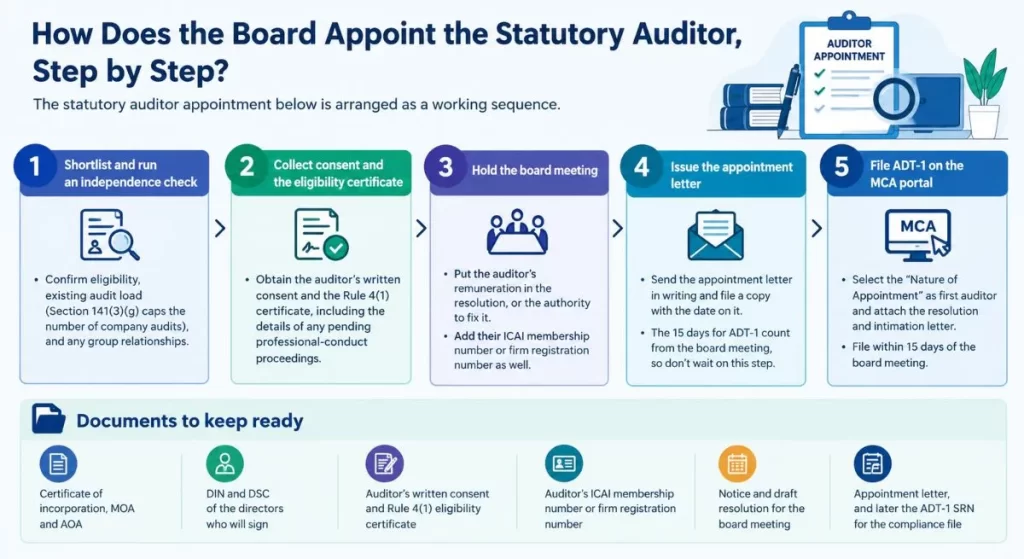
The statutory auditor appointment below is arranged as a working sequence.
Step 1: Shortlist and run an independence check
Confirm eligibility, existing audit load (Section 141(3)(g) caps the number of company audits), and any group relationships.
Step 2: Collect consent and the eligibility certificate
Obtain the auditor’s written consent and the Rule 4(1) certificate, including the details of any pending professional-conduct proceedings.
Step 3: Hold the board meeting
Put the auditor’s remuneration in the resolution, or the authority to fix it. Add their ICAI membership number or firm registration number as well.
Step 4: Issue the appointment letter
Send the appointment letter in writing and file a copy with the date on it. The 15 days for ADT-1 count from the board meeting, so don’t wait on this step.
Step 5: File ADT-1 on the MCA portal
Select the “Nature of Appointment” as first auditor and attach the resolution and intimation letter. File within 15 days of the board meeting.
Documents to keep ready
- Certificate of incorporation, MOA and AOA
- DIN and DSC of the directors who will sign
- Auditor’s written consent and Rule 4(1) eligibility certificate
- Auditor’s ICAI membership number or firm registration number
- Notice and draft resolution for the board meeting
- Appointment letter, and later the ADT-1 SRN for the compliance file
A 30-Day Countdown for the Parent’s Finance Team
Using the worked example (incorporation on 12 January 2026):
Day | Date | Action |
0 | 12 Jan | Diary 11 Feb as the Board deadline. Confirm DSC and DIN status for every director who will sign. |
1–7 | 13–19 Jan | Shortlist auditors. Run the independence check, including any services the firm’s network provides to the foreign parent (Section 144 covers the holding company). |
8–14 | 20–26 Jan | Collect the auditor’s written consent and the Rule 4(1) eligibility certificate. Draft the board notice and resolution. |
15–22 | 27 Jan–3 Feb | Hold the board meeting and minute the appointment. Issue the appointment letter. |
23–37 | 4–18 Feb | File ADT-1 within 15 days of the meeting. Save the SRN to the compliance file. |
If the Board meets on day 30 (11 February), ADT-1 falls due on 26 February.
ADT-1 Filing for the First Auditor: Is It Mandatory?
This is the question the market answers differently, and the reason ADT-1 filing deserves its own analysis.
Rule 4(2) does not expressly require ADT-1 for a Board-appointed first auditor under Section 139(6). The revised form, effective 14 July 2025, now offers a first-auditor option, and MCA’s FAQ recommends filing. Until MCA clarifies, file within 15 days of the Board meeting and keep the SRN.
Three readings in circulation (2025–2026)
Reading | Basis | Practical effect |
“Not mandatory” | Rule 4(2) refers only to the fourth proviso to Section 139(1), not Section 139(6) | Strictly, no express filing duty |
“Mandatory from 14 July 2025” | Revised form adds a first-auditor option, but Rule 4(2) was not amended | Treat as a strong signal to file, though MCA has not declared it mandatory |
“Unsettled, file anyway” | ICSI’s April 2026 representation asks MCA to clarify | Prudent course while clarity is pending |
The ICSI representation
On 16 April 2026, ICSI wrote to the MCA seeking clarity on whether ADT-1 is mandatory for a Section 139(6) first auditor and for casual vacancies under Section 139(8). Read the ICSI representation. ICSI listed the representation again in its 20 August 2026 follow-up to MCA. As of 28 October 2026, we found no MCA circular resolving it. Check the MCA website before you file.
The revised form followed MCA Notification G.S.R. 359(E) of 30 May 2025, which added first-auditor options to ADT-1. MCA’s own ADT FAQ (No. 35) acknowledges that Rule 4(2) points to Section 139(1) and not Section 139(6), yet recommends filing for the first auditor. ICSI adds that AOC-4 validations can push companies to file ADT-1 later.
Our practical view
“The debate is legal; the consequence is operational. If no ADT-1 SRN exists, the AOC-4 filing for the first financial year can hit validation friction. Filing within 15 days costs little and reduces the risk of a portal validation issue later.” – CA Naveen S N.
For Indian subsidiary compliance, MSNA’s working practice is to file.
Penalty exposure under Section 147
Contravention of Sections 139 to 146 can attract a fine of ₹25,000 to ₹5 lakh on the company and ₹10,000 to ₹1 lakh on each officer in default. Since the Companies (Amendment) Act, 2020 removed the imprisonment option for officers, the exposure is monetary and depends on the circumstances.
If your finance team is deciding how to document the ADT-1 position in the board file, MSNA’s virtual CFO and compliance support team can review the approach with you.
When Must the Board Appoint the First Auditor? A 2026 Worked Example
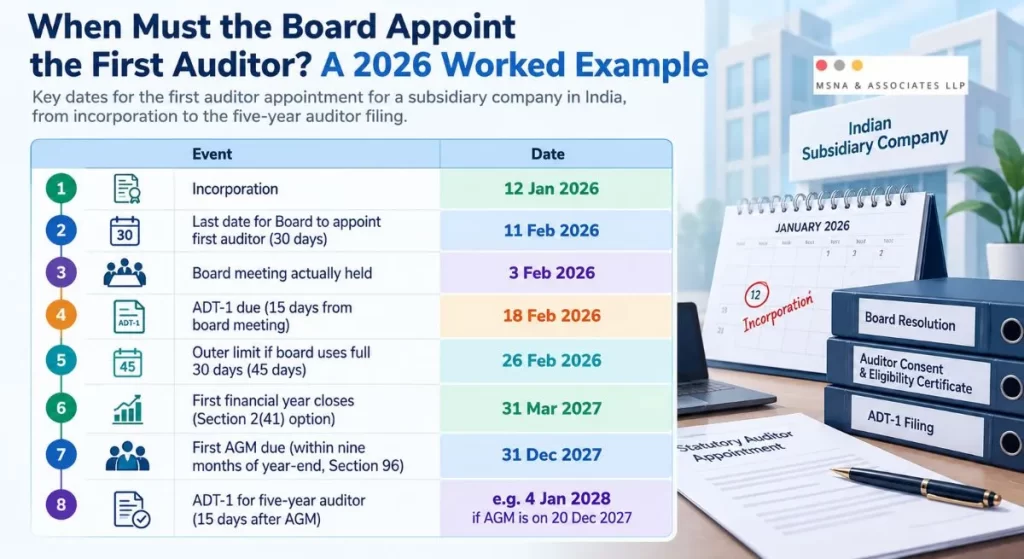
Assume an Indian subsidiary is incorporated on 12 January 2026.
Event | Date |
Incorporation | 12 Jan 2026 |
Last date for Board to appoint first auditor (30 days) | 11 Feb 2026 |
Board meeting actually held | 3 Feb 2026 |
ADT-1 due (15 days from board meeting) | 18 Feb 2026 |
Outer limit if board uses full 30 days (45 days) | 26 Feb 2026 |
First financial year closes (Section 2(41) option) | 31 Mar 2027 |
First AGM due (within nine months of year-end, Section 96) | 31 Dec 2027 |
ADT-1 for five-year auditor (15 days after AGM) | e.g. 4 Jan 2028 if AGM is on 20 Dec 2027 |
What Foreign Subsidiary Pitfalls Do Parent Companies Often Miss?
Overseas parents tend to repeat a handful of slips, so check these before the first board meeting.
1. Treating the parent’s approval as the appointment
The parent’s written approval does not replace the Board resolution under Section 139(6).
2. Missing DSC and DIN readiness
ADT-1 needs a digital signature. Delays in director DSCs are a common cause of lapsed 30-day windows.
3. Misaligned reporting calendars
A foreign subsidiary must follow India’s April–March financial year, while the parent may report on a calendar year. Agree early on group reporting packages with the auditor.
Where group consolidation genuinely needs a different year, the first proviso to Section 2(41) allows an application to the Tribunal.
4. Leaving group-audit coordination to chance
The Indian auditor signs the Indian statutory opinion. The group auditor may still need a reporting package and access to working papers. Agree timelines, materiality and access in writing before the first quarter-end.
Our US subsidiary registration guide and UAE subsidiary setup page outline how post-incorporation steps like this fit into the setup.
What Common Mistakes Affect First Auditor Appointment for Subsidiary Companies in India?
These are the slips worth checking before first auditor appointment in India is minuted.
Mistake | Why it matters | Fix |
Counting 30 days from the first board meeting | The 30 days run from incorporation | Diary the date on incorporation day |
Parent signs a consent instead of a Board resolution | Section 139(6) gives the first appointment to the Board | Hold a board meeting and minute the resolution |
Appointing before consent and certificate arrive | Rule 4(1) requires both | Collect them first |
Skipping ADT-1 because it is “not mandatory” | AOC-4 may later ask for the SRN | File within 15 days and save the SRN |
Choosing the auditor on fee alone | Thin scoping delays the first AOC-4 and AGM | Compare scope, team and independence |
One firm for books and audit | Restricted by Section 144 | Keep the roles separate |
Independence and Section 144: What the First Auditor Cannot Do
Section 144 bars a statutory auditor from providing certain services to the company, its holding company or its subsidiaries, directly or indirectly. These include:
- Accounting and bookkeeping
- Internal audit
- Design and implementation of financial information systems
- Investment advisory, investment banking and outsourced financial services
- Actuarial and management services
Our opinion: Subsidiaries can run into this inadvertently when one firm is hired for “everything”. The statutory auditor and the internal auditor should be separate appointments, a distinction we unpack in our internal audit page. Because the holding company is covered too, check the auditor’s network services to your foreign parent before the board meeting.
If bookkeeping is outsourced, keep it with a separate provider, for example outsourced accounting for US businesses or for UAE businesses.
What Happens If the First Auditor Resigns Before the First AGM?
A first auditor can leave before the first AGM, and the Companies Act sets a short window to replace them.
If the first auditor resigns
The Board fills the vacancy within 30 days under Section 139(8), and members approve the appointment at a general meeting convened within three months of the Board’s recommendation. The resigning auditor files Form ADT-3 within 30 days of resigning, and the replacement holds office until the next AGM. Whether ADT-1 is needed here is part of the same ICSI query.
No revenue, still an audit
A newly incorporated subsidiary with no transactions must still appoint an auditor and get its accounts audited. A “dormant” first year is not an exemption.
After the First Auditor: Statutory Audit and Internal Audit
At the first AGM, members appoint the statutory auditor under Section 139(1) by ordinary resolution for a five-year term, and ADT-1 is filed within 15 days of the AGM. The statutory audit gives an external opinion on the accounts.
Since the statutory audit is an annual, backwards-looking opinion, many boards also set up a risk-based internal audit in the first year to test controls in real time. See also the types of internal audit and this risk-based internal audit case study.
“Statutory audit tells the parent what happened. Internal audit tells management what is about to go wrong. Early-stage subsidiaries benefit from both.” – CA Naveen S N. Meet the team.
First-Year Compliance Calendar for an Indian Subsidiary
Use this compliance calendar as a starting checklist for MCA compliance.
Task | Typical timeline |
First board meeting and auditor appointment | Within 30 days of incorporation |
ADT-1 for first auditor | Within 15 days of appointment |
FC-GPR (FDI reporting) | Within 30 days of share allotment |
INC-20A (commencement of business), where applicable | Within 180 days of incorporation |
First AGM | Within nine months of first year-end |
AOC-4 / MGT-7 | 30 / 60 days from AGM |
ADT-1 for five-year auditor | Within 15 days of AGM |
A virtual CFO arrangement can keep this calendar visible to both India and parent finance teams and make Indian subsidiary compliance easier to track. A professional review can help you assess how this applies to your subsidiary. The MSNA team can walk through your incorporation date, the appointment timeline and the ADT-1 position with you.
Bottom Line On First Auditor Appointment for Subsidiary Companies in India
For the first auditor appointment for subsidiary companies in India, get the Board resolution for the statutory auditor appointment done early, document eligibility, and file ADT-1 to keep your records clean. If your team would like a second pair of eyes on the appointment process or the first-year controls, talk to the MSNA’s Internal Audit Services in India.
Need Clarity on Your Indian Subsidiary’s Auditor Appointment?
Frequently Asked Questions About First Auditor Appointment for Subsidiary Companies in India
What is the deadline for first auditor appointment in a subsidiary company?
Section 139(6) gives the Board 30 days from incorporation to appoint the first auditor. If the Board fails to act, it must inform the members, who can then appoint at an EGM within 90 days.
Can the foreign parent appoint the first auditor directly?
The Board of the Indian subsidiary appoints first. The members (typically the parent and any nominee shareholder) can appoint through an EGM only after the Board has failed to appoint in time and informed them.
Is ADT-1 mandatory for the first auditor?
Rule 4(2) refers to Section 139(1), so there is no express duty for a Section 139(6) appointment. The revised form includes a first-auditor option and MCA’s FAQ recommends filing, but Rule 4(2) has not been amended to make it express. Filing within 15 days is the prudent course.
Can the first auditor be reappointed at the first AGM, and is ADT-1 needed again?
Yes, the first auditor can be chosen again. At the first AGM, the members appoint the statutory auditor under Section 139(1) for a five-year term, and the same firm is eligible if it still meets Section 141. This appointment does need ADT-1. Rule 4(2) applies to it directly, so file within 15 days of the AGM.
How long does the first auditor stay in office?
The first auditor holds office until the first AGM ends, and that can be longer than people expect. A company incorporated on or after 1 January can run its first financial year to 31 March of the following year. The first AGM is then due within nine months of that year-end. In the worked example (incorporated 12 January 2026), the first auditor could serve for nearly two years.
Related
Discover more from MSNA & Associates LLP
Subscribe to get the latest posts sent to your email.