

If your UAE parent company has an Indian subsidiary or joint venture that has started generating profits, you are likely asking a practical question: how do you actually repatriate profits from India to UAE, and how much of it will you keep?
Under the Foreign Exchange Management Act (FEMA), 1999, and the Income-tax Act, 1961, Indian companies can freely repatriate profits to a UAE parent or shareholder through dividends, without RBI approval, provided the applicable withholding tax has been deducted, and Form 15CA/15CB has been filed with the bank.
In our engagements with UAE-based promoters, the most common holdup is not the tax rate itself but timing: companies wait until a dividend is already declared to start chasing the Tax Residency Certificate, and that single delay pushes the whole remittance back by several weeks.
This guide walks UAE-based promoters, finance heads, and investment managers through the current profit repatriation rules in India, the tax cost under the India-UAE DTAA, the FEMA classification, and the actual banking steps involved.
What Does "Repatriation of Profits From India To UAE" Mean Under FEMA?
Repatriation, under FEMA, means moving foreign exchange out of India to a person or entity resident outside India, in this case your UAE parent or shareholder. Here is how FEMA classifies these movements.
- FEMA sorts every cross-border payment into two buckets: current account or capital account
- Dividends, royalties, technical service fees, and interest on ECBs fall under current account. These move fairly freely, with no prior RBI approval needed
- Capital account transactions, like a share buyback or capital reduction, involve actual transfer of assets or liabilities, so they bring extra valuation and reporting requirements
- The route you pick isn’t just a compliance call. It shapes the tax outcome too, so decide with the group’s broader tax position in mind, not just what’s simplest for this one transfer
What Are the Main Routes to Repatriate Profits From India to UAE?
Most Indian subsidiaries of UAE companies use one or a combination of the following four channels.
Route | FEMA classification | RBI approval | Typical use case |
Dividend | Current account | Not required | Straightforward, most common route for regular profits |
Royalty / Fees for Technical Services (FTS) | Current account | Not required | Where the UAE parent licenses IP or provides technical support |
ECB interest repayment | Current account | Case-dependent, largely automatic | Where the Indian entity has borrowed from the UAE parent |
Share buyback/capital reduction | Capital account | Not required, but reporting-heavy | Larger one-time exits or restructuring |
Dividends are usually the simplest option because they attract a flat withholding rate under the India-UAE DTAA and do not require the transfer pricing documentation that royalty or FTS payments do. A company weighing a large one-time repatriation may still find that a structured mix of dividend and royalty reduces the overall Indian tax outflow, depending on the intercompany agreements already in place.
If you are still at the entry stage and haven’t set up the Indian structure yet, an overview of setting up a company in India from the UAE covers the entity choices that shape which of these routes will even be available to you later.
What Tax Applies When You Repatriate Profits From India to UAE?
Dividends paid by an Indian company to a UAE shareholder are taxed at source in India, capped at 10% under the India-UAE DTAA, and this is usually the first number a UAE finance head wants confirmed.
- Since April 2020, India has not levied Dividend Distribution Tax (DDT) on the company. Instead, the shareholder is taxed directly, which is why the withholding tax at the point of remittance matters so much.
- The domestic rate under Section 115A of the Income-tax Act is 20%, plus applicable surcharge and cess, taking the effective rate to roughly 20.8% to 21.84%.
- Under Article 10 of the India-UAE DTAA, as amended by the 2007 Protocol, this is capped at a flat 10% for a UAE tax resident who is the beneficial owner of the dividend.
Basis | Effective withholding rate |
Domestic rate (Section 115A, no treaty benefit claimed) | ~20.8% to 21.84% |
India-UAE DTAA rate (Article 10, treaty benefit claimed) | 10% |
To claim the 10% treaty rate, the UAE entity needs to hold a valid Tax Residency Certificate (TRC) issued by the UAE Ministry of Finance and submit Form 10F and a beneficial ownership declaration to the Indian company, in line with the documentation requirements under Rule 21AB of the Income-tax Rules, 1962.
The DTAA also carries a Limitation of Benefits (LOB) clause, which means treaty benefits may be denied where the main purpose of a structure appears to be obtaining the treaty rate rather than carrying on genuine business activity in the UAE.
This is a fact-specific area, so the substance of the UAE entity (office, staff, management, and control) is worth documenting well before a repatriation is planned.
What Does the Treaty Rate Actually Save You? A Worked Example
Here is how a straightforward dividend payout compares under both rates.
Scenario | Amount |
Distributable profit | ₹1,00,00,000 |
Tax at domestic rate (~21.84%, no treaty claimed) | ₹21,84,000 |
Net repatriable at domestic rate | ₹78,16,000 |
Tax at DTAA rate (10%, treaty claimed) | ₹10,00,000 |
Net repatriable at DTAA rate | ₹90,00,000 |
Difference in favor of claiming the treaty rate | ₹11,84,000 |
That gap of roughly ₹11.84 lakh on a ₹1 crore dividend is only available if the TRC and Form 10F are already on file when the board declares the dividend. A UAE Ministry of Finance TRC takes a few weeks to process, so requesting it four to six weeks ahead of the planned dividend declaration is a reasonable working buffer.
How Does This Interact With UAE Corporate Tax on the Parent's Side?
A question we increasingly get from UAE-based promoters is what happens to the dividend once it lands on their side of the border, given the UAE’s 9% corporate tax that came into effect on business profits above the applicable threshold.
Dividends received by a UAE parent from a qualifying shareholding in a foreign subsidiary are generally eligible for the participation exemption under the UAE Corporate Tax Law, meaning the dividend itself is not added back into the UAE parent’s taxable income, subject to meeting the ownership and holding-period conditions. Where any residual Indian tax has been withheld beyond what the participation exemption would otherwise shelter, groups should also check whether a foreign tax credit is available under Article 24 of the India-UAE DTAA, since double taxation relief and the exemption route are not automatically interchangeable and the right answer depends on the specific facts of the UAE entity.
What FEMA Guidelines Apply When You Repatriate Profits From India to UAE?
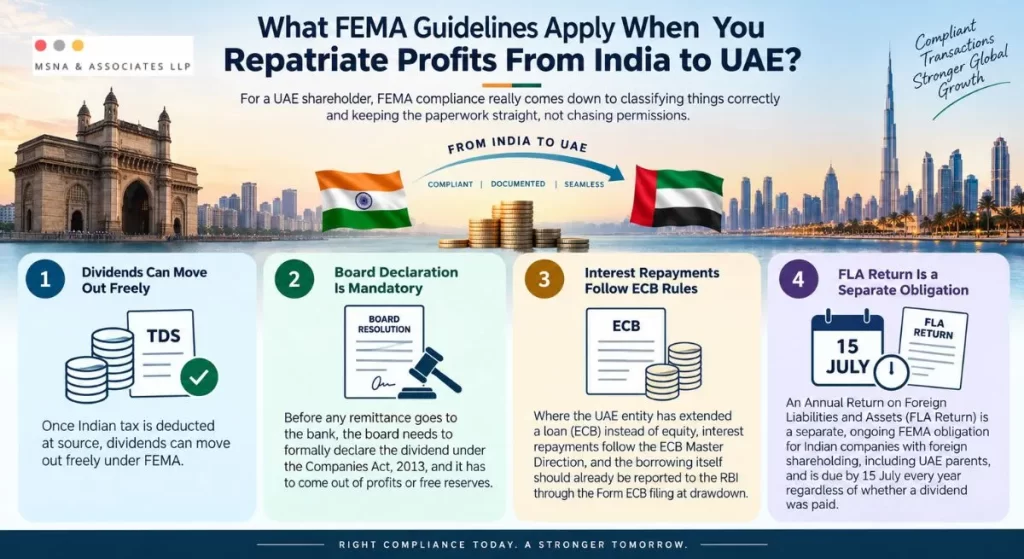
For a UAE shareholder, FEMA compliance really comes down to classifying things correctly and keeping the paperwork straight, not chasing permissions
- Once Indian tax is deducted at source, dividends can move out freely under FEMA
- Before any remittance goes to the bank, though, the board needs to formally declare the dividend under the Companies Act, 2013, and it has to come out of profits or free reserves
- Where the UAE entity has extended a loan (ECB) instead of equity, interest repayments follow the ECB Master Direction, and the borrowing itself should already be reported to the RBI through the Form ECB filing at drawdown.
- An Annual Return on Foreign Liabilities and Assets (FLA Return) is a separate, ongoing FEMA obligation for Indian companies with foreign shareholding, including UAE parents, and is due by 15 July every year regardless of whether a dividend was paid.
Has Anything Changed Recently for UAE-Owned Entities?
Two regulatory developments from 2026 are worth flagging, and it matters which one actually applies to your structure.
- Branch/liaison office repatriation is still just a draft. The RBI has proposed replacing the current lengthy approval process with chartered-accountant certification for branches, liaison, and project offices repatriating profits or winding-up proceeds, under the Draft Foreign Exchange Management (Establishment in India of a Branch or Office) Regulations, 2025, released for public consultation on October 3, 2025. This only matters if your Indian entity is a branch or liaison office, not a subsidiary.
- Banking dividend norms are locked in for FY 2026-27. The RBI’s Commercial Banks – Prudential Norms on Declaration of Dividend and Remittance of Profits Directions, 2026 (RBI/2025-26/387, dated March 10, 2026), along with the accompanying amendment to the Setting Up of Wholly Owned Subsidiaries by Foreign Banks Guidelines, tighten dividend and profit-remittance conditions. But only for commercial banks and foreign banks’ wholly-owned banking subsidiaries in India. This matters only if your UAE parent runs a banking WOS here
Neither change affects a standard UAE-owned trading or services subsidiary right now. Confirm status with your compliance team if you’re a branch office or banking entity.
Do You Need RBI Approval to Repatriate Profits From India to UAE?
For most UAE-owned Indian companies, the answer is no. Dividend and royalty repatriation both fall under the automatic route, so the Indian company’s authorized dealer bank can process the remittance directly, no separate RBI application needed, as long as the documentation is in order.
RBI involvement becomes more likely in a narrower set of situations.
- The Indian company operates in a sector where foreign investment itself required prior government approval (for example, certain regulated or strategic sectors).
- The transaction is a capital account transfer, such as a buyback, capital reduction, or winding up of a branch office, which needs RBI-prescribed reporting even though it does not need prior approval in most cases.
- There is a discrepancy between the FDI reporting on record (such as Form FC-GPR at the time shares were issued) and the current shareholding pattern.
What Is the Banking Process for Outward Remittance to the UAE?
Once the Indian company’s board has approved the dividend and the tax position is settled, the actual transfer moves through the company’s authorized dealer bank in a fairly standard sequence.
Step | What happens |
1. Board resolution | The board declares the dividend, drawing from profits or reserves as the Companies Act requires. |
2. Tax computation | The CA works out the withholding tax, using the DTAA rate where the TRC and Form 10F are already in hand. |
3. Form 15CB | A chartered accountant certifies the remittance and the tax deducted through Form 15CB, as Rule 37BB of the Income-tax Rules, 1962 requires. |
4. Form 15CA | The company then files Form 15CA on the income tax e-filing portal, pointing back to that 15CB. |
5. Bank submission | Everything gets submitted to the AD bank alongside the remittance request. |
6. SWIFT transfer | The bank remits funds to the UAE parent’s account via SWIFT, usually in USD or AED |
A remittance can move within one to two weeks once the paperwork is complete, though this depends on the bank’s internal checks and how promptly the TRC and Form 10F are available. Incorrect SWIFT or beneficiary bank details are a common, avoidable cause of delay or fund returns.
What Documents Are Required for Profit Repatriation to the UAE?
Keeping this checklist ready before initiating a remittance tends to shorten the overall timeline considerably.
- Board resolution declaring the dividend
- Audited financial statements supporting the profits or reserves
- UAE Tax Residency Certificate (TRC) for the relevant financial year
- Form 10F and beneficial ownership declaration from the UAE shareholder
- Chartered accountant’s certificate in Form 15CB
- Form 15CA acknowledgment from the income tax portal
- FIRC or shareholding records confirming the original inward investment (for the bank’s FEMA check)
What Common Mistakes Delay Profit Repatriation From India to UAE?
A few recurring issues account for most of the delays finance teams run into.
- Applying the DTAA rate without a valid, current-year TRC on file, which the AD bank or the tax department may later question.
- Treating dividends and royalties as interchangeable, without checking if the royalty arrangement actually has a proper intercompany agreement and transfer pricing documentation behind it
- Declaring a dividend before confirming the company has enough distributable profits or reserves under the Companies Act
- Leaving the TRC request until the remittance is due, when it can actually take a few weeks to get from the UAE Ministry of Finance
- Overlooking the annual FLA Return, which is unrelated to any specific remittance but still a mandatory FEMA filing for foreign-owned Indian companies.
In Summary
Repatriating profits from an Indian company to a UAE parent is a well-established, largely automatic process once the underlying documentation, particularly the TRC, Form 10F, and Form 15CB, is in place. The tax cost is materially lower under the India-UAE DTAA than under domestic law, but claiming it correctly depends on timing and substance, not just paperwork filed at the last minute.
MSNA’s FEMA advisory and Form 15CA/15CB filing support can help you Setup New Company In India from the UAE and build this timeline before your next dividend declaration
Plan Your India-to-UAE Profit Repatriation
Frequently Asked Questions About Repatriate profits from India to UAE
Is prior RBI clearance needed to send dividends from India to the UAE?
No. Dividend remittances move through FEMA’s automatic route via the company’s authorized dealer bank, with RBI involved only in narrower cases like buybacks or FDI reporting mismatches.
What percentage of a dividend gets withheld before it reaches the UAE?
Roughly 20.8–21.84% without treaty benefit, or a flat 10% once the UAE entity’s TRC, Form 10F, and beneficial-ownership declaration are on file.
What's a realistic timeline from board approval to funds landing in the UAE?
One to two weeks after Form 15CA/15CB and the TRC are ready, though the AD bank’s own review can extend this.
Can a UAE company repatriate profits without maintaining a taxable presence in India?
Yes. Repatriation of dividends as a shareholder is a separate issue from running a Permanent Establishment in India.
Related
Discover more from MSNA & Associates LLP
Subscribe to get the latest posts sent to your email.