

IT Audit & IT Governance: What’s the Real Difference?
If your business runs on technology (and let’s be honest, whose doesn’t?), you’ve got two big responsibilities: keeping your IT in check and making the right calls about it. That’s where IT audit & IT governance come in. One should follow rules and make the risk under control. The other sets the rules, goals, and direction in the first place.
Think of it like a football match, IT governance is the coach deciding the game plan, and IT audit is the referee checking if everyone’s actually playing by the rules. Both are crucial, but they play very different roles.
In this blog, we’ll explain what they are, how they differ, and how they work together, using the most recent global standards and frameworks so you can apply them effectively in your organisation.
What Is IT Governance?
IT governance sits with leaders, boards, executives, and CIOs. It creates the framework that ensures IT aligns with the business needs, meets ethical and legal standards, as well as manages risk. In simple terms, governance answers questions like: “Are we using IT responsibly? Are we investing in the right things? Do we know who’s accountable?”
The latest international standard, ISO/IEC 38500:2024, lays out six principles: responsibility, strategy, acquisition, performance, conformance, and human behaviour. We designed it so boards and leaders can make sure IT works well,safely and transparently.
NIST’s Cybersecurity Framework version 2.0 takes governance to a new level by defining a standalone “Govern” function. This reflects a shift; governance isn’t just a part of cybersecurity, it must lead it. That means risk strategy, oversight, policy, and supply-chain risk are now front and centre.
In India SEBI has come up with Cyber Security and Cyber Resilience Framework(CSCRF) and made it mandatory for companies in the capital market and many other applicable regulated entities. The CSCRF Framework defines the entire Governance mechanism and prompts companies to build their own policies adopting this framework. The CSCRF Regulations also mandates VAPT(Vulnerability Assessment and Penetration Testing) and cyber audits for these applicable entities
What Is an IT Audit?
An IT audit is a reality check. It’s performed by internal audit teams or external specialists, including an IT audit company, to ensure controls are in place and working. These controls can include user access rules, change management procedures, data backups, and security monitoring, collectively known as IT audit controls. The internal audit team of the IT firm also follows essential guidelines for better compliance.
To ensure correct configuration, documentation, and evidence trails, auditors in India will assess these standard controls for companies. They report on control failures and suggest improvements.
This role is independent; it’s about assurance, not decision-making. It answers, “Did governance work? Are they truly managing risk, implementing policies, and establishing the right controls to mitigate risks? Are any process-level changes necessary?”
For more on independence and the “Three Lines Model,” see the Institute of Internal Auditors’ guidance.
Which Companies In India Need An IT Audit?
SEBI-regulated entities need one under the CSCRF, with audit frequency set by their category. Companies regulated by RBI or IRDAI usually have their own IT audit mandates too. Outside these sectors, any company running a statutory internal audit will often bring IT controls into scope once its systems reach a certain size, since weak IT controls can affect the reliability of financial reporting.
How IT Governance and IT Audit Work Together?
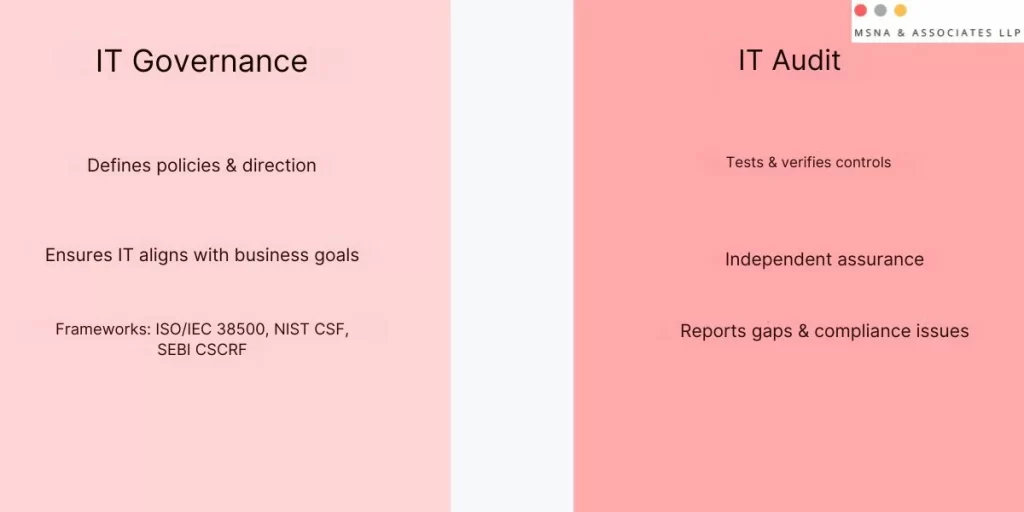
Governance sets all the expectations: “All employees must use multi-factor authentication (MFA), and all vendor contracts must meet security standards.” Audit checks whether these rules are being followed. For example, an IT audit general control review will examine MFA settings, login logs, and exceptions to verify compliance.
If auditors find gaps, they report them to governance, which then adjusts policies, provides training, or enforces controls more strictly. This creates a feedback loop: governance sets direction, audit verifies execution, and the organization improves continuously.
What Frameworks Support IT Governance and IT Audit Beyond ISO and NIST?
ISO 38500 and NIST CSF 2.0 set the direction and risk posture. Day-to-day control design in India usually draws from COBIT 2019, ISACA’s framework for mapping governance goals to specific control objectives.
GRC (Governance, Risk, and Compliance) platforms bring policy, risk register, and audit evidence into one system instead of scattered spreadsheets.
Two controls show up in almost every audit finding. IAM (Identity and Access Management) covers who has access and why. Segregation of Duties (SoD) makes sure the person who requests a change is not the same person who approves and deploys it.
IT Risk Assessment comes before all of this. It is the periodic exercise that decides which systems get audited first, based on business impact and threat exposure.
Why IT Governance and IT Audit Are Important Right Now?
Regulators and investors are putting more and more pressure on businesses to handle cybersecurity in a responsible way. Boards and CISOs must demonstrate that they not only create policies but also ensure they are followed.
The introduction of NIST CSF 2.0 in early 2024 made this clear. The “Govern” feature shows that governance is not optional; it’s an important part of managing IT risk.
As cloud computing, AI, and complex supply chains grow, they create new risks. Governance frameworks define how to handle these risks, and audits verify that teams apply the policies consistently across all systems and vendors.
IT Governance vs IT Audit: Quick Comparison
| Area | IT Governance | IT Audit |
|---|---|---|
| Purpose | Direction, strategy, accountability | Verify, assess, report |
| Owner | Board, CIO, leadership | Internal/External auditors |
| Frequency | Continuous | Periodic (quarterly/annually) |
| Output | Policies, frameworks, controls | Findings, gaps, recommendations |
| KPI Focus | Alignment & maturity | Effectiveness & compliance |
Common IT Audit and IT Governance Findings
These are the issues that come up most often when we review a company’s IT controls.
1. Not all accounts are subject to MFA:
Attackers can easily access high-risk accounts when multi-factor authentication isn’t used for every user. This raises the possibility of credential-based breaches and produces security.
2. Outdated user accounts (contractors, former employees):
Hidden backdoors are created by inactive accounts that stay open long after individuals depart the company. These forgotten accounts are frequently used by attackers to obtain unauthorised access.
3. Insufficient documentation for change management:
Teams lose insight into what was altered and why when IT changes are not appropriately documented. This makes it difficult to look into problems and increases system instability.
4. DR/backup testing has not been completed:
Untested disaster recovery plans or backups could lead to a malfunction when they’re most needed. Frequent testing guarantees that systems can be promptly restored in the event of an emergency.
In practice, most first-time IT audits find the same pattern. MFA policy exists on paper, but the exception list grows untracked until an incident forces the question. The fix is simple: assign one owner to review that list every month.
The same goes for stale accounts. Teams usually know they should deactivate accounts when someone leaves. What’s missing is a fixed process that ties account deactivation to the HR exit checklist, so it happens automatically instead of relying on someone remembering.
.
Real-World Examples of IT Audit And IT Governance
Imagine your organisation says, “All accounts must use MFA.” That’s governance. Now, an IT audit general controls review checks user settings, login logs, and exception lists. If MFA wasn’t always enforced, audit flags it, and governance adjusts.
Or, your company uses third-party cloud services. Governance sets criteria, vendor security
assessments, and contract clauses. Later, audit tests the vendor files, risk scores, and support SLAs. That tells governance whether the policy worked.
If you’re looking for an IT audit firm in India, you’d check firms that know local rules like SEBI CSCRF Regulations and global standards like ISO 38500 and NIST. These firms test controls, produce reports, and help leaders improve governance.
KPIs That Make Sense
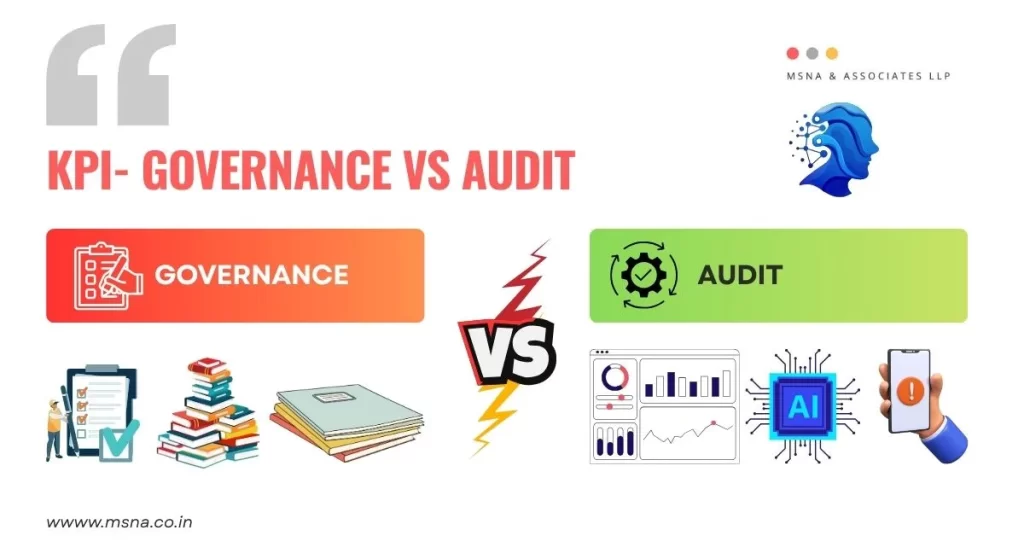
Instead of vague targets, use clear KPIs:
- For governance: percent of IT operations aligned with policy, frequency of board risk reviews, and adoption rates of key policies.
- For audit: number of control failures, time taken to resolve issues, and percent of repeat findings.
These metrics help leadership measure alignment and improvement, and help auditors demonstrate impact
When You Need One or Both?
If your strategy changes or the level of compliance you expect rises, it’s time to update your IT governance. It’s important for policies to be clear and to be in line with standards like SEBI CSCRF Regulations, ISO/IEC 38500:2024 and NIST CSF 2.0.
An IT audit is what you do when you need to make sure that rules are working. Audits connect choices made by the government with operations in the real world. They can be done in-house, by an IT audit company, or by IT audit firms in India.
It’s not enough to have strong governance without audits. Without administration, audits have no point. For IT to be responsible and dependable, they work together.
Final Thoughts: From Strategy to Action: Ensuring IT Success
Whether you work with external IT audit companies in India or run audits in-house, keep governance and audit active and connected, define your strategy, implement controls, verify them, and improve continuously.
If you want practical help tying these pieces together. Our team of Internal Auditors in Bangalore can provide hands-on support without adding noise, helping you turn policy into reliable practice. We assist clients in adopting SEBI SCSRF Regulations, assist with their IT Governance Policy and do ITGC Testing of controls as part of the audits.
Partner with MSNA & Co. for Smarter Audits
Related
Discover more from MSNA & Associates LLP
Subscribe to get the latest posts sent to your email.