

How many hours did your finance team spend last month keying invoices, chasing receipts, and matching bank lines? And how much was left for forecasting or cash planning?
An Accounts Backoffice Delivery Service closes that gap. For US businesses working in US GAAP and UAE businesses preparing for FTA e-invoicing, it hands the repeatable accounting work to a dedicated external team that runs it to defined timelines, controls, and reporting standards. The decisions, client relationships, and strategy stay with your own team.
For CFOs and finance heads in the US and UAE, the timing matters in 2026. Talent is harder to hire, and UAE e-invoicing deadlines are close. The sections below show where the cost is usually decided, what current data indicates, and how to judge which tasks to pass to an outside team.
Key Takeaways
- An Accounts Backoffice Delivery Service gives a dedicated team the routine, rules-driven tasks, while work that needs professional judgment stays with you.
- Cost benefits are usually assessed through cost per transaction and the ability to scale capacity, rather than hourly rate alone.
- Benchmarks show a wide gap between average and best-in-class accounts payable cost per invoice
- In 2026, US and UAE finance teams face two pressures: a shortage of accounting staff and UAE e-invoicing deadlines
- Outsourcing fails when processes are undocumented. Document and stabilise your workflow before handing it over.
- Before approaching a provider, run the Cost Leakage Audit in this guide.
What Is an Accounts Backoffice Delivery Service?
It is a managed model in which a specialist team handles your day-to-day finance back office: the recurring work that keeps books accurate but does not need your senior judgment. It is the working core of accounts back office services and sits under our wider accounting outsourcing practice.
Function | What the delivery team handles |
Bookkeeping | Coding, ledger maintenance, month-end close support |
Accounts payable | Invoice capture, approval routing, vendor payment runs |
Accounts receivable | Invoicing, collections follow-up, cash application |
Reconciliation | Bank, card, vendor, and intercompany matching |
Transaction processing | High-volume entries, expense and journal posting |
Reporting | MIS packs, ageing reports, compliance-ready schedules |
Why Does 2026 Make an Accounts Backoffice Delivery Service a Priority?
Three pressures are converging this year.
1. Talent is scarce
A 2026 Advancetrack survey of mid-sized accounting firms (up to 30 partners) in the UK, Australia, the US and Canada found that 73% say they are turning away potential clients because they lack staff. In the US, more than three out of four CPA firms are considering, planning, or already using accountants working remotely from India and other countries.
2. Manual processing is expensive
Ardent Partners’ 2025 AP Metrics report puts the average cost of processing an invoice at $9.40, while best-in-class teams with mature AP automation keep it at $2.78.
3. UAE compliance is changing
The UAE e-invoicing pilot opened on 1 July 2026. Businesses with revenue of AED 50 million or more must appoint an accredited service provider by 30 October 2026 and go live on 1 January 2027. Smaller businesses must appoint by 31 March 2027 and go live on 1 July 2027.
2026 data point | Figure | Source |
Mid-sized firms (UK, Australia, US, Canada) declining new clients because they lack staff | 73% | |
US CPA firms already offshoring | about 25% | AICPA 2023 MAP survey |
Cost per invoice: others vs best-in-class | $9.40 vs $2.78 | |
Invoice exception rate: others vs best-in-class | 22% vs 9% | |
UAE e-invoicing go-live (AED 50m+) | 1 Jan 2027 | |
ASP appointment deadline (AED 50m+) | 30 Oct 2026 | UAE Ministry of Finance, eInvoicing Programme, 30 June 2026 |
In our assessment, accounting back office outsourcing works best as added capacity where you need it, rather than as a replacement for your whole team
How Does an Accounts Back Office Delivery Service Reduce Cost per Transaction?
Cost benefits usually come from three areas: fewer repetitive tasks, a lower cost for each transaction, and a staffing model that rises and falls with your workload.
1. Cut Repetitive Workload First
Repetition is the cheapest place to start. Typical candidates:
- Keying and coding vendor bills
- Matching bank statements to the ledger
- Sending payment reminders
- Preparing recurring month-end schedules
- Filing and retrieving supporting documents
Each task is small. Together they consume hours every week that a salaried finance professional should not spend.
2. Measure Cost per Transaction
Cost per invoice = (AP staff cost + software + overhead) ÷ invoices processed. Work this out for your own team first. Ardent Partners’ 2025 AP Metrics report puts the average at $9.40 per invoice and best-in-class teams at $2.78. Your figure will depend on volumes, systems and process maturity.
Benchmark | Cost per invoice | Source |
Average | $9.40 | |
Best-in-class (AP automation leaders) | $2.78 |
These benchmarks describe teams with mature AP automation. They do not measure outsourcing on its own
3. Turn Fixed Payroll into Flexible Cost
Beyond base pay, an in-house employee brings hiring expenses, training time, tool licences, and the cost of paying for capacity you do not need year-round. A delivery model scales with volume. That shifts accounting from a fixed overhead to a variable one, which helps businesses with seasonal peaks or fast growth.
How Does an Accounts Backoffice Delivery Service Improve Operational Efficiency?

Efficiency improves in four ways: transactions are processed faster, errors drop, capacity follows demand, and your in-house team gets more time for work that adds greater value.
1. Faster Transaction Processing
Ardent Partners’ 2025 research shows best-in-class teams complete the invoice cycle in about 3.1 days. Standardised workflows are one factor associated with faster invoice cycles. Faster accounts payable also protects early-payment discounts and vendor relationships.
2. Fewer Errors, Fewer Exceptions
Rework falls when teams use set checklists, a maker-checker review step and written processing rules. Best-in-class AP automation leaders keep exception rates near 9%, versus 22% for other organisations. Fewer exceptions mean fewer late-night corrections before a close.
3. Scalable Accounting Resources
Well-scoped outsourced accounting services let you add capacity for quarter-end without a permanent hire.
Need three extra people for quarter-end? A delivery team flexes up and back down. Our accounting support services are structured so capacity can be adjusted as workload changes.
4. Higher-Value Work for Your Internal Team
When routine work leaves, your team gets time for:
- Cash flow forecasting
- Budget-versus-actual analysis
- Pricing and margin reviews
- Investor and lender reporting
- Business partnering with operations
Original Tool: The Back-Office Cost Leakage Audit
Before choosing a provider, score your own process. This audit is our own framework, built from the patterns we see when reviewing client workflows.
Check | Warning sign | Likely leak |
Rework rate | More than 1 in 5 invoices needs correction | Poor data capture |
Close timeline | Month-end takes over 10 working days | Late reconciliation |
Senior time | Managers post entries weekly | Role mismatch |
Overtime | Recurring overtime at every quarter-end | Capacity gap |
Document trail | Support lives in inboxes and WhatsApp | Audit and control risk |
How to read it: Two or more warning signs mean your workflow is a strong candidate for transfer. Zero or one means fix internally first.
A professional review of your workflow can help you assess which processes suit transfer.
Which Accounting Tasks Should You Hand Off, and Which Stay In-House?
Not everything belongs with an external team. This matrix reflects the principle our partners apply. Our accounting support services follow this same split between rules-based and judgment-based work.
Hand off (rules-based) | Keep in-house (judgment-based) |
Data entry and coding | Accounting policy decisions |
Bank reconciliation | Management estimates and provisions |
Routine collections follow-up | Key customer negotiations |
Standard reporting packs | Board and investor narrative |
Statutory filing preparation | Final sign-off and approvals |
What Does Outsourced AP Look Like Once UAE E-Invoicing Goes Live?
UAE e-invoicing changes how invoice data moves, so an outsourced accounts payable process needs a few new rules before go-live on 1 January 2027.
What Are the Key UAE E-Invoicing Dates?
The Ministry of Finance moved the first appointment deadline, but the go-live date stayed where it was.
Business group | Appoint an ASP by | Go live |
Revenue AED 50 million or more | 1 January 2027 | |
Revenue below AED 50 million | 31 March 2027 | 1 July 2027 |
The extension came through Ministerial Decision No. 56 of 2026, which amends Ministerial Decision No. 244 of 2025. The system itself is set out in Ministerial Decision No. 243 of 2025.
What Does the UAE E-Invoicing Model Require?
Four points shape how any finance team, in-house or outsourced, has to work.
- Both issuers and recipients must appoint an Accredited Service Provider.
- The system follows the Peppol-based five-corner model, and B2C transactions are excluded.
- Failing to issue and transmit an e-invoice on time costs AED 100 per invoice, capped at AED 5,000 per calendar month.
- Missing the ASP appointment or implementation deadline costs AED 5,000 for each month of delay.
What Changes for Outsourced AP Teams?
Our view is that five handoff rules matter most.
- Received invoices arrive as structured data through the ASP network, so AP intake moves away from PDFs and inbox attachments.
- Vendor master data, such as names, tax registration numbers and addresses, needs to be clean before go-live.
- Rejected or mismatched invoices need a named owner and an agreed response time.
- Approvals and sign-off rights stay with your team.
- The delivery team works on your India-side accounting records and processes. ASP appointment, FTA reporting and UAE filings stay with your UAE entity and its accredited provider.
For US Businesses
- Back-office teams should work in US GAAP and your chosen platform.
- Time-zone overlap and defined handoff windows matter more than headcount.
- ICAI operates an Accounting Process Outsourcing portal for foreign organisations seeking Indian CA firms. It is a facilitation platform and does not imply endorsement of any individual firm
“In our experience, many finance teams find skilled people spending time on rules-based work. Reviewing where work sits is often a useful first step”
CA Naveen
Our perspective: the 2026 shift is away from buying the lowest rate. One 2026 industry analysis observes that the focus has moved from securing the lowest hourly rate to achieving maximum integration with the outsourcing provider. We agree. Integration with your finance back office matters more than a discount.
When Does an Accounts Backoffice Delivery Service Not Work?
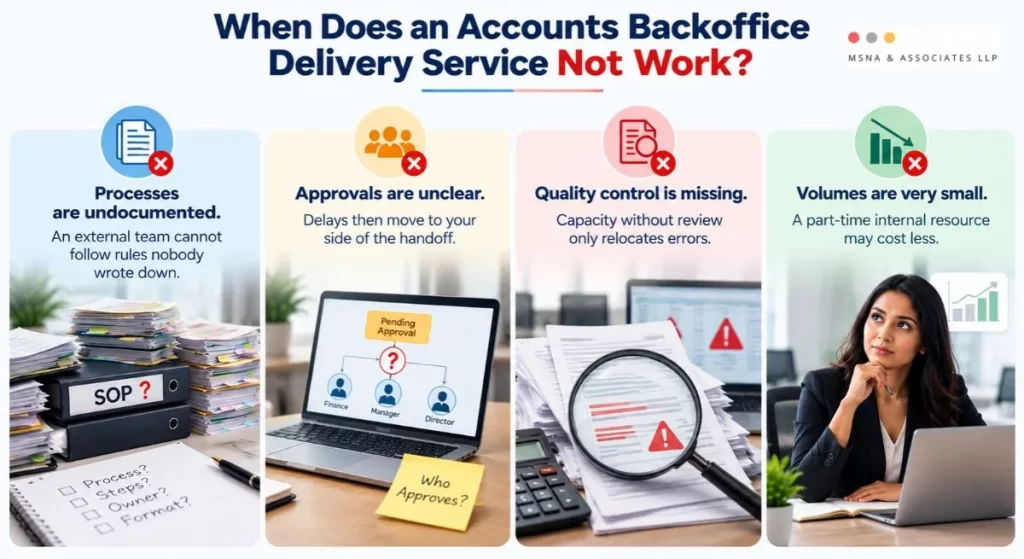
Balanced advice builds trust. Expect poor results when:
- Processes are undocumented. An external team cannot follow rules nobody wrote down.
- Approvals are unclear. Delays then move to your side of the handoff.
- Quality control is missing. Capacity without review only relocates errors.
- Volumes are very small. A part-time internal resource may cost less.
Your First 90 Days: Implementation Roadmap
A phased handover keeps risk low and results visible. Moving one process at a time lets you test quality and turnaround before you widen the scope.
Phase | Timeline | Key actions |
Discover | Days 1–15 | Map workflows, volumes, and tools; run the leakage audit |
Document | Days 16–30 | Write SOPs, approval matrix, access and security rules |
Pilot | Days 31–60 | Transfer one process, such as AP or bank reconciliation |
Expand | Days 61–90 | Add processes, set review cadence, agree reporting formats |
Start with one function. Prove it, then widen scope.
How Do You Choose an Accounts Back Office Services Partner?
Ask these questions of any provider:
- Which ICAI-registered professionals supervise the work?
- How is client data protected and access logged?
- Which systems do they work in, such as Xero, QuickBooks, Zoho Books, or Tally?
- How are exceptions escalated, and how fast?
- What reporting do you receive, and how often?
- How is the contract exited if needs change?
Our US accounting support and UAE accounting and VAT services pages outline how these points are handled on our engagements.
Conclusion On Accounts Backoffice Delivery Service
An Accounts Backoffice Delivery Service works when it is treated as a redesign of where work sits, not just a cost cut. Move repeatable work to a dedicated team, keep judgment with your leaders, and measure cost per transaction.
If you want to see how this applies to your volumes, our team can review your workflow and outline options. You can start from our accounting outsourcing overview.
This article is for general information and is not professional advice. Please consult a qualified Chartered Accountant for your specific situation.
Explore Accounting Back Office Support
Frequently Asked Questions About Accounts Backoffice Delivery Service
What does an Accounts Backoffice Delivery Service include?
Typically bookkeeping, accounts payable, accounts receivable, reconciliation, transaction processing, and recurring reporting.
Is accounting outsourcing only for large companies?
No. SMEs and accounting firms often benefit most because they lack the volume to justify full internal teams.
Will outsourcing reduce control over my finances?
Provided that all approvals, permissions, and sign-off rights remain with you. The definition of control is in the agreement and process.
How long does onboarding take?
Many engagements follow a phased plan of about 60 to 90 days. This is because the true timeline varies from process to process.
Related
Discover more from MSNA & Associates LLP
Subscribe to get the latest posts sent to your email.