3 Biggest Financial Challenges Faced by MSMEs: How VCFOs Solve Them
Micro, Small, and Medium Enterprises (MSMEs) contribute nearly a third of India’s GDP and employ over 260 million people. Despite this scale, many MSME owners face daily financial friction.
Whether it’s paying suppliers on time, filing monthly taxes, or chasing delayed customer payments, these aren’t just isolated hiccups. They point to deeper financial challenges of MSMEs that, left unresolved, can slow growth, block funding, and create long-term instability.
In this blog, we break down the three most pressing financial problems MSMEs deal with today and explain how a Virtual CFO (VCFO) can help solve them with a practical, system-driven approach.
Financial Challenges for MSMEs: Loan and Cash Flow Problems
Why does it happen?
- There’s a ₹69 trillion credit demand from MSMEs in India. But only about ₹14.5 trillion is met by formal sources; that’s just 20% of what’s needed.
- Most micro and small businesses don’t have what banks want: clean books, years of history, or collateral.
- Even among eligible enterprises, only 14–20% get bank credit. Medium-sized ones? Even lower at 4–9%.
What it does for a business
No money means no new goods, no renovations, and no cushion for unexpected demand. You’re forced to turn down large orders, delay expansion, or operate with razor-thin margins. Growth slows. Agility is lost. Competitors move ahead. This is where many MSME challenges start.
How a VCFO helps
A VCFO does more than just tidy your accounts. They clean things up so that banks will consider you eligible for a loan.
- Prepares clean, lender-ready financials using cloud tools and real business data
- Builds credible cash flow forecasts that banks can rely on
- Unlocks access to CGTMSE, MSME Credit Cards, or invoice discounting, even without collateral
- Connects you with fintech lenders, not just traditional banks
Result
You gain multiple funding routes, and you’re no longer one rejection away from a cash crisis.
Financial Challenges of MSMEs: Late Payments & Cash Gaps
Why does it happen?
- About 52% of B2B payments are delayed beyond 90 days, with some cities worse off; Delhi NCR, Bengaluru, and Hyderabad hover around 42–52% overdue rates.
- Typical payment cycles are 90–120 days, despite legal 45-day timelines under the MSME Act.
What it does for a business
Your bills arrive on time, even if your payments don’t. Salaries, rent, vendor dues, raw material costs, they don’t wait. You either borrow at high rates or pause production. Either way, it eats into margins and affects trust.
How a VCFO helps
Tracks receivables and flags ageing invoices early
Helps onboard TReDS, or sets up factoring/reverse-factoring
Redesigns payment terms that match your real cash conversion cycle
Result
When cash starts coming in on time, things settle. You can breathe easier and plan forward.
Financial Challenges for MSMEs: Compliance Overload
Why does it happen?
- A manufacturing MSME faces around 998 different regulatory requirements and over 1,450 filings a year.
- Annual compliance costs range from ₹13 to ₹17 lakh, plus “over 480 clauses carry imprisonment risk.”
- Labor laws alone account for about 66% of criminally punishable infractions.
What it does for a business
Founders get dragged into paperwork instead of growth. Missed filings mean notices. Late payments mean penalties.
Eventually, compliance fatigue sets in, and that’s when costly mistakes happen. Among MSME challenges and opportunities, this is one area where quick fixes can make a significant difference.
How a VCFO helps
- Migrates you to cloud-based accounting and compliance platforms
- Schedules filings for GST, TDS, ROC, and prevents a last-minute rush
- Prepares audit-ready files, handles notices, and flags tax deadlines in advance
Result
Compliance becomes a routine, not a firefight. You focus on growth, not government portals.
Impact Of Automation, Cloud tools, AI-driven VCFOs On MSMEs
Automation, cloud tools, and AI are reshaping MSMEs in the following ways:
Automation:
- It makes the process faster and accurate.
- It improves cash flow management.
- It simplifies the compliance and reporting.
Cloud Tools:
- Enhance real-time financial visibility, like tracking of cash flow, inventory and profit.
- provides better flexibility.
- It helps in protecting the sensitive financial data.
AI-driven CFOs :
- It enhances lending by enabling faster loan approvals.
- It helps in predicting financial forecasting.
- AI-driven CFO uses tools for business intelligence and analytics to provide the business owner with actionable insights.
Beyond the Basics: Planning & Digital Support
Money issues don’t exist in isolation. Late payments affect cash flow, which affects compliance and also loan approvals. These connected problems are at the heart of the financial challenges of MSMEs.
A good VCFO helps you fix the whole chain, not just one link. They go beyond books and taxes.
- They set up cash dashboards so you can see risks before they hit.
- They benchmark your margins against those of others in your industry.
- They even run “what if” plans. What if costs go up? What if demand spikes? What if you enter a new market?
This kind of financial thinking helps you stop reacting and start making confident moves.
When you hire a Virtual CFO, they fix cash flow delays and improve it for efficient functioning of the business.
The Financial Challenges of MSMEs Aren’t Permanent – Here’s a Smarter Way Out
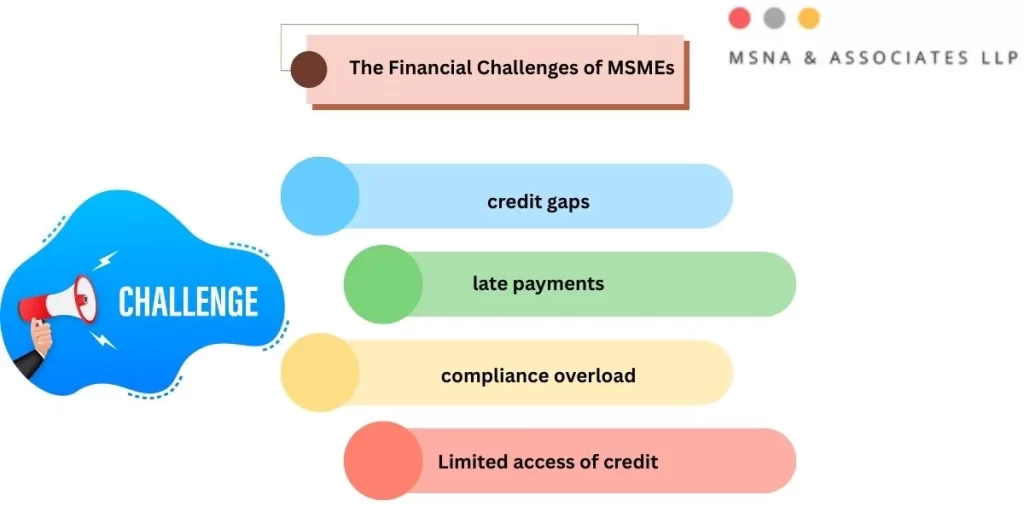
Every day, we see how the three core financial challenges of MSMEs—credit gaps, late payments, and compliance overload—feed off each other. Fix one, and the next two get easier; ignore them, and each becomes harder and more expensive.
At MSNA and Associates LLP, we built our VCFO practice for exactly this loop. The goal is simple: give you enterprise‑grade finance muscle without being your full‑time CFO.
Power Your MSME’s Growth withVCFO Support
Related
Discover more from MSNA & Associates LLP
Subscribe to get the latest posts sent to your email.