
Getting an apostille for US documents for Indian company registration starts with one distinction: Notarization and apostille are not the same step. A notary confirms who signed a document. An apostille confirms that the notary’s signature and seal are genuine, so Indian authorities accept the document without embassy involvement. Founders often use the two terms interchangeably. That mix-up is where most delays start.
For US founders registering a company in India, most corporate documents need both steps, in order. Notarise first. Apostille second. Skip either one, or get the sequence wrong, and the Registrar of Companies (ROC) can flag your filing. This is one of the most common reasons an incorporation application comes back with a query instead of an approval.
This guide breaks down what each process actually does, which documents are needed, and where founders tend to lose time.
What Is the Difference Between Apostille and Notarization?
Both processes authenticate a document. They just do different jobs.
- Notarization verifies identity. A US notary public checks your ID, watches you sign, and stamps the document.
- Apostille verifies the notary. The Secretary of State of the issuing state certifies that the notary’s signature and seal are real.
Here’s how they compare side by side.
Aspect | Notarization | Apostille |
Performed by | Notary Public | Secretary of State (or US Dept. of State for federal documents) |
What it confirms | The signer’s identity | The notary’s authority and seal |
Level | Local or county | State or federal |
Required for India | Yes, first step | Yes, second step |
Typical turnaround | Same day | 5 to 15 business days, depending on state |
Notarization alone does not satisfy Indian requirements. India needs the apostille layered on top.
Why Does India Require Apostille for US Documents?
India deposited its instrument of accession to the Hague Apostille Convention on 26 October 2004; the Convention entered into force for India on 14 July 2005, per the Hague Conference on Private International Law (HCCH). Before that, every foreign document needed consular attestation, a slower process involving the Indian Embassy directly.
Under the Convention, a single apostille certificate replaces that entire embassy step. Since the US is also a member country, a document apostilled in the US is accepted in India as authentic, with no further legalization needed.
This is why the sequence matters. Notarization plus apostille is the complete, Hague-recognized package. Notarization by itself is not.
Which US Documents Need Apostille for Indian Company Registration?
Not every document in your incorporation file needs an apostille. Some only need notarization. A few need neither. Founders who apostille everything waste time and money.
Document | Notarization Needed | Apostille Needed | Notes |
Certificate of Incorporation (US parent) | Yes | Yes | Required to prove the parent entity exists |
Board Resolution authorizing India subsidiary | Yes | Yes | Must name the authorized signatory |
Power of Attorney (POA) | Yes | Yes | Needed if a local representative signs on your behalf |
Passport copy of foreign director/subscriber | Yes | Usually, check with your bank | Some banks want an apostille even when ROC accepts notarized only |
Address proof of foreign director | Yes | Usually | Utility bill or bank statement, less than 2 months old |
MOA/AOA subscriber pages (if signed outside India) | Yes | Yes | Signature page must match the apostilled POA signatory |
Digital Signature Certificate (DSC) application | Yes | Sometimes | Depends on the certifying authority’s documentation rules |
A quick way to think about it: if the document proves something about a US entity or a US-based signatory, and it will be filed with an Indian government authority, plan for both steps.
What Is the Step-by-Step Apostille Process for US Documents for Indian Company Registration?
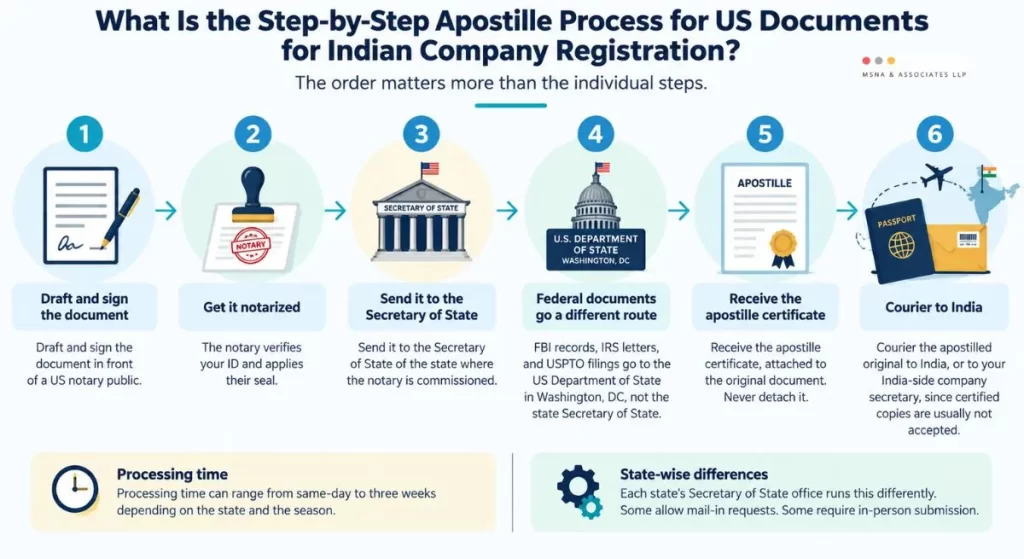
The order matters more than the individual steps.
- Draft and sign the document in front of a US notary public.
- Get it notarized. The notary verifies your ID and applies their seal.
- Send it to the Secretary of State of the state where the notary is commissioned.
- Federal documents go a different route. FBI records, IRS letters, and USPTO filings go to the US Department of State in Washington, DC, not the state Secretary of State.
- Receive the apostille certificate, attached to the original document. Never detach it.
- Courier the apostilled original to India, or to your India-side company secretary, since certified copies are usually not accepted.
Each state’s Secretary of State office runs this differently. Some allow mail-in requests. Some require in-person submission. Processing time can range from same-day to three weeks depending on the state and the season.
Notarization vs Apostille for Company Registration: Which Comes First?
Notarization always comes first for documents signed by an individual, like a POA or a board resolution.
There’s one exception. Documents issued directly by a US federal or state government body, such as a Certificate of Good Standing, often go straight to apostille without a separate notarization step, since the issuing authority’s seal is already on file with the Secretary of State.
If you’re unsure which category your document falls into, check with the issuing authority before you start the clock. Reversing the order means starting over.
What Mistake Do We See Most Often With US Founders?
In our incorporation filings for US-founded entities, this is the single most common gap we see: founders apostille the Certificate of Incorporation and stop there, assuming that’s the only document that matters. But the ROC also wants the Board Resolution and the subscriber pages of the MOA and AOA properly authenticated, since those are the documents that actually authorize someone to act for the company in India.
The Certificate of Incorporation proves the company exists. It does not prove that the person signing your Indian paperwork is allowed to. That authority comes from the Board Resolution and POA. Missing those is the single biggest reason we see incorporation filings sent back for resubmission.
Our advice: build your document checklist around who is signing what, not just which documents exist.
Do Foreign Directors Need to Apostille Their Passport?
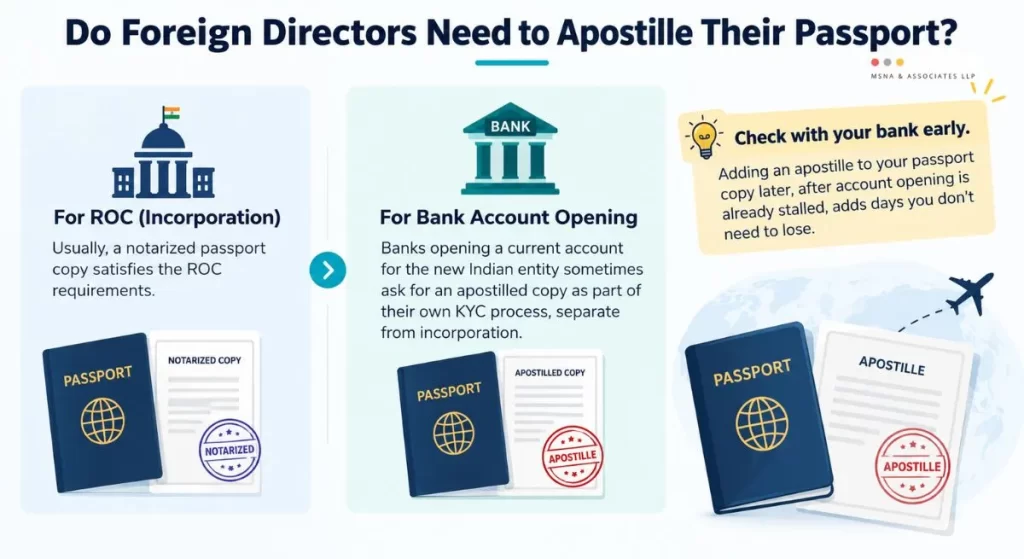
Usually, a notarized passport copy satisfies the ROC. But banks opening a current account for the new Indian entity sometimes ask for an apostilled copy as part of their own KYC process, separate from incorporation.
Check with your bank early. Adding an apostille to your passport copy later, after account opening is already stalled, adds days you don’t need to lose.
Does It Matter If the US Parent Is an LLC vs. a C-Corp?
Yes, slightly. The documents you apostille depend on how your US entity is structured.
A C-Corp apostilles its Certificate of Incorporation, plus a Board Resolution signed by the board.
An LLC (Limited Liability Company) doesn’t have a board, so there’s no Board Resolution. Instead, it apostilles its Certificate of Formation, plus a Member Resolution (or an excerpt from its Operating Agreement) authorizing someone to act on the company’s behalf.
If your ROC paperwork asks for a “Board Resolution” but your US entity is an LLC, tell your India-side company secretary right away. Submitting the wrong document type is a smaller version of the same problem covered above: missing proof that the signer is actually authorized.
What Happens If You Skip a Step or Get the Order Wrong?
The consequences are procedural, not dramatic, but they cost time.
- The ROC issues a resubmission query, pausing your application.
- You have to restart the notarization-then-apostille chain for the affected document.
- Bank account opening, which usually follows incorporation, gets pushed back too.
- If your India entry has a fundraising or operational deadline attached, this delay ripples into that timeline.
None of this is unrecoverable. It’s just avoidable with the right sequence from the start.
How Long Does the Full Process Usually Take?
Timelines shift depending on the state and how many documents are involved, but here’s a rough range founders can use to plan.
Stage | Typical Timeline |
Notarization | Same day |
State apostille | 5 to 15 business days |
Federal apostille – mail-in | 6 to 12 business weeks |
Federal apostille – in-person/courier drop-off | 7 business days per the Department’s own published timeline |
Courier to India | 3 to 7 business days |
ROC review after filing | 5 to 10 business days |
Bonus tip: Add buffer time. Apostille offices see seasonal backlogs, and a document sent back for correction restarts part of this clock.
These timelines come from the Department of State’s official processing windows, along with recent reports from apostille service providers. Mail-in requests are currently taking longer than the Department’s stated timeline. Check current processing times with your state or the Department of State before filing, since delays can happen due to season or office closures.
What Should Legal and Compliance Teams Check Before Filing?
A short pre-filing check saves a resubmission cycle later. Run through this before you send anything to the ROC.
- Confirm which documents need apostille, notarization, or both, for your specific entity type.
- Notarize first, unless the document is government-issued.
- Send state-issued documents to that state’s Secretary of State. Send federal documents to the US Department of State.
- Never separate the apostille certificate from the original document.
- Ask your bank about their own apostille requirements before assuming ROC rules cover everything.
- Match every signatory named in the POA and Board Resolution to the person actually signing the MOA and AOA.
- Courier delays and processing backlogs happen more often than you’d think, especially near US holidays, so pad your timeline accordingly.
Apostille for US Documents for Indian Company Registration: Avoid ROC Resubmission
Apostille and notarization aren’t complicated once you know the order. What trips up most founders isn’t the process itself. It’s assuming one step covers what actually requires two.
A short checklist, built around your specific documents and signatories, usually prevents the delay before it happens.
If you’re setting up an Indian subsidiary and want a second look at your document checklist before you start the apostille process, MSNA & Associates LLP’s India-entry services can help you map out exactly what your filing needs.
Avoid ROC Resubmission Delays
Common Questions Founders Ask About apostille for US documents for Indian company registration
Does a scanned copy of an apostilled document work for ROC filing?
No. The ROC generally wants the physical, apostilled original, or a copy certified against that original. Scanned images of an apostille sticker are one of the more common reasons filings get sent back.
Can a US-based CPA notarize documents for Indian incorporation?
No. A CPA is not a notary public. The notarization has to come from a licensed notary public, even if your CPA firm is coordinating the paperwork on your behalf.
Do documents ever need translation along with apostille?
Only if the original isn’t in English. Since most US corporate documents already are, this rarely applies for US-to-India filings, but it’s worth confirming if any document was issued in a different language.
Related
Discover more from MSNA & Associates LLP
Subscribe to get the latest posts sent to your email.