


If you’re running a business out of Dubai, Abu Dhabi, or anywhere else in the UAE and looking at India as your next market, private limited vs LLP in India is usually the first real decision you’ll make. It comes before the paperwork, before the bank account, before anything else.
Get this one right, and everything after it is easier. Get it wrong, and you end up fixing it later, at real cost and real delay.
The choice isn’t really about cost or how fast you can register. It comes down to one question: are you building something you’ll eventually raise money for or sell equity in? Or are you building something you’ll run yourself, simply taking profit out and back to the UAE, year after year?
Once you know the answer, the rest of this decision gets a lot simpler.
This guide breaks down private limited vs LLP in India for a UAE business across cost, timeline, funding, FEMA rules, and how easily profit actually moves back to the UAE.
Key Takeaways
- If you plan to raise equity funding at any point, Private Limited is almost the right call. LLPs structurally can’t issue the instruments most investors require.
- FDI (Foreign Direct Investment) in an LLP is legally permitted, but only in sectors with 100% automatic-route FDI and zero performance conditions. Private Limited has wider access.
- LLP compliance cost is genuinely lower in year one, since a statutory audit only becomes mandatory above ₹40 lakh turnover or ₹25 lakh capital contribution. A Private Limited company needs an audit regardless of turnover.
- LLP profit isn’t taxed twice. Once the LLP pays tax, a partner’s share is exempt. Private Limited dividends get taxed again in the shareholder’s hands.
- Neither structure is better. They fit different outcomes, and switching later costs time and money.
The Four-Question Test Before You Choose Between Private Limited vs LLP in India For UAE Business
Answer these four questions first, and the right structure usually becomes obvious before you’ve read a single row of the tables below.
- Will you raise equity funding from investors at any stage? If yes, that alone points to Private Limited.
- Do you need to issue ESOPs to attract talent? LLPs have no share-based equivalent.
- How much annual compliance cost can you realistically absorb in year one? If it’s tight, LLP’s lighter compliance load matters.
- Will the business need to invest in other Indian companies or entities down the line? LLP’s downstream investment rights are considerably narrower than a Private Limited company’s.
A UAE founder who answers “yes” to questions 1 or 4 should stop weighing cost and timeline altogether. Those two questions override everything else in this comparison.
Private Limited vs LLP In India for UAE Business: The Core Comparison
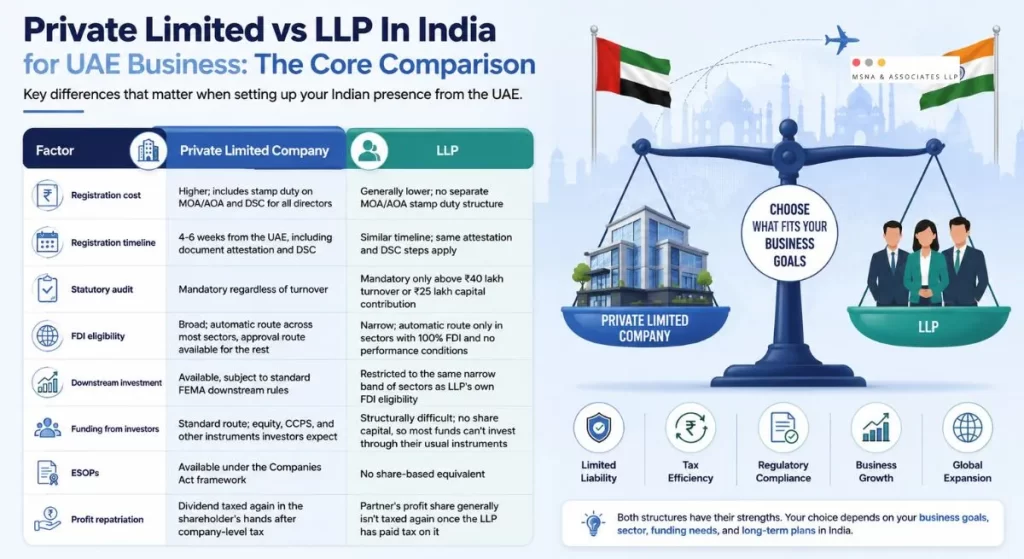
The table below lays out the eight factors that matter most once you’re comparing these two structures from outside India.
Factor | Private Limited Company | LLP |
Registration cost | Higher; includes stamp duty on MOA/AOA and DSC for all directors | Generally lower; no separate MOA/AOA stamp duty structure |
Registration timeline | 4-6 weeks from the UAE, including document attestation and DSC | “Similar timeline; same attestation and DSC steps apply |
Statutory audit | Mandatory regardless of turnover | Mandatory only above ₹40 lakh turnover or ₹25 lakh capital contribution |
FDI eligibility | Broad; automatic route across most sectors, approval route available for the rest | Narrow; automatic route only in sectors with 100% FDI and no performance conditions |
Downstream investment | Available, subject to standard FEMA downstream rules | Restricted to the same narrow band of sectors as LLP’s own FDI eligibility |
Funding from investors | Standard route; equity, CCPS, and other instruments investors expect | Structurally difficult; no share capital, so most funds can’t invest through their usual instruments |
ESOPs | Available under the Companies Act framework | No share-based equivalent |
Profit repatriation | Dividend taxed again in the shareholder’s hands after company-level tax | Partner’s profit share generally isn’t taxed again once the LLP has paid tax on it |
Cost: Which Structure Costs Less to Run From the UAE?
At incorporation, the difference is modest; both structures need document attestation, DSC, and a resident director or designated partner based in India. If you’re also evaluating the overall Cost of Company Formation in India for NRIs & UAE Investors, it’s important to look beyond registration fees and consider ongoing compliance expenses as well.
A Private Limited company needs a statutory audit every year, regardless of turnover, typically ₹10,000–30,000 depending on complexity. An LLP only crosses into mandatory audit territory once turnover exceeds ₹40 lakh or capital contribution exceeds ₹25 lakh, under Section 34(4) of the LLP Act.
For a UAE founder testing a smaller venture before committing serious capital, that difference is real money saved every year, not just a one-time saving. However, over the long term, the total cost should be assessed alongside your funding plans, compliance obligations, and expected business growth.
The audit-cost gap closes fast once a business actually grows. If you’re confident you’ll cross ₹40 lakh in turnover within 18-24 months, don’t let this year’s audit saving drive the decision. You’ll be paying for an audit either way soon enough.
Private Limited vs LLP India for UAE Business: Which Registers Faster from the UAE?
Not meaningfully different.
Both structures go through the same UAE-specific friction points: document attestation through MOFAIC and the Indian Consulate, since the UAE isn’t a Hague Apostille Convention member and apostille isn’t available for UAE-issued documents, DSC issuance without Aadhaar-based e-KYC, and finding someone based in India to fulfil the residency requirement.
If timeline is the deciding factor in your comparison, it shouldn’t be. The gap between the two is a matter of days.
Regardless of the structure you choose, the incorporation process requires proper documentation, attestation, and regulatory filings to set up a new company in India from the UAE successfully.
Funding: Why Most UAE Founders Raising Capital End Up at Private Limited
This is where the decision usually resolves itself.
- An LLP has no share capital. Partners hold a contribution and a profit-sharing ratio, not shares.
- Most venture funds, angel investors, and family offices invest through equity or convertible preference shares. An LLP can’t issue either.
- Certain you’ll never raise outside equity? An LLP works fine, and the compliance load is lighter.
- Even a chance of raising, including “maybe in two years”? Default to Private Limited from day one.
- Converting an LLP into a company later is possible, but it’s real work: fresh filings, a new PAN, and a pause in operations while it processes.
FEMA and FDI: Where LLP Eligibility Gets Narrow
Foreign investment into an LLP is legal, but the rules are tighter than most UAE founders expect. FDI into an LLP is only allowed under the automatic route, and only in sectors where 100% FDI is permitted with no conditions attached. If your sector has any conditions at all, even under the automatic route, an LLP simply isn’t eligible for that investment.
A Private Limited company doesn’t have this problem. It can use the automatic route in unconditional sectors, and the approval route in sectors with conditions or caps. That flexibility doesn’t exist for an LLP at all.
Most UAE founders read “100% FDI allowed” as a blanket statement and stop there. It isn’t one. The real question is whether that 100% comes with conditions attached, and for an LLP, any condition at all rules the structure out entirely. That single word, unconditional, is where the real risk sits, and it’s worth checking against your specific sector before you file anything.
A concrete example of where this bites: e-commerce is often cited as a sector with 100% automatic-route FDI. But the marketplace model comes with conditions attached. No more than 25% of sales from one vendor group, no direct or indirect control over inventory pricing. Those conditions are enough to disqualify an LLP from receiving that FDI at all, even though a Private Limited company in the same business qualifies under the approval-conditional framework. This is exactly the gap between “100% FDI allowed” and “100% FDI allowed without conditions” that trips founders up.
Downstream investment follows the same narrow logic: an LLP that has received FDI can only invest further into other Indian companies or LLPs that are themselves in the same 100%-automatic, no-condition sector band. A Private Limited company’s downstream investment rights, while still governed by FEMA, aren’t boxed in this tightly.
Profit Repatriation: Which Structure Moves Money Back to the UAE More Efficiently?
An LLP pays a flat 30% tax on its profit at the entity level. Once that tax is paid, a partner’s share of the profit generally isn’t taxed again when it’s withdrawn or repatriated.
A Private Limited company’s dividend, by contrast, is taxed a second time: the company pays tax on its profit first, and the dividend is then taxed again in the shareholder’s hands when distributed.
For a UAE founder planning to draw profit out regularly rather than reinvest it, this difference compounds year over year. It’s not usually enough on its own to override the funding question above, but for a founder who’s already decided against raising equity, it’s a genuine point in an LLP’s favour.
Scalability: ESOPs, Share Transfers, and Bringing in New Investors
A Private Limited company can issue ESOPs under the Companies Act framework, transfer shares between parties relatively simply, and bring in new investors across multiple funding rounds without restructuring the entity.
An LLP can bring in new partners, but there’s no share-based equivalent to an ESOP pool, and each change in partnership is a more manual, agreement-driven process than a straightforward share allotment.
For a UAE founder planning to hire senior talent with equity as part of the offer, or planning more than one funding round, this is a structural limitation an LLP doesn’t have a workaround for.
“If there’s any chance of raising in the next few years, it’s worth a conversation before you file — the structure choice is far cheaper to get right now than to unwind later.”
Founders tend to treat ESOPs as a later-stage problem, something to figure out once there’s actually a team to grant equity to. That’s backwards. The structure decision happens now, at incorporation, and it’s the one thing you can’t retrofit cheaply. If there’s any realistic chance you’ll want to offer equity to a first senior hire within two or three years, that possibility belongs in today’s decision, not next year’s.
Common Mistakes Founders Make When Choosing Between a Private Limited vs LLP India For UAE Business
These are the same four mistakes that come up again and again in conversations with UAE founders who chose in a hurry.
- Choosing LLP purely for the lower year-one compliance cost, then needing to convert to a Private Limited company within 18 months once a funding conversation starts, at real cost and delay.
- Assuming FDI works the same way for both structures. The sector-eligibility gap for LLPs catches founders who assumed “100% FDI allowed” applied uniformly.
- Ignoring the profit repatriation difference because it seems like a tax detail rather than a structural one, when it materially affects how much actually reaches the UAE each year.
- Defaulting to Private Limited by habit, even when the business genuinely has no funding or ESOP plans, and paying for a mandatory audit it didn’t need to carry.
Choosing Between Private Limited vs LLP in India for UAE Businesses
Cost and timeline rarely decide this well on their own. The four-question test earlier in this guide gets most UAE founders to the right answer faster than a line-by-line comparison does, funding and downstream investment plans should decide the structure, with compliance cost and repatriation efficiency as the tiebreaker when funding isn’t part of the plan. Consulting a professional can help you map this against your specific sector, funding timeline, and where you actually intend the profit to end up.
Need Clarity on the Right Business Structure for India?
Private Limited vs LLP India for UAE Business: FAQs for UAE Entrepreneurs
Can a UAE investor hold 100% ownership in either structure?
Yes, in eligible sectors. Private Limited allows up to 100% FDI across a broader range of sectors than LLP, which is limited to sectors with unconditional 100% automatic-route FDI.
Is LLP registration cheaper than Private Limited for a UAE founder?
At incorporation, only modestly. The real cost gap shows up annually, through the mandatory audit a Private Limited company carries regardless of turnover.
Can an LLP be converted to a Private Limited company later if funding plans change?
Yes, but it’s a genuine process involving fresh filings and a new PAN, not a quick administrative update. It’s worth choosing correctly at the outset if funding is even a possibility.
Does profit repatriation really differ enough between the two to matter?
For a founder planning to withdraw profit regularly rather than reinvest it, yes. The second layer of tax on Private Limited dividends adds up meaningfully over a few years.
Related
Discover more from MSNA & Associates LLP
Subscribe to get the latest posts sent to your email.