

Over 300,000 US accountants have left the profession since 2020 according to Wall Street Journal reporting on the trend. A full-time bookkeeper now costs a small business upwards of $3,950 a month in base salary alone. Outsourced accounting for US small businesses solves that problem directly. It gets the same bookkeeping, reconciliation, and financial reporting work done, at a fraction of the in-house cost, without waiting months to fill a role that fewer qualified people exist to fill.
CPA exam candidates have fallen sharply over the same period too, with unique candidate numbers down more than a third from their 2016 peak, per AICPA Trends report data.
Most small business owners don’t notice the real in-house cost until they add it all up: the salary, the 25-40% in benefits and overhead on top of it, the months it takes to find and train a replacement when someone leaves.
This guide covers what it actually costs for outsourced accounting for US small businesses, when switching makes sense, and a real cost breakdown from one business that made the move.
Key Takeaways
- A full-time in-house bookkeeper costs a small business $70,000-$85,000+ a year once salary, benefits, and in-house accountant cost US overhead are counted.
- Outsourced accounting in the US typically runs $500-$2,500 a month; outsourcing to India runs lower still, often starting around $650 a month.
- Industry benchmarks point to substantial savings on total accounting cost when switching from in-house to an outsourced team in India. Actual savings depend on transaction volume, scope, and your current in-house cost base, and this isn’t a guaranteed outcome for every business.
- The right time to switch is usually before the books fall behind, not after; missed reconciliations and late filings are expensive to unwind.
- QuickBooks bookkeeping and similar software don’t replace the need for a bookkeeper. They make an outsourced relationship easier to manage, not less necessary.
Why Is Outsourced Accounting for US Small Businesses So Expensive Right Now?
Three things are driving costs up at the same time, and they compound each other rather than acting alone.
1. The talent pool is shrinking.
The Bureau of Labour Statistics puts total US accountant and auditor employment at roughly 1.6 million as of 2024, a number that hasn’t grown to match the sharp rise in exits and retirements, leaving demand outpacing the available pool.
2. Compliance work is getting heavier.
The One Big Beautiful Bill Act brought new IRS documentation rules for 2026, and one of them hits small businesses directly: qualified tips and overtime now need to be reported separately, using new W-2 Box 12 codes (TP for tips, TT for overtime), with equivalent treatment on 1099s.
3. Turnover costs more than the salary gap suggests.
When an in-house bookkeeper leaves, a business doesn’t just lose a salary line; it loses institutional knowledge of how the books were actually kept. The replacement search then happens in the same shrinking talent pool that made hiring expensive the first time.
None of these three factors is a short-term spike. Each is a structural shift in the US accounting labour market, which is why salaries for in-house hires and hourly rates for local firms have both moved upward together, not independently.
How Do The 2026 W-2 And 1099 Changes Affect Outsourced Teams?
Here’s a quick breakdown of what each change actually means, and who’s on the hook for it.
2026 Change | What’s Changing | If You Handle It In-House | If You Outsource It |
Overtime pay now has to be broken out separately from regular wages | You’ll need to update your payroll software and get your team up to speed | Already baked into the service | |
New tip code on the W-2 | Tipped employees now need to be tagged by occupation | You’ll need to build out a new classification process | Already baked into the service |
Contractor overtime and tips get the same separate treatment | More work at year-end close | Just part of the routine | |
System readiness deadline | Payroll systems need to be updated before the 2026 filing season kicks in | Vendor calls, testing, staff briefings, add it to your plate | Already on the provider’s radar |
Bottom line: if you’re doing this in-house, every row on that table is extra work landing on someone’s desk. If you’re outsourced, it’s already handled. It’s one more reason the real cost of staying in-house in 2026 tends to run higher than the salary comparison alone suggests.
What Does an In-House Bookkeeper or Accountant Actually Cost?
Here’s what the market actually pays across the different in-house and local options, before any of the outsourcing numbers come into the picture.
Role | Typical Cost |
Full-time in-house bookkeeper (salary only) | $47,000-$49,000/year |
Full-time in-house bookkeeper (fully loaded, with benefits and overhead) | $70,000-$85,000+/year |
Part-time in-house bookkeeper | $1,500-$4,000/month |
Freelance bookkeeper | $300-$900/month, or $20-$60/hour |
Local CPA firm (bookkeeping) | $800-$3,000/month |
CPA hourly rate | $150-$400/hour |
Fractional CFO/Controller | $2,500-$8,000/month |
The salary line is only part of the real number. Benefits, payroll taxes, software licenses, recruiting, and onboarding time add 25-40% on top of base salary, which is how a $49,000 salary turns into a $70,000+ actual cost.
What Does Outsourced Accounting For US Small Businesses Cost In The US vs India?
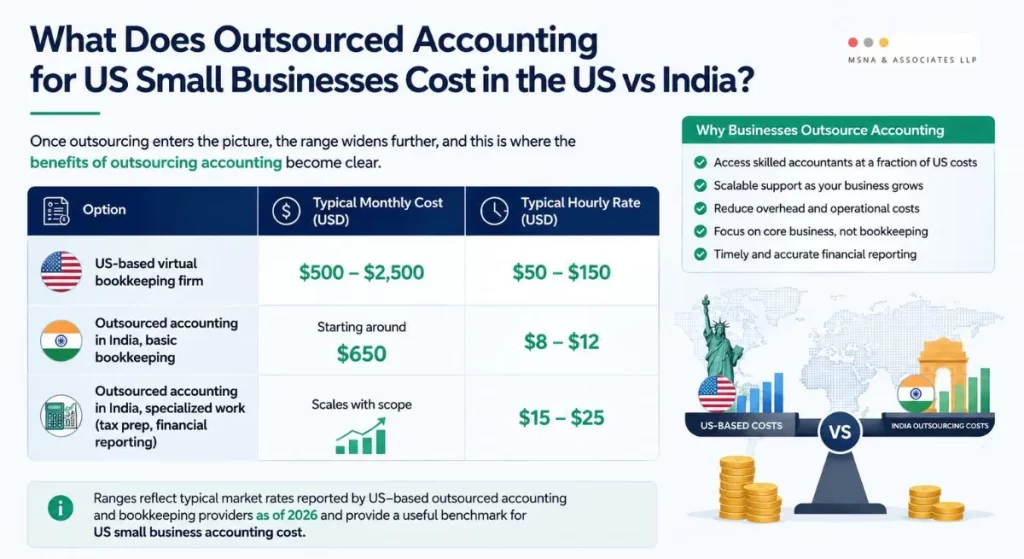
Once outsourcing enters the picture, the range widens further, and this is where the benefits of outsourcing accounting become clear.
Option | Typical Monthly Cost | Typical Hourly Rate |
US-based virtual bookkeeping firm | $500-$2,500 | $50-$150 |
Outsourced accounting in India, basic bookkeeping | Starting around $650 | $8-$12 |
Outsourced accounting in India, specialized work (tax prep, financial reporting) | Scales with scope | $15-$25 |
Ranges reflect typical market rates reported by US-based outsourced accounting and bookkeeping providers as of 2026 and provide a useful benchmark for US small business accounting cost.
The gap between a US-based virtual firm and an India-based outsourced team isn’t about quality; it’s about cost structure. Indian outsourced accounting teams commonly include Chartered Accountants and professionals trained in US GAAP, a growing number of whom pursue the US CPA credential each year. The lower rate reflects cost of living and currency, not a lower standard of work.
When Should A Small Business Actually Switch To Outsourced Accounting?
If you’re wondering when to outsource bookkeeping, a few signals tend to show up before a business actually decides to switch
- Transaction volume has outgrown a part-time bookkeeper’s bandwidth. Reconciliations start slipping from weekly to monthly, then further behind.
- The books are needed for something bigger than day-to-day tracking, a loan application, a fundraise, or a due diligence request, and they’re not clean enough to hand over as-is.
- The business now operates in multiple states, and sales tax nexus rules have made compliance more than a single bookkeeper can reasonably track.
- The founder is doing the books personally, past the point where their time is worth more spent elsewhere in the business. This is often also the point to look at a Virtual CFO rather than just outsourced bookkeeping.
- A bookkeeper has left, and replacing them at current market rates costs more than restructuring the function entirely.
Any one of these on its own is a reasonable trigger. Two or more at once usually means the switch is overdue, not upcoming.
Case Study: How Much Can Outsourced Accounting For US Small Business Actually Save?
The following is an illustrative example based on typical outsourcing outcomes
A Denver-based e-commerce business doing about $2.5 million in annual revenue was running its books through a full-time in-house bookkeeper.
Before, in-house:
- Salary: $52,000/year
- Benefits and payroll taxes: roughly $18,000/year
- Total loaded cost: about $70,000/year
After being outsourced to India, same scope of work (bookkeeping, accounts payable and receivable, monthly financial statements):
- Cost: roughly $1,800/month
- Total annual cost: about $21,600/year
The switch meaningfully reduced the business’s annual accounting spend while adding a review layer the in-house setup didn’t have.
What Does Outsourced Accounting For US Small Business Include?
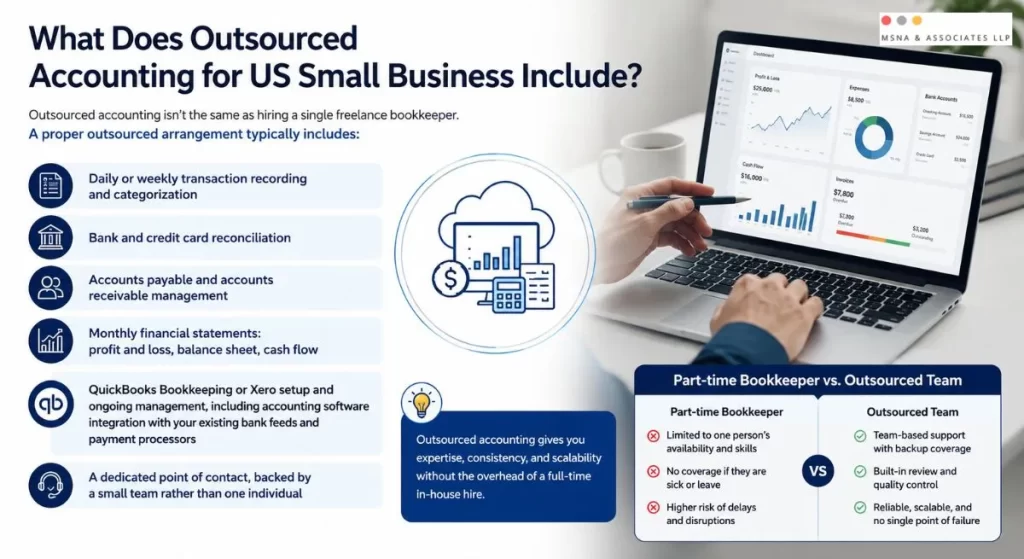
Outsourced accounting isn’t the same as hiring a single freelance bookkeeper. A proper outsourced arrangement typically includes:
- Daily or weekly transaction recording and categorization
- Bank and credit card reconciliation
- Accounts payable and accounts receivable management
- Monthly financial statements: profit and loss, balance sheet, cash flow
- QuickBooks Bookkeeping or Xero setup and ongoing management, including accounting software integration with your existing bank feeds and payment processors
- A dedicated point of contact, backed by a small team rather than one individual
This is also where the part-time bookkeeper vs outsourcing comparison tends to break down.
A part-time hire is limited to one person’s availability and one person’s skill ceiling. If they’re out sick or leave, the books stop moving until someone new is found. An outsourced team is built with backup coverage and a review layer, so there’s no single point of failure at the same price range.
What Are The Common Concerns US Small Business Owners Have About Outsourcing To India ?
These come up in nearly every first conversation, and they deserve a straight answer rather than a brushed-off one.
Is my financial data secure?
Reputable Indian accounting firms hold SOC 2 Type II or ISO 27001 certifications, the same security standards enterprise accounting vendors are held to.
Will they understand US GAAP and IRS rules?
Indian accounting professionals working with US clients are specifically trained in US GAAP and IRS compliance, not just Indian accounting standards.
Will communication be a problem?
Most outsourced teams overlap working hours with US time zones for at least part of the day, and the time difference often means work started in the evening is done by the next US morning.
What if I need to make changes fast?
A properly structured outsourced relationship includes a dedicated contact, not a ticket queue, so changes in scope don’t require renegotiating a contract each time.
What Should You Look For Before Switching To Outsourced Accounting For US Small Business?
Not every provider is the same, and the difference usually shows up in these five things before it shows up anywhere else.
- Certifications: SOC 2 Type II or ISO 27001, at minimum
- US GAAP and IRS compliance experience specifically, not general bookkeeping experience
- A named point of contact, not a rotating support pool
- Clear pricing tied to transaction volume and scope, not a vague flat rate that changes once you’re locked in
- A trial period or a smaller initial scope before committing to full-scale bookkeeping
Mistakes Businesses Make When Switching To Outsourced Accounting
Most of the cost reduction this guide describes assumes a clean switch. A few common missteps are what actually erode that advantage in practice.
1. Switching without a clean starting point.
Handing over books that are already months behind means paying for catch-up work before the ongoing savings even start.
2. Choosing on price alone.
The cheapest quote sometimes reflects a smaller, less experienced team, not just a lower cost structure.
3. Not defining scope clearly upfront.
Vague agreements about what’s included lead to scope disputes later, exactly the kind of friction outsourcing was supposed to remove.
4. Keeping the old system running in parallel too long.
Some businesses keep a part-time in-house bookkeeper “just in case” for months after switching, which erases a chunk of the savings the switch was supposed to deliver.
Making The Decision For Outsourced Accounting For US Small Businesses
The cost gap between in-house and outsourced accounting for US small businesses is rarely marginal. For most US small businesses, it runs into tens of thousands of dollars a year, with quality that can often be maintained when the provider is chosen carefully. Businesses that switch before the books fall behind tend to see the savings show up from month one, rather than having them absorbed by catch-up work.
Consulting a Outsource accounting/bookkeeping services to India for US Businesses can help you compare your current US small business accounting cost against what an outsourced accounting for US small businesses setup would look like for your specific transaction volume and complexity.
Explore Outsourced Accounting Options for Your Business
Frequently Asked Questions About Outsourced Accounting For US Small Businesses
Is outsourced accounting actually cheaper than QuickBooks and doing it myself?
For very early-stage businesses with minimal transactions, doing it yourself in QuickBooks can work temporarily. Once transaction volume grows, the time cost of doing it yourself usually exceeds what outsourcing would have cost.
How much does accounting outsourcing India cost for small business compared to hiring in-house?
Industry estimates consistently point to meaningful cost reduction compared to a fully loaded in-house hire, often enough to materially change the economics, though the exact figure depends on transaction volume and scope
Is a part-time bookkeeper cheaper than outsourcing?
Often, on paper. But a single part-time bookkeeper has no backup coverage and a fixed skill ceiling. An outsourced team typically costs a similar range while including review layers a solo hire can’t provide.
Does outsourcing to India work with the accounting software I already use?
Yes, Most outsourced teams just work inside whatever you’re already using, QuickBooks, Xero, or similar, since those are usually already synced to your bank feeds. No need to switch systems.
Related
Discover more from MSNA & Associates LLP
Subscribe to get the latest posts sent to your email.