
Exhaustive Coverage of All Financial KPIs Measured by Virtual CFOs
Beyond generating profits, tracking the right CFO financial KPIs is crucial for staying profitable and making informed decisions. Yet many founders either don’t know what to measure or don’t have time to track the numbers closely.
From cash flow to customer acquisition cost, virtual CFOs help monitor key financial metrics that reflect the actual performance of your business.
This guide will break down the top CFO financial KPIs and show how virtual CFOs help you stay financially sharp.
Top CFO Financial KPIs Tracker by Virtual CFOs in India
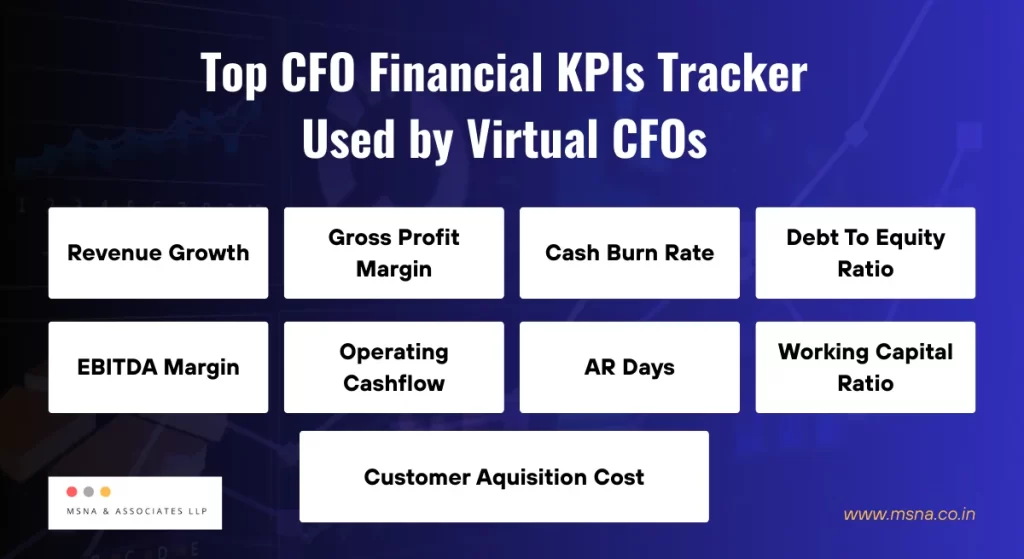
The revenue growth rate shows how quickly your business income is increasing over time.
It reveals whether your sales and marketing strategies are effectively driving expansion. Having a target revenue in place and comparing it with the actual revenue monthly will also ensure that the revenue numbers are effectively tracked.
Why Revenue Growth Rate Important for a VCFO?
Early-stage investors look for startups with steady and forecastable growth patterns.
2. Gross Profit Margin
This is the percentage of income retained after accounting for the cost of goods sold (COGS). It shows how efficiently your business turns revenue into profit from core operations.
Why Gross Profit Margin is Important?
Decent profit margins signal a sustainable business model. Low gross margins are often converted into negative net margins, so having a good gross profit margin becomes very important.
3. Burn Rate
Commonly used in funded startups, the burn rate shows how quickly you’re using up cash reserves. It’s usually tracked monthly. Keeping our burn rate under check becomes very important to track our future runway.
Why is Burn Rate Important?
It supports in cash runway and future fundraising.
4. EBITDA Margin
EBITDA margin (Earnings Before Interest, Taxes, Depreciation, and Amortization) assesses a business’s ability to generate profit from operations, excluding interest, taxes, depreciation, and amortization. This KPI effectively tracks the business’s operational performance.
Why is EBITDA considered important by VCFO?
Gives a clear view of business performance without accounting adjustments.
5. Operating Cash Flow
This KPI tracks how much cash your business generates from normal operations. It’s more realistic than paper profit. As always told, profit in financials is not equal to cash flow in the business.
Why is Operating Cash Flow important?
Positive cash flow is important to pay salaries, vendors, and taxes on time.
6. Accounts Receivable Collection Days (AR Days)
It measures how long it takes customers to pay you after a sale. This takes into account the average of receivables and gives an overview of how many days customers are taking to make the payment.
Why Accounts Receivable Collection Days is Important?
High AR days can choke cash flow. It is important to compare the accounts receivable collection days with the average credit period given to our customers and check if there is a major deviation, if any.
7. Working Capital Ratio
It shows your ability to meet short-term obligations using current assets.
Why is Working Capital Important?
A working capital ratio between 1.2 – 2 is usually healthy for SMEs.
8. Debt-to-Equity Ratio
This KPI measures how much debt you’re using to finance your business versus owner’s equity.
Why is Debt-to-Equity Important?
Too much debt can pose tough challenges for banks and investors. A ratio of more than 2:1 needs to be properly tracked and could be risky.
9. Customer Acquisition Cost (CAC) vs. Lifetime Value (LTV)
It’s a comparison between the cost you spent to acquire a new customer versus the profit they bring to your business over time.
Why CAC vs LTV is Important?
If LTV is not at least 3x the CAC, your business may struggle to scale profitably.
How Virtual CFOs Track and Report these Financial KPIs?

Virtual CFOs bring structure, tools, and expert insights to make your KPIs useful. Here’s how they do it:
Use of Smart Dashboards and Tools
Using tools like Zoho Analytics, Power BI, and Google Data Studio, virtual CFOs set up real-time dashboards. These tools pull data from accounting software and show you live metrics in one place – no need to dig through Excel files.
Monthly and Quarterly KPI Reviews
Through MIS review sessions with founders and teams, Virtual CFOs walk through insights, trends, and red flags. Beyond reporting, these meetings help make data-driven decisions about hiring, marketing, pricing, and fundraising.
Tailored KPI Frameworks
Whether you’re a D2C startup, SaaS company, or manufacturing unit, virtual CFOs customize KPIs based on your business model. For instance, CFOs track the CAC: LTV ratio for a SaaS firm and inventory turnover for a retail brand.
Integration With Compliance and Forecasting
VCFOs tie KPIs to financial forecasts, tax compliance, and investor reporting to ensure your books are clean and your business stays on track.
Clear Visual Reporting for Stakeholders
Instead of complex financial jargon, virtual CFOs use simple charts, scorecards, and summaries for founders/co-founders to easily understand business performance.
If you are planning to hire a virtual CFO for your firm, start with our guide on How to Hire Virtual CFOs in Bangalore, which gives valuable insights on making the right hiring decisions.
Why These CFO Financial KPIs are Important for Business Health?
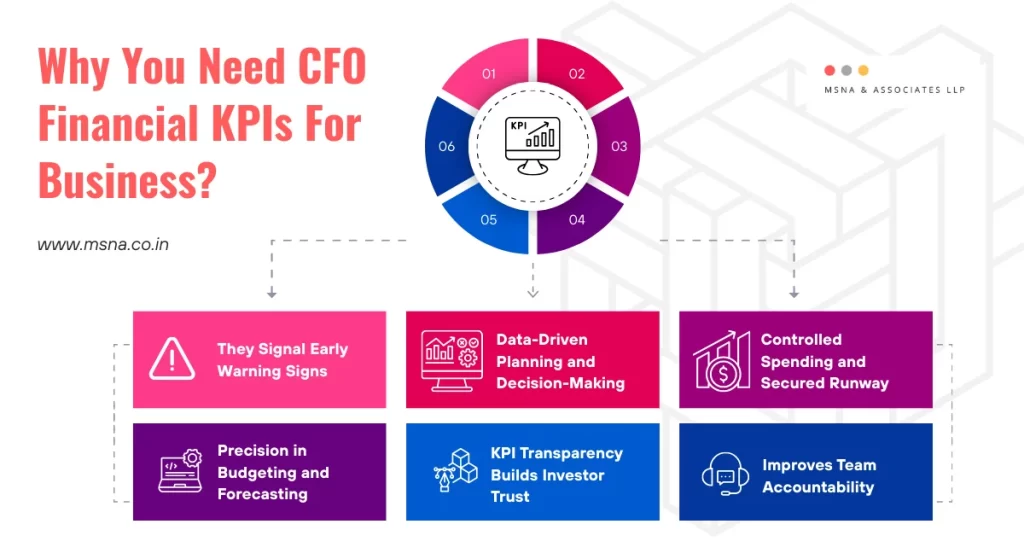
Tracking the right CFO financial KPIs is all about making smarter business decisions. Here’s why these KPIs are critical for maintaining a healthy business:
They Signal Early Warning Signs
KPIs serve as an early warning system, alerting you to financial challenges like operational costs and liquidity shortages before they escalate.
Data-Driven Planning and Decision-Making
When you track burn rate and working capital closely, you can time your next fundraise, expansion, and cost rationalization with ease. Virtual CFOs use these metrics to support strategic growth.
Controlled Spending and Secured Runway
Understanding cash flow and spending rate helps you ensure you can cover salaries, marketing, and daily operations without running into financial trouble.
Precision in Budgeting and Forecasting
KPI trends guide your financial forecasting, so you can avoid over- or under-spending and stay aligned with your goals.
KPI Transparency Builds Investor Trust
Investors look beyond revenue. They want to see profitability, unit economics, and operational efficiency. Reliable KPI tracking builds trust and increases fundraising potential.
Improves Team Accountability
When founders and department heads track KPIs, they can measure performance and align teams toward results that truly matter.
Best Tools Virtual CFOs Use For KPIs
- Power BI
- Tableau
- Klipfolio
- Databox
- Geckoboard
Why CFO Financial KPIs Matter More Than Ever
Beyond reporting financial KPIs, virtual CFOs help you:
- Interpret CFO financial KPIs
- Set targets
- Make strategic decisions.
For both startups and scaling SMEs, monitoring the right KPIs is essential – it determines whether your business grows or plateaus.
If you need help setting up KPI tracking for your business, let MSNA & Associates LLP help you. Our virtual CFO services are built to bring clarity, control, and confidence to your financials.
Stage-wise CFO Financial KPI Focus Explained By Virtual CFO?
| Business Stage | Primary Business Goal | Key CFO Financial KPIs to Track | Why These KPIs Matter Most |
|---|---|---|---|
| Early-Stage Startup | Survival & runway | Burn Rate, Operating Cash Flow, CAC vs LTV | Ensures you don’t run out of cash before product-market fit |
| Revenue-Generating Startup | Predictable growth | Revenue Growth Rate, Gross Margin, AR Days | Shows whether growth is sustainable and cash-efficient |
| Scaling SME | Profitability & control | EBITDA Margin, Working Capital Ratio, Debt-to-Equity | Prevents growth from killing margins or liquidity |
| Fundraising Phase | Investor readiness | Burn Rate, CAC:LTV, EBITDA, Cash Flow Forecast | Investors focus on unit economics and runway clarity |
| Mature Business | Stability & value creation | Operating Cash Flow, Debt Ratios, Profit Margins | Protects long-term financial health and valuation |
How often VCFO suggest to review KPIs?
VCFO suggest reviewing a few KPIs weekly, such as cash flow, while some of the KPIs they suggest reviewing on a monthly or quarterly like burn rate or EBITDA margin.
Common Mistakes Founders Make While Tracking Financial KPIs
- Focus on incorrect metrics.
- Ignoring the quality of data.
- Improper use of financial insight.
- Not able to manage cash flow and budget.
Related
Discover more from MSNA & Associates LLP
Subscribe to get the latest posts sent to your email.




Pingback: 10 Business Challenges Addressed by VCFOs in India - MSNA & Associates LLP
Pingback: IT Audit & IT Governance: What’s the Real Difference? - MSNA & Associates LLP
Pingback: 3 Biggest Financial Challenges Faced by MSMEs: How VCFOs Solve Them? - MSNA & Associates LLP