

The Securities and Exchange Board of India (SEBI) has introduced a new regulatory framework for portfolio managers through the SEBI (Portfolio Managers) Regulations, 2026. The new regulations will replace the existing SEBI (Portfolio Managers) Regulations, 2020, with effect from 1 April 2027.
The changes go beyond updating regulatory language. They introduce new operational requirements, revise eligibility criteria, expand permissible investment avenues, establish a separate route for mutual fund-focused portfolio management and strengthen compliance responsibilities.
For registered portfolio managers, these changes require careful preparation. Firms must review their net worth calculations, client agreements, investment processes, disclosure documents, internal controls and compliance systems before the new framework takes effect.
The transition also creates important considerations for internal audits. Auditors must assess whether portfolio managers have identified the regulatory changes, assigned responsibility for implementation and established appropriate controls to meet the new requirements.
This article examines the key changes under the SEBI Portfolio Managers Regulations 2026, their practical implications and the areas portfolio managers should prioritise before 1 April 2027.
When Do the SEBI Portfolio Managers Regulations 2026 Become Effective?
SEBI notified the Securities and Exchange Board of India (Portfolio Managers) Regulations, 2026, on 7 October 2026. Although SEBI notified the regulations in October 2026, they will become effective only on 1 April 2027.
The transition creates two distinct regulatory periods:
| Period | Applicable regulatory framework |
|---|---|
| Until 31 March 2027 | SEBI (Portfolio Managers) Regulations, 2020, as amended |
| From 1 April 2027 | SEBI (Portfolio Managers) Regulations, 2026 |
Therefore, portfolio managers must continue complying with the existing framework until 31 March 2027. They must apply the new requirements from 1 April 2027.
The regulations also provide specific transition periods for certain requirements. For example, existing portfolio managers receive 12 months from the commencement date to meet the new liquid-asset requirement. Other provisions provide a 36-month transition period for specified matters.
Expert perspective: Portfolio managers should not wait until March 2027 to begin implementation. They should complete their regulatory gap assessment, identify responsible teams and obtain management approval for corrective actions well before the effective date.
1. Changes in Portfolio Manager Eligibility and Registration Requirements
The 2026 regulations revise several eligibility and registration requirements. These changes affect the principal officer, compliance officer, infrastructure and financial position of portfolio management firms.
Revised Net Worth Calculation
Under the 2020 framework, portfolio managers calculated net worth using paid-up equity capital and free reserves, after specified deductions.
The 2026 regulations revise this calculation by expressly including the securities premium account and deducting loans and advances given by the portfolio manager, including amounts given to related parties or associates.
The revised calculation broadly follows this structure:
Net Worth = Paid-up Equity Capital + Securities Premium Account + Free Reserves – Accumulated Losses – Deferred Expenditure – Miscellaneous Expenditure Not Written Off – Loans and Advances Given by the Portfolio Manager
Portfolio managers must examine how these changes affect their existing financial position.
For example, a firm may report sufficient net worth under the earlier calculation. However, substantial advances to group companies or related parties could reduce its eligible net worth under the revised definition.
The minimum net worth requirement for regular portfolio managers remains ₹5 crore, subject to the applicable provisions and exceptions.
Compliance implication: Portfolio managers should recalculate their net worth using the revised definition and assess whether they can maintain the prescribed threshold continuously.
New Requirement to Maintain Unencumbered Liquid Assets
One important addition under the 2026 regulations is the requirement to deploy at least 10% of the minimum net worth requirement in unencumbered liquid assets.
For a regular portfolio manager with a minimum net worth requirement of ₹5 crore, this translates into:
Minimum net worth: ₹5 crore
Required liquid-asset allocation: 10%
Minimum unencumbered liquid assets: ₹50 lakh
Eligible instruments include:
Cash
Deposits with scheduled commercial banks
Money market instruments
Government securities
Treasury bills
Repos on government securities
Units of liquid and overnight mutual fund schemes
Other instruments specified by SEBI
The assets must remain unencumbered. Therefore, portfolio managers should not count pledged securities, lien-marked deposits or assets used as collateral towards this requirement.
Existing portfolio managers receive 12 months from 1 April 2027 to comply, which means they must meet the requirement by 31 March 2028.
Expert perspective: This requirement makes treasury management an important compliance area. Firms should maintain a separate liquid-asset register, monitor encumbrances and reconcile eligible balances with their financial records.
Revised Principal Officer Eligibility Criteria
The new regulations revise the educational qualifications for the principal officer.
Eligible qualifications include:
Graduation from a recognised university or institution.
CFA Charter.
Chartered Accountant qualification.
Company Secretary qualification.
Cost and Management Accountant qualification.
However, the educational relaxation does not remove the experience and NISM certification requirements.
The principal officer must continue to meet the prescribed five-year experience requirement, including at least two years in relevant areas such as portfolio management, investment advisory or fund management.
The required NISM certification must also remain valid.
Additional Employee and Compliance Officer Requirements
The 2026 regulations recognise research analyst experience as relevant experience for certain additional employees.
They also extend qualification requirements to personnel of Independent Fund Managers who have investment decision-making authority.
Further, the compliance officer must satisfy eligibility criteria that SEBI will specify.
Portfolio managers should therefore review employee qualifications, experience records, NISM certifications and compliance officer eligibility once SEBI issues the relevant detailed requirements.
2. Introduction of Independent Fund Managers
The 2026 regulations introduce the concept of an Independent Fund Manager (IFM).
An IFM manages client portfolios in affiliation with a registered portfolio manager, subject to the terms and conditions specified by SEBI.
This provision creates a regulated framework for portfolio managers to work with external fund managers.
Under the earlier framework, portfolio managers faced restrictions on making investment decisions based on another entity’s advice. The new regulations recognise an IFM-based arrangement as a permitted route, subject to SEBI’s conditions.
However, this arrangement introduces additional responsibilities.
Portfolio managers should examine:
The legal agreement with the Independent Fund Manager.
The scope of investment decision-making authority.
Qualifications of personnel making investment decisions.
Fee arrangements and revenue-sharing structures.
Conflict-of-interest identification and management.
Client disclosures and investment records.
Ongoing monitoring and supervision.
Expert perspective: An affiliation with an Independent Fund Manager does not eliminate the registered portfolio manager’s accountability. The firm must establish clear oversight arrangements and maintain evidence that the IFM operates within the permitted framework.
Portfolio managers should also wait for SEBI’s detailed conditions before implementing this model.
3. Introduction of PRIM: Portfolio Management Service Route for Investing in Mutual Fund Units
One of the notable developments under the 2026 regulations is the introduction of PRIM, a separate regulatory route for portfolio managers investing in mutual fund units.
PRIM stands for Portfolio Managers Route for Investing in Mutual Fund Units.
It provides a specialised framework for portfolio managers that want to offer portfolio management services through direct mutual fund investments.
PRIM Eligibility and Net Worth Requirements
The new framework provides a lower entry threshold for entities exclusively offering PRIM.
| Requirement | Regular portfolio manager | Exclusive PRIM applicant |
|---|---|---|
| Minimum net worth | ₹5 crore | ₹2 crore |
| Unencumbered liquid assets | ₹50 lakh | ₹20 lakh |
| Minimum client investment | ₹50 lakh | ₹25 lakh |
| Principal officer experience | 5 years | 2 years |
The PRIM applicant must maintain the prescribed net worth at all times and hold at least 10% of the minimum net worth in unencumbered liquid assets.
The principal officer must meet the specified educational and NISM certification requirements.
Permitted Investments Under PRIM
PRIM restricts investments to direct plans of mutual funds in India.
The permitted investment universe includes:
Direct mutual fund plans.
Index funds.
Exchange-traded funds (ETFs).
Specialised Investment Funds (SIFs).
The minimum investment per client is ₹25 lakh. Renewals count as fresh investments under the new framework.
PRIM does not provide the same investment flexibility as regular portfolio management services. For example, direct equity, debt securities and derivatives fall outside the permitted PRIM investment universe.
What Existing Portfolio Managers Should Consider?
Existing registered portfolio managers can also offer PRIM through segregated investment approaches, subject to SEBI’s conditions.
They must maintain clear separation between regular PMS activities and PRIM activities.
This separation should cover:
Investment approaches.
Client eligibility and minimum investment.
Investment universe.
Client disclosures.
Operational records.
Compliance monitoring.
Expert perspective: PRIM creates an additional business opportunity for eligible portfolio managers. However, firms should assess whether their existing systems can maintain separate client classifications, investment restrictions and reporting processes without creating operational overlap.
4. Changes in Client Investment and Portfolio Management Requirements
The 2026 regulations revise several requirements governing client investments, investment decisions and permissible securities.
These changes require portfolio managers to review their investment policies, client agreements and portfolio monitoring systems.
Revised Definition of Discretionary Portfolio Management
The definition of a discretionary portfolio manager changes significantly.
Under the 2020 regulations, the definition referred to the exercise of any degree of discretion over the investment of funds or management of the portfolio.
The 2026 regulations use the terms complete discretion over the investment of funds and management of the portfolio.
This change may affect how firms classify their investment mandates.
For example, a client who retains the right to approve transactions, veto investment decisions or determine certain execution parameters may not fit comfortably within the revised discretionary definition.
Portfolio managers should examine the actual decision-making process rather than relying only on the terminology used in existing agreements.
The classification also affects reporting and operational requirements, including the applicable performance calculation methodology.
Expansion of the Permissible Investment Universe
The new regulations expressly recognise several investment avenues.
These include:
Initial public offerings (IPOs).
Primary-market debt issuances.
Securities listed or traded on recognised stock exchanges.
Money market instruments.
Mutual fund units.
Foreign securities, subject to SEBI’s specified conditions.
Unlisted securities, subject to applicable limits.
Exchange-traded derivatives, subject to SEBI’s conditions.
The framework therefore provides greater flexibility in portfolio construction.
However, this flexibility does not mean that portfolio managers can invest without restrictions.
They must follow the applicable investment limits, client agreements, disclosure requirements and regulatory conditions.
Changes in Unlisted Securities Investment
The earlier framework prescribed a 25% limit for certain investments in unlisted securities.
The 2026 regulations replace the fixed regulatory percentage with limits and conditions specified by SEBI from time to time.
Portfolio managers should monitor the applicable SEBI circulars and avoid assuming that the revised regulations automatically permit unrestricted unlisted investments.
They must also examine client authorisations, disclosure requirements and portfolio-level investment restrictions.
Introduction of Foreign Securities and Exchange-Traded Derivatives
The new regulations expressly permit discretionary and non-discretionary portfolio managers to invest in foreign securities, subject to conditions specified by SEBI.
They also recognise exchange-traded derivatives as a permissible investment avenue, subject to regulatory limits.
However, portfolio managers must not interpret these provisions as unrestricted permission to undertake overseas investments or leverage-based transactions.
The regulations continue to restrict borrowing of funds or securities on behalf of clients. Firms must also consider applicable margin, collateral and cross-border regulatory requirements.
Expert perspective: Firms should update their investment policies and portfolio monitoring systems only after mapping the relevant SEBI conditions. A wider investment universe increases the importance of pre-trade checks, exposure monitoring and documented investment approvals.
5. New Restrictions on Investment Management and Execution Outside India
Regulation 16(2) introduces an important operational restriction.
Portfolio managers cannot carry out investment management operations or execute transactions relating to PMS outside India, except for the execution of trades involving foreign securities.
This provision has implications for firms that rely on overseas teams, offshore dealing desks or external service providers.
For example, a portfolio manager operating from India should carefully assess whether overseas employees participate in investment decisions or perform investment management activities.
The firm should examine:
Location of investment decision-makers.
Location of dealing and execution teams.
Overseas outsourcing arrangements.
Investment approval workflows.
System access and trading permissions.
Records showing where investment decisions originate.
Expert perspective: Firms with international operations should document the distinction between investment management and permitted execution of foreign-security trades. They should also review outsourcing arrangements to identify activities that could conflict with the new restriction.
6. Revised Disclosure Document and Client Agreement Requirements
The 2026 regulations strengthen the importance of client-facing disclosures and contractual documentation.
Digital Delivery of the Disclosure Document
Portfolio managers must provide the Disclosure Document in digital format along with a disclosure document certificate in the format specified by SEBI, before entering into the investment agreement.
They must also provide a physical copy free of cost when a client requests one.
Firms should maintain evidence of digital delivery, including:
Date and time of delivery.
Document version.
Client acknowledgement.
Applicable investment approach.
Supporting disclosure certificate.
Annual Certification of the Disclosure Document
An independent Chartered Accountant must certify the contents of the Disclosure Document in the format specified by SEBI.
The new regulations require certification:
At the time of grant of registration.
Annually, within six months from the end of the financial year.
The portfolio manager must file the certificate with SEBI before circulating the Disclosure Document to clients.
For a financial year ending 31 March, the six-month period ends on 30 September.
This makes annual certification an important compliance-calendar requirement.
Changes to Disclosure Documents and Client Communication
When a material change occurs, portfolio managers must update the Disclosure Document through an addendum.
The new regulations provide a 15-calendar-day period for filing the addendum with SEBI and communicating the material change to clients.
The firm should establish a process to identify material changes and initiate both reporting activities within the prescribed timelines.
Examples may include changes in investment approaches, fees, conflicts of interest and related-party arrangements.
Expert perspective: Portfolio managers should maintain a centralised document-control process. Without version control, different clients may receive outdated disclosures, creating unnecessary regulatory and operational risks.
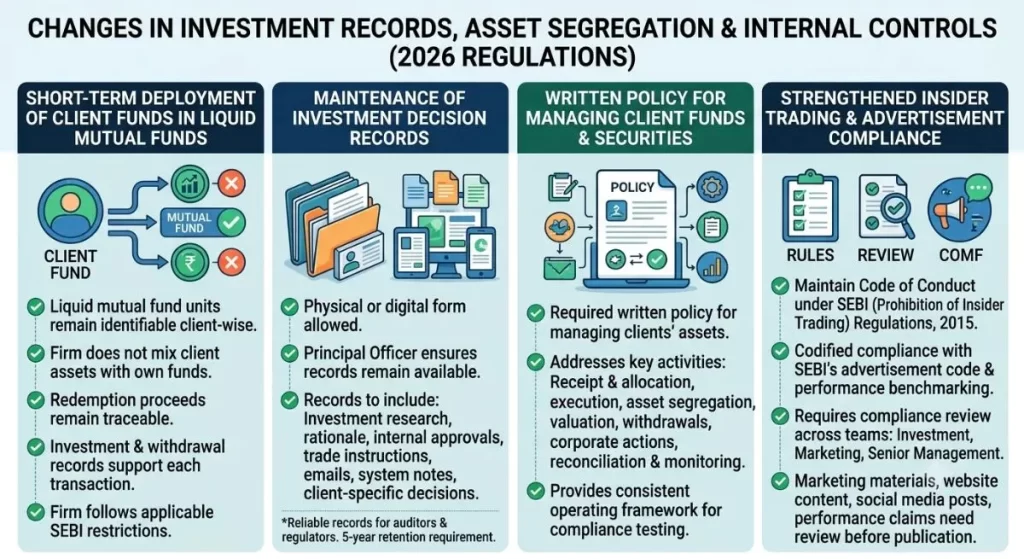
7. Changes in Investment Records, Asset Segregation and Internal Controls
The 2026 regulations retain important client protection requirements while introducing additional operational expectations.
Short-Term Deployment of Client Funds in Liquid Mutual Funds
The new framework provides a conditional relaxation in the segregation requirements for short-term deployment of client funds in liquid mutual funds for cash management.
Portfolio managers must follow the conditions specified by SEBI.
Firms should ensure that:
Liquid mutual fund units remain identifiable client-wise.
The firm does not mix client assets with its own funds.
Redemption proceeds remain traceable.
Investment and withdrawal records support each transaction.
The firm follows applicable SEBI restrictions.
Maintenance of Investment Decision Records
The regulations recognise that portfolio managers may maintain investment decision records in physical or digital form.
The principal officer must ensure that the required investment records remain available.
These records may include:
Investment research.
Investment rationale.
Internal approval records.
Trade instructions.
Supporting emails and system notes.
Client-specific investment decisions.
Portfolio managers should maintain reliable records that allow auditors and regulators to reconstruct the decision-making process.
The regulations also retain a five-year record-retention requirement and provide for additional documents that SEBI may specify.
Written Policy for Managing Client Funds and Securities
The new regulations require portfolio managers to maintain a written policy for managing clients’ funds and securities.
The policy should address important operational activities, including:
Receipt and allocation of client funds.
Investment execution.
Asset segregation.
Valuation.
Withdrawals and transfers.
Corporate actions.
Reconciliation and monitoring.
A documented policy gives the firm a consistent operating framework and provides auditors with a basis for testing compliance.
Strengthened Insider Trading and Advertisement Compliance
The new regulations also expressly require portfolio managers to maintain a code of conduct under the SEBI (Prohibition of Insider Trading) Regulations, 2015.
They further codify compliance with SEBI’s advertisement code and performance benchmarking framework.
These requirements make compliance review important across investment teams, marketing departments and senior management.
Portfolio managers should ensure that marketing materials, website content, social media posts and performance claims receive appropriate compliance review before publication.
8. Increased Compliance Responsibilities for Eligible Fund Managers
The 2026 regulations also revise the framework applicable to Eligible Fund Managers (EFMs).
One notable change concerns the reporting frequency.
The earlier framework required quarterly reporting. The new regulations provide for monthly reporting in the format specified by SEBI.
This increases the reporting and review responsibilities of eligible fund managers.
They should establish processes to:
Extract the required information every month.
Validate the accuracy of reported data.
Obtain appropriate internal approvals.
Submit reports within the prescribed timelines.
Maintain evidence of filing and reconciliation.
The regulations also revise certain obligations concerning investments in Indian securities, fees and compliance with the SEBI (Foreign Portfolio Investors) Regulations, 2019.
Portfolio managers must determine which provisions apply to their eligible investment funds based on whether those funds invest in Indian securities, foreign securities or both.
They should not apply a single compliance checklist to every EFM arrangement without examining the specific regulatory applicability.
9. Related-Party Transactions and Conflict-of-Interest Management
The new regulations modify the definition of a related party, including changes to the criteria applicable to certain public companies.
The revised definition may affect the list of entities that portfolio managers classify as related parties.
Firms should revisit their related-party master data and examine whether their investment approval and disclosure processes reflect the new definition.
The review should cover:
Directors and partners.
Relatives of relevant persons.
Promoter and promoter-group relationships.
Shareholding thresholds.
Investments in related parties and associates.
Conflict-of-interest disclosures.
The Disclosure Document must continue to address related-party transactions in accordance with applicable ICAI standards.
Expert perspective: Portfolio managers should not simply remove entities from their existing related-party lists based on the revised wording. They should document the revised assessment and obtain appropriate compliance approval before changing the master data.
10. Changes in Inspection, Enforcement and Regulatory Accountability
The 2026 regulations also strengthen the regulatory accountability of portfolio managers.
SEBI Circulars and Guidelines Become Binding Compliance Requirements
The new framework expressly states that clarifications and guidelines issued by SEBI through notes or circulars are binding on portfolio managers.
This is particularly important because several requirements in the 2026 regulations depend on conditions that SEBI will specify separately.
Portfolio managers must therefore monitor regulatory updates and translate new circulars into operational procedures.
A regulatory-change tracker should capture:
Date of circular or notification.
Relevant regulatory provision.
Applicable business function.
Required policy or process changes.
Responsible personnel.
Implementation deadline.
Evidence of completion.
Recovery of Inspection and Investigation Expenses
The new regulations empower SEBI to recover expenses associated with inspections and investigations, including auditor fees, from portfolio managers.
Firms should maintain proper records of regulatory correspondence, inspection findings and related financial obligations.
They should also evaluate the accounting treatment of any inspection-related expense or demand.
New Power to Relax Strict Enforcement
Regulation 43 introduces a mechanism through which SEBI may relax strict enforcement in specified circumstances.
These circumstances include:
Procedural or technical non-compliance.
Non-compliance caused by circumstances beyond the portfolio manager’s control.
Situations where strict enforcement creates undue hardship for clients.
The applicant must submit an application explaining the grounds for relief and pay a non-refundable fee of ₹1 lakh.
This provision creates a formal route for seeking regulatory relief. However, portfolio managers should not treat it as a substitute for maintaining effective compliance controls.
11. What Should Portfolio Managers Do Before 1 April 2027?
The transition to the new PMS regulatory framework requires a coordinated implementation plan.
Portfolio managers should assign responsibilities to compliance, finance, operations, investment management, technology and internal audit teams.
The following checklist can help firms prepare.
| Compliance area | Recommended action |
|---|---|
| Regulatory gap assessment | Compare the 2020 and 2026 regulations and identify affected processes. |
| Net worth | Recalculate net worth using the revised definition. |
| Liquid assets | Plan for the ₹50 lakh unencumbered liquid-asset requirement, where applicable. |
| Principal officer | Review educational qualifications, experience and NISM certification. |
| Compliance officer | Monitor and implement SEBI’s eligibility criteria when specified. |
| Client agreements | Update investment authority and mandate classification. |
| Disclosure Document | Review content, digital delivery and annual CA certification processes. |
| Investment policies | Update permissible investment and monitoring procedures. |
| PRIM | Establish separate eligibility, investment and operational controls if offering PRIM. |
| Independent Fund Managers | Review proposed affiliation agreements and oversight arrangements. |
| Offshore operations | Assess investment decision-making and execution locations. |
| Books and records | Review digital recordkeeping, retention and retrieval controls. |
| Regulatory reporting | Update compliance calendars and reporting responsibilities. |
| Internal audit | Revise audit programmes to cover the new regulatory requirements. |
Recommended Implementation Timeline
Before 1 April 2027
Complete the regulatory gap assessment.
Identify provisions requiring immediate changes.
Obtain management approval for the implementation plan.
Review client agreements and Disclosure Documents.
Update internal policies, SOPs and compliance checklists.
Reassess employee eligibility and investment decision-making authority.
From 1 April 2027
Apply the 2026 regulations to new and ongoing operations.
Monitor compliance with the revised requirements.
Maintain evidence of implementation.
Track SEBI circulars and additional conditions.
By 31 March 2028
Meet the 12-month transition requirement for existing portfolio managers to deploy the prescribed unencumbered liquid assets.
Within the applicable 36-month transition period
Address requirements for which the regulations provide a 36-month transition, including the specified commencement-related obligations for existing portfolio managers.
Portfolio managers should maintain separate milestone trackers for each transition provision rather than treating all requirements as having the same deadline.
12. How Does the New PMS Framework Affect Internal Audits?
The changes under the SEBI Portfolio Managers Regulations 2026 make regulatory compliance an important area of internal audit.
Internal auditors should move beyond checking whether the firm has updated its policies. They should also test whether the revised controls operate effectively.
A structured audit programme should cover the following areas.
Financial Compliance Review
Auditors should:
Recalculate net worth using the revised definition.
Verify the treatment of securities premium.
Examine loans and advances to related parties and associates.
Verify the eligible liquid-asset balance.
Check whether the liquid assets remain unencumbered.
Operational Compliance Review
Auditors should:
Verify client-wise segregation of funds and securities.
Review investment decisions against client agreements.
Test adherence to permissible investment limits.
Examine PRIM investment restrictions, where applicable.
Review overseas investment management and execution arrangements.
Documentation and Disclosure Review
Auditors should:
Verify the latest Disclosure Document version.
Check digital delivery evidence.
Review independent CA certification.
Test material-change reporting timelines.
Examine client agreements and investment authority.
Verify investment decision records and retention controls.
Governance and Regulatory Reporting Review
Auditors should:
Examine compliance officer reporting arrangements.
Verify employee qualification and certification records.
Review EFM monthly reporting, where applicable.
Examine regulatory circular trackers.
Verify management approval of revised policies.
Review closure of earlier inspection observations.
The audit team should also classify findings according to their regulatory significance, financial impact and potential effect on client interests.
Expert perspective: A well-designed internal audit should identify implementation gaps before they become regulatory breaches. Portfolio managers should use audit findings to strengthen controls, assign corrective-action owners and monitor closure through management reporting.
Conclusion: Prepare for the SEBI PMS Regulatory Transition Before April 2027
The SEBI Portfolio Managers Regulations 2026 introduce important changes to the regulatory framework governing portfolio management services in India.
The revised net worth calculation, liquid-asset requirement, updated eligibility criteria, Independent Fund Manager framework, PRIM route and expanded investment avenues will affect how portfolio managers operate.
At the same time, stronger documentation, reporting, disclosure and internal control requirements increase the importance of effective compliance management.
Portfolio managers should treat the transition as a structured regulatory implementation exercise rather than a simple policy update.
Early preparation will help firms identify gaps, revise operating procedures, strengthen governance and establish the evidence required to demonstrate compliance from 1 April 2027.
For internal auditors, the new framework also provides an opportunity to strengthen regulatory assurance by reviewing both the design and operating effectiveness of compliance controls.
Strengthen Your PMS Regulatory Compliance Framework
Frequently Asked Questions About SEBI Portfolio Managers Regulations 2026
When will the SEBI Portfolio Managers Regulations 2026 become effective?
The SEBI Portfolio Managers Regulations 2026 will become effective on 1 April 2027. They will replace the 2020 regulations from that date.
What is the minimum net worth requirement for a portfolio manager under the new regulations?
The minimum net worth requirement for a regular portfolio manager remains ₹5 crore. The new framework also requires at least 10% of this minimum net worth, or ₹50 lakh, to be maintained in eligible unencumbered liquid assets, subject to the applicable transition provisions.
What is PRIM under the new PMS regulations?
PRIM stands for Portfolio Managers Route for Investing in Mutual Fund Units. It provides a separate regulatory route for eligible portfolio managers to invest client funds in direct mutual fund plans, including index funds, ETFs and Specialised Investment Funds.
What is the minimum investment under PRIM?
The minimum investment per client under PRIM is ₹25 lakh. Renewals count as fresh investments under the new framework.
Related
Discover more from MSNA & Associates LLP
Subscribe to get the latest posts sent to your email.