
When To Review Your Company's SOP: Learn From Our Virtual CFO
In the fast-moving corporate environment, having a robust Standard Operating Process (SOP) is essential for efficiency, compliance, and scale. But when is the right time to review or build these SOPs?
The answer lies in Q1 and Q2 of the financial year, a uniquely opportune window when finance, operations, and compliance teams are best positioned to drive change.
Let’s explore why Q1 and Q2 offers the best timing for SOP planning and what areas organizations should focus on.
Why Are Q1 and Q2 of a Financial Year the Ideal SOP Window?
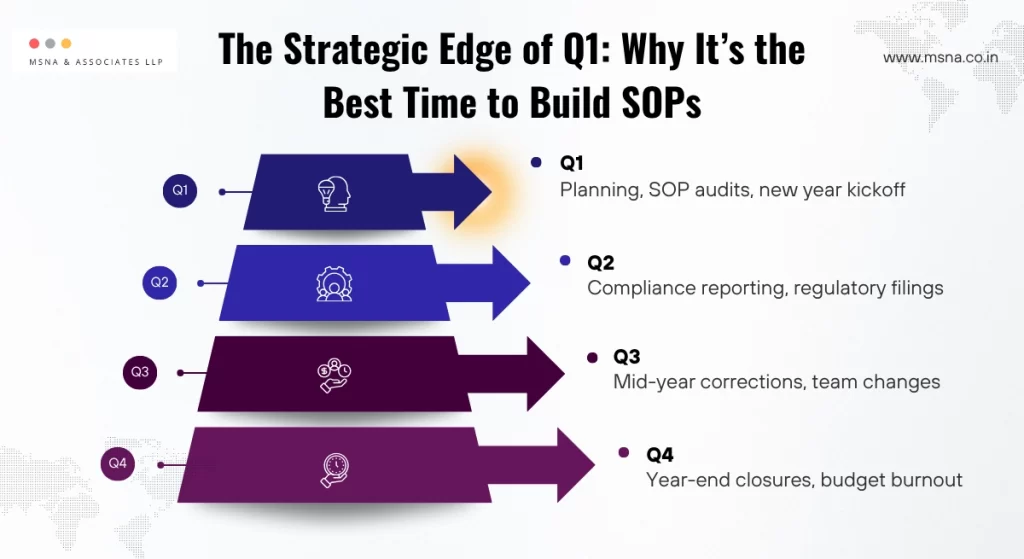
Q1 and Q2 of a financial year are the times when companies gear up for annual book closures, create an annual operating plan (AOP) for the upcoming financial year, prepare and close financial statements, and make themselves audit-ready.
This is the time in most companies when finance personnel have some bandwidth to close out all pending and long-overdue tasks, as well as important but non-urgent tasks. Q2 and Q4 will always be power-packed quarters, the former for the audit closures and regulatory filings, and the latter for the financial year-end closures.
Why SOPs Matter in Q1 and Q2: Prioritizing Systems Over People
In this article, I wanted to discuss how Q1 and Q2 of a financial year can be used productively by building or reviewing SOPs to reflect necessary changes in organizational processes.
Every growing organization needs SOPs in place to ensure that as they expand and scale, they have processes to keep systems running smoothly with minimal intervention from staff.
The goal of any process owner is to ensure their processes and systems are not entirely dependent on people.
Organizational Changes in Q1 and Q2: SOPs as a Growth Enabler
Q1 and Q2 are the quarters where the organization gears up for the new financial year with new plans in place.
Organizations may have various expansion plans –
- Maybe planning to introduce new products/service lines,
- Maybe planning to restructure the organization hierarchy and reduce redundancies,
- Maybe looking at new distribution channels,
- Maybe looking at outsourcing or insourcing a lot of processes, etc..
So Q1 and Q2 become the best times to:
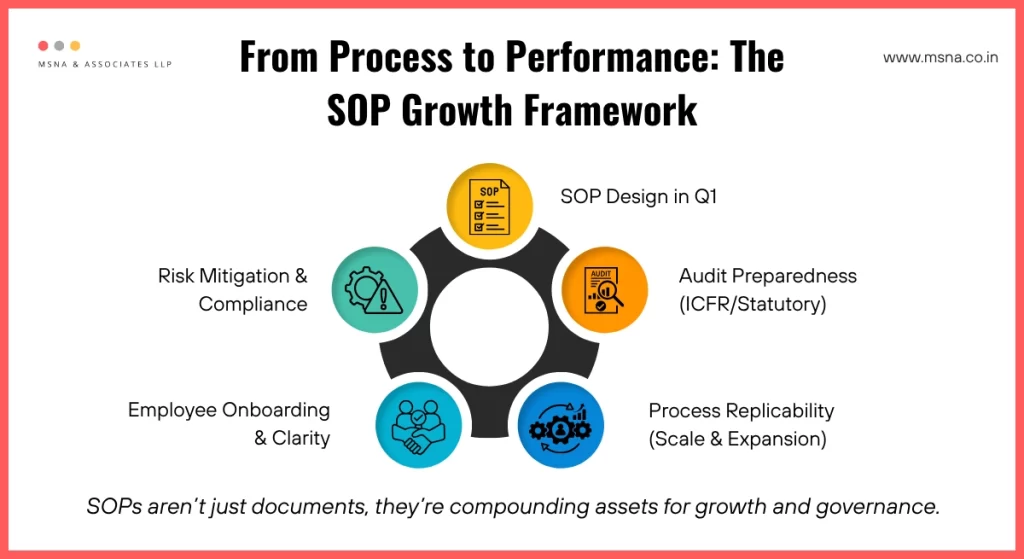
- See if we have the operational/HR/finance SOPs in place
- See if there is a need to revise operational/HR/finance SOPs if they are already in place.
- See if the Finance SOPs and Risk Control Matrix(RCMs) needed for Internal Controls over Financial Reporting (ICFR) is aligned with the current process.
- See if the risk register needs any updates this year with the updated controls
- Verify that all previous internal audit observations have been addressed and resolved.
SOP Review Checklist for Q1 and Q2: A Table for Quick Help
| Action Item | Purpose |
|---|---|
| Check if operational/HR/finance SOPs are in place | Ensure foundation for operational scale and clarity |
| Revise SOPs if already in place | Update for current structure, tech stack, or workflows |
| Align Finance SOPs and RCMs with ICFR requirements | Ensure statutory and internal audit compliance |
| Update the risk register with revised controls | Reflect changing risk landscape |
| Review if internal audit observations are addressed | Prepare for follow-up audits or external assessments |
How do Updated SOPs Support Compliance and Scale?
These are the following ways it will help:
- Having updated SOPs in place will set the base for the upcoming financial year
- SOPs work great, especially if the organization is planning to scale up and have more geographical expansions. The SOPs can then be easily replicated in the new place.
- SOPs can be used as a manual for a new joiner joining the department to understand the entire functioning of the department and his/her role.
- SOPs coupled with FAQs can help answer all commonly asked questions by team members. This reduces duplication and saves time. This will help, especially in HR related policies.
- SOPs can surely help the statutory audit and ICFR audits, and will be a mandatory ask. It will also aid in the internal audits planned for the year.
MSNA’s Virtual CFOs Real-Time Engagements in SOP Implementation
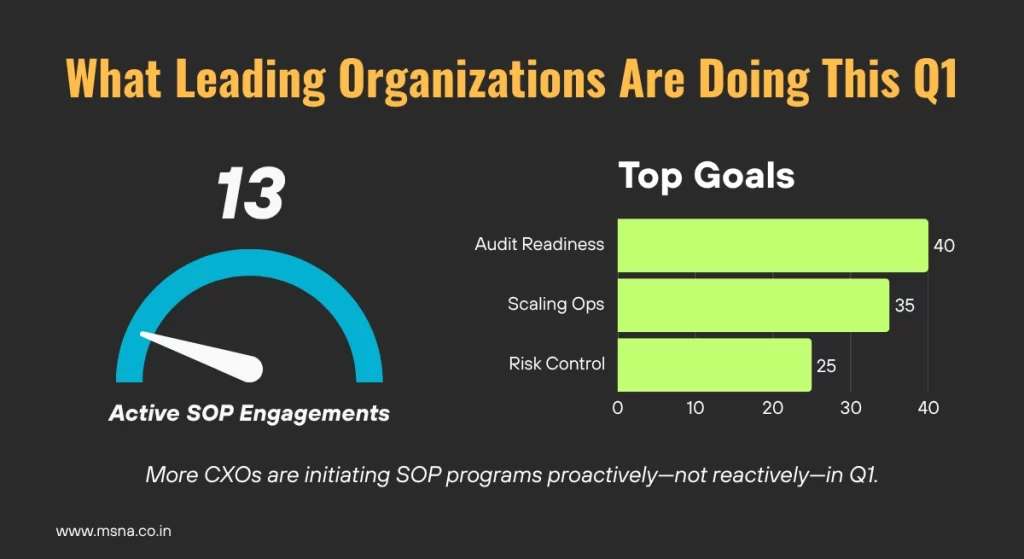
At MSNA, our Virtual CFOs are currently engaged with 12-13 projects happening in parallel, and this makes us happy that there is a lot more awareness among clients regarding the processes and internal controls.
It also reiterates the importance of having SOPs in place. Sometimes, the requests are voluntary, not because they are mandated by law.
Use Q1 and Q2 to Future-Proof Your Processes
So, to conclude, this is the best time of the financial year to revamp the processes, focus on building good internal controls, and mitigate all the risks so that the organization can achieve its intended goals and objectives.
I hope this article helped you understand the importance of this aspect. I am happy to contribute and learn in the process. If you need assistance to review or build SOPs, get in touch with our Virtual CFOs in Bangalore.
Related
Discover more from MSNA & Associates LLP
Subscribe to get the latest posts sent to your email.



Pingback: 7 Essential Internal Controls for Manufacturing Companies in India