AI and Auditing: Smarter Risk Detection with Human Oversight
In IT firms, audits have always been about sharp eyes as well as sharper judgment. But now, there’s a new player in the room, artificial intelligence. It can scan millions of transactions in minutes, spot patterns no human could, and never complain about overtime.
The question isn’t whether AI and auditing will work together; it’s how fast you can make them a winning team.
In this blog, we’ll cut through the noise and show you exactly where AI shines in audit, where human skill still leads, and how to blend both for results you can trust.
What We Mean by AI and audit
When we say AI and audit, we refer to audit workflows enhanced by machine intelligence. Risk assessment tools for smarter internal audit can analyse vast data, flag anomalies, and even draft summaries. But humans still guide the conclusions, apply ethics and human intelligence, and make complex judgments.
Meanwhile, AI auditing also covers auditing the AI systems themselves, checking if they are fair, explainable, and well-controlled. That is an emerging and necessary practice.
The Rapid Rise of AI in Audit Teams
Audit teams are quickly incorporating AI tools into their workflow. A recent Wolters Kluwer survey found that 39% of internal auditors already use AI, and another 41% plan to adopt it within 12 months. “By 2026, organizations will double adoption, driven mainly by productivity and efficiency gains.”
Firms like EY are investing heavily in AI platforms like their EY.ai Agentic Platform to automate tasks such as data collection and compliance. These tools process thousands of transactions quickly, letting auditors focus on insight rather than routine.
At PwC, junior auditors no longer just crunch numbers. Within three years, many will be supervising the AI systems doing that work. The firm is shifting its training and career path design because AI auditors and tax consultants are working differently now.
Big firms give new joiners different trainings that prepare them for fast-track promotions. Automation reduces the time for data sanitisation and collation, allowing new joiners to focus on bigger aspects.”
The Big Gains: Benefits of AI in Audit
Using AI in audit brings clear advantages:
1. Coverage and Speed
AI reviews full populations, not just samples. That means anomalies don’t slip through. Traditional audit has always focused on sampling and extrapolating the results to the population. “Considering the entire population for coverage increases the level of assurance to the Board and the Audit Committee.”
2. Better Risk Detection
Before things blow up, systems trained on past data flag unusual patterns, fraud indicators, or control breakdowns.
3. Automation of Routine Work
From document reviews to reconciliations, AI cuts manual work so auditors can take up their strategic game.
4. Fewer False Positives
Smarter AI fraud detection means fewer wasted investigations.
Human auditors can then focus on real problems.
In short,AI audit does help you to get greater coverage and manage time better.
How Leading Firms Combine Human and AI Audit
Some companies do the best of both worlds. To begin with,AI in audit initially looks at the data, sorting through logs, looking for strange trends, and highlighting possible problems.Then,People examine the risky instances that require a decision.”
We keep track of everything, including datasets, accuracy scores, and model revisions. “Trainers teach auditors to question results, not merely read reports.
To keep checks fair, developers and reviewers work on different things. And when AI sees a problem, it has to give a clear explanation.
If the system makes mistakes, there’s a clear playbook, how to roll back, investigate, and fix without losing time.
Regulatory and Assurance Implications
Regulators are tightening rules around AI and auditing. Consequently, new proposals call for clear validation steps, explainable models, and proper documentation; without them, audits may fail board or regulatory reviews.”
Industry bodies like ISACA now offer the Advanced in AI Audit (AAIA) certification to train AI auditors and tax consultants in bias detection, validation, and governance.
In addition,standards such as ISO/IEC 42001, NIST’s AI Risk Management Framework, and the upcoming EU AI Act mean IT firms must integrate model documentation, drift testing, and explainability into audits now, not later.
A Short, Integrated Checklist for IT Leaders
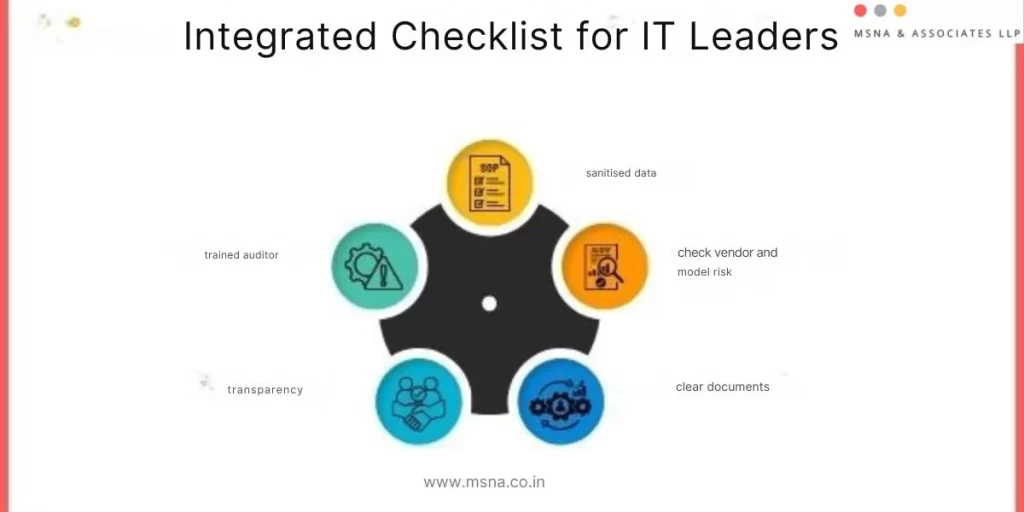
Start with your data. However, AI surely needs sanitised data and not unstructured data. Ensure you have a good ERP in place. Are logs in one place, consistent, and time-stamped? If the foundation’s shaky, AI in audit won’t get far.
Next, check vendor and model risk.
Do clear documents explain how models were trained, tested, and tracked over time?
No guesswork here, transparency matters.
Make sure you bake explainability in
When the system flags a risk, you should be able to explain it in plain language.
That’s what makes audit evidence usable.
Keep people in the loop for high-stakes calls. Moreover, if AI spots something serious, a trained auditor should review it before taking action.
And don’t skip the training. Audit teams need to know how to question AI, test results, catch bias, and confirm findings. That’s how you build lasting strength in AI for auditing.
Keeping AI Audits Practical and Trustworthy
AI isn’t taking the place of auditors; it’s changing how they do their jobs. The best thing you can do is to combine technology with sound human judgment. This makes the audits faster, clearer, and more reliable. Moreover, shifting to AI and auditing is a continuous process rather than a one-time thing. You have to keep improving your data, questioning your results, and learning new skills.
For IT leaders and audit teams, the challenge is knowing where to start and how to build a process that holds up over time. A lot of new-age Firms. work at that intersection, helping businesses connect the dots between tech and governance so AI becomes a genuine asset, not just another buzzword.
Unlock the Power of AI and Auditing
Related
Discover more from MSNA & Associates LLP
Subscribe to get the latest posts sent to your email.