How VCFO Helps In Growth of E-commerce Industry in India?
Orders are coming in. Ads are running. Sales look good on the dashboard. Yet the bank balance tells a different story. Money is stuck in inventory, returns are eating margins, and cash feels tight right when growth is supposed to feel exciting. This is a common problem for fast-scaling online brands in India.
Growth without financial clarity can quietly slow a business down. This is where vCFO helps in the growth of e-commerce, by turning numbers into clear decisions, controlling cash leaks, and helping brands scale without losing grip on profits.
In this blog, we will talk about how vCFOs are quietly driving this change by helping e-commerce companies not only stay alive but also grow in one of the world’s fastest-growing digital markets.
VCFO Helps In Growth Of Ecommerce Amid India’s Rapid E-commerce Expansion
As of FY 2025, India’s e-commerce market is valued at about ₹13,04,703 crores (US$151 billion), up from ₹10,82,875 crores (US$125 billion) in FY 2024. It’s expected to hit nearly ₹29,88,735 crores (US$345 billion) by 2030. That means the e-commerce growth rate in India is projected at 18-20% CAGR for the next few years.
This shows how quickly the market is expanding beyond metros into tier-2 and tier-3 cities.
How VCFO Helps In Growth Of Ecommerce Across the Fastest Growing E-commerce Sectors?
Not all parts of e-commerce are growing equally. Some categories are pulling ahead and shaping the future.
- Quick commerce (10-30 minute deliveries, mainly groceries) already makes up about 20% of e-commerce and is rising rapidly.
- Beauty & Personal Care (BPC) is one of the strongest categories in FY 2025-26, with more value and repeat buyers.
- Direct-to-consumer (D2C) brands are growing rapidly by using their websites and marketplaces. Fashion, home, and personal care are the main areas where this movement is happening.
- Social commerce is helping small sellers reach buyers in smaller towns and rural areas
These are all the fastest-growing e-commerce sectors, and each one of them comes with unique financial challenges. That’s where strong financial planning becomes important.
Why Fast Growth Brings Tough Challenges and How VCFO Helps In Growth Of Ecommerce in India?
E-commerce in India grows fast, but without the right systems, many issues start building up:
- Cash flow gaps: You spend on inventory, ads, and logistics upfront, but payments get delayed or lost in returns/refunds.
- Inventory risk: Overstock ties up the cash. Understock damages the reputation. Both hurt growth.
- Margins under pressure: Discounts, free delivery, commissions, returns, and promotions cut into the profits.
- Complex costs: Every marketplace, state tax, and vendor adds layers of expenses. Marketing channels vary in cost and results.
- Weak reporting: Without dashboards and forecasts, decisions can be reactive, and mistakes surface too late.
- Compliance headaches: The GST, the marketplace rules, and the cross-border policies become more complex as you expand.
Amazon had to deal with this in FY25; its Indian branch can cut losses by almost 89% by being more efficient and tracking costs. That’s exactly the kind of financial clarity a vCFO gives.
Note: A Virtual CFO for an E-Commerce company works only in the initial stages of the business up to a small scale growt,h and once the scale is established, a Virtual CFO may not work, and the company will need a full-time CFO. So this is for smaller businesses trying to grow and reach a scale where they would need a Virtual CFO.
VCFO vs In-House CFO: How VCFO Helps in Growth in E-commerce in India?
Here’s a real comparison between an in-house CFO, who offers full-time control, and a vCFO, who delivers flexible expertise without high fixed costs.
| Feature | Virtual CFO (vCFO) | In-House CFO |
|---|---|---|
| Cost | Monthly retainer of ₹30,000–₹1.5 lakh based on business needs | Fixed annual salary of ₹25–75 lakh+ |
| Exposure | Works across multiple D2C brands and marketplaces | Focused on a single company |
| Systems | Ready-to-use tools for cash flow, margins, and reporting | Built gradually, often from scratch |
| Flexibility | Scales up during peak sales and scales down later | Cost remains constant year-round |
| Compliance | Backed by CA teams handling GST and statutory filings | Requires internal teams or additional hires |
| Best Suited For | E-commerce & D2C brands earning ₹5–100 crore | Large enterprises above ₹100 crore |
What a VCFO Does for Growth Of E-Commerce Industry?
A VCFO works like a CFO but remotely or part-time, making them cost-effective for growing businesses. Here’s how they support the growth of the e-commerce industry in India
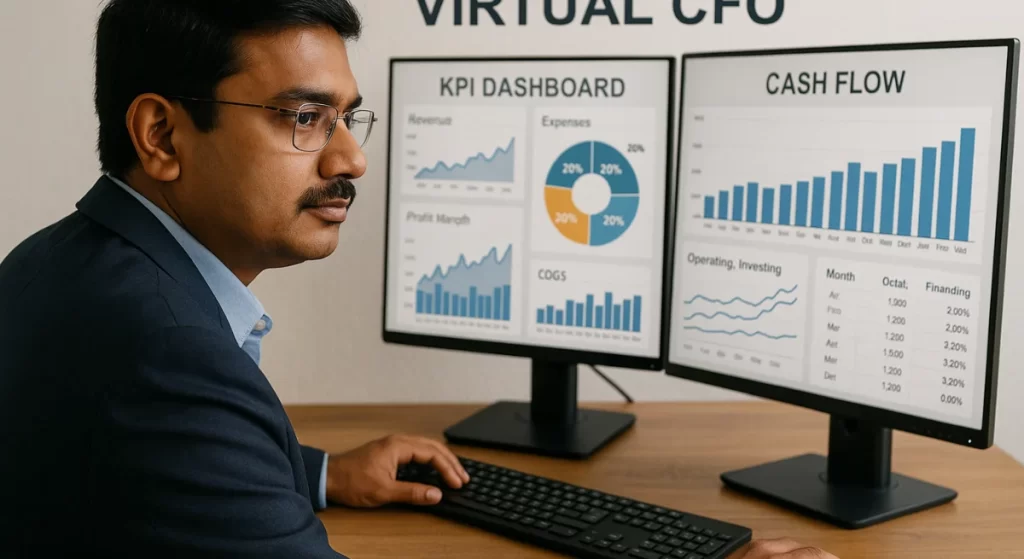
Cash Flow Forecasting
For example, they make models for money coming in (sales, marketplace payments) and going out (inventory, ads, logistics, wages). They also think about things like delays, returns, and the time of year. This gives you a good idea of your cash direction.
Profitability by SKU
Not every SKU makes money. A VCFO digs into the product-level costs, goods sold, shipping, returns, platform fees, and ad spend. They also show you which SKUs are losing money and which ones are making money, so you can cut down on waste and make more money overall. This helps the company focus on profitable SKUs and evaluate on loss making ones.
Smarter Pricing and Promotions
Discounts drive volume but crush the margins. A vCFO models scenarios to see the true impact of the promotions by helping you strike a balance between growth and profitability
Inventory and Working Capital
They optimize stocking levels by preventing both the stockouts and overstocking. Negotiating better vendor terms frees up the working capital and can fuel growth instead of just sitting in the warehouses.
Dashboards and Reporting
VCFOs set Cash Runway, Contribution Margin, CAC, LTV, and Inventory Days. Moreover, by keeping the lines of communication open, you can strike off issues before they escalate.
Compliance and Taxation
They keep track of GST rules, marketplace compliance, and vendor contracts. Staying penalty-free saves both money and focus.
Fundraising and Investor Readiness
When you’re ready to raise funds, a vCFO builds projections, financial decks, and models that investors expect. They also run “what-if” scenarios for expansion or new spending.
Who Should Hire a VCFO in the Growth of E-commerce Industry in India?
You likely need a VCFO if:
- You’re selling across many SKUs or marketplaces, and your profits are unclear.
- You often face cash flow difficulties.
- Your ad spend is very high, but your ROI is uncertain.
- You’re planning to raise funds or thinking of expanding into new markets.
- Your entity is in the early stages and not scaled to a level that needs a full-time CFO
Costs vary depending on complexity, but even small improvements in margin or cash flow often cover the fees.
Key Metrics to Track with a VCFO Helps Growth of E-commerce Industry in India
- Customer Acquisition Cost (CAC)
- Lifetime Value (LTV)
- Contribution Margin per Order
- Days Inventory Outstanding (DIO)
- Repeat Purchase Rate
- Cash Runway
These numbers make growth measurable and sustainable
How VCFO Helps In Growth Of Ecommerce with Smarter Financial Leadership?
The growth of the e-commerce industry in India is not slowing down; it will only get bigger and more competitive in the near future. Small businesses, marketplaces, and everyone else need good financial planning, risk management, and decision-making based on data to stay ahead. As a result, Virtual CFOs are needed. They provide the same level of knowledge as a full-time CFO, but their services are more flexible and less expensive.
For e-commerce companies that want to scale without losing control over finances, vCFO services can make all the difference. A lot of Firms are already helping businesses streamline their financial strategies, improve compliance, and prepare for long-term growth. If you want to do well in a market that changes so quickly, you might need to find the right business partner. We at MSNA do provide Virtual CFO services
How VCFOs Assist E-Commerce Companies in Getting Ready for Marketplace Scrutiny and GST Audits?
Regulatory oversight is growing as India’s e-commerce sector expands.
Marketplace vendors are more likely to receive GST notices, reconciliation problems, and compliance audits.
A VCFO guarantees:
- GST returns and marketplace data should be properly reconciled.
- Clean records for input tax credits and vendor payments
- decreased chance of fines and legal issues
- Strong compliance fosters confidence among financial institutions, investors, and marketplaces.
Marketplace vs Own Website: How a VCFO Helps Decide the Right Mix?
Indian e-commerce companies frequently struggle to decide between selling on their own websites and through marketplaces like Amazon, Flipkart, and Meesho.
Different fees, cash cycles, and risks are associated with each channel.
A VCFO assists companies in assessing:
- Real profitability following marketplace commissions and fines
- Impact of delayed settlements on cash flow
- Short-term sales volume versus long-term brand value
- Instead of becoming unduly reliant on a single platform, this enables e-commerce companies to develop a balanced channel strategy.
FAQs Related To VCFO Helps In Growth of E-commerce Industry In India
How soon can an e-commerce business see benefits after hiring a VCFO?
Within two to three months, you should be able to see changes in your cash flow and cost control. Most of the time, strategic ideas for making money and growing happen within 6 to 12 months.
Can a VCFO help e-commerce brands expand to Tier-2 and Tier-3 cities?
Absolutely. They assess logistics, costs, and demand patterns to ensure that development into smaller cities is financially feasible and profitable.
How does a VCFO help e-commerce businesses in India optimize cash flow during festive sales seasons?
A virtual CFO helps Indian e-commerce businesses by looking at sales data, guessing cash flow, and keeping track of rising marketing and inventory costs during holiday times.
What role does a vCFO play in managing GST compliance for e-commerce platforms operating across multiple states in India?
A virtual CFO makes sure that e-commerce sites follow GST rules by figuring out their tax obligations properly, taking care of claims for Input Tax Credit (ITC), and filing their returns on time.
For sites that work in more than one Indian state, where tax rates and rules for following them may be different, this is very important.
Ready to Scale Your E-commerce Business with Financial Clarity?
Related
Discover more from MSNA & Associates LLP
Subscribe to get the latest posts sent to your email.