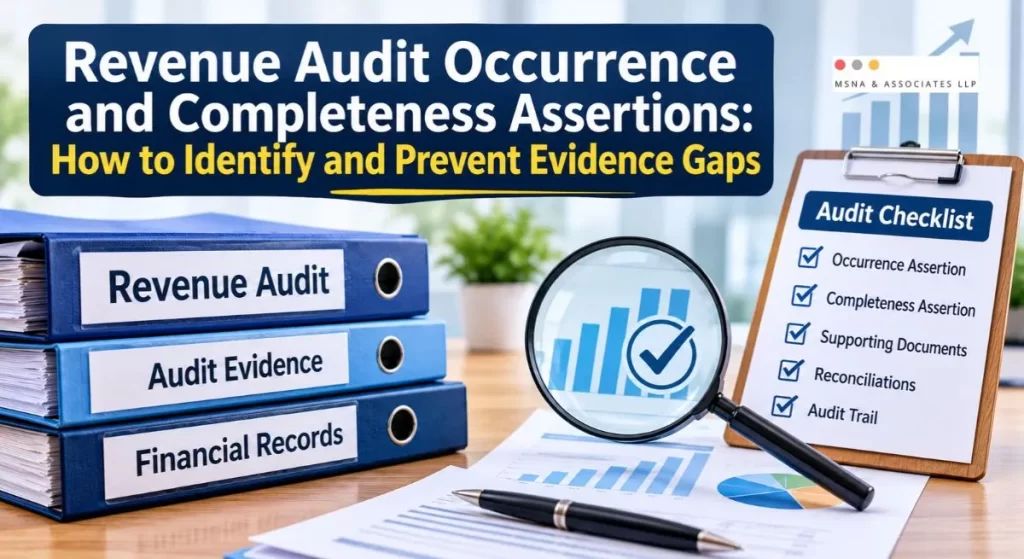

Revenue figures can appear accurate in financial statements while the supporting records tell a different story. Some transactions may have been recorded without sufficient evidence that they actually occurred. Others may have taken place but never entered the accounting records.
These situations create two important audit risks: occurrence and completeness.
For finance teams, the challenge is not limited to recording revenue correctly. They must also maintain reliable evidence showing that reported transactions are genuine and that all relevant transactions have been recorded.
Consider a company that reports substantial revenue at the end of a financial year. During the audit, the finance team produces sales registers, invoices and accounting extracts. However, the dispatch records are incomplete, different departments maintain different versions of the sales data, and employees cannot explain certain entries.
The auditor now faces two questions:
Did the reported revenue transactions actually occur?
Have all revenue transactions that should have been recorded been included?
This article explains revenue audit occurrence and completeness assertions, why they matter, how evidence gaps develop and what businesses can do to improve their audit readiness.
What Are Occurrence and Completeness Assertions in a Revenue Audit?
Occurrence and completeness are financial statement assertions that help auditors assess whether transactions and balances are appropriately represented in the financial statements.
They address two different risks. Occurrence focuses on transactions that have been recorded, while completeness focuses on transactions that should have been recorded but may be missing.
What Is the Occurrence Assertion?
The occurrence assertion examines whether recorded transactions actually took place and relate to the entity.
In a revenue audit, it helps establish whether sales recorded in the books represent genuine transactions rather than fictitious, duplicated or unsupported entries.
For example, a company records a sale of ₹5 lakh. The auditor may examine the sales invoice, customer order, dispatch documentation and other relevant supporting evidence to establish whether the transaction occurred.
The auditor does not rely solely on the presence of an accounting entry. The supporting records must provide appropriate evidence for the transaction.
Common occurrence-related concerns include:
Sales recorded without an underlying customer order or valid transaction.
Invoices generated without corresponding delivery or service evidence.
Duplicate revenue entries.
Transactions recorded in the wrong accounting period.
Revenue entries supported by incomplete or inconsistent documentation.
What Is the Completeness Assertion?
The completeness assertion examines whether all transactions and events that should have been recorded have actually been included in the accounting records.
In a revenue audit, this means checking whether revenue-generating transactions have been omitted from the books.
For example, a company completes several customer deliveries before the financial year closes. However, some deliveries do not appear in the sales register. The auditor must investigate whether these transactions should have been recognised as revenue and whether the accounting records are complete.
Common completeness-related concerns include:
Goods dispatched but not recorded in the sales register.
Completed services omitted from revenue records.
Missing invoices or gaps in sequential invoice records.
Unrecorded transactions near the financial year-end.
Differences between operational records and accounting data.
Difference Between Occurrence and Completeness Assertions
| Basis | Occurrence assertion | Completeness assertion |
|---|---|---|
| Main question | Did the recorded transaction actually happen? | Have all relevant transactions been recorded? |
| Primary concern | Unsupported or fictitious transactions | Missing or omitted transactions |
| Audit direction | From accounting records to supporting evidence | From source documents to accounting records |
| Example | Recorded sale without evidence of delivery | Completed delivery missing from the sales register |
| Main audit risk | Revenue overstatement | Revenue understatement |
Understanding this distinction helps auditors design procedures that address both directions of risk.
Why Are Occurrence and Completeness Important in Revenue Auditing?
Revenue is often a significant financial statement item. Errors in revenue recording can affect reported financial performance, profitability, receivables and management decisions.
An audit that examines only recorded invoices may identify unsupported sales but overlook transactions that never entered the books. Similarly, checking only dispatch records against accounting entries may not adequately address whether recorded transactions were genuine.
Both assertions therefore require attention.
Preventing Revenue Overstatement
If a company records sales that did not genuinely occur, its revenue and potentially its profit may be overstated.
Occurrence-focused procedures help auditors investigate whether recorded transactions have adequate supporting evidence.
Identifying Unrecorded Revenue
If completed sales or services are omitted from the accounting records, reported revenue may be understated.
Completeness-focused procedures help auditors trace relevant source records into the accounting system.
Improving Financial Reporting Reliability
Reliable revenue records help management prepare financial statements using consistent and supportable information.
They also make it easier to investigate discrepancies, explain unusual movements and respond to audit queries.
Strengthening Internal Controls
Reviewing both assertions can reveal weaknesses in sales processing, invoicing, dispatch documentation, data handling and financial reporting controls.
These findings can help businesses improve their processes instead of repeatedly correcting the same documentation issues.
What Does SA 500 Require When Evaluating Revenue Audit Evidence?
SA 500, Audit Evidence, provides the framework for obtaining and evaluating audit evidence.
The standard explains that audit evidence must be sufficient and appropriate. Sufficiency relates to the quantity of evidence, while appropriateness relates to its quality, including relevance and reliability.
For revenue audits, this distinction is important. A large collection of documents does not automatically provide reliable evidence if the documents are incomplete, inconsistent or unrelated to the transaction being examined.
1. Sufficiency of Audit Evidence
Sufficiency concerns how much audit evidence the auditor obtains.
The quantity required depends on factors such as the assessed risks and the quality of the available evidence.
For example, where revenue records contain repeated inconsistencies, the auditor may need additional procedures or evidence to address the identified risk.
2. Appropriateness of Audit Evidence
Appropriateness concerns the relevance and reliability of the evidence.
An invoice may establish that a billing document was generated, but it may not independently establish that the underlying goods were delivered or the service was performed.
Depending on the transaction and assessed risk, the auditor may need to examine additional records, such as:
Customer purchase orders.
Delivery challans or goods dispatch records.
Proof of delivery.
Service completion or acceptance records.
Customer confirmations.
Bank receipts and collection records.
Relevant system-generated transaction reports.
The auditor evaluates the evidence in the context of the assertion being tested.
3. Reliability of Information Produced by the Entity
SA 500 also requires auditors to consider the reliability of information produced by the entity when using it as audit evidence.
For example, a sales register generated from an accounting system may be useful. However, the auditor must consider whether the information is sufficiently accurate and complete for the intended audit purpose.
If employees can modify source data without an adequate record of changes, or if multiple versions of a report circulate without clear ownership, the reliability of that information may be affected.
Practical implication: Businesses should maintain controlled records, clear data ownership, documented reconciliations and an identifiable audit trail.
A Practical Audit Case: How Revenue Evidence Gaps Create Audit Challenges
A revenue audit can become difficult when the company records transactions but cannot produce consistent supporting documentation.
In one audit situation, the review identified three important weaknesses in the company’s documentation and data-handling practices.
1. Disorganised Physical Registers
The company maintained important transaction information in physical registers. However, the records were not organised consistently, making it difficult to trace individual entries to the corresponding supporting documents.
This created challenges when the audit team attempted to verify the transactions.
Audit implication: When source records are difficult to locate or trace, the auditor may need additional procedures to obtain sufficient appropriate evidence.
Recommended improvement: Maintain a structured documentation system with unique transaction references, document indexes and clear cross-references between invoices, dispatch records and accounting entries.
2. Inadequately Trained Employees
Employees responsible for maintaining records did not consistently understand the documentation requirements or the importance of preserving supporting evidence.
As a result, certain records were incomplete or difficult to explain during the audit.
Audit implication: A process can exist on paper but still fail when employees do not understand how to follow it.
Recommended improvement: Assign clear responsibilities, provide role-based training and establish a review process for important revenue documentation.
3. Multiple Versions of Base Data
Different versions of the underlying data created inconsistencies between the information maintained by departments.
Without a clearly identified source of truth, it became difficult to establish which version represented the final and accurate transaction information.
Audit implication: Inconsistent source data can affect the reliability of audit evidence and make reconciliation more difficult.
Recommended improvement: Establish controlled data ownership, restrict unauthorised changes and retain version histories so that the origin and modification of records can be traced.
What Can Businesses Learn from This Case?
These issues demonstrate that audit evidence problems are not always caused by incorrect accounting entries. They can also arise from weak documentation practices, unclear responsibilities and poor data management.
Where sufficient appropriate evidence cannot be obtained, the auditor must evaluate the implications for the audit and the auditor’s report. The reporting outcome depends on the circumstances, including the materiality and pervasiveness of the possible effects. A documentation gap does not automatically result in a qualified opinion.
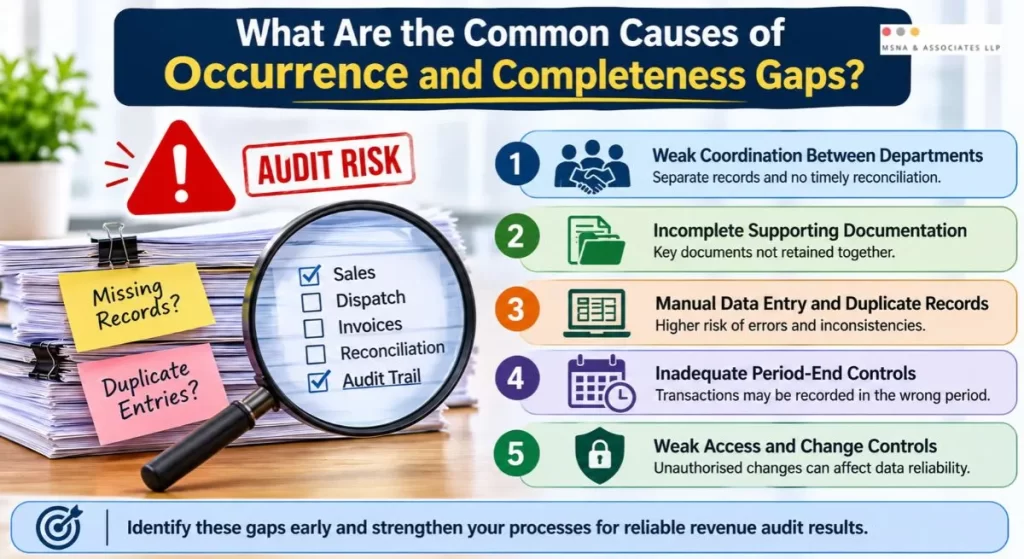
What Are the Common Causes of Occurrence and Completeness Gaps?
Businesses may face evidence gaps even when they use accounting software and follow established financial procedures.
The following issues can affect the reliability and completeness of revenue records.
1. Weak Coordination Between Departments
Sales, dispatch, operations and finance teams may maintain separate records without a consistent reconciliation process.
For example, the dispatch team may record completed deliveries while the finance team waits for invoices before updating the sales register. If the process does not identify and resolve pending transactions, differences may remain undetected.
2. Incomplete Supporting Documentation
Invoices, purchase orders, delivery records and service completion documents may not be retained together or linked through a common transaction reference.
This makes it difficult to trace an accounting entry back to its source.
3. Manual Data Entry and Duplicate Records
Manual processes can increase the risk of duplicate entries, missing transactions and inconsistent data.
The risk becomes more significant when employees maintain parallel spreadsheets without defined ownership or review.
4. Inadequate Period-End Controls
Transactions close to the financial year-end require appropriate attention to cut-off and recording.
If dispatches, service completion records and invoices are not reviewed together, revenue may be recorded in the wrong period or omitted.
5. Weak Access and Change Controls
When several employees can modify transaction data without appropriate authorisation or change logs, the business may struggle to establish the accuracy and origin of its records.
How Can Businesses Prevent Revenue Audit Evidence Gaps?
Businesses can reduce documentation-related audit difficulties by strengthening the processes that create, maintain and review revenue records.
The following measures address practical weaknesses in the revenue cycle.
1. Implement System-Driven Documentation
Use accounting and operational systems that create consistent transaction records and connect relevant documents.
Where possible, link customer orders, invoices, dispatch records, service completion documents and accounting entries through unique transaction references.
A structured system can help employees retrieve evidence without depending entirely on physical registers or individual spreadsheets.
2. Assign Clear Documentation Responsibilities
Every stage of the revenue process should have an identified owner.
For example:
The sales team should maintain customer orders and approved sales information.
The dispatch team should preserve delivery and shipment evidence.
The operations team should maintain service completion records.
The finance team should ensure appropriate accounting entries and reconciliations.
The designated reviewer should examine exceptions and unresolved differences.
A maker-checker process can help ensure that important entries and changes receive an independent review.
3. Preserve Original Transaction Data
Businesses should retain original transaction records and maintain a documented process for correcting errors.
Where systems permit, use access restrictions and change logs to identify who modified a record, when the change occurred and why it was made.
This supports traceability and reduces uncertainty when auditors examine historical information.
4. Reconcile Operational Records with Accounting Records
Revenue reconciliation should not stop at comparing the sales register with the general ledger.
Depending on the business model, relevant reconciliations may include:
Customer orders against invoices.
Dispatch records against sales invoices.
Service completion records against revenue entries.
Sales registers against the general ledger.
Credit notes and sales returns against the original transactions.
Period-end source records against the revenue cut-off.
Investigate differences promptly and document the reason for each material exception.
5. Maintain a Complete Audit Trail
A useful audit trail should allow an authorised reviewer to trace a transaction from its source to the accounting records and, where relevant, back to the supporting documentation.
Maintain:
Unique transaction identifiers.
Document references and dates.
Approval records.
Reconciliation statements.
Exception reports.
Details of corrections and adjustments.
Records of review and approval.
This makes it easier to investigate discrepancies and respond to audit queries.
6. Conduct Periodic Internal Reviews
Businesses should review revenue documentation before the statutory audit begins.
A periodic review can identify missing records, unexplained differences, duplicate entries and incomplete reconciliations.
The review should focus on high-risk transactions, unusual entries and transactions recorded close to the reporting date.
Revenue Audit Readiness Checklist
Finance teams can use the following checklist to assess whether their revenue documentation is organised and traceable.
| Review area | What should be checked? |
|---|---|
| Sales records | Are recorded revenue transactions supported by relevant documents? |
| Customer orders | Are orders retained and linked to the corresponding transactions? |
| Dispatch records | Can goods dispatched be traced to the relevant accounting entries? |
| Service records | Is there evidence supporting completed services, where applicable? |
| Invoice sequence | Are missing, cancelled and duplicate invoice numbers investigated? |
| Credit notes | Are adjustments supported, authorised and linked to the original transactions? |
| Revenue cut-off | Have transactions around the reporting date been reviewed? |
| Reconciliations | Are operational records reconciled with accounting records? |
| Data integrity | Are access rights and changes to important records controlled? |
| Audit trail | Can the source and approval history of important transactions be traced? |
A completed checklist does not replace audit procedures. It helps management identify documentation weaknesses before they become difficult to resolve during the audit.
How Do SA 315, SA 330 and SA 500 Apply to Revenue Audit Assertions?
Three auditing standards are particularly relevant when considering revenue audit risks and evidence.
1. SA 315 : Identifying and Assessing the Risks of Material Misstatement
SA 315 deals with understanding the entity and its environment, including its internal control system, to identify and assess risks of material misstatement.
In a revenue audit, understanding the sales process, invoicing controls, dispatch procedures and accounting systems can help the auditor identify where occurrence or completeness risks may arise.
For example, a business that relies on disconnected spreadsheets and manual invoice processing may have different risks from one that uses integrated systems with documented approvals.
2. SA 330 : The Auditor’s Responses to Assessed Risks
SA 330 addresses how auditors respond to the risks identified and assessed under SA 315.
The auditor designs further audit procedures based on the assessed risks. These may include tests of controls and substantive procedures, as appropriate.
For revenue transactions, procedures may involve examining supporting documents, testing reconciliations, investigating unusual entries and reviewing transactions around the reporting date.
3. SA 500 : Audit Evidence
SA 500 provides the principles for obtaining sufficient appropriate audit evidence.
The auditor evaluates whether the evidence is relevant and reliable and whether its quantity is sufficient for the audit purpose.
For businesses, this reinforces the importance of maintaining accurate source records, consistent documentation and traceable transaction information.
Conclusion: Build Reliable Revenue Records Before the Audit Begins
Revenue audit occurrence and completeness assertions address two essential questions: whether recorded transactions genuinely occurred and whether all relevant transactions have been recorded.
Businesses should not treat audit documentation as a task that begins only when the auditor requests records. It should form part of the regular revenue cycle.
Consistent source documentation, clear departmental responsibilities, controlled data, timely reconciliations and periodic internal reviews can help reduce evidence gaps and improve financial reporting reliability.
The objective is not simply to produce more documents. It is to maintain relevant, reliable and traceable evidence that supports the transactions recorded in the financial statements.
Further reading: Businesses can also review relevant guidance on common audit documentation mistakes and the statutory audit checklist for CFOs.
Strengthen Your Revenue Audit Documentation
Frequently Asked Questions About Revenue Audit Occurrence and Completeness Assertions
What is the difference between occurrence and completeness in a revenue audit?
Occurrence checks whether recorded revenue transactions actually took place. Completeness checks whether all revenue transactions that should have been recorded have been included in the accounting records.
Why are occurrence and completeness important in revenue auditing?
They help auditors address the risks of unsupported revenue entries and omitted transactions. Together, they support the evaluation of whether revenue information is appropriately represented in the financial statements.
What documents support the occurrence assertion for revenue?
Depending on the transaction, supporting evidence may include customer orders, sales invoices, dispatch records, proof of delivery, service completion records and customer confirmations.
The auditor determines which evidence is relevant and reliable for the specific audit objective.
How can an auditor test the completeness of revenue?
An auditor may select source records such as dispatch documents or service completion records and trace them into the accounting records. The auditor may also examine invoice sequences, reconciliations and transactions around the financial year-end.
What is the role of SA 500 in revenue audit evidence?
SA 500 explains the auditor’s responsibility to obtain sufficient appropriate audit evidence. It addresses the quantity, relevance and reliability of evidence used to support audit conclusions.
Can missing revenue documentation lead to a qualified audit opinion?
It can contribute to a modified audit opinion if the auditor cannot obtain sufficient appropriate evidence and the possible effects are material. Whether the opinion is qualified or a disclaimer depends on the circumstances and the pervasiveness of the possible effects. A documentation gap alone does not automatically result in a qualified opinion
Related
Discover more from MSNA & Associates LLP
Subscribe to get the latest posts sent to your email.