


Audit rotation is the Companies Act, 2013 requirement that prescribed companies replace their statutory auditor after a fixed tenure. Section 139(2), read with Rules 5 and 6 of the Companies (Audit and Auditors) Rules, 2014, allows an individual auditor to hold office for one five-year term and an audit firm for two, after which a five-year gap must pass.
Aimed at CFOs, finance heads, company secretaries, directors and audit committees, this guide explains how auditor rotation functions in India. It covers who must rotate, how tenure is counted, how rotation connects to reappointment and fresh appointment, and what changed in 2025–26.
Key takeaways
- Who must rotate: listed companies; unlisted public companies with ₹10 crore+ paid-up capital; private companies with ₹50 crore+ paid-up capital; any company with ₹50 crore+ public borrowings or deposits.
- Who is exempt: One Person Companies and small companies (up to ₹10 crore capital and ₹100 crore turnover from 1 December 2025).
- Tenure: an individual auditor serves one five-year term, and a firm serves two (ten years). A five-year cooling-off follows.
- Replacements: common partners and network firms cannot step in.
- Who decides: the audit committee recommends, the Board approves, members appoint at the AGM, and Form ADT-1 is filed within 15 days.
- 2026–27 is a peak year: Prime Database’s June 2026 analysis shows 1,030 auditor tenures at 997 listed companies expiring in FY27.
- The Corporate Laws (Amendment) Bill, 2026 is not law yet. Plan on the rules as they stand.
What Is Audit Rotation Under the Companies Act 2013?
Audit rotation is a statutory requirement to replace the statutory auditor after a fixed tenure. It sits in Section 139(2), read with Rules 5 and 6 of the Companies (Audit and Auditors) Rules, 2014.
The idea is not new in India. A 1972 proposal to insert clause (1B) in Section 224 of the Companies Act, 1956 would have introduced rotation, but the 1974 amendment enacted only a ceiling on audits per auditor (ICAI, The Chartered Accountant, June 2014). Mandatory rotation became law under Section 139(2) of the 2013 Act.
A covered company that misses rotation can face penalties under Section 147, and so can its officers and the auditor (see the penalties table below)
Why the law insists on it?
- Reduces over-familiarity between management and the auditor
- Keeps the auditor independent of management, which good governance depends on.
- Brings fresh professional scepticism to the statutory audit
- Gives the audit committee a periodic, structured reset
Statutory auditor rotation vs audit partner rotation
Firm-level statutory auditor rotation is a Companies Act requirement. Separately, under Section 139(3), members may resolve that the audit partner or team be rotated at intervals, or that the audit be conducted by more than one auditor. A listed company may therefore face both.
Individual vs firm: how the clock differs
Parameter | Individual auditor | Audit firm |
Maximum tenure | 1 term of 5 years | 2 terms of 5 years (10 years) |
Cooling-off | 5 years | 5 years |
Reappointment in same company | Barred during cooling-off | Barred during cooling-off |
Substitution by related party | Barred (common partner/network) | Barred (common partner/network) |
Audit Rotation Applicability: Which Companies Must Rotate?
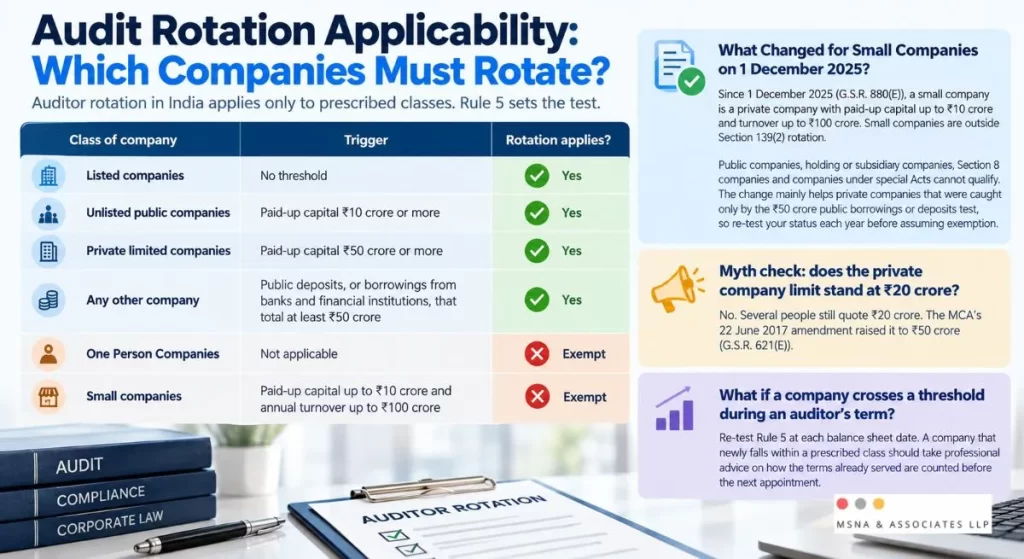
Auditor rotation in India applies only to prescribed classes. Rule 5 sets the test.
Class of company | Trigger | Rotation applies? |
Listed companies | No threshold | Yes |
Unlisted public companies | Paid-up capital ₹10 crore or more | Yes |
Private limited companies | Paid-up capital ₹50 crore or more | Yes |
Any other company | Public deposits, or borrowings from banks and financial institutions, that total at least ₹50 crore | Yes |
One Person Companies | Not applicable | Exempt |
Small companies | Paid-up capital up to ₹10 crore and annual turnover up to ₹100 crore | Exempt |
What Changed for Small Companies on 1 December 2025?
Since 1 December 2025 (G.S.R. 880(E)), a small company is a private company with paid-up capital up to ₹10 crore and turnover up to ₹100 crore. Small companies are outside Section 139(2) rotation.
Public companies, holding or subsidiary companies, Section 8 companies and companies under special Acts cannot qualify. The change mainly helps private companies that were caught only by the ₹50 crore public borrowings or deposits test, so re-test your status each year before assuming exemption.
Myth check: does the private company limit stand at ₹20 crore?
No. Several people still quote ₹20 crore. The MCA’s 22 June 2017 amendment raised it to ₹50 crore (G.S.R. 621(E); see RSM India’s note on the amendment).
Common belief | What the rule says |
“Every private company must rotate.” | Only those with ₹50 crore+ paid-up capital, or ₹50 crore+ public borrowings/deposits |
“A firm can continue if it changes its partner.” | Common partners with the outgoing firm trigger the bar |
“Rotation resets if the name changes.” | Network association is tested, not branding |
“Auditors need yearly ratification.” | Removed by the 2017 amendment (effective 2018) |
What if a company crosses a threshold during an auditor’s term?
Re-test Rule 5 at each balance sheet date. A company that newly falls within a prescribed class should take professional advice on how the terms already served are counted before the next appointment.
Quick test: Does Audit Rotation Apply to Your Company?
Step | Question | If yes | If no |
1 | Is it a One Person Company or a small company? | Exempt. Stop here. | Go to step 2 |
2 | Is it listed? | Rotation applies | Go to step 3 |
3 | Is it an unlisted public company with paid-up capital of ₹10 crore or more? | Rotation applies | Go to step 4 |
4 | Is it a private company with paid-up capital of ₹50 crore or more? | Rotation applies | Go to step 5 |
5 | Does it have ₹50 crore or more in public deposits or borrowings from banks or financial institutions? | Rotation applies | Rotation is not mandatory, but the Section 139(1) term still applies |
Auditor Tenure and Cooling-Off: How Terms Are Counted
Under Section 139(1), an auditor’s term runs until the conclusion of the sixth AGM, counting the AGM at which the appointment is made as the first. Rotation caps how many such terms can run back to back.
A worked example
Take a listed company and Firm A:
- First term: appointment at the 2021 AGM, running until the 2026 AGM
- Second term: Firm A is reappointed at the 2026 AGM and serves until 2031
- Rotation: Firm A is required to retire in 2031
- Cooling-off: Firm A is ineligible to return for five years, so its earliest comeback falls in the 2036 cycle
Apply it: find the AGM at which your current auditor was first appointed, then mark the sixth AGM and the tenth-year limit on your AGM calendar. If the firm is in its second term, start the successor process at the 24-month point in the roadmap below.
The common-partner and network bar
A successor firm may not have a partner in common with the retiring firm, nor belong to the same network of audit firms.
Practical view: A shared partner or network link is a frequent reason a proposed successor becomes ineligible
When Does Section 139(2) Not Apply, or Work Differently?
Specified IFSC companies are one case: the provisos to Section 139(2) do not apply to them. Government companies follow separate appointment rules involving the CAG. Under Section 139(3), members may resolve to rotate the audit partner or team, or to require joint audit. Sector regulators such as the RBI may set stricter limits.
How Is a Statutory Auditor Appointed or Reappointed? Step by Step
Under Section 139(11), appointments are made after considering the audit committee’s recommendation. The audit committee under Section 177 therefore sits at the centre of the process.
- Track expiry. Map the outgoing auditor’s term-end to the AGM calendar.
- Test applicability. Re-check Rule 5 thresholds at each balance sheet date.
- Shortlist on auditor eligibility. Check Section 141 criteria and the Rule 6 bar.
- Collect consent and certificate. The incoming auditor has to give written consent and a certificate that they’re eligible to be appointed.
- Obtain the audit committee recommendation. Then take the Board’s approval.
- Pass the ordinary resolution at the AGM.
- File Form ADT-1 within 15 days of the AGM, on MCA V3.
Auditor eligibility checklist
- No disqualification under Section 141
- No common partner or network link with the outgoing auditor
- Independence confirmed for relationships, fees and non-audit services
- Capacity and sector experience matched to the company’s complexity
- Peer review or quality credentials, where relevant
Casual vacancies and removal
- A casual vacancy is filled by the Board within 30 days. If it arose from resignation, members approve within 3 months.
- Removal mid-term needs prior Central Government approval (Form ADT-2) and a special resolution.
How Many Auditor Tenures Expire in 2026–27?
Audit rotation data (Prime Database, June 2026, via The Economic Times)
Metric | Figure |
Auditor tenures expiring in FY 2026–27 | 1,030 at 997 companies |
Of these, reaching the 10-year maximum | 385 |
Auditor tenures expiring in FY 2027–28 | 314 at 305 companies |
Big Six share of Nifty 500 audits | 330 companies (66%), up from 65% |
Big Six share of all listed audits | 775 of 2,436 (31.8%) |
Auditors who resigned before completing the annual audit, FY26 | 71 auditors (68 companies), against 58 in FY25 |
Standalone audit fees, FY25 | ₹2,099 crore (+9%) |
Source: The Finance Story, citing Prime Database.
What the numbers show
Prime Database’s June 2026 analysis found that tenures of 1,030 auditors at 997 companies expire in FY27, against 314 auditors at 305 companies in FY28. By our arithmetic, that is about 3.3 times as many companies rotating in FY27 as in FY28. Of the 1,030 expiring auditors, 385 (about 37%) reach the maximum 10-year tenure. The Big Six audit affiliates (BDO, Deloitte, EY, Grant Thornton, KPMG and PwC, as grouped by Prime Database) audit 66% of Nifty 500 companies audit 66% of Nifty 500 companies and 31.8% of all listed audits, so audit committees should test eligibility and capacity early
Does Longer Auditor Tenure Hurt Audit Quality?
The evidence is mixed. A Managerial Auditing Journal study of Indian firms (2001–2015) found longer tenure generally enhanced audit quality. The exception was companies paying abnormally high auditor compensation, especially in business groups or where the CEO also chairs the board.
Perspective: Rotation is a useful safeguard, but it is not a substitute for governance. Strong audit committees, disciplined fee-setting and a healthy internal audit function matter as much as the calendar.
Do Banks and NBFCs Follow Stricter Rotation Rules?
Some regulators layer tighter limits over Section 139.
Entity | Governing framework | Tenure | Cooling-off |
Most companies in scope | Companies Act, 2013 | 5-yr term; firm up to 10 yrs | 5 years |
Banks, UCBs, NBFCs (RBI-regulated) | 3 continuous years | 6 years |
RBI also requires joint audit for entities with assets of ₹15,000 crore or more. Where both regimes apply, the stricter rule governs in practice.
2026 Watchlist: The Corporate Laws (Amendment) Bill, 2026
The Bill was introduced in the Lok Sabha on 23 March 2026 (Bill No. 85 of 2026) and sent to a Joint Parliamentary Committee, which presented its report on 3 August 2026. Proposals relevant to audit:
- Exempting prescribed classes of companies from appointing an auditor. The JPC recommended limiting this to private companies.
- Raising the small-company ceiling to ₹20 crore capital and ₹200 crore turnover.
- Expanding NFRA’s role. The JPC recommended deleting the proposal to let NFRA make regulations on how investigations are conducted.
As of 28 October 2026 this remains a Bill. Plan on current law and revisit once it is enacted.
What would the Bill’s non-audit services bar mean for a handover?
Rotation decides who audits you next. The Corporate Laws (Amendment) Bill, 2026 would also limit what the outgoing auditor can still do for you. As introduced, it bars outgoing auditors from providing non-audit services, such as tax advisory, internal audit and consulting, to the company and its group for three years. The JPC report of 3 August 2026 recommends cutting that to one year, and reports suggest the restricted services may be set by rules. The Bill is not yet law.
Action for audit committees: list every non-audit engagement your outgoing firm holds. If any would fall in the restricted categories, plan a second handover alongside the audit one, but don’t restructure anything until the final text is enacted.
Audit Rotation Readiness Roadmap
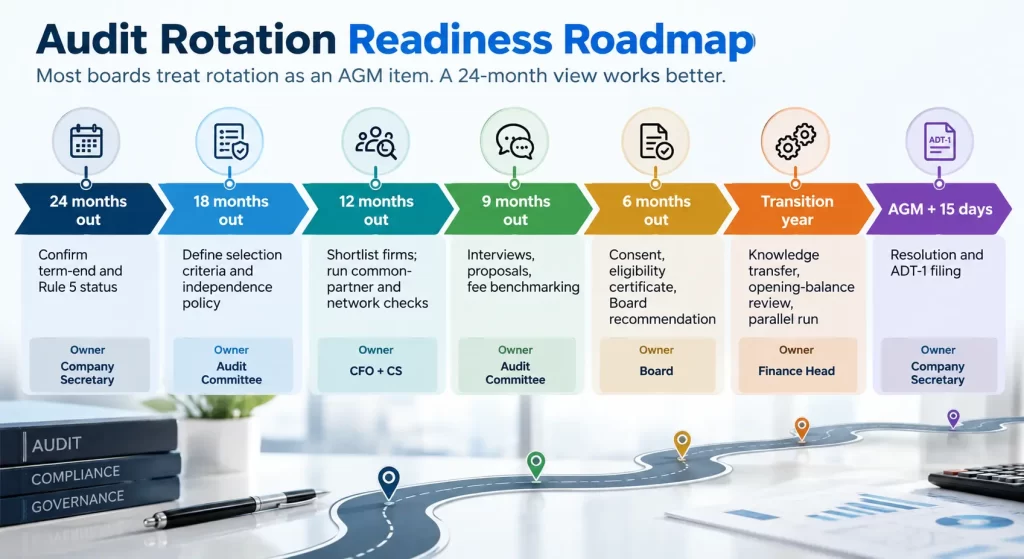
Most boards treat rotation as an AGM item. A 24-month view works better.
Timeline | Action | Owner |
24 months out | Confirm term-end and Rule 5 status | Company Secretary |
18 months out | Define selection criteria and independence policy | Audit Committee |
12 months out | Shortlist firms; run common-partner and network checks | CFO + CS |
9 months out | Interviews, proposals, fee benchmarking | Audit Committee |
6 months out | Consent, eligibility certificate, Board recommendation | Board |
Transition year | Knowledge transfer, opening-balance review, parallel run | Finance Head |
AGM + 15 days | Resolution and ADT-1 filing | Company Secretary |
Where internal audit helps?
A strong internal audit function de-risks the handover. It can document control gaps, open items and process maps ahead of the new auditor’s first year.
How Should an Audit Committee Choose the Incoming Auditor?
Criterion | What to examine |
Independence | Network ties, fees, non-audit services |
Sector depth | Comparable engagements and team seniority |
Quality systems | Review processes, technology, documentation |
Capacity | Team size against your audit calendar |
Communication | Frequency and clarity of reporting to the committee |
Transition plan | Handover method and opening-balance approach |
“Audit rotation works best when it is treated as a governance project, not a filing event. Starting the successor evaluation well ahead of the AGM gives the audit committee time to test independence, eligibility and capacity.”
[Naveen], Founder, MSNA
What Are The Common Mistakes in Statutory Auditor Rotation ?
- Using outdated thresholds (the ₹20 crore figure)
- Missing a threshold crossing mid-term when capital or borrowings grow (re-test Rule 5 at each balance sheet date)
- Skipping the common-partner and network check
- Treating auditor reappointment as automatic at the end of the first term
- Filing ADT-1 late
What Are The Penalties for Non-Compliance?
Who | Provision | Penalty |
Company | Section 147(1) | ₹25,000 up to ₹5,00,000 |
Officer in default | Section 147 | ₹10,000 up to ₹1,00,000 |
Auditor | Section 147(2) | ₹25,000 up to ₹5,00,000 |
Penalty ranges are as summarised in CapEasy’s 2026 guide. Outcomes depend on the facts of each case.
Final Thoughts On Audit Rotation
Audit rotation is a governance tool, and auditor rotation in India is entering its busiest stretch. Companies that map auditor tenure early, check eligibility carefully and involve the audit committee tend to manage the change with less disruption.
If your audit committee wants a structured view of rotation timelines, eligibility checks and governance documentation, consulting a Internal audit Firm in Bangalore can help you assess how this applies to your company. This article is informational and is not legal advice.
Plan for Statutory Auditor Rotation with Confidence
Frequently Asked Questions About Audit Rotation
What is the cooling-off period for auditor rotation?
Five years from the end of the term, before reappointment in the same company. Related firms are also barred.
Does statutory auditor appointment require shareholder approval?
Yes. An ordinary resolution at the AGM follows the audit committee and Board recommendation.
Can an audit firm be reappointed after 10 years?
Yes, but only after a five-year cooling-off that follows its second term, and provided Section 141 criteria are met.
Does auditor reappointment need annual ratification?
No. Annual ratification was removed by the 2017 amendment.
Does audit rotation apply to an LLP?
A procurement audit examines your buying process and controls. A vendor audit examines a supplier’s own operations.
What is joint audit?
Joint audit means the statutory audit is conducted by more than one auditor. Under Section 139(3), members may resolve to require it. The RBI mandates it for banks and NBFCs from ₹15,000 crore of assets.
Related
Discover more from MSNA & Associates LLP
Subscribe to get the latest posts sent to your email.