

Businesses often outsource activities such as housekeeping, security, facility management, maintenance and other support services. While outsourcing helps organisations manage operational requirements, it also creates a responsibility to monitor whether contractors fulfil their statutory obligations towards the employees deployed at the organisation’s premises.
One important area that requires attention is Employees’ Provident Fund (EPF) compliance. Merely collecting a contractor’s PF payment challan does not always establish that the employees actually working at the organisation have been correctly included in the contribution records.
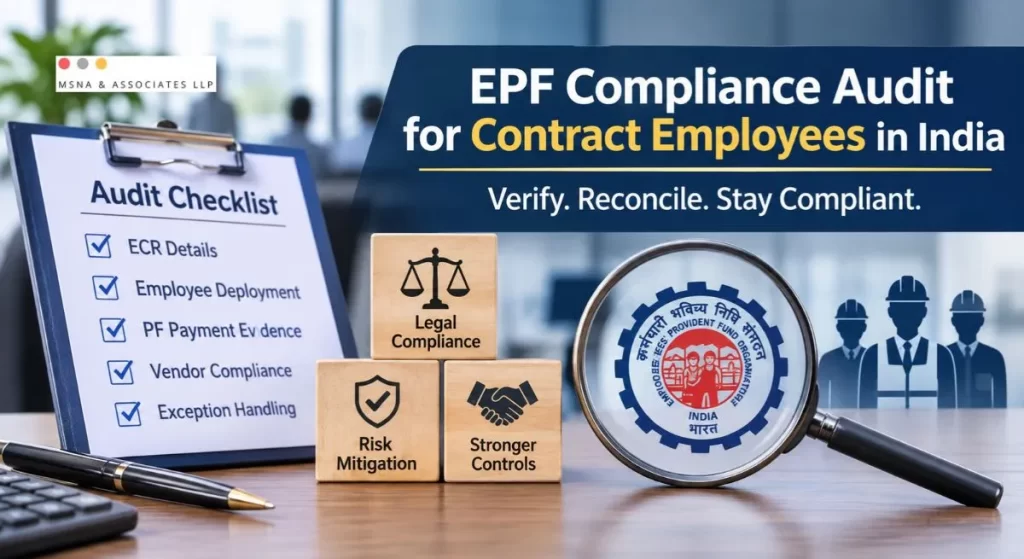
An EPF compliance audit for contract employees in India helps businesses examine whether contractors have correctly reported their workforce, calculated applicable contributions and maintained supporting records.
An internal audit of a client’s Procure-to-Pay (P2P) process identified precisely this issue. The audit revealed differences between the employees deployed at the client’s premises and the employees appearing in the contractor’s Electronic Challan-cum-Return (ECR).
This case study explains the observation, its implications and the controls businesses can introduce to strengthen contractor compliance.
1. Background: How Did the Internal Audit Identify the EPF Compliance Gap?
The internal audit covered the client’s Procure-to-Pay process, including the verification and approval of invoices raised by service providers.
During the audit, the team selected a housekeeping service provider for detailed examination. The client collected PF payment challans from the contractor along with the monthly invoices. However, the process did not require the contractor to submit employee-wise ECR details or allow the finance team to reconcile those details with the contract employees deployed at the client’s premises.
This created a gap in the verification process.
The presence of a PF payment challan established that a payment had been made. However, it did not independently establish whether the contractor had reported the correct employees or deposited the applicable contributions for the workers providing services to the client.
What Is an Electronic Challan-cum-Return (ECR)?
The Electronic Challan-cum-Return (ECR) is an electronic filing through which an employer reports employee-wise provident fund contribution details and generates the corresponding challan for payment.
Depending on the applicable reporting requirements and ECR process, the return contains information that helps verify details such as:
Employee identification details, including the relevant UAN.
Wages considered for contribution.
Employee and employer contribution amounts.
Other applicable contribution and administrative details.
The reporting period for which contributions are being filed.
A payment challan and an ECR serve related but different purposes. The challan provides evidence of the payment, whereas the ECR provides the employee-level information underlying the reported contributions.
For this reason, businesses should examine both documents instead of treating the payment challan as complete evidence of contractor compliance.
2. What Are the Legal Responsibilities for EPF Compliance of Contract Employees?
Businesses should understand the statutory framework before designing contractor verification controls.
The Code on Social Security, 2020 came into force on 21 November 2025, consolidating several earlier social security laws, including the Employees’ Provident Funds and Miscellaneous Provisions Act, 1952.
The Code contains specific provisions relating to provident fund contributions and employees engaged through contractors.
Section 16: Contributions for Employees Engaged Through Contractors
Section 16 of the Code on Social Security, 2020 provides for provident fund contributions in respect of employees, including those employed directly or through a contractor.
The provision is important because the engagement of workers through an external service provider does not, by itself, remove them from the scope of applicable provident fund requirements.
Businesses should therefore examine the nature of the establishment, statutory coverage, employee eligibility and applicable contribution requirements when reviewing contractor arrangements.
Section 17: Contribution in Respect of Employees and Contractors
Section 17 addresses the recovery of provident fund contributions and related charges paid or payable in respect of employees engaged through contractors.
It permits the employer to recover specified amounts from the contractor through contractual deductions or as a debt. It also restricts contractors from recovering the employer’s contribution and specified charges from employees.
This provision reinforces the importance of clear contractual arrangements and proper verification of statutory payments.
Why Should the Principal Employer Verify Contractor Compliance?
The organisation engaging contract labour should not rely solely on the contractor’s declaration that all statutory requirements have been met.
It should establish a documented process to verify:
Whether the contractor has the required EPFO registration and applicable coverage.
Whether the contractor has reported the workers deployed at the organisation.
Whether the reported wages and contributions appear consistent with available deployment records.
Whether the relevant contributions have been deposited.
Whether discrepancies have been investigated and resolved.
The exact legal responsibilities should be assessed under the provisions and rules applicable to the establishment and the relevant employment arrangement. Businesses should also review the latest EPFO notifications and operational guidance before finalising their compliance procedures
3. What Did the Internal Audit Reveal? Key EPF Compliance Discrepancies
When the audit team requested employee-wise ECR details from the housekeeping contractor, the contractor initially resisted sharing the records.
The audit team explained that the documents were necessary to verify statutory compliance for the employees deployed at the client’s premises. When the client withheld the contractor’s payment pending submission of the required information, the contractor eventually provided the ECR.
The review identified two significant discrepancies.
1. ECR Included Employees Not Deployed at the Client’s Premises
The contractor’s ECR contained names of individuals who were not working at the client’s premises during the period under review.
This raised a question about whether the contractor had allocated the reported employee contributions correctly to the client’s service arrangement.
Without employee-level reconciliation, the client could not easily identify whether the contractor’s reported workforce matched the actual workforce deployed under the contract.
2. Actual Contract Employees Were Missing From the ECR
The audit also identified that certain employees actually working at the client’s premises did not appear in the contractor’s ECR.
This was a more significant concern because the client had no employee-wise evidence establishing that the relevant workers had been included in the contractor’s PF contribution reporting for the period examined.
The observation demonstrated a weakness in the existing invoice verification process.
The client had collected payment challans, but it had not verified whether the contractor’s employee-wise records corresponded with the people actually providing services.
What Does This Observation Tell Us?
The two discrepancies highlight why businesses should reconcile three separate sets of information:
Deployment records: Who actually worked at the organisation’s premises?
ECR records: Who did the contractor report for the relevant contribution period?
Payment evidence: Were the reported contributions deposited?
Each record serves a different purpose. Reviewing them together provides stronger audit evidence than examining a payment challan alone.
4. What Are the Financial and Compliance Implications of EPF Gaps?
An incomplete contractor verification process can expose an organisation to financial, statutory and operational risks.
The extent of the exposure depends on the facts, applicable legal provisions, employee eligibility, contribution periods and the findings of the relevant authority.
1. Risk of Unreported Employee Contributions
When employees deployed at a client’s premises do not appear in the contractor’s ECR, the organisation may lack evidence that the applicable contributions have been correctly reported for those workers.
This requires further investigation with the contractor and, where necessary, the relevant records available through EPFO.
2. Potential Statutory Exposure
Incomplete or incorrect contribution reporting may lead to statutory proceedings, assessment of dues, interest, damages or other consequences, depending on the applicable provisions and circumstances.
Organisations should not assume that a contractor’s payment challan automatically resolves the compliance risk.
3. Inaccurate Vendor Billing
If the contractor’s employee records do not match the actual workforce deployed, the organisation may also face questions about the accuracy of the vendor’s billing.
For example, the contractor may raise an invoice based on a specified number of deployed employees, while the supporting statutory records show a different workforce.
This mismatch should be investigated before the organisation approves the invoice.
4. Weak Vendor Monitoring
When the organisation does not collect employee-wise statutory records, it has limited visibility into the contractor’s compliance performance.
This can allow recurring documentation gaps to continue across multiple billing periods without timely detection.
5. Inadequate Audit Trail
A payment approval supported only by an invoice and payment challan may not provide sufficient evidence that the organisation performed the intended statutory compliance checks.
A documented reconciliation and approval process creates a clearer audit trail and helps management demonstrate how it monitored vendor compliance.
In the case discussed, the audit identified a monthly financial implication described as a few thousand rupees. However, the audit did not establish a verified cumulative loss over ten years. Any historical exposure would require a separate review of employee deployment records, contribution filings and payment evidence.
5. How Can Businesses Strengthen EPF Compliance Verification for Contract Employees?
Businesses can reduce the risk of similar discrepancies by incorporating employee-level statutory checks into their vendor management and invoice approval processes.
The following controls can help.
1. Obtain Employee-Wise ECR Details Every Month
The organisation should require contractors to submit the relevant ECR details for each contribution period along with their monthly invoices and payment evidence.
The documentation should enable the finance or compliance team to identify the employees included in the contractor’s return.
2. Reconcile the ECR With Employee Deployment Records
The organisation should compare the contractor’s ECR with its attendance, deployment and access records.
The reconciliation should identify:
Employees deployed at the premises but missing from the ECR.
Employees appearing in the ECR but not found in deployment records.
Employees who joined or left during the reporting period.
Differences in employee identification details.
Unexplained changes in the reported workforce.
The team should document the reasons for each mismatch and obtain supporting explanations from the contractor.
3. Verify PF Payment Evidence
After reviewing the employee-wise ECR, the organisation should examine the corresponding payment challan and payment status.
The team should check whether:
The payment relates to the correct contribution period.
The establishment details correspond with the contractor.
The payment evidence supports the reported contribution amount.
The relevant payment has been completed.
Any shortfall, delay or outstanding amount has been explained.
Where appropriate, businesses can use the EPFO employer and principal employer facilities to support their verification process.
4. Introduce a Statutory Compliance Check Before Invoice Approval
The invoice approval workflow should include a defined statutory documentation checkpoint.
For example, the finance team should not complete the compliance-related approval until it has received the required ECR, payment evidence and employee reconciliation.
Where discrepancies arise, the organisation should record the issue, obtain clarification and escalate unresolved matters to the responsible department.
5. Maintain a Monthly Contractor Compliance Tracker
A centralised compliance tracker can help the organisation monitor the status of each contractor.
The tracker may contain:
| Information | Purpose |
|---|---|
| Contractor name and EPFO establishment details | Identifies the service provider |
| Contribution month | Tracks the relevant reporting period |
| Number of employees deployed | Records the actual workforce |
| Number of employees appearing in ECR | Supports employee-level reconciliation |
| ECR submission status | Tracks document receipt |
| PF payment status | Tracks payment evidence |
| Reconciliation differences | Records exceptions |
| Resolution status | Tracks corrective action |
| Invoice approval status | Links compliance checks with payment |
This tracker also helps management identify contractors with repeated documentation gaps and prioritise follow-up.
6. Include Clear Compliance Requirements in Vendor Agreements
Vendor agreements should specify the contractor’s responsibility to maintain statutory registrations, submit applicable returns and provide supporting payment evidence.
The agreement should also define the organisation’s right to seek employee-wise compliance information, investigate discrepancies and apply contractual remedies where appropriate.
Clear documentation requirements reduce the likelihood of disputes when the organisation requests statutory records.
6. How Does Internal Audit Help Identify Contractor EPF Compliance Gaps?
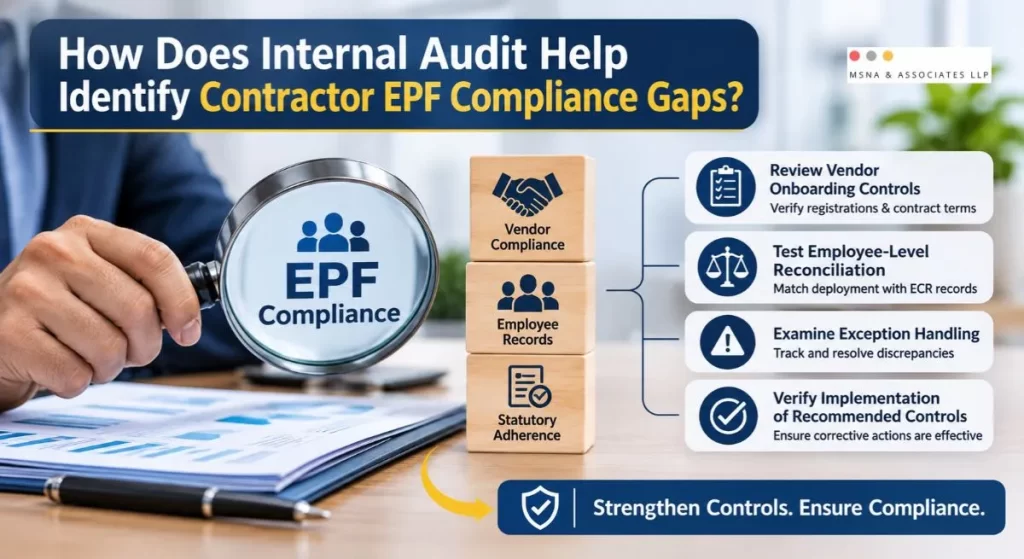
Internal audit can evaluate whether the organisation’s contractor management process provides adequate assurance over statutory documentation and payment approvals.
Rather than checking only whether the finance team has collected a document, auditors can examine whether the document supports the transaction and the underlying compliance requirement.
1. Review Vendor Onboarding Controls
Auditors can examine whether the organisation verifies relevant statutory registrations and compliance requirements before appointing a contractor.
They can also check whether the contract clearly defines documentation responsibilities and the frequency of submission.
2. Test Employee-Level Reconciliation
Auditors can select a sample of contractors and contribution periods, then compare:
Employee deployment and attendance records.
Contractor ECR details.
PF payment challans and payment evidence.
Monthly service invoices.
Internal invoice approval records.
This approach helps identify missing employees, unsupported employee entries and differences between reported and actual deployment.
3. Examine Exception Handling
Auditors should assess how the organisation handles missing ECRs, delayed payments, employee mismatches and incomplete supporting documents.
A strong control process should assign responsibility for investigating each exception, establish timelines for resolution and retain evidence of closure.
4. Verify Whether Recommended Controls Have Been Implemented
After reporting the audit observation, internal audit can follow up on management’s corrective action.
The follow-up should distinguish between a recommendation that management has accepted, a control that management has planned and a control that has actually been implemented and tested.
This distinction is important because management’s acceptance of an audit recommendation does not, by itself, establish that the control is operating effectively.
7. Management Response: What Action Was Proposed After the Audit?
Following the audit observation, the client acknowledged the need to strengthen its contractor compliance verification process.
Management agreed to introduce the collection of ECR details and related payment records along with contractor invoices. It also planned to verify the employee-wise information against the contract employees deployed at its premises before processing payments.
The proposed change was scheduled for implementation during FY 2026–27.
This response addressed the central weakness identified by the audit: the absence of employee-level reconciliation between deployment records and contractor PF filings.
The actual effectiveness of the revised process would need to be assessed through a subsequent review of implementation evidence and sample transactions.
8. Key Lessons From This EPF Compliance Audit Case Study
This case provides several practical lessons for organisations that rely on outsourced services.
A Payment Challan Alone Is Not Sufficient Evidence
A challan demonstrates payment information, but employee-wise ECR verification provides additional evidence about the individuals and contributions reported.
Employee Deployment and Statutory Records Must Match
Businesses should not assume that the contractor’s reported workforce automatically matches the employees deployed at their premises.
A monthly reconciliation can help identify missing or unrelated employee entries.
Statutory Compliance Should Form Part of Invoice Approval
Vendor payment procedures should include relevant compliance checks rather than treating statutory documents as routine attachments.
Internal Audit Should Examine the Effectiveness of Controls
Internal audit should go beyond checking whether documentation exists. It should evaluate whether the organisation’s controls identify and address the risks they are designed to manage.
Conclusion: Why Employee-Level Verification Matters in Contractor Compliance
Outsourcing a service does not mean that an organisation should overlook the statutory compliance risks associated with the workers deployed by its contractors.
As this internal audit case demonstrates, collecting PF payment challans without examining employee-wise ECR details can leave important gaps in the verification process.
A structured EPF compliance audit for contract employees in India should therefore consider the relationship between actual employee deployment, ECR reporting and contribution payment evidence.
Businesses can strengthen their Procure-to-Pay controls by introducing monthly employee-level reconciliation, documented exception handling and clear statutory compliance requirements in vendor agreements.
A Practical Next Step for Businesses
Organisations that engage housekeeping, security, facility management or other outsourced service providers can review their existing vendor onboarding and invoice approval procedures to determine whether employee-wise EPF verification forms part of the process.
An internal audit review can help management identify documentation gaps, assess the effectiveness of existing controls and develop corrective actions based on the organisation’s risk exposure.
Strengthen Your Contractor EPF Compliance Controls
Frequently Asked Questions About EPF Compliance Audits for Contract Employees
What Is an EPF Compliance Audit for Contract Employees?
An EPF compliance audit for contract employees examines whether a contractor has correctly reported eligible employees, calculated applicable provident fund contributions and deposited the required amounts.
It also evaluates whether the organisation engaging the contractor has suitable procedures to verify statutory compliance
Is a PF Payment Challan Sufficient to Verify Contractor Compliance?
A payment challan is important evidence of payment, but it does not independently establish whether all eligible contract employees have been correctly reported.
Businesses should also review employee-wise ECR details and reconcile them with actual deployment records.
What Is the Difference Between an ECR and a PF Challan?
An ECR is the electronic return containing employee-wise contribution information for the relevant period. The corresponding challan supports the payment of the reported contributions.
Both documents serve different purposes and should be examined together during contractor compliance verification.
Why Should Businesses Reconcile ECR Details With Attendance Records?
Attendance and deployment records help establish which employees actually worked at the organisation’s premises. Comparing these records with the ECR can identify employees who are missing from the return or entries that do not correspond with the deployed workforce.
How Can Internal Audit Help Improve Contractor Compliance?
Internal audit can assess vendor onboarding, review statutory documents, test employee-level reconciliations, examine payment approvals and evaluate the resolution of compliance exceptions.
Its recommendations can help management strengthen the control environment and improve the reliability of vendor compliance records.
Related
Discover more from MSNA & Associates LLP
Subscribe to get the latest posts sent to your email.